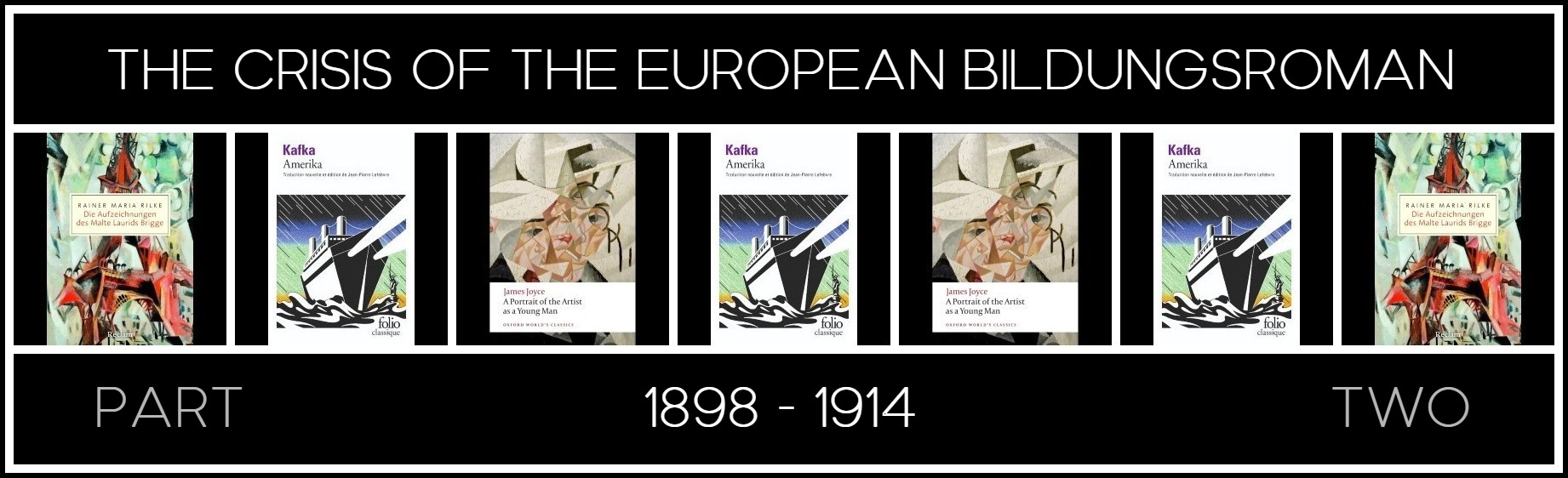
‘A Useless Longing for Myself’
THE CRISIS OF THE EUROPEAN BILDUNGSROMAN, 1898-1914 – PART 2
Franco Moretti
Posted by kind permission of Franco Moretti, Professor Emeritus of English and Comparative Literature, Stanford University
From Franco Moretti, The Way of the World: The Bildungsroman in European Culture, New Edition. Translated by Albert Sbragia.
(London: Verso, 2000) pp. 236-245
THIS IS PART 2 OF THE ESSAY – READ PART 1 FIRST
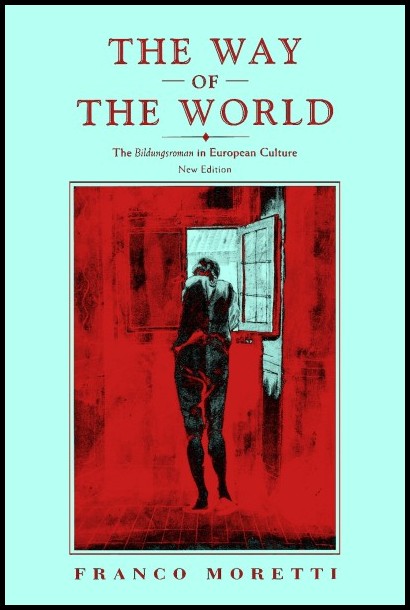
FRANCO MORETTI
The Way of the World:
The Bildungsroman in European Culture
Unusual as it is for a great lyric poet to write a good novel, in these years Rainer Maria Rilke did it (he did it twice, if one considers the shorter text of 1898, Ewald Tragy), and in Malte he posed a kind of symbolic problem that only the later poetry of the Elegies would solve. As for Joyce, in Stephen Hero he had already mentioned Dante’s Vita Nuova—where the story is literally a pre-text for the lyrics—as a possible model; later on, his hero’s theory of epiphanies was another attempt to subordinate the narrative line to punctual poetic vision. Lyric novel then. But what are those privileged moments that set poetry in motion?
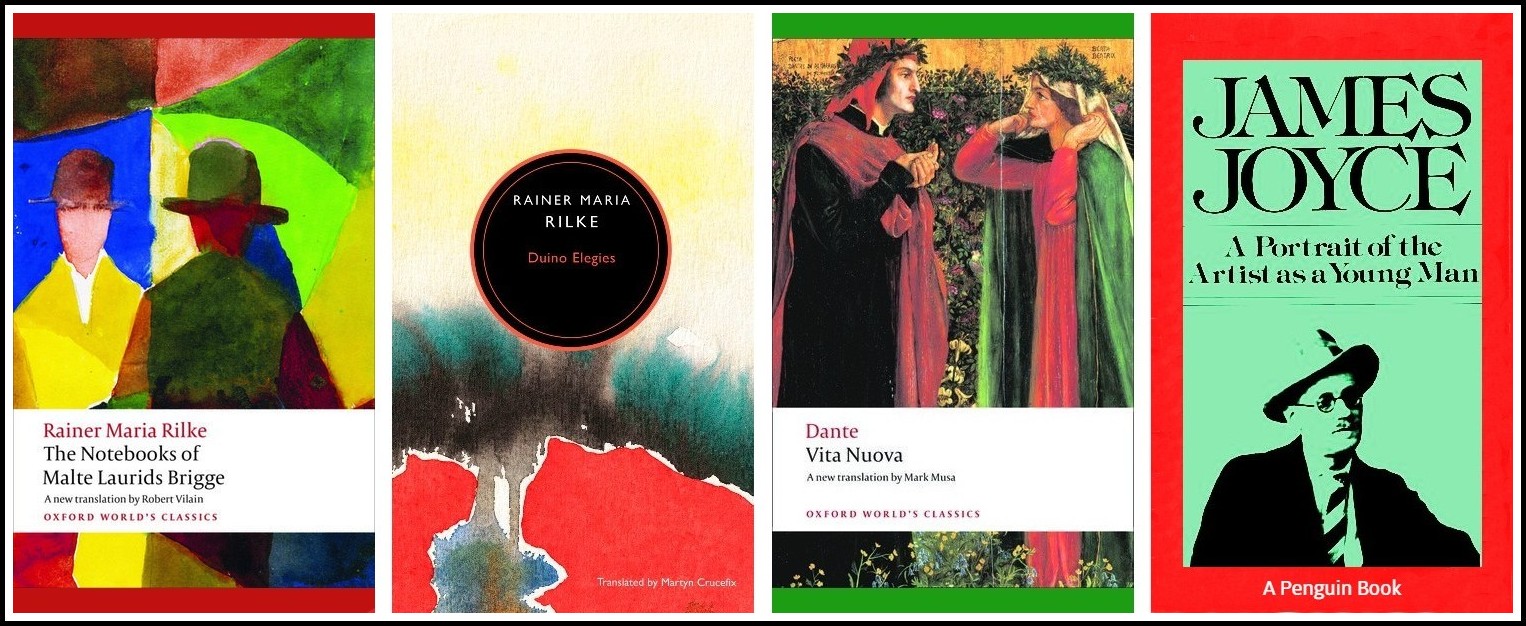
Rilke, The Notebooks of Malte Laurids Brigge | Rilke, Duino Elegies | Dante, Vita Nuova | Joyce, A Portrait of the Artist as a Young Man
Predictably, they are traumas again—traumatic discoveries of sexual desires that are as a rule both socially illicit and psychically irresistible. After the collapse of Youth and Experience, this new, alien force (the Es, the Id) pulverizes the only remaining cornerstone of the Bildungsroman: the unity of the Ego. Yet its disruptive violence also brings to light the hidden worlds and unexpected possibilities out of which will arise the ‘poetry’ thematized in the late Bildungsroman. What Tonio learns from his secret, unreciprocated love for Hans Hansen proves ‘more important than what he was forced to learn at school’ . It is in the bedroom of a prostitute that Törless has a first glimpse of that ‘second sight’ that will be his major intellectual discovery. It is while approaching a prostitute that Stephen ‘awakes from a slumber of centuries’ and feels the ‘dark presence’ of his future poetry. All these episodes (which have no equivalent in the tradition of the Bildungsroman) are announcing that new reality—the unconscious, taken in a broad sense—which will play a crucial role in the constitution of twentieth-century subjects, and in their socialization, which will consist more and more in an attempt to address and colonize, in a variety of ways, their prelogical, submerged selves. (Modernism, in fact, may well be seen as the aesthetic protagonist of this new pattern of Western socialization, in which unconscious psychic materials are no longer obstacles but instruments of social integration.)
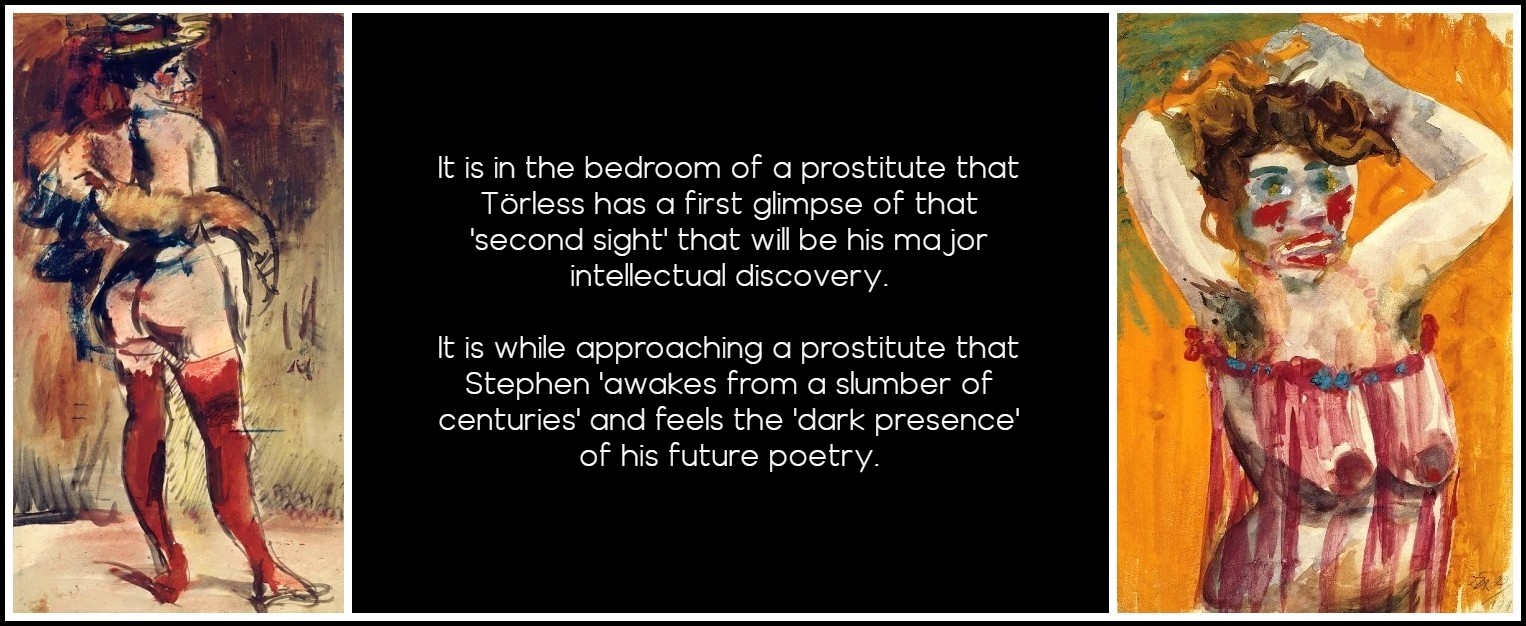
Georges Roualt, Fille, 1905 | Otto Dix, Dame, 1922
But in our novels such long-term developments are not in sight yet; we have the problem, not the solution, and the unconscious is still the spellbinding discovery of an unforgettable page by Rilke, in which Malte, still a child, finds himself trapped in alien clothes, and in front of a mirror: ‘For a moment I felt an indescribable, painful, and useless longing for myself: then there was “he” alone, der Unbekannte, the Unknown; there was nothing but him. He was the stronger of the two, and I was the mirror.’ A child facing a mirror, and trying on some new clothes, like so many young novelistic heroes. Two archetypal scenes in the construction of Western identity: but the emergence of the unconscious-unknown reverses their meaning, and they appear now as the destructive trauma described in Beyond the Pleasure Principle, against which, writes Freud, ‘all possible means of defense will be mobilized.’ ‘God, all these thoughts, these strange desires, this looking for and groping after a meaning! To be able to dream, to be able to sleep! And what is to come—let it come.’ Thus Jakob von Gunten; and Törless: ‘You used to be so gentle to me’. ‘Shut up! It wasn’t me! It was a dream. A whim.’ — It wasn’t me! Törless’s disavowal of his emotions sums up the strategy of the genre as a whole: having always dealt with the growth of self-consciousness, it was inevitable for the Bildungsroman to recoil in front of an alien, unconscious reality. As is often the case in history, the very conditions of its previous supremacy prevented the Bildungsroman from playing a central role in the new phase of Western socialization.
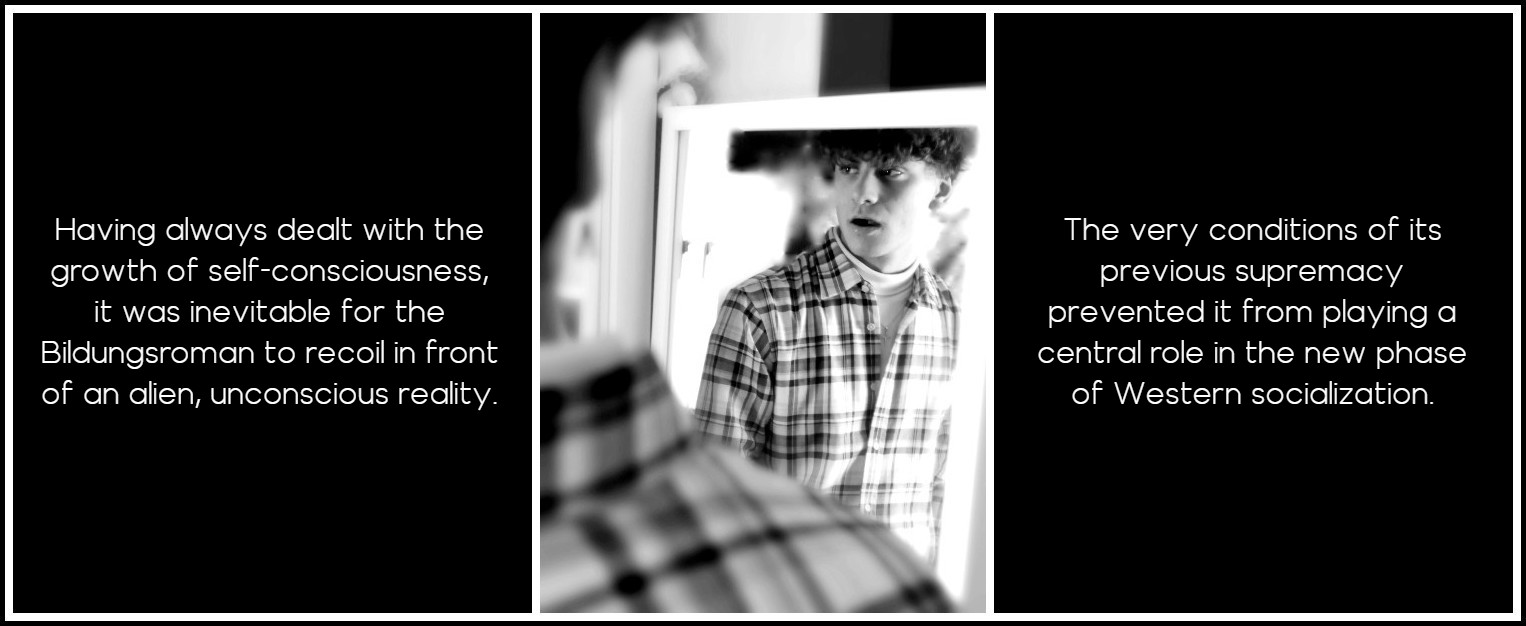
Photo: Joe Pearson, Unsplash
‘I am in between two worlds, at home in neither, and as a consequence everything is a bit difficult for me.’ Although Tonio Kröger’s last letter to his Russian friend seems to announce the emotional fissures to come, his story suggests that the acclaimed artist and impeccable bourgeois is in fact at home in both worlds. ‘But what had there been, in all that time in which he had become what he now was? Waste; desert; chill; and spirit! And art!’ Waste—and art! The secret of Mann’s narrative lies in the simultaneity of the two: the humiliations inflicted on the young Tonio always reshaped by the beautiful words of the mature Kröger. This isn’t just a story of traumas overcome: it is Mann’s very style that is anti-traumatic. To borrow another expression from Beyond the Pleasure Principle, it is a style that unfailingly brings those shocks ‘to the level of consciousness’, ordering as ‘lived experiences’ within conscious memory those traumas that, for the younger generation, will aimlessly follow each other as so many unrelated presents. This is even truer of Youth, where Marlow defuses traumas by transforming them, so to speak, into instant memories: We pumped watch and watch, for dear life, and it seemed to last for months, for years, for all eternity, as though we had been dead and gone to a hell for sailors. And there was something in me that thought, By Jove! This is the deuce of an adventure—something you read about; and it is my first voyage as second mate—and I am only twenty—and here I am. I was pleased. I would not have given up the experience for worlds. How remote is this ‘something’ from Malte’s ‘Unbekannte’! It is a reflexive, friendly support to personal identity, not a threat to it: and whereas Rilke’s hero will feel ‘a useless longing’ for himself, Marlow still cries aloud his confident ‘here I am!’
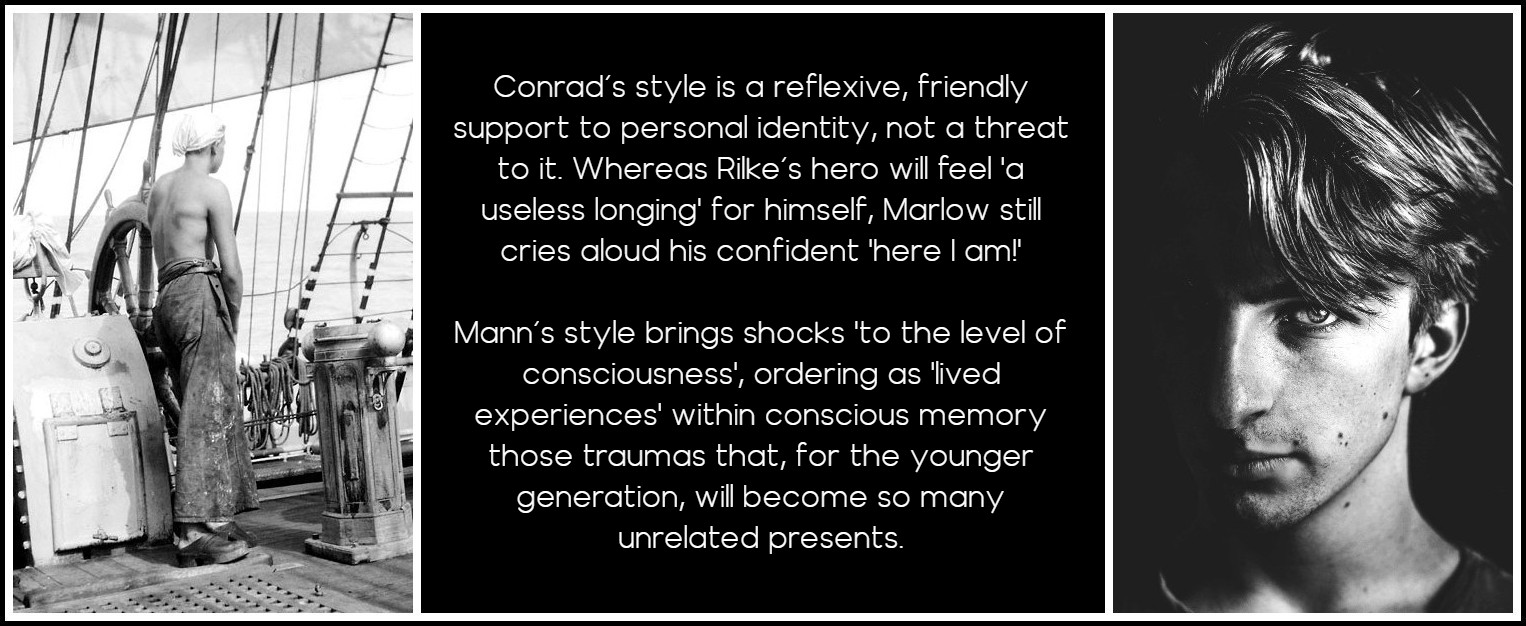
Midships helm, Herzogin Cecilie, 1928 (Photo: National Maritime Museum, London) | Photo: Seth Johnston, Unsplash
Rilke on traumas: ‘If words did indeed exist for that event, I was still too much of a child to find them.’ In Benjamin’s famous essay, traumas force Baudelaire’s poet to cry out in pain; in Musil, they are encircled by a labyrinth of dubious tropes; in Kafka, hidden by a haze of qualifying clauses. In all these instances, the clearest sign that a trauma has occurred is the fact that language no longer works well: that it is impossible to find adequate words for the reality of war, as millions of veterans will put it. In Conrad and Mann, on the contrary, the proper words are always at hand. As Marlow’s ship blows up, nearly killing him, ‘the sky and the serenity of the sea were distinctly surprising. I suppose I expected to see them convulsed with horror.’ In a single sentence Conrad combines here hyperbole and scepticism, danger and distance, youth and maturity: the trauma has been overcome because it has been stylized. And the style is, of course, irony: ‘Yet, on the other hand, Tonio himself could feel that the writing of verses was something excessive, something definitely unbecoming, and, to a certain extent, he had to concur with all those people who considered it a surprising occupation. Except that …’ Tonio’s poetic vocation has arisen out of a sequence of traumas, and its discovery was itself a trauma: but the words of ‘all those people’—the prosaic words of common opinion—are there, and are capable of counterbalancing all that. It is the antiradicalism of irony, which so much delighted the young Mann: irony as mediation, as the diplomatic device to keep crises under control. Irony as the style of good breeding, and of bourgeois decorum: ‘As an artist, Lisaweta, one is already enough of an adventurer in his heart. Outwardly, one has to wear proper clothes, for God’s sake, and behave like a respectable person!’ And also, why not, write in a sensible, civilized style.
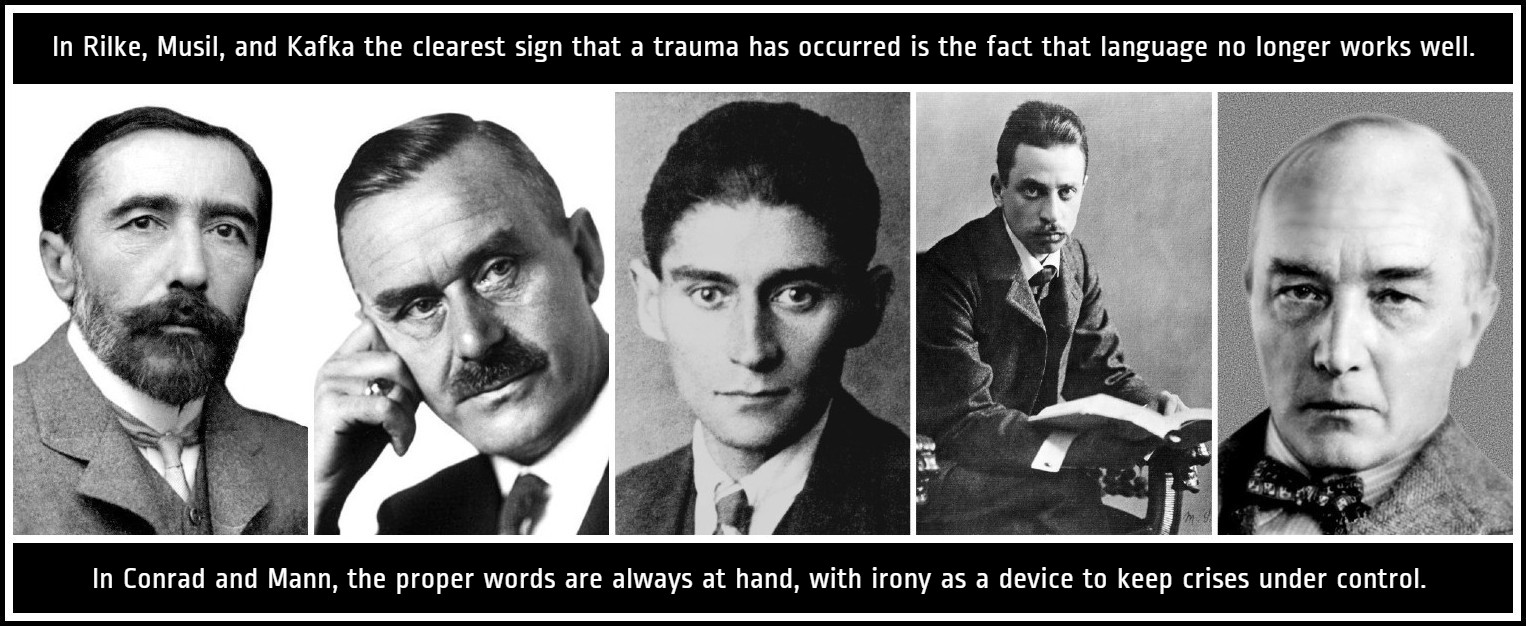
Joseph Conrad | Thomas Mann | Franz Kafka | Rainer Maria Rilke | Robert Musil
And behave like a respectable person. According to Norbert Elias, this would imply first of all holding in check one’s animal drives. This is why table manners are such a basic test of urbanity, and also why dinners have had such relevance in civilized and civilizing novels. But Portrait opens with a dinner’s violent disruption, and Amerika’s first turning point is announced—at dinner again—by the violation of all bodily and linguistic etiquette. The hour of Dinnerdämmerung has come, and it is not (only) a joke, because dinners embody a vital social need—the need for neutralized spaces: for areas where people may meet without fear under the protection of clear, unchallenged rules. (The rules themselves, of course, cannot be socially neutral, but they apply impartially to everybody.) Moreover, when a world enjoys a Hundred Years’ Peace (as Polanyi defined European history between 1815 and 1914) neutralized spaces tend inevitably to increase in number, and to occupy a growing portion of social existence: the Bildungsroman, for instance, took place almost entirely within their boundaries—and understandably so, because in such areas individual growth is sheltered, and easier, and less painful. When Mr. Green’s behaviour at dinner makes Karl Rossmann feel that ‘their inevitable social and worldly relations were to bring total victory or total defeat to one of them’, what Kafka implies is that the neutralized space par excellence has reverted to the state of a battlefield; so that, even from this side, the subject is no longer shielded from traumatic encounters.
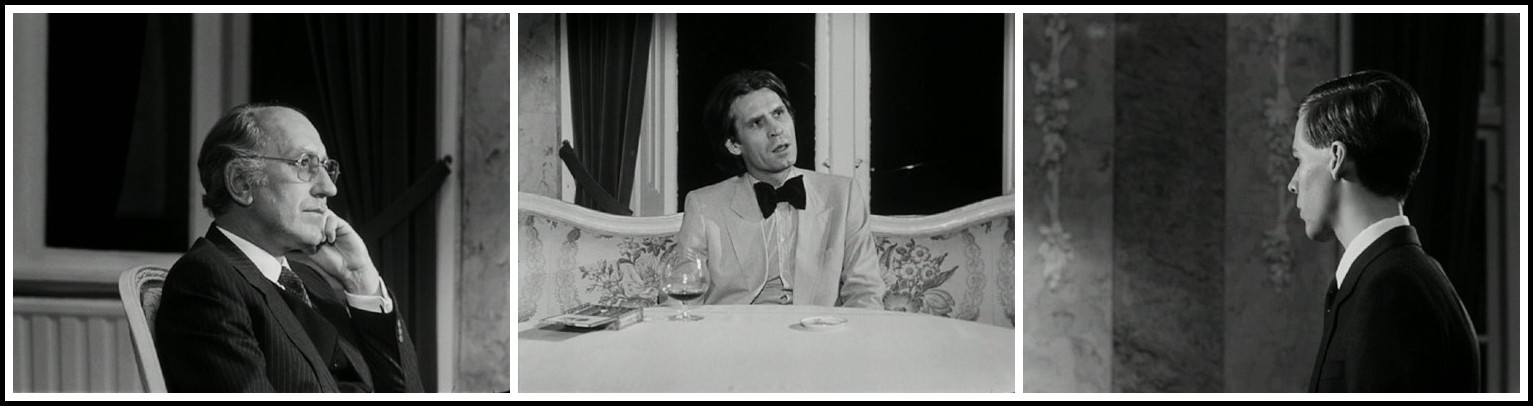
Danièle Huillet & Jean-Marie Straub, Amerika, Franz Kafka
Free, equal, homogeneous enclaves—within societies that are emphatically not so. There is something so unreal about neutralized spaces that their disruption, however threatening, has nonetheless a liberating quality. As in the tragic paradigm, the pain of trauma is the price for truth: for the discovery of a violent power behind the facade of an impartial civilization: for the epiphany of ‘class relations’, as Jean-Marie Straub retitled his lucid, pitiless version of Amerika. But something is missing from these social epiphanies: claritas, as Stephen would say. The moment of revelation turns out to be also the moment of maximum ambiguity—most notably in Amerika, where hesitant and contradictory formulations are the puzzling echoes of all narrative turning points (so much so that Straub, in order to establish his reading of the text, erased from it almost all of the dialogue). Despite Stephen’s peroration on ‘radiance’, then, the striking fact about epiphanies, in the late Bildungsroman, is that they are indeed signs—but signs belonging to an unknown language, ‘a language we cannot hear’, as Törless puts it. ‘He was thinking of ancient paintings he had seen in museums without understanding them well. He was waiting for something, just as he always had when in front of those paintings—but nothing ever happened. What would it be? Something extraordinary, never seen before; words could not say it.’ ‘My life here’, writes Jakob von Gunten, ‘strikes me at times as an incomprehensible dream.’ And Malte: ‘If words did indeed exist for that event, I was still too much of a child to find them. I obscurely foresaw that life would be full of strange things, meant for one only, and unspeakable.’
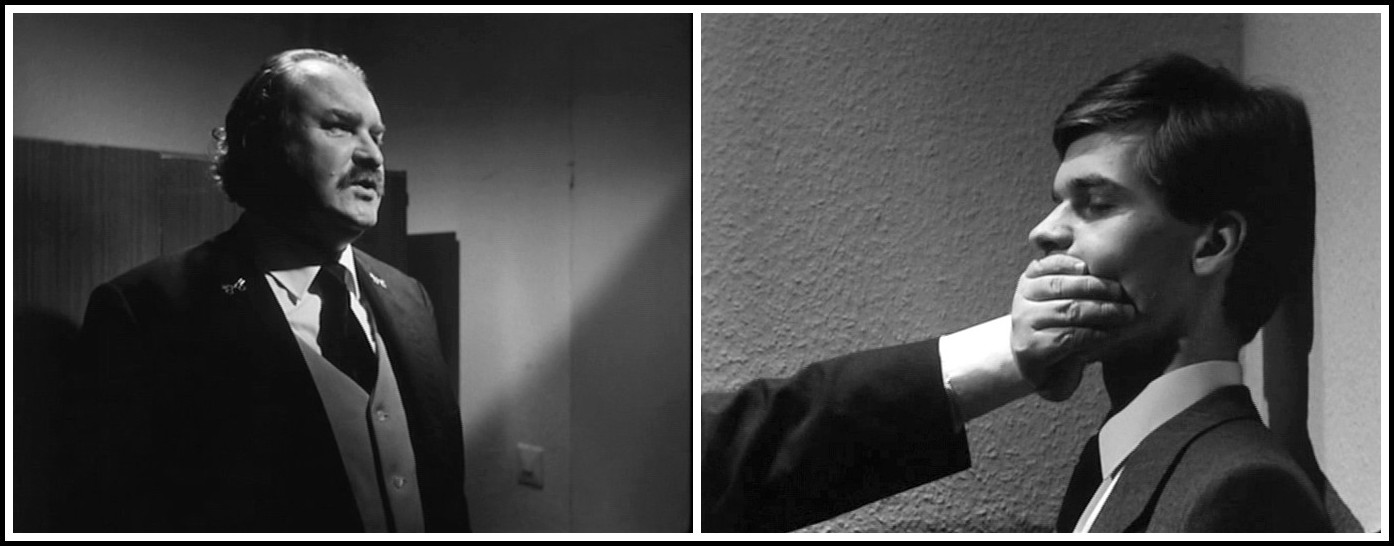
Danièle Huillet & Jean-Marie Straub, Amerika, Franz Kafka
What promised to be a painful knowledge turns out to be a painful enigma. Rilke again: What did that old woman want from me, creeping out of that hole? I understood that the old pencil was a sign, a sign for the initiated; a sign that drop-outs know well. This was two weeks ago. But now not a single day goes by without one of these encounters. Not only at sunset, but at midday, in the most crowded streets, all of a sudden a short man appears, or an old woman, and they beckon, they show me something, and then they vanish. We are so used to grieving for the meaninglessness of life that, at first, it may be hard to realize that Malte’s complaint, here, is that the world is too meaningful; there are too many signs, and signs are threats, because in them lurks der Unbekannte, the Unknown. (‘All / Is not itself’, as the Elegies will say.) This veritable semiotic anxiety will then produce its own form of regression: the yearning for a world freed from the plurality, and hence the uncertainties, of signification: for a world of Un-signs, as it were. It is Tonio Kröger’s longing for what is ‘irrelevant and simple’. It is Kafka’s impossible hope—so well described by Sartre—for a stretch of flat meaningless nature. It is Jakob’s compulsive drive to hide all personal signs under a uniform. But the most revealing figure is Rilke’s ‘mother’: the Erklärer, the ‘light-thrower’ of Malte and the Elegies, who turns signs into things; who de-semiotizes, so to say, what is ‘nightly-suspect’, restoring in its place the solid reality of ‘those dear, usual objects which stay there, ohne Hintersinn, with no hidden meaning, good, simple, unequivocal’.
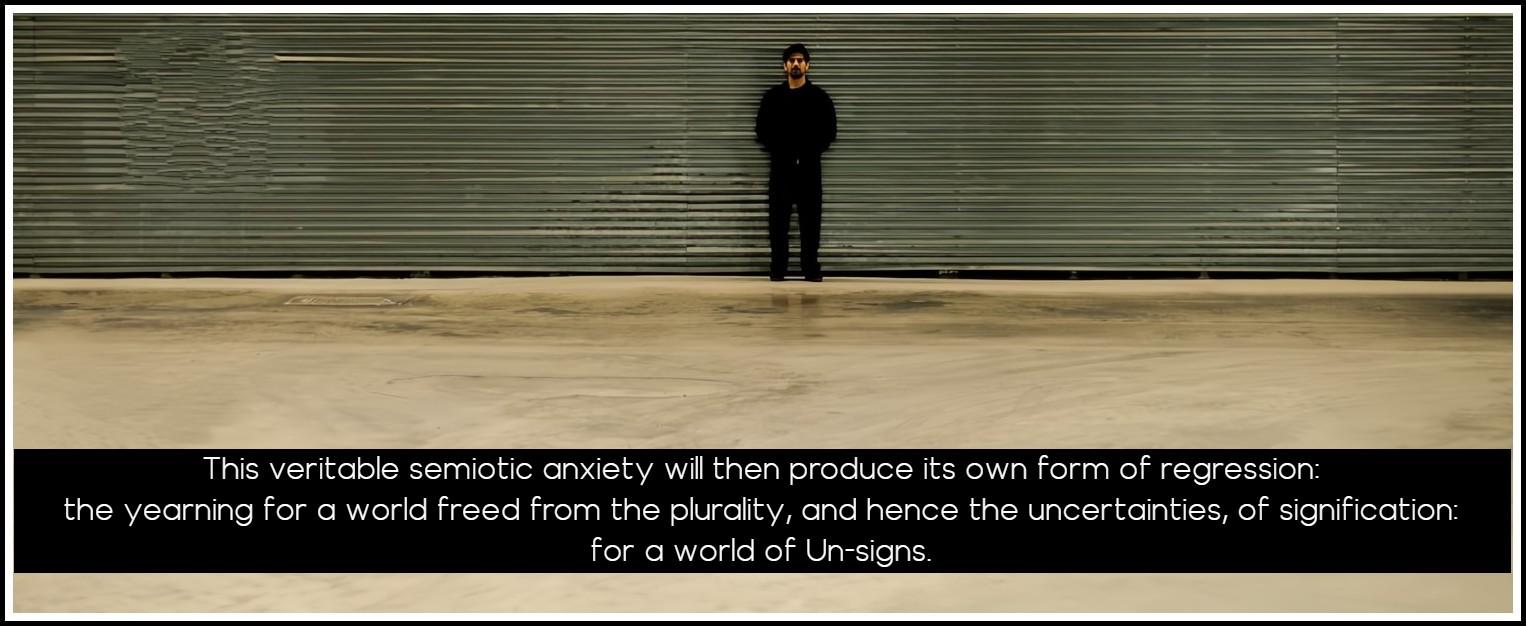
Photo: Eduardo Ramos, Unsplash
Till that moment he had not known how beautiful and peaceful life could be. The green square of paper pinned round the lamp cast down a tender shade. On the dresser was a plate of sausages and white pudding and on the shelf there were eggs. They would be for the breakfast in the morning after the communion in the college chapel. White pudding and eggs and sausages and cups of tea. How simple and beautiful was life after all! It is the most obedient evening in Stephen’s life, and his words echo Malte’s delight in the lack of hidden meaning of good simple objects. But it is only a passing moment: in the struggle among signs and Un-signs Portrait sides resolutely with the former. ‘Many in our day’, reads the 1904 sketch, ‘cannot avoid a choice between sensitiveness and dullness.’ Simplicity may be a form of dullness, after all: sensitiveness, the capacity to perceive and confront Rilke’s unknown—to see ‘a winged form flying above the waves and slowly climbing the air’. As Portrait’s great epiphanic passage begins, Stephen faces the same question—What did it mean?’—that paralysed his predecessors. But in his case the enigmatic meaningfulness of ‘a girl gazing out to sea’ is ‘an instant of ecstasy’, and his prompt mention of medieval illuminations—signs growing out of signs—shows that he is perfectly at home in the labyrinth of endless semiosis. In a Rimbaud-like episode of initiation and rebirth—a perfect kernel, in all possible respects—epiphany redeems the meaninglessness of the past, revealing that Stephen’s youth had always had a secret aim—the discovery of an artist’s ‘soul’—and that it has finally achieved it. One could not wish for a better closure for Joyce’s ambitious Künstlerroman.
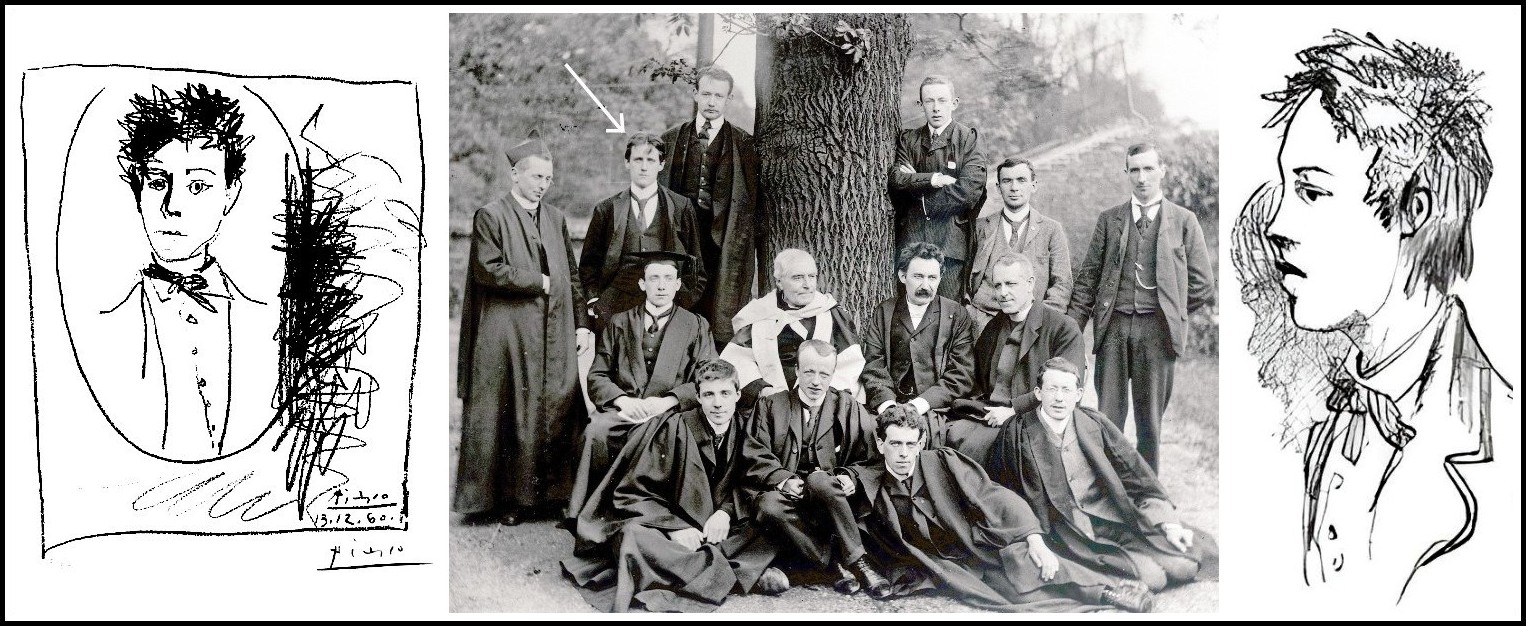
Rimbaud by Picasso | James Joyce, University College Dublin, 1902 | Rimbaud by Cazals
Except that, of course, Portrait goes on, and the following chapter, compared to all previous ones, is strikingly blank and pointless. Neither visions nor rebirths here, but idle conversations to kill the time; no menacing institutions, but a banal everydayness; the seer has turned into a young pedant, for whom epiphany is just a tricky philological riddle. In every respect, this last chapter seems to have one possible function only: the merely negative one of invalidating what, up to then, had been constructed as the meaning of the novel. And here, of course, one may claim that all texts play this trick upon themselves, plunging happily into unreadability, with which the case is dismissed. But I happen to think that literature is not produced to multiply symbolic tensions out of control, but rather to reduce and contain them: and as the ending of Portrait seems to contradict this thesis, I have to provide an explanation for it. Why this slowdown, this anticlimax? Why should Joyce undo the meaningful irreversibility of chapter four? Indeed, why did Joyce write the fifth chapter at all?
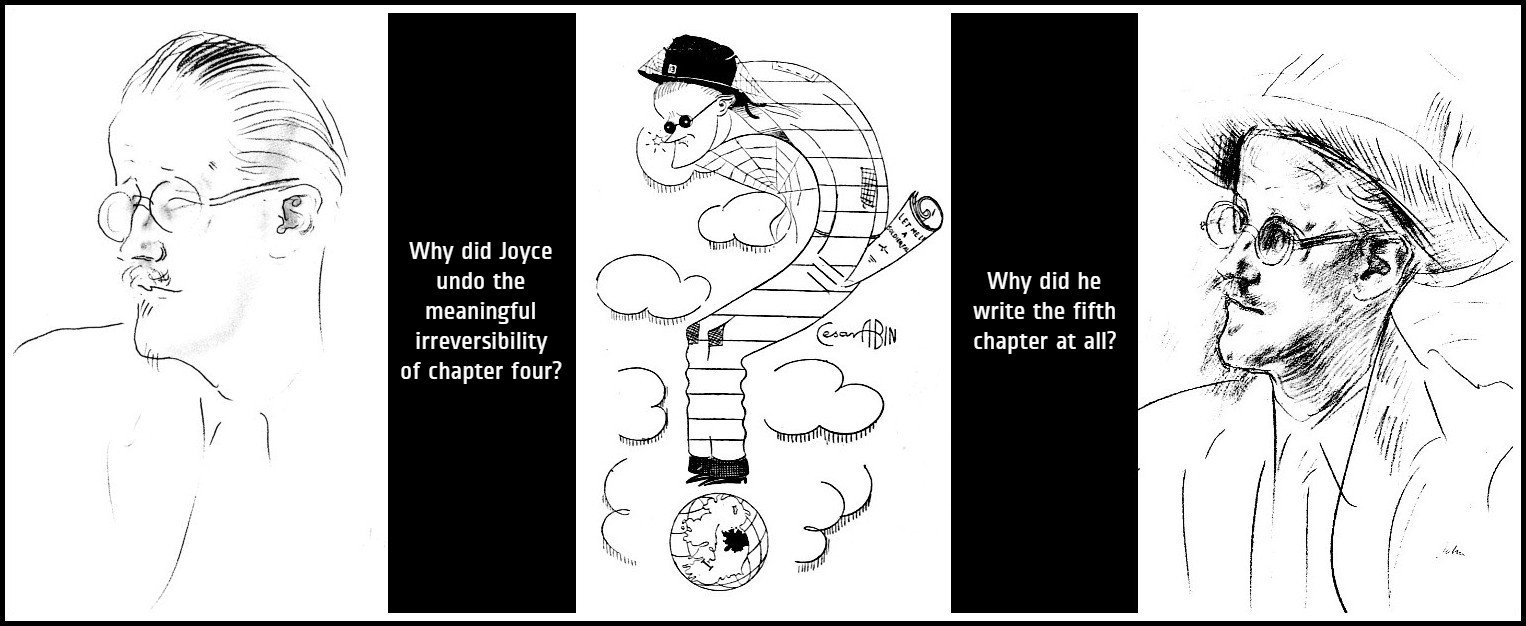
James Joyce
Perhaps the last question is stupid, period. Or perhaps it would be stupid if novels were perfect beings, thoroughly inspired by one unitary design: in which case all that is there has to be there, and the idea of a useless element is simply inconceivable. Like most things human, however, novels may be closer to bricolage than to engineering: and in this case images, episodes, or whole chapters would be highly contingent products, which may, or may not, be where they are; and may, or may not, work well in the overall structure. Writers make literature, as the saying goes, but cannot choose the conditions, nor the materials with which they make it. Let us think of Joyce as a bricoleur, then, musing upon the materials put at his disposal by literary tradition. First of all, reasonably enough, the debris of the Bildungsroman itself: Flaubert’s flat prose of the world, where the very notions of experience and growth had disappeared. ‘It would be easier’, wrote Pound in 1917, ‘to compare Portrait with L’Éducation sentimentale than with anything else’: true, but to revitalize the form of the Bildungsroman Joyce also needed an antidote to Flaubert’s insignificant everydayness. And what better choice than the poetry of traumatic intensity originating in Baudelaire, and developed by Rimbaud, who was, after all, the archetypal ‘artist as a young man’ of the late nineteenth century? In a somewhat similar vein to Benjamin’s Baudelaire, Joyce’s use of epiphany may thus be seen as a bold attempt to confront traumas and their linguistic turbulence: to master and ‘use’ them as means for self-revelation, and growth (and even socialization: they point the road to adult work).
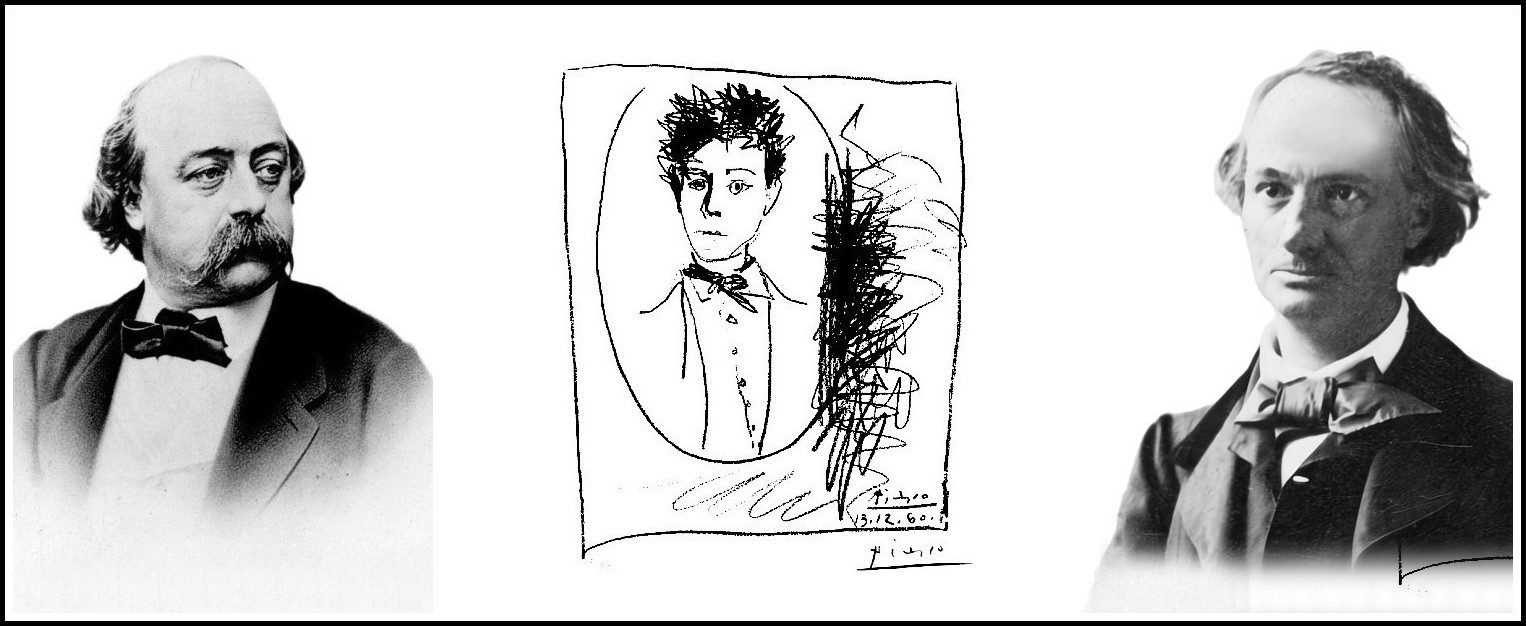
Flaubert | Rimbaud | Baudelaire
Flaubert and Rimbaud: a plausible matrix for Portrait’s well-known oscillation between ‘dullness’ and ‘sensitiveness’, between a meaningless everyday (preferably at the beginning of chapters), and meaningful revelations (preferably at the end). Flaubert and Rimbaud. Flaubert or Rimbaud, we should rather say. Their versions of experience were so utterly incompatible that, ‘in the end’, no reconciliation or compromise was possible: Joyce had to choose between them. But what should be the criterion for his final choice? What made more sense in terms of the regeneration of the Bildungsroman was clear enough: Rimbaud, kernels, epiphany, chapter four. But just as clear was what made more sense within the wider historical trend of Western narrative: Flaubert, satellites, prosaic dullness, chapter five. Joyce’s double choice was, then, the sign of a double bind: of a contradiction that even the most scrupulous bricoleur in the world (which Joyce certainly was) could not hope to solve. The merit of Portrait lies precisely in not having solved its problem. Or in plainer words: the merit of Portrait lies in its being an unmistakable failure.
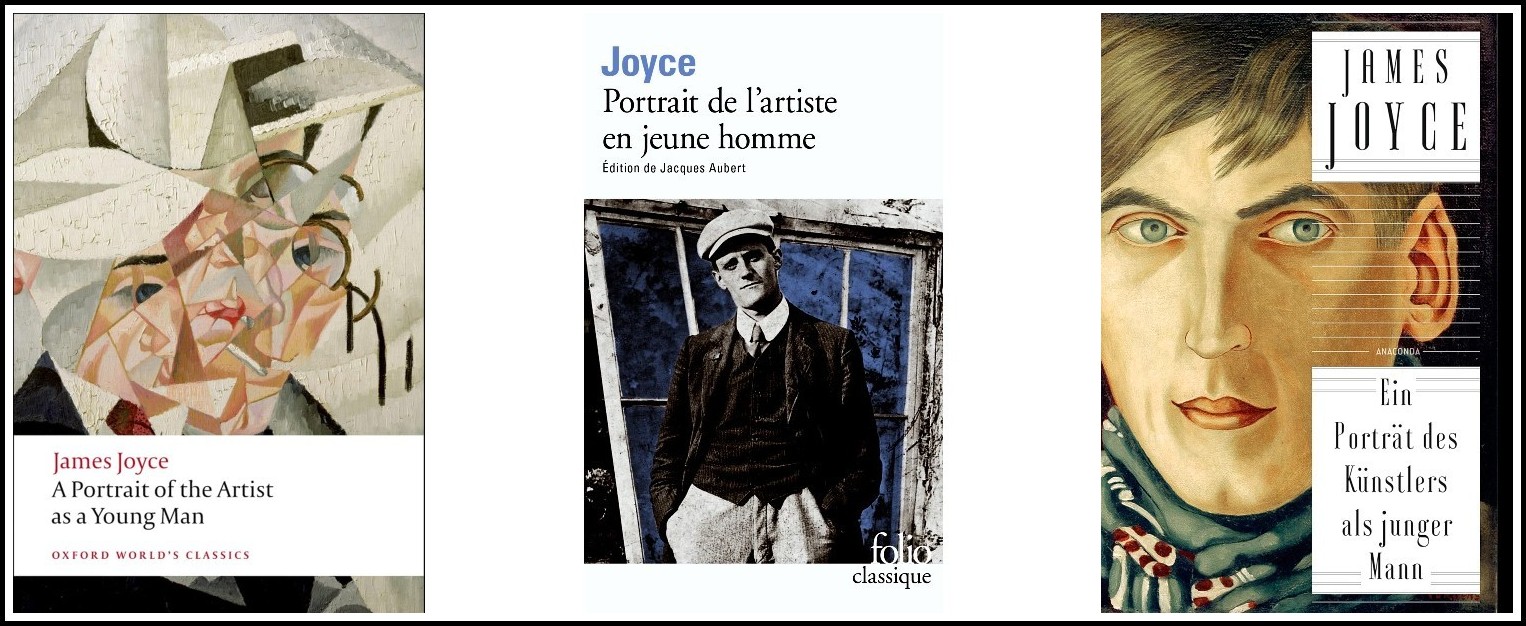
James Joyce, A Portrait of the Artist as a Young Man
‘The merit of Portrait lies in its being an unmistakable failure.’
Portrait as bricolage; as bricolage manqué: as a structural failure. And fortunately so. Had it been otherwise—had Portrait been, say, as good as Tonio Kröger—we would have no Ulysses. Thomas Mann’s bricolage—his essayistic mediation between the realistic novel and German tragic thought—proved so successful that he preserved its formula for half a century, thereby introducing no great novelty in the evolution of narrative. Inertia is the dominant force, even in the realm of literature, and as long as a form works well there is no reason to modify it: it is only when it fails that the need for change arises. Think of the internal articulation of the late Bildungsroman: at one pole the smooth formal achievements of Youth and Tonio Kröger, at the opposite one, the increasingly unstable-unfinished mosaics of Malte, Portrait, and Amerika (with Törless and Jakob von Gunten somewhere in between). In terms of historical evolution: on one side a well-functioning Bildungsroman, and the Long Nineteenth Century of Conrad and Mann; on the opposite side, erratic and unsteady structures, and the modernism-to-come of Rilke, Kafka, and Joyce. Doesn’t this suggest that the latter trio was literally forced into modernism by its failure with the previous form? Without failures, I insist, we would have no literary evolution, because we would have no need for it. Perhaps, then, we should stop pretending that failures are really masterpieces in disguise, and should learn to accept them as failures, appreciating their unique historical role.
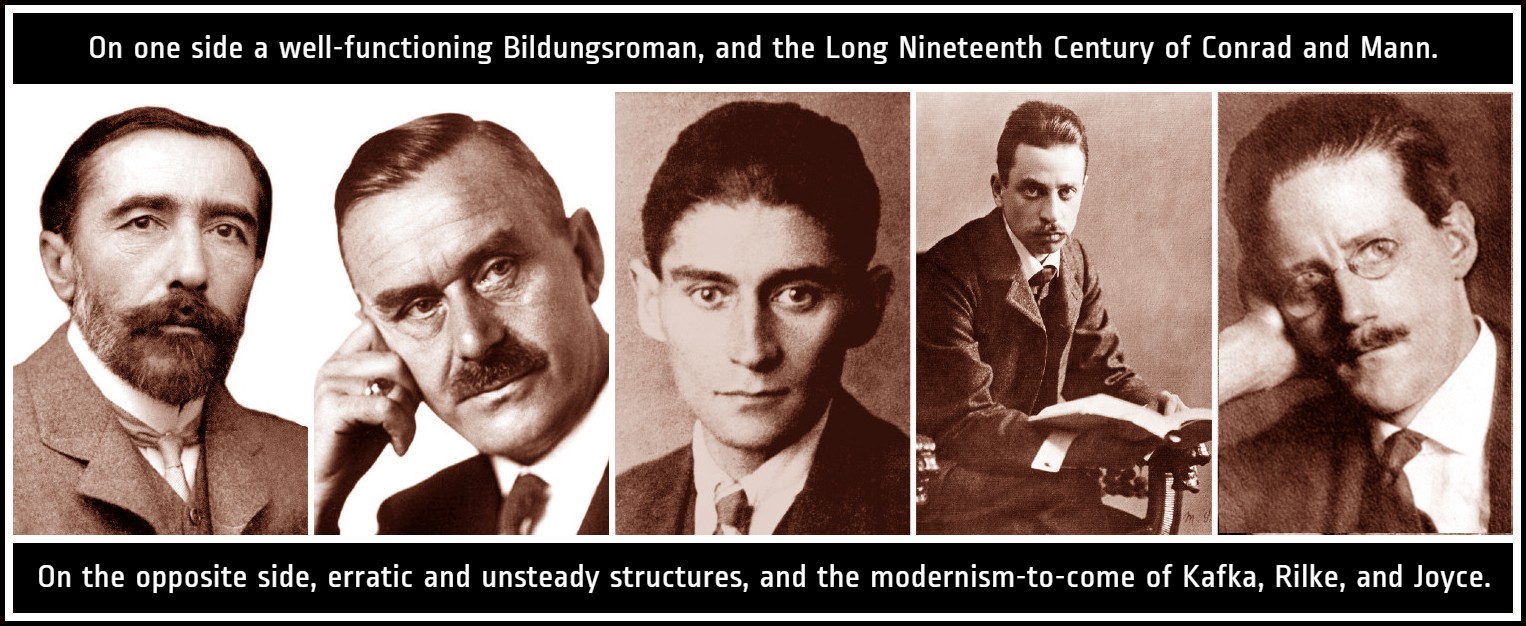
Joseph Conrad | Thomas Mann | Franz Kafka | Rainer Maria Rilke | James Joyce
To the inevitable question, ‘Would you mind explaining what exactly is a literary failure?’ I would reply, although sketchily, that it is the sort of thing that occurs when a form deals with problems it is unable to solve. This definition presupposes in its turn the idea that symbolic forms are fundamentally problem-solving devices: that they are the means through which the cultural tensions and paradoxes produced by social conflict and historical change are disentangled (or at least reduced). Here lies the so-called social function of literature, with its so-called aesthetic pleasure: solving problems is useful and sweet. So much for my personal convictions, which I have tried to justify more at length elsewhere, and which are of course thoroughly questionable. But if they strike you as plausible, then a form that addresses problems it cannot solve is indeed a failure, socially and aesthetically. For the late Bildungsroman—this most painfully intelligent and strangely short-lived episode of modern literature—this insoluble problem was the trauma. The trauma introduced discontinuity within novelistic temporality, generating centrifugal tendencies toward the short story and the lyric; it disrupted the unity of the Ego, putting the language of self-consciousness out of work; it dismantled neutralized spaces, originating a regressive semiotic anxiety. In the end, nothing was left of the form of the Bildungsroman: a phase of Western socialization had come to an end, a phase the Bildungsroman had both represented and contributed to. The strength of its pattern—the stubbornness, in a sense—can be seen nowhere as clearly as in Joyce, who devoted a first novel to Stephen Dedalus, and then a second novel, and then the beginning of a third novel. But the nineteenth-century individual—Stephen Hero—could hardly survive in the new context, and in an epoch-making change the decentered subjectivity of Leopold Bloom—this more adaptable, more ‘developed’ form of bourgeois identity—set the pattern for twentieth-century socialization.
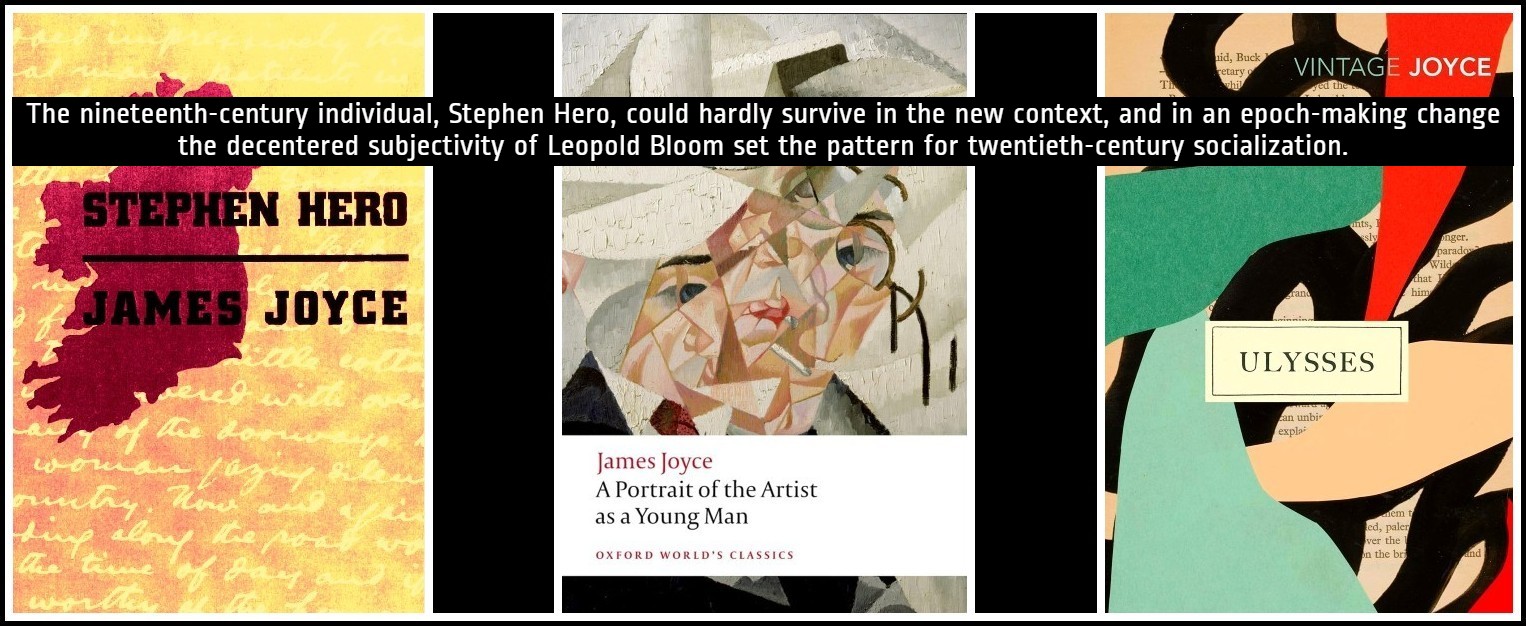
JAMES JOYCE
Stephen Hero | A Portrait of the Artist as a Young Man | Ulysses
Just one final remark, on Portrait again. As we saw, we have here a Flaubertian field of repetition, satellites, and meaninglessness—and a Rimbaudian one of epiphanies, kernels, and meaningfulness. Joyce’s first representation of epiphany, however, had been more complicated than that. Stephen Hero, chapter 25: He was passing through Eccles St one evening, one misty evening, with all these thoughts dancing the dance of unrest in his brain when a trivial incident set him composing some ardent verses which he entitled a ‘Villanelle of the Temptress’. A young lady was standing on the steps of one of those brown brick houses which seem the very incarnation of Irish paralysis. A young gentleman was leaning on the rusty railings of the area. Stephen as he passed on his quest heard the following fragment of colloquy out of which he received an impression keen enough to afflict his sensitiveness very severely. The Young Lady — (drawing discreetly) … O, yes … I was … at the … cha … pel … / The Young Gentleman — (inaudibly) … I … (again inaudibly) … I … / The Young Lady — (softly) … O … but you’re … ye … ry … wick… ed … This triviality made him think of collecting many such moments together in a book of epiphanies. By epiphany he meant a sudden spiritual manifestation, whether in the vulgarity of speech or of gesture or in a memorable phase of the mind itself. He believed that it was for the man of letters to record these epiphanies with extreme care, seeing that they themselves are the most delicate and evanescent of moments.

Photo: Aarn Giri, Unsplash
Triviality, vulgarity, the commonplaces uttered by the Young Lady. The significance of what is insignificant: this was the pathbreaking discovery made by Stephen Dedalus as he was walking, of all places, through Eccles St: Ulysses. But the encounter had taken place too early, and the oxymoron of a meaningful meaninglessness was still too elusive: and so, in that same page of Stephen Hero, Joyce hid his discovery under a stratum of symbolist topoi—ardent, extreme care, delicate, evanescent—that make it almost unrecognizable. Inertia again; the resistance to change; the new that can manifest itself only in disguise, as a compromise formation. And an ephemeral compromise: after Stephen Hero, Joyce soon veered away from ‘superficial’ epiphanies, soon to replace them with the ‘deeply deep’ ones of Portrait. Yet that early page had been written, and since Stanislaus Joyce was nice enough not to throw it away, it may teach us that literary change does not occur as a straight growth (Stephen Hero, then Portrait, then Ulysses), but as a branching process (Stephen Hero, and then either Portrait or Ulysses). Joyce chose the Portrait way, as we know, but it led nowhere. Far from preparing Ulysses, Portrait delayed it, and in order to invent Bloom, Joyce had to forget his Künstlerroman and retrace his steps all the way back to that initial bifurcation near Eccles St. It is an arabesque that may be taken as a miniature for the late Bildungsroman as a whole: every tree has its dead branches, and this, alas, was one of them.
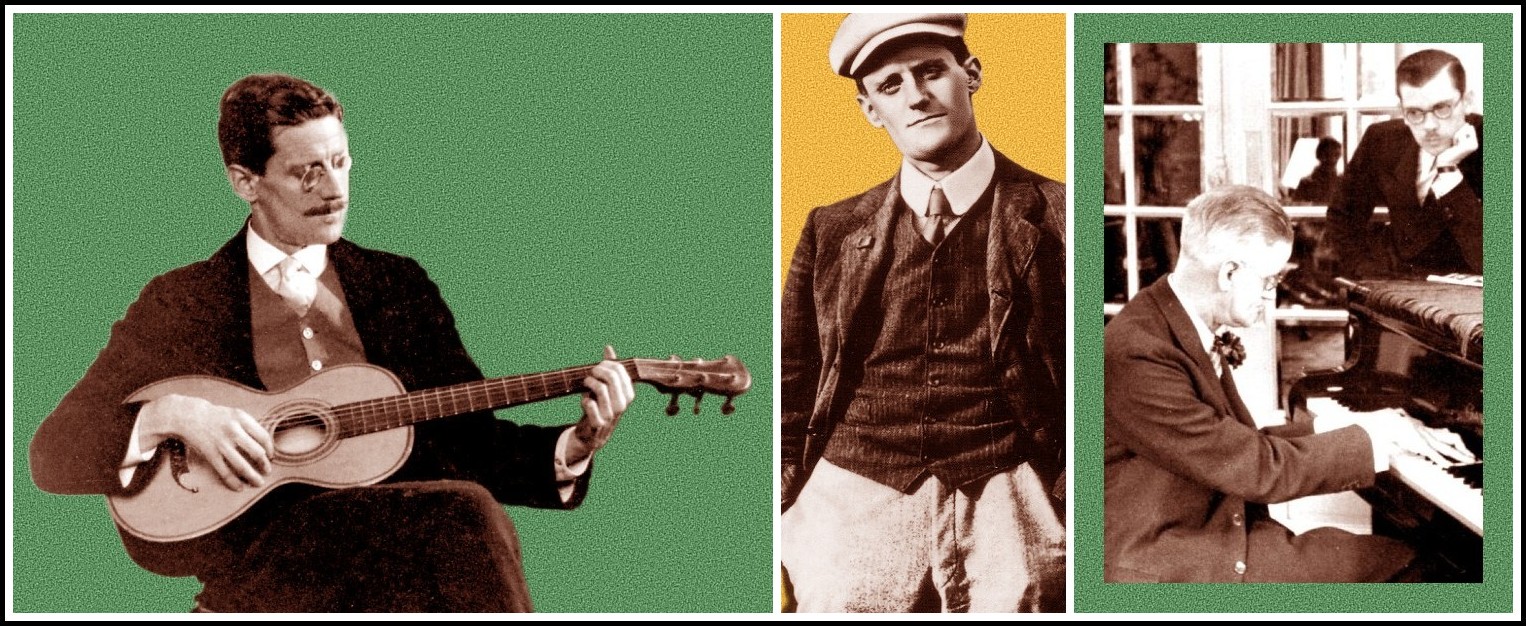
James Joyce
FRANCO MORETTI: THREE BOOKS
CLICK ON THE IMAGE TO GO TO A DESCRIPTION OF THE BOOK
The Way of the World
Canon/Archive
Far Country
MARA, MARIETTA: A LOVE STORY IN 77 BEDROOMS – READ THE FIRST CHAPTER
A literary novel by Richard Jonathan
RICHARD JONATHAN, ‘MARA, MARIETTA: A LOVE STORY IN 77 BEDROOMS’ — READ THE FIRST CHAPTER
AMAZON & APPLE BOOKS

RICHARD JONATHAN, ‘MARA, MARIETTA: A LOVE STORY IN 77 BEDROOMS’ | AMAZON PAPERBACK OR KINDLE

RICHARD JONATHAN, ‘MARA, MARIETTA: A LOVE STORY IN 77 BEDROOMS’ | APPLE iBOOK
MARA, MARIETTA: A LOVE STORY IN 77 BEDROOMS
A literary novel by Richard Jonathan
Available from AMAZON (paper | ebook) & iBOOKS, GOOGLE PLAY, KOBO & NOOK (see LINKS below)
RELATED POSTS IN THE MARA MARIETTA CULTURE BLOG
CLICK ON THE IMAGE TO GO TO THE POST
By Richard Jonathan | © Mara Marietta Culture Blog, 2026 | All rights reserved
Comments