Looking into the Abyss: The Poetics of Manet’s ‘Bar’
MANET: A BAR AT THE FOLIES-BERGÈRE – ANALYSIS – PART 1
Jack Flam
Jack Flam, Emeritus Faculty, is Distinguished Professor of 19th- and 20th-Century European and American Art, City University of New York Graduate Center.
Condensed from Jack Flam, ‘Looking into the Abyss: The Poetics of Manet’s A Bar at the Folies-Bergère’
in Twelve Views of Manet’s ‘Bar’, ed. Bradford Collins (Princeton: Princeton University Press, 1996) pages 164-168
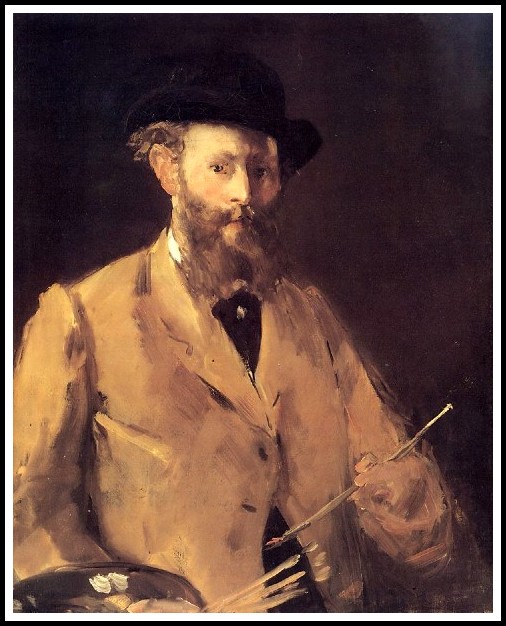
Manet, Self-Portrait with Palette, 1879
I. INTRODUCTION
Manet’s A Bar at the Folies-Bergère is so finely nuanced and fraught with ambiguity that it virtually demands a diversity of interpretations. In fact, the very notion of finding the ‘right’ interpretation of the painting—or even of there being a single right interpretation—verges on the absurd. But while we cannot solve all the mysteries evoked by such a work, or even resolve its most apparent contradictions, we can illuminate them by probing those aspects of the picture that we feel to be most important. That is, we can distinguish between what we might call stronger and weaker readings of it. And taken together, various strong readings can give us a fuller picture of what we are looking at. In this essay I will focus on certain aspects of what might be called the poetics of the Bar at the Folies-Bergère: its suggestive ambiguities, its strikingly original use of traditional iconographical elements, and the provocative way in which this picture redefines certain aspects of realist painting.
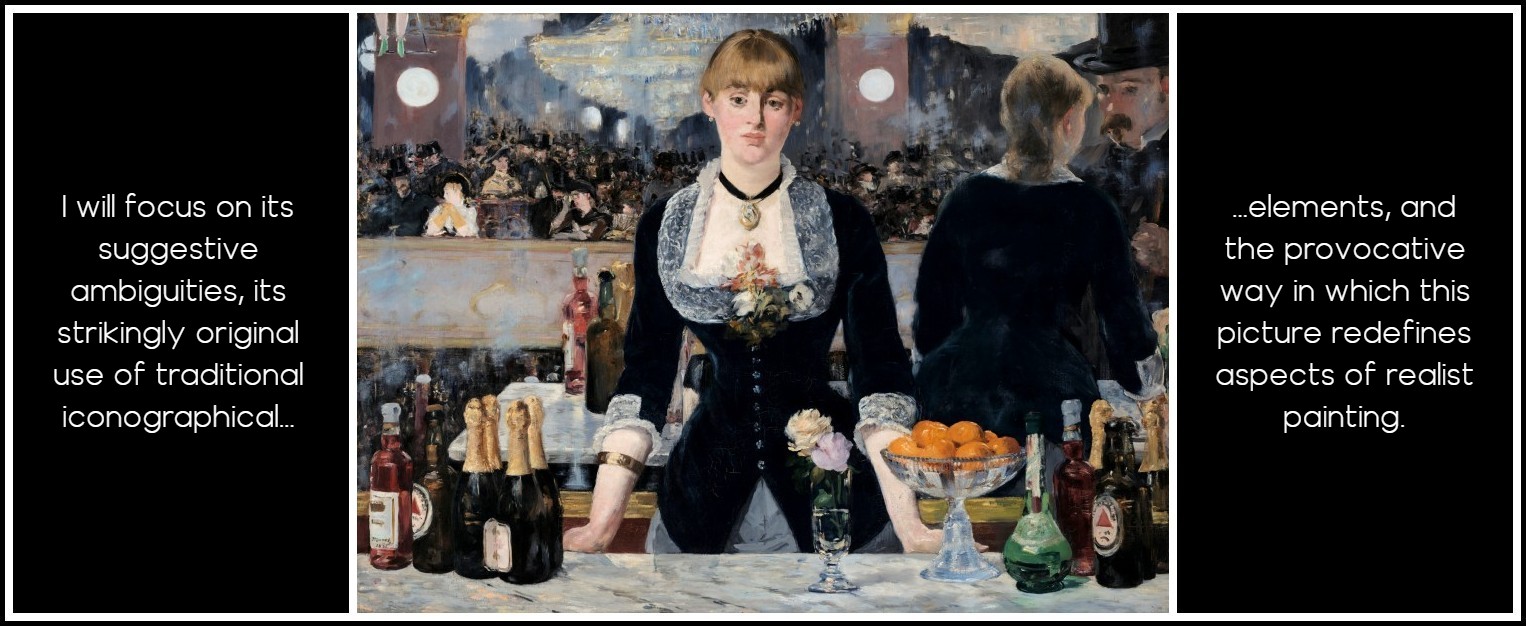
Manet, A Bar at the Folies-Bergère, 1881-82
II. WHAT WE SEE
A Bar at the Folies-Bergère is, among other things, an extended meditation on a number of dualities. One of the most striking aspects of the picture is the centrality of the barmaid and the way that she seems to define or mediate everything else depicted. She stands exactly in the center of the painting in a nearly symmetrical pose. Her gaze is distant, melancholy, absent; although she is firmly rooted in her surroundings she also seems detached from them, as if she is focused on something in her mind rather than in the world before her eyes.
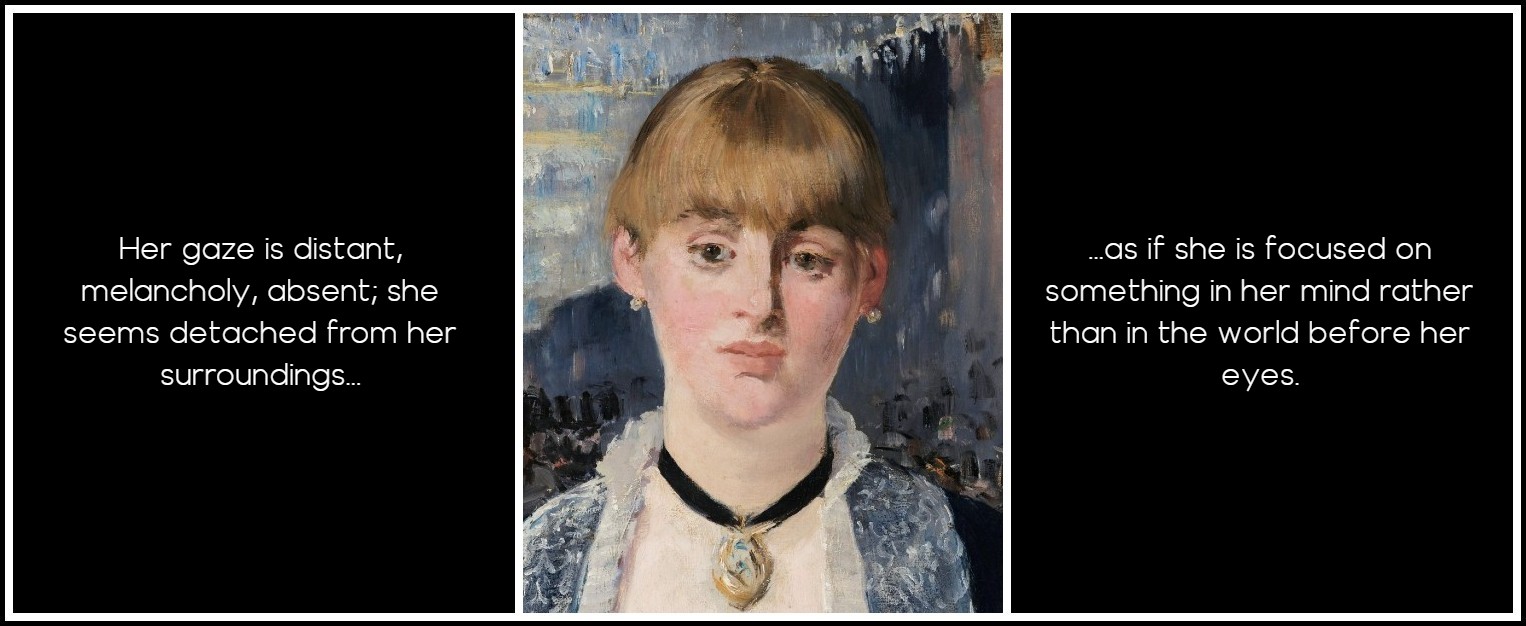
Manet, A Bar at the Folies-Bergère, 1881-82 (detail)
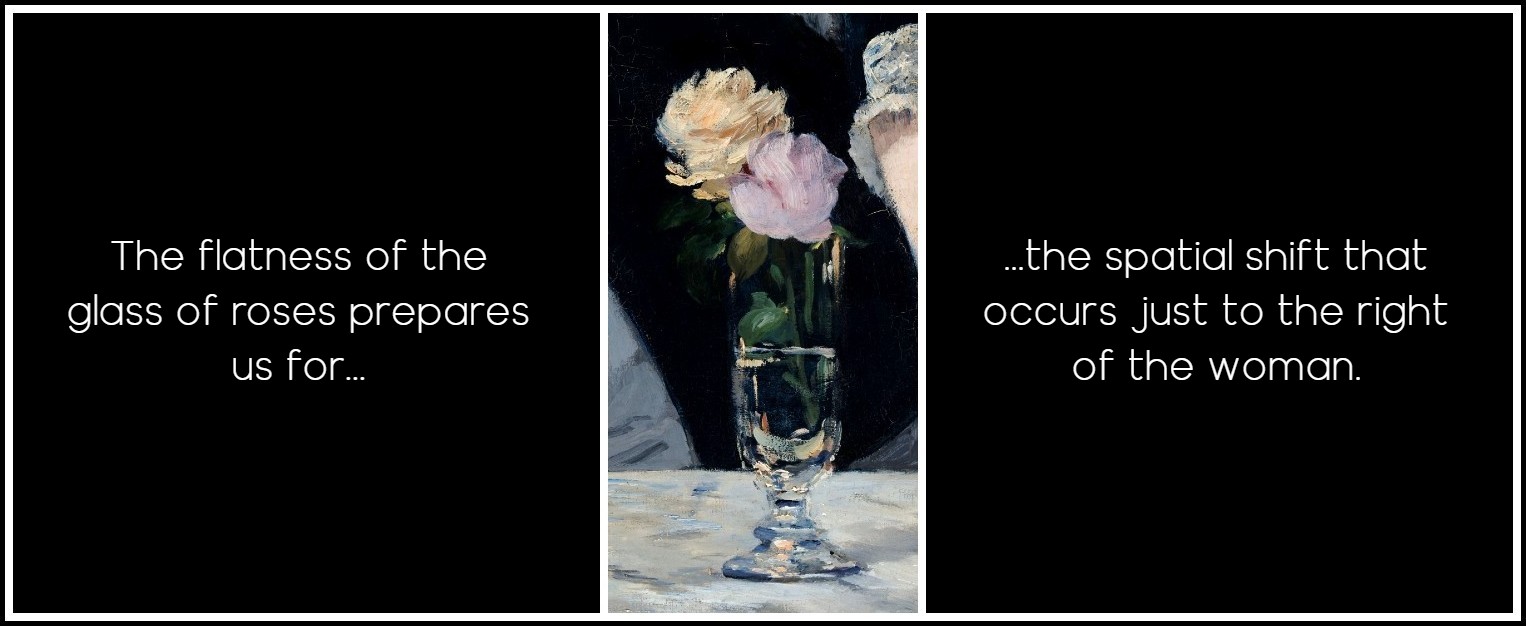
The marble-topped bar that she leans on supports a provocative array of objects. The champagne and the beer seem to make a wry reference to the broad spectrum of social classes, tastes, and even nationalities of the Folies’ clientele. But the combination of objects is also puzzling. Why are so many champagne bottles set out like this where they will lose their chill? And why the bowl of mandarin oranges—so unexpected in such a place? Don’t the two roses in the stemmed glass call a bit too much attention to themselves as a warm ‘personal touch’ on this public bar? And why is the glass with the roses seen from a different angle than the other objects on the bar—in profile and more flattened out?
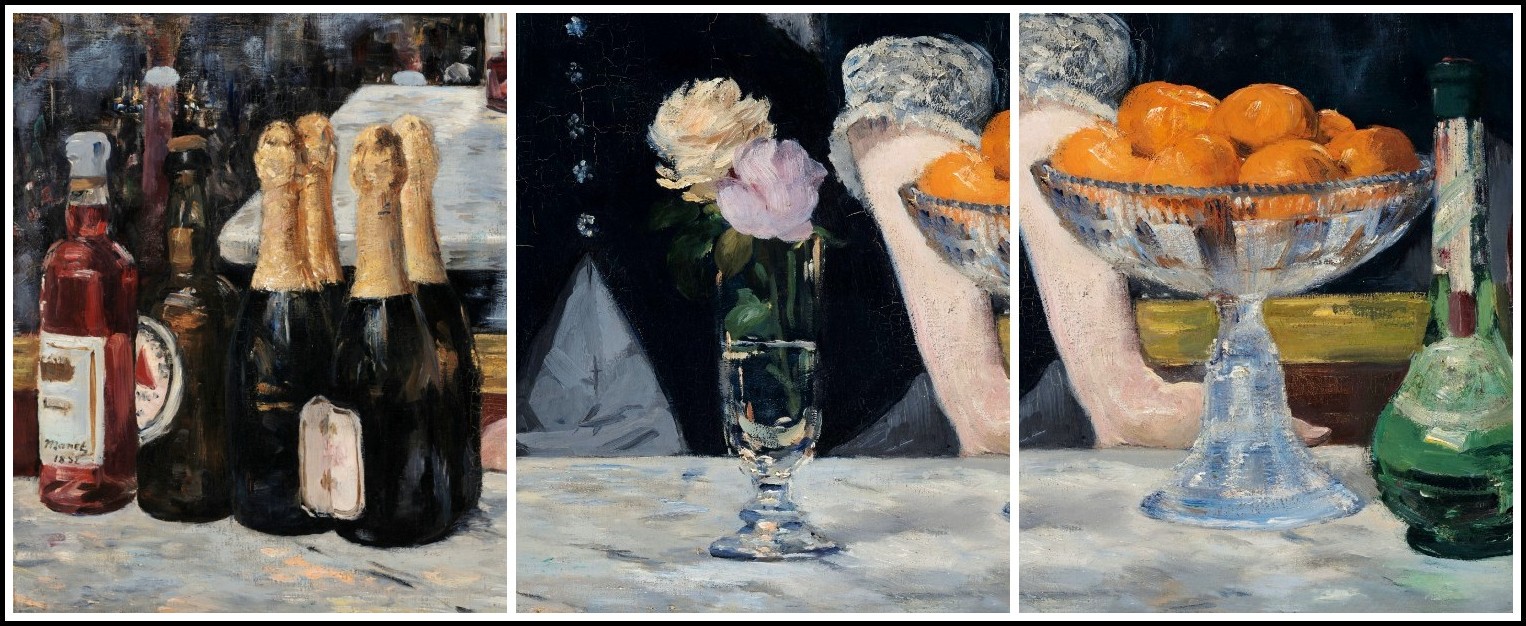
Manet, A Bar at the Folies-Bergère, 1881-82 (details)
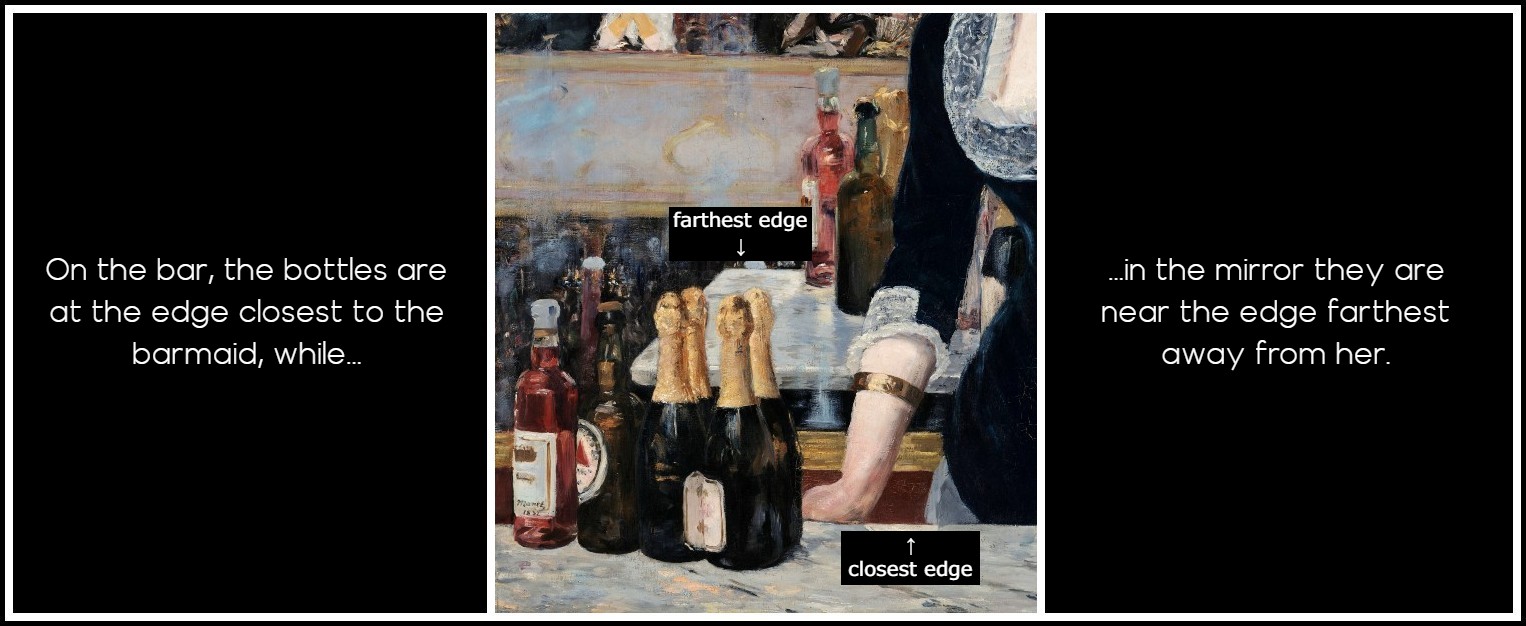
What we see on the bar, however, represented as ‘real,’ is only the beginning of what eventually becomes a dizzying array of disparities between what is seen inside and outside the mirror, and these are emblematically reinforced by the way the insistent perspective of the left edge of the bar thrusts our eye into the mirror, while outside the mirror the bar suggests an indefinite lateral extension. The mirror does not reflect exactly any of the real things we see before it and sometimes reverses our expectations. The reflections of all the bottles on the left side of the bar, for example, are depicted on its wrong edge. (On the bar, the bottles are at the edge closest to the barmaid, while in the mirror they are near the edge farthest away from her.)
Manet, A Bar at the Folies-Bergère, 1881-82 (detail)
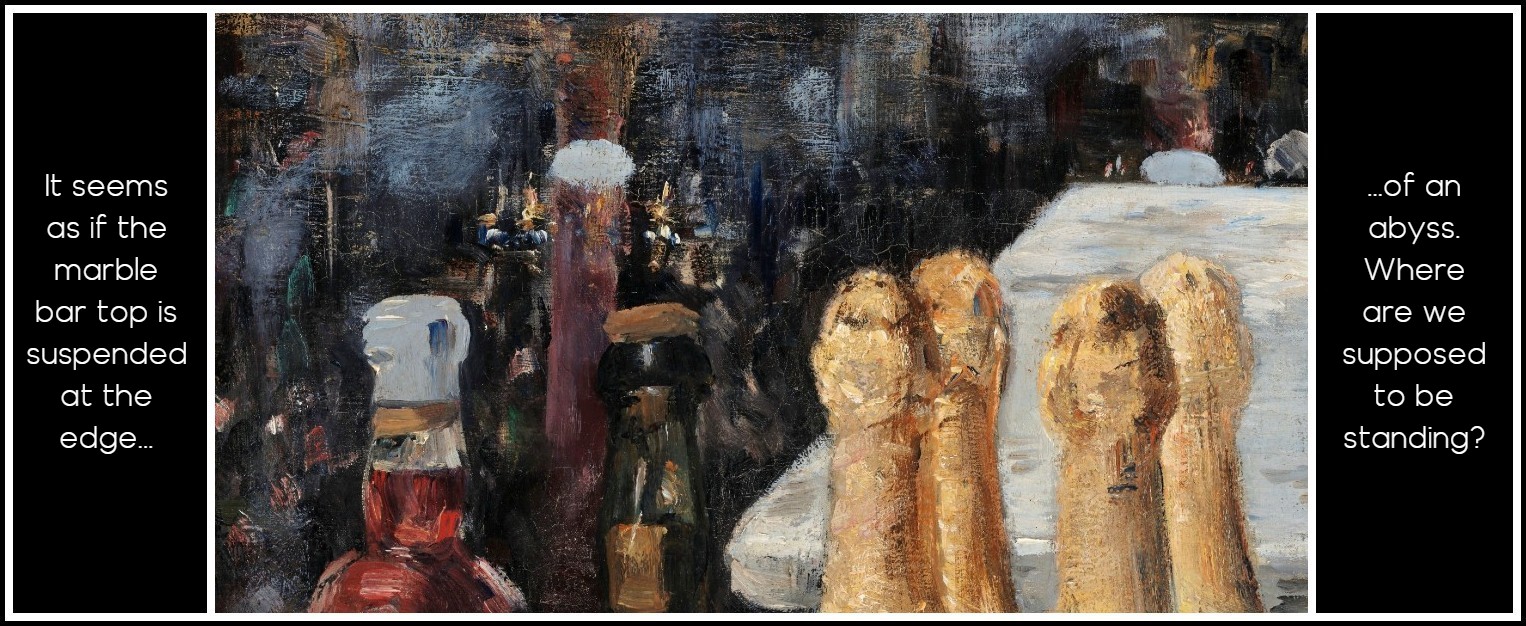
The whole world in the mirror seems to exist in another kind of space. At the lower left, for example, we see reflected the ground floor of the Folies, complete with columns, walls, and people. But amazingly, there is nothing between the edge of the bar and the precipitous drop down to the ground floor below—no balcony rail (such as we see across the way), no space to stand or walk. While in the actual Folies-Bergère, there would have been a good deal of space in front of such a bar—enough room for a promenade and a row or two of tables—in the painting it seems as if the marble bar top is suspended at the edge of an abyss. And if this is so, then where are we supposed to be standing?
Manet, A Bar at the Folies-Bergère, 1881-82 (detail)
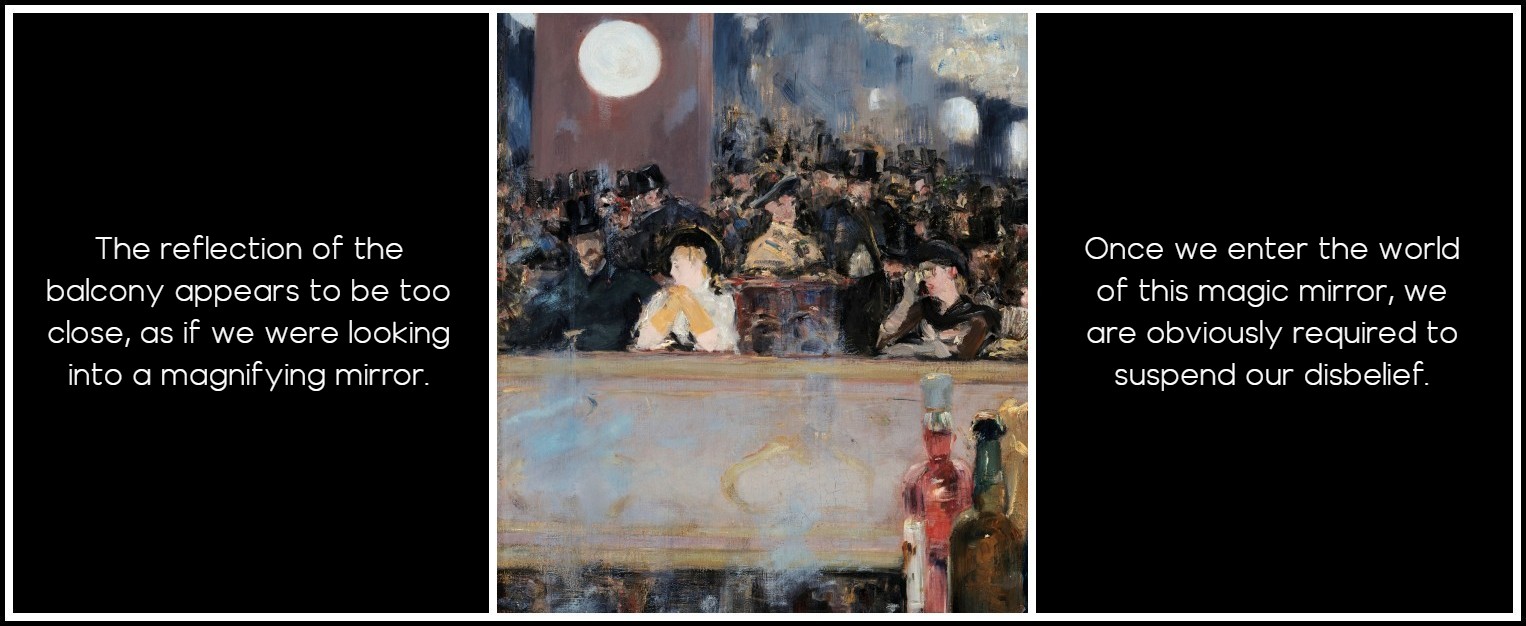
Our own supposed distance from the bar is relatively easy to determine. Judging by the 45 degree angle at which its left edge is reflected, and from the curves of the bottoms of the bottles, we would estimate our position to be directly in front of the woman and about two meters away from her. This is borne out by our view of the woman herself; we appear to see her full front and from a slight distance. But since there appears to be virtually no floor space in front of the bar, in order to see the woman and bar as we do we would have to be hovering in thin air. Once we have adjusted to these flagrantly incongruous elements, the fact that the reflection of the balcony across the way appears to be too close—as if we were looking into a magnifying mirror—has its own peculiar logic. For once we enter the world of this magic mirror, its lower limits indicated by a gilt frame and its surface insisted upon by irregular scumbles of blue-grey paint, we are obviously required to suspend our disbelief.
Manet, A Bar at the Folies-Bergère, 1881-82 (detail)
The far balcony is a curious mixture of precise details and general impressions. It, too, is full of mirrors, which seem to evoke an infinity of reflections, as suggested by the flickering images of globed lanterns and crystal chandeliers. Two of the women on the far balcony seem to be watching the stage show…
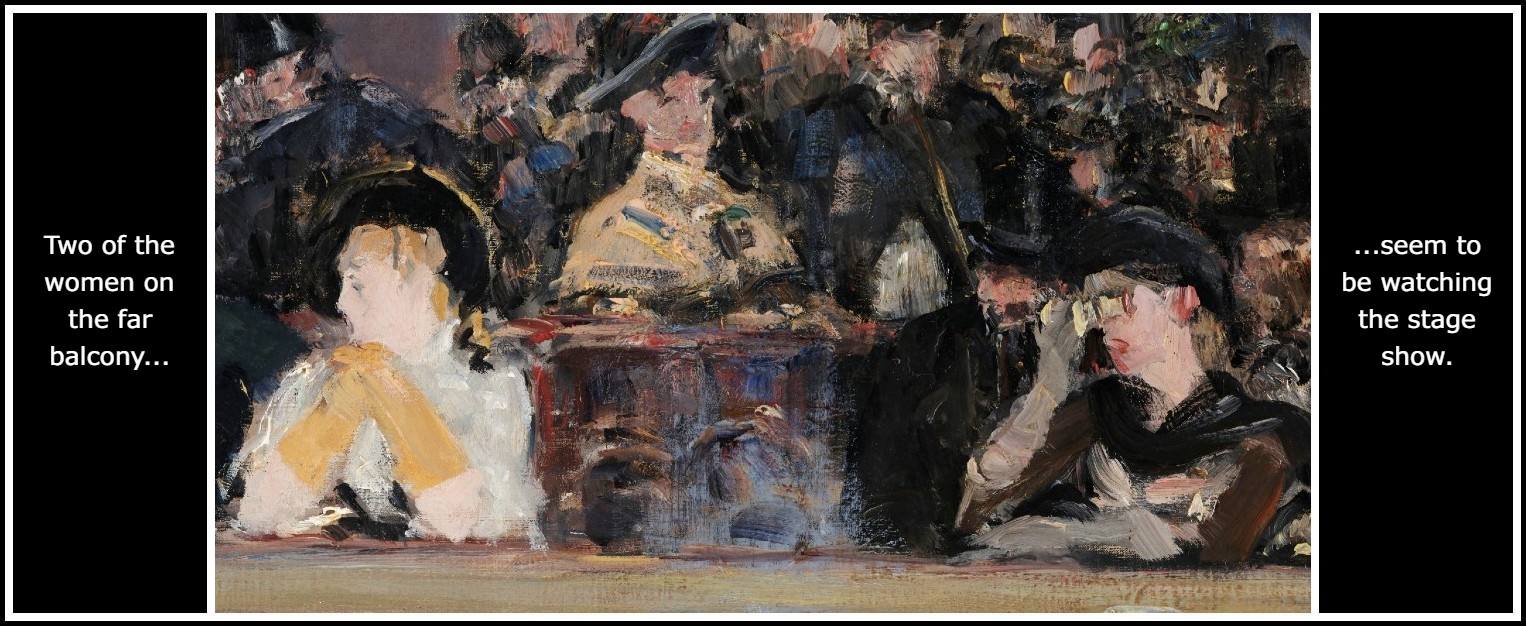
Manet, A Bar at the Folies-Bergère, 1881-82 (detail)
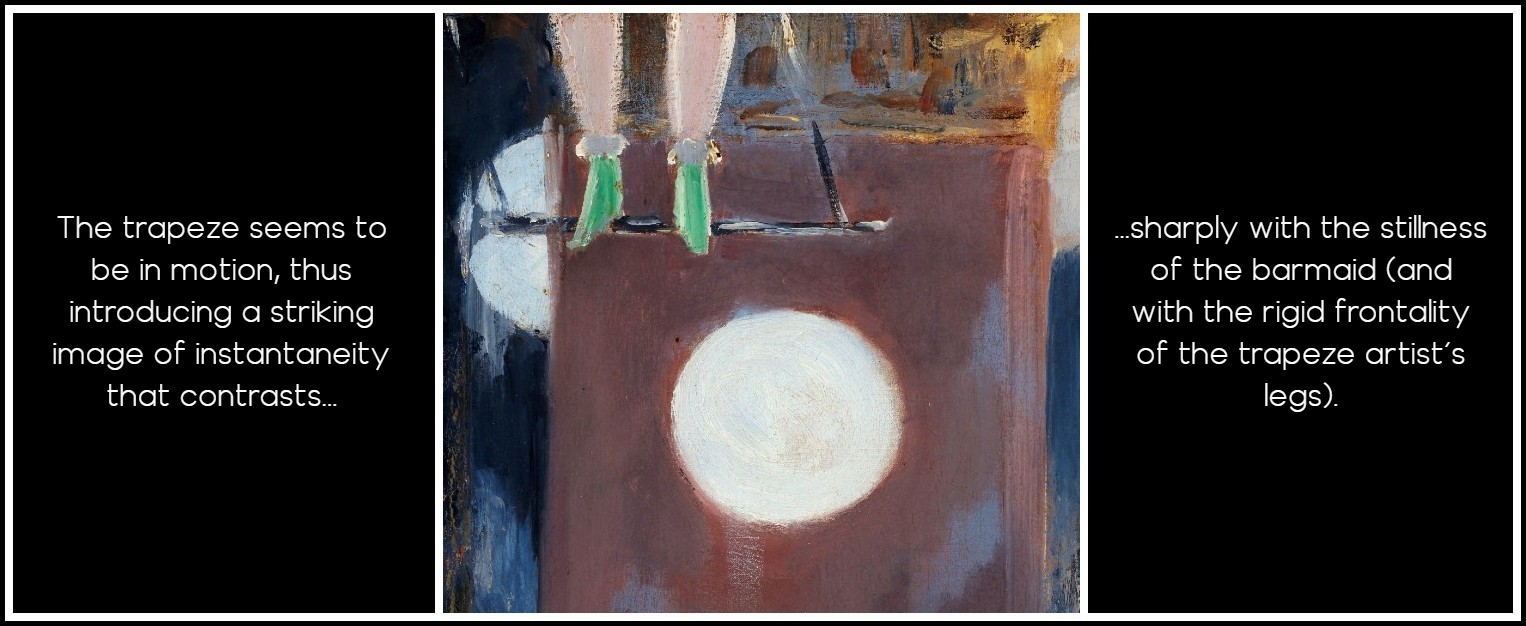
…which includes a trapeze artist whose calves and green slippers hover incongruously at the upper left. This, we now realize, may be an indirect reference to the incongruousness of our own position, for we too are hovering in mid-air. But even more important, the trapeze seems to be in motion, thus introducing a striking image of instantaneity that contrasts sharply with the stillness of the barmaid (and with the rigid frontality of the trapeze artist’s legs).
Manet, A Bar at the Folies-Bergère, 1881-82 (detail)
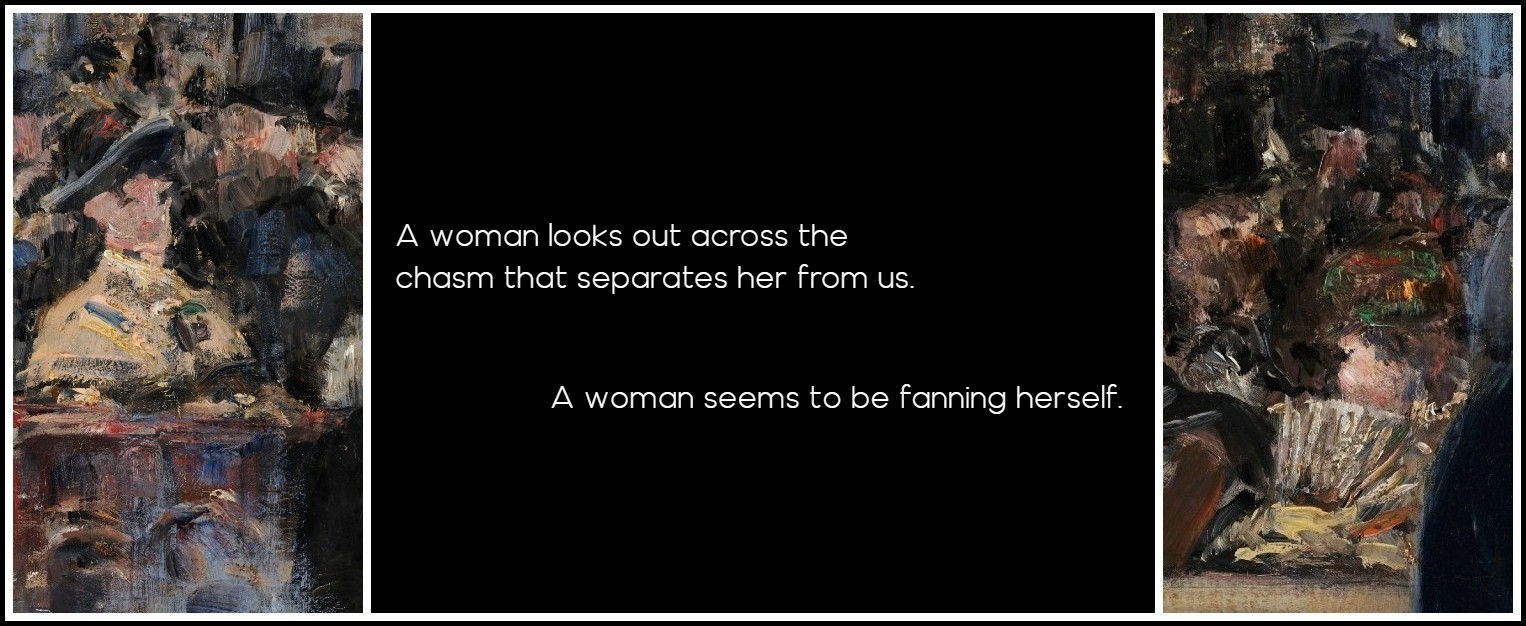
Another woman across the way seems to be fanning herself, while still another looks out across the chasm that separates that balcony from our own.
Manet, A Bar at the Folies-Bergère, 1881-82 (details)
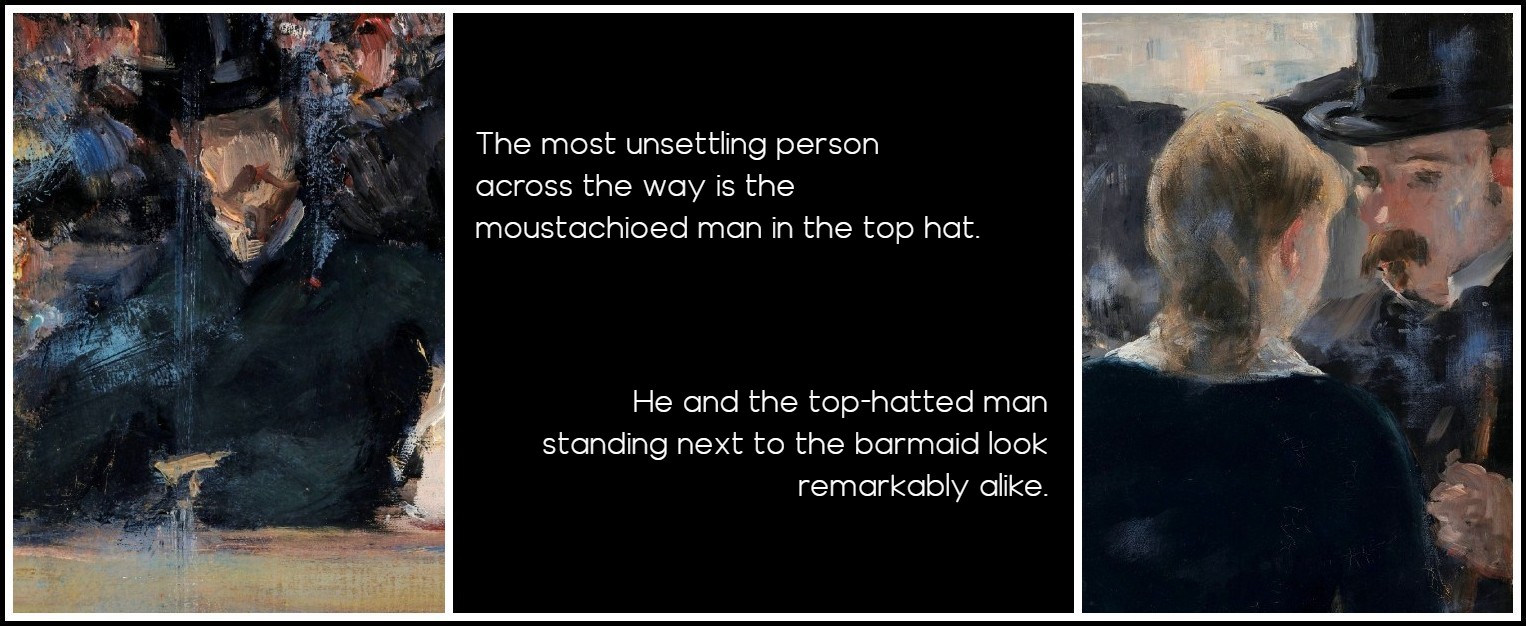
But the most unsettling person across the way is the moustachioed man in the top hat, seated in the front row of the balcony at the picture’s far left. He and the top-hatted man standing next to the barmaid look remarkably alike. And he seems to be looking directly at us; or, more to the point, directly at the barmaid.
Manet, A Bar at the Folies-Bergère, 1881-82 (details)
His gaze brings us back to our own contemplation of the barmaid. We notice that her hair falls over her forehead in low bangs and we have the impression that at the back of her head it is pulled back and up, perhaps in a compact bun or small ponytail. Around her neck she wears what appears to be a cameo suspended from a black ribbon. We can almost make out what is represented on the cameo, a miniature picture within the picture, but it remains indecipherable. In a curious way, it becomes a kind of sign for the questionable legibility of other things in the painting.
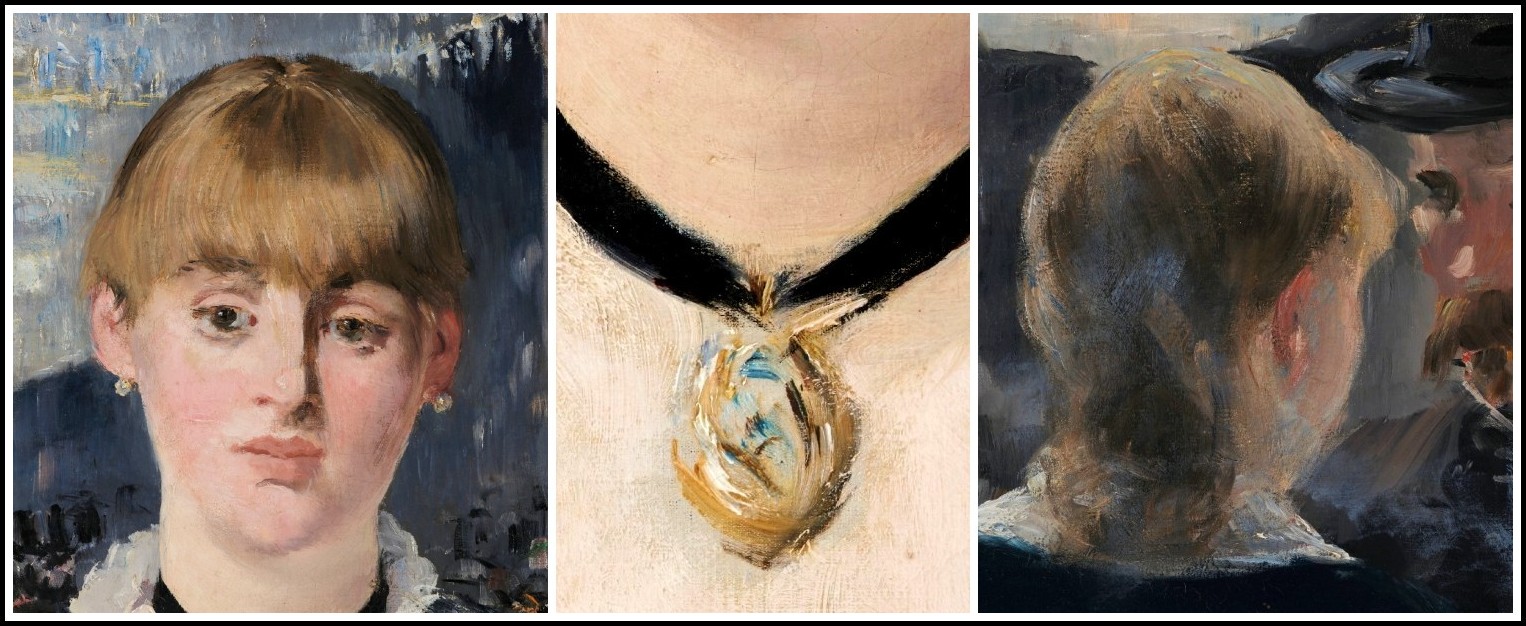
Manet, A Bar at the Folies-Bergère, 1881-82 (details)
Her bodice is cut low, bordered with lace and decorated with flowers which are rendered so impressionistically that it is difficult to say what they are: perhaps peonies or small roses.
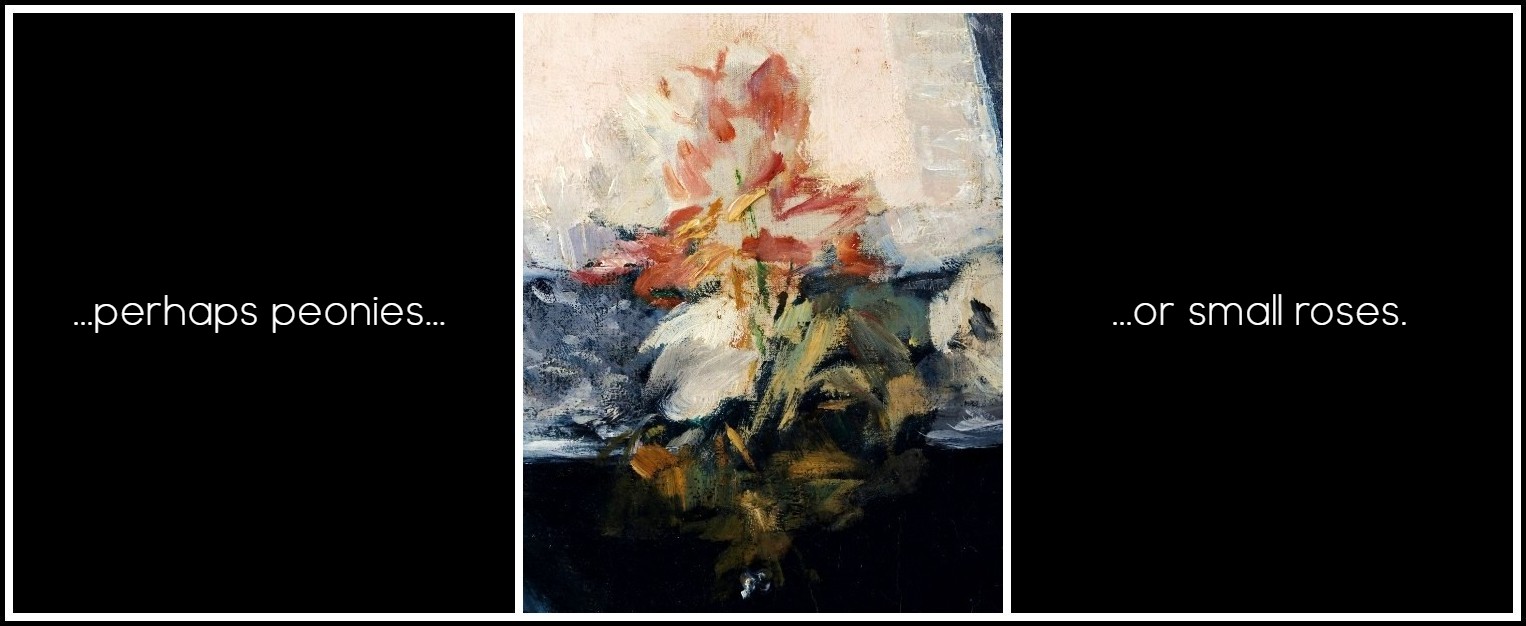
Manet, A Bar at the Folies-Bergère, 1881-82 (detail)
Just below this corsage a row of buttons leads our eye down the center of her close-fitting jacket, which is parted at the bottom to reveal a gray triangle bisected by the broken line of what appears to be a seam. And here a most unsettling thing happens. We realize that this triangular area very much resembles a pudendum—a reading that is reinforced by the insistent vertical of the seam. A kind of pudency almost blocks out this perception, but it is so obviously suggested, underlined as it were by a bold horizontal brushstroke, that it is difficult to ignore. This triangular shape is given emphasis by the way it rhymes with a number of others, including the large triangular shape of the woman herself.
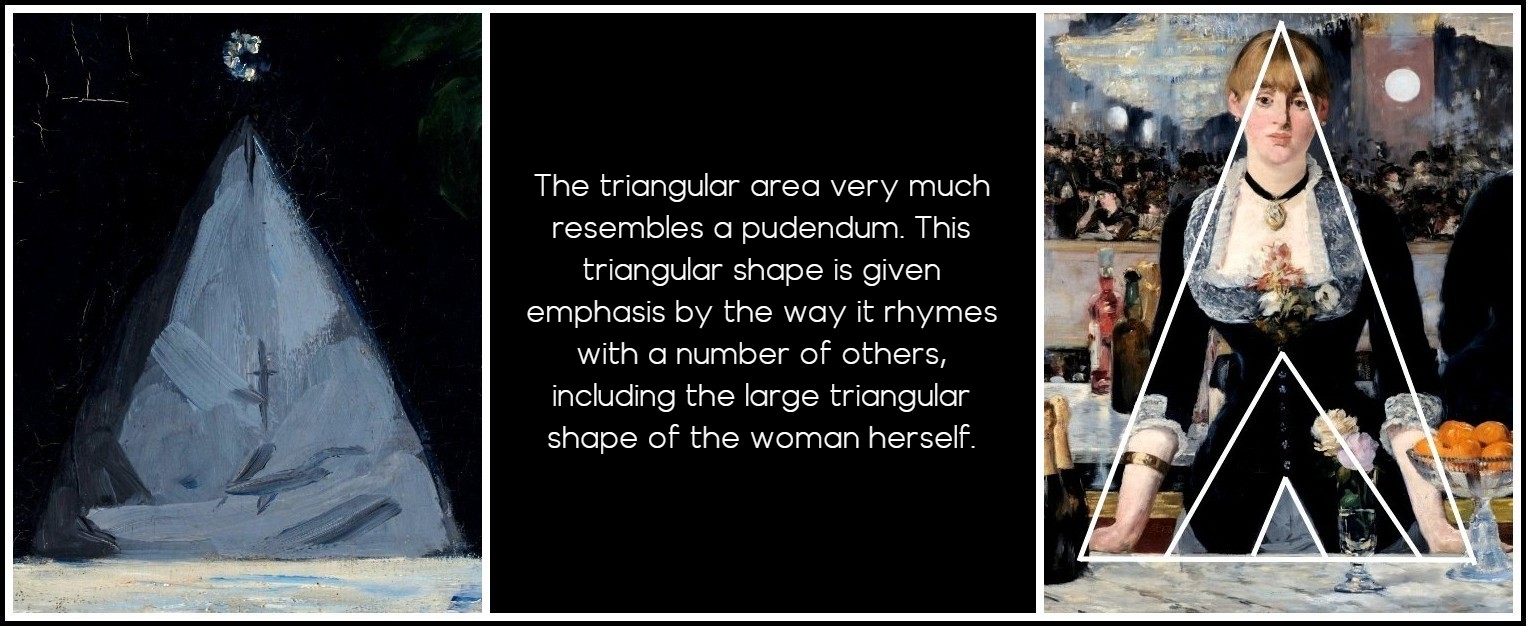
Manet, A Bar at the Folies-Bergère, 1881-82 (details)
The woman’s body is a crucial transitional point in the rightward warp of the image in the mirror, and by extension of the whole picture space. For on the right side of the painting the willful distortions of the mirror become even more pronounced. As our gaze moves toward her from the left, we are aware of a gradually increasing reflective distortion toward the right. At her body, this warping effect becomes intensified, and in the right side of the picture the intensity of the distortions increases radically.
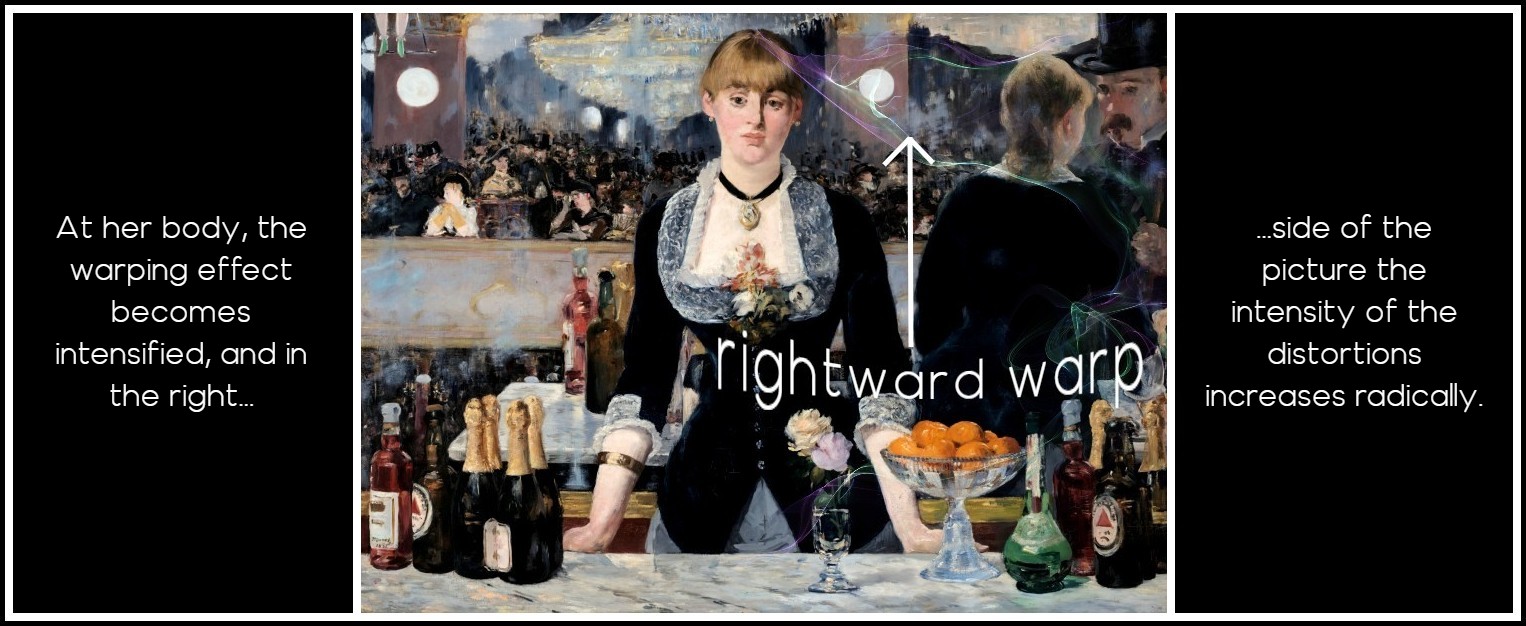
Manet, A Bar at the Folies-Bergère, 1881-82
The spatial incongruity of the glass of roses gives emphasis to this transitional passage; its flatness modulates the tangibility of the woman and prepares us for the spatial shift that occurs just to the right of her.
Manet, A Bar at the Folies-Bergère, 1881-82 (detail)
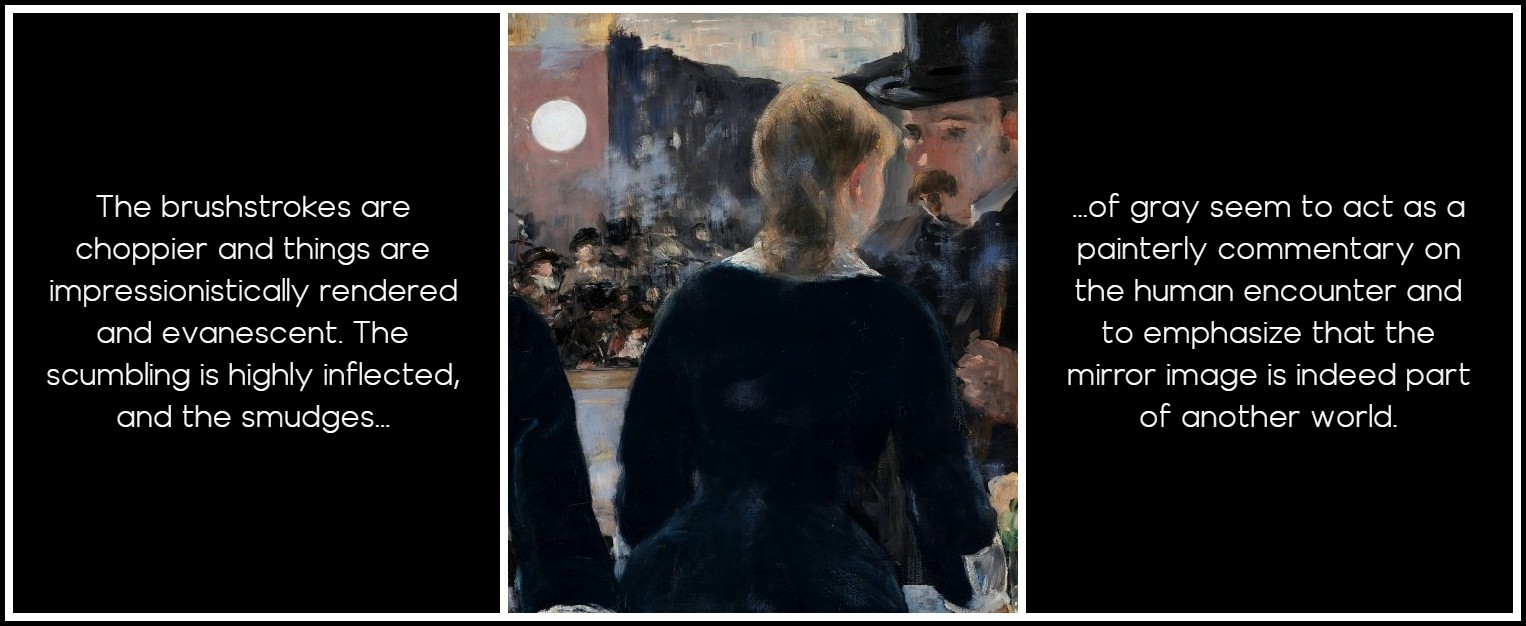
It is here, of course, that we find the most striking incongruity in the picture: the contrast between the image of the woman standing behind the bar and her reflection in the mirror, in which she is seen addressing a man. If the woman we face is erect, austere, and remote—an elaborately decorated object of desire, at once very much present but also disengaged—the woman whose back we see in the mirror seems to lean forward and she appears warmer, gentler, eager to please. She not only behaves differently, she actually looks different. She is plumper, her hair falls in unexpectedly casual wisps, she wears no earring, and her jacket appears undecorated and severe. And of course, even more obviously than with the bottles, her reflection is in the wrong place. It is at this point that we become aware of just how much the mirror reflection has been warping to the right, how intense the pressure of separation between the worlds outside and inside the mirror has been. Throughout the mirror image, the brushstrokes are choppier and things are more impressionistically rendered and more evanescent; but here this becomes especially exaggerated. The scumbling becomes most highly inflected here, and the smudges of gray seem to act as a painterly commentary on the human encounter and to emphasize that the mirror image is indeed part of another world. Thus when we confront the man who stands before the woman in the mirror, his presence is jarring but not entirely unexpected. We only wonder, where on earth is he standing after all? Our first impulse is to seek some simple physical explanation for this weird disparity Surely, the mirror must be curved, or set at an angle to the picture plane. But it is at precisely this point that the picture becomes even more insistent on the impossibility of our denying the impossible.
Manet, A Bar at the Folies-Bergère, 1881-82 (detail)
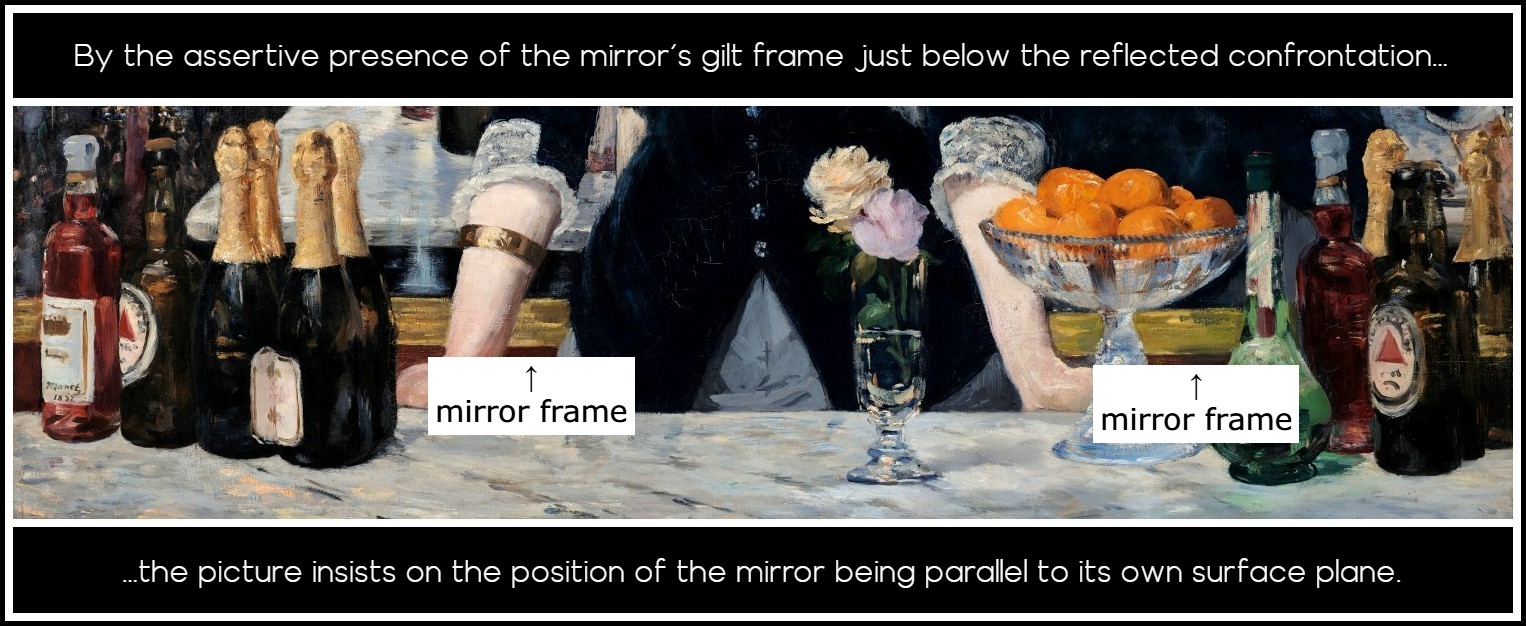
For it is at this point that the picture insists most strongly on the position of the mirror being parallel to its own surface plane, by the assertive presence of the mirror’s gilt frame just below the reflected confrontation. Although the frame here is slightly lower than it is on the left side of the painting, it is still clearly parallel to the edge of the bar and to the picture plane. Try as we may, there is no way for us to deny what is clearly meant to be undeniable.
Manet, A Bar at the Folies-Bergère, 1881-82 (detail)
CONTINUED IN PART 2 (SEE ‘RELATED POSTS’ BELOW)
MARA, MARIETTA: A LOVE STORY IN 77 BEDROOMS – READ THE FIRST CHAPTER
A literary novel by Richard Jonathan
RICHARD JONATHAN, ‘MARA, MARIETTA: A LOVE STORY IN 77 BEDROOMS’ — READ THE FIRST CHAPTER
AMAZON & APPLE BOOKS

RICHARD JONATHAN, ‘MARA, MARIETTA: A LOVE STORY IN 77 BEDROOMS’ | AMAZON PAPERBACK OR KINDLE

RICHARD JONATHAN, ‘MARA, MARIETTA: A LOVE STORY IN 77 BEDROOMS’ | APPLE iBOOK
MARA, MARIETTA: A LOVE STORY IN 77 BEDROOMS
A literary novel by Richard Jonathan

Available from AMAZON (paper | ebook) & iBOOKS, GOOGLE PLAY, KOBO & NOOK (see LINKS below)
RELATED POSTS IN THE MARA MARIETTA CULTURE BLOG
CLICK ON THE IMAGE TO GO TO THE POST


By Richard Jonathan | © Mara Marietta Culture Blog, 2025 | All rights reserved
Comments