Samuel Beckett
THIS EMPTIED HEART: WATT’S UNWELCOME HOME – PART 1
John Robert Keller
Posted by kind permission of John Robert Keller, MD M.Litt. PhD., psychoanalyst in private practice in Toronto.
From John Robert Keller, Samuel Beckett and the Primacy of Love (Manchester University Press, 2002) pp. 90-100
This study does not use any biographical information. It is a textual study.
Readers who wish to track the bibliographic references in this study and the page numbers for citations from the novel,
or to consult the notes, are referred to the book, which is (was?) available in an Open Edition version.
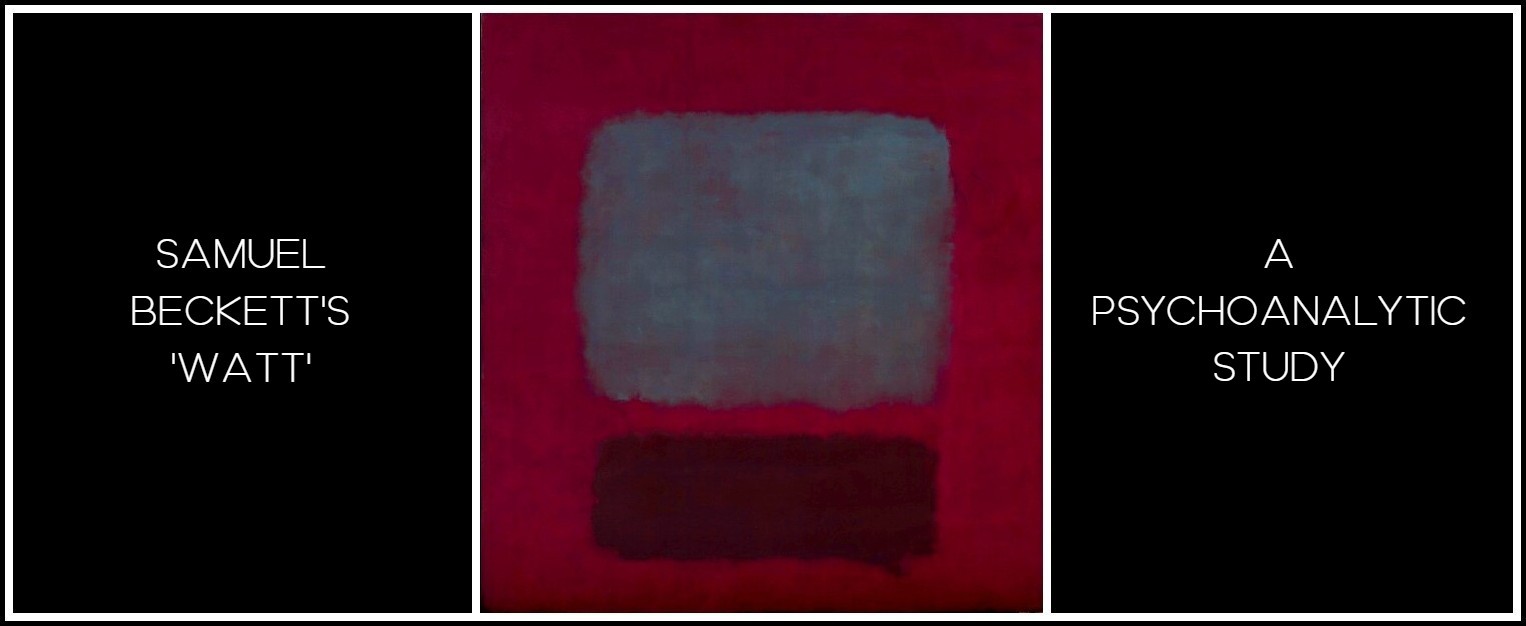
Mark Rothko, No. 37/19 (Slate Blue and Brown on Plum), 1958
I. INTRODUCTION
Beckett’s second published novel, Watt, tells the story of the title character’s journey to, stay in, and expulsion from the house of a Mr Knott, to which he has been drawn, or summoned, to act as a servant. After his stay in the house, Watt becomes psychotic, ending up in a sort of asylum. Sam, the narrator, befriends him there, but admits the text may not approximate reality, since he can trust neither Watt’s recollection (of his stay with Knott) nor his own recollection (of Watt’s telling). Central to the book is the ‘unknowability’ of Knott, and ‘unknowability’ permeates the work itself, creating confusion within the reader that reflects the emotional and cognitive state of the main character. Watt can be read as an attempted repair of an infantile-self hovering near psychic disintegration (represented by Watt) through reconnection to maternal aspects of Mr Knott, a powerful, early imago variously experienced as withholding, uninterested and sadistic. The novel explores early experience within the Autistic Contiguous and Paranoid Schizoid Positions, and there is a fluidity of imagos. At times, Watt appears predominantly in the maternal role, depleted through endless, unconditional loving of his master, while Knott acts as a devouring, insatiable infant, reflecting the condensed, confused experience of the narrative-self in its relation to an internal mother felt to be unreachable.
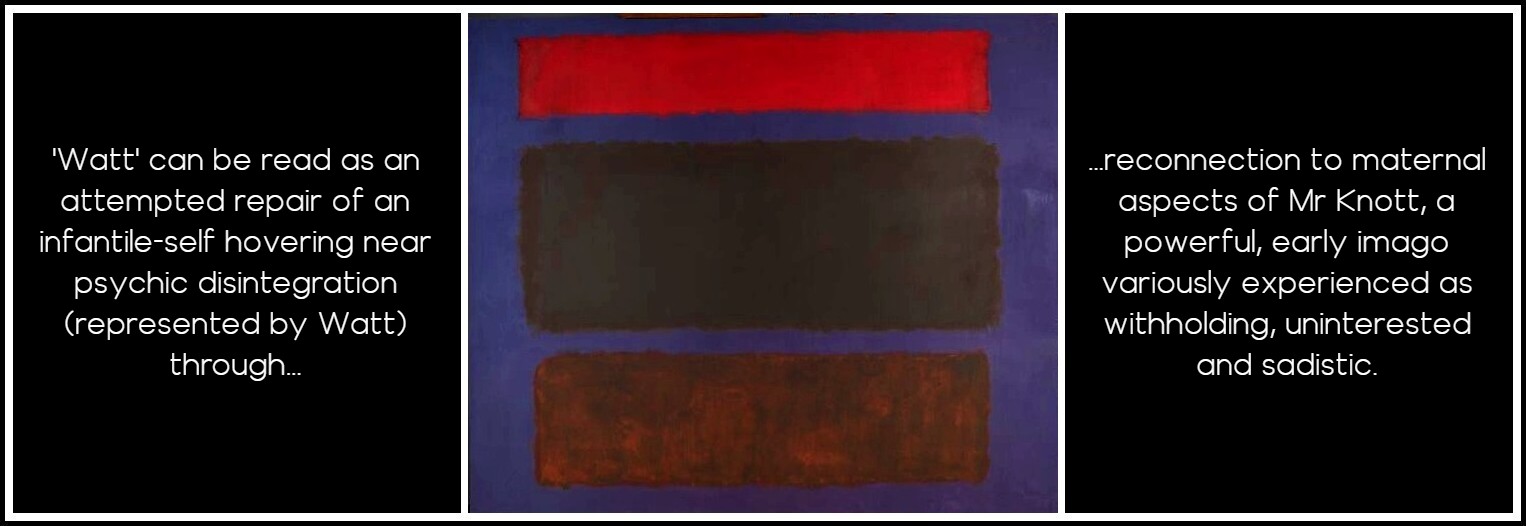
Mark Rothko, No. 16, 1960
Hoefer views Watt’s journey to Knott as an epistemological adventure doomed to failure because ‘there is no logical formulation to explain Mr Knott’. She believes Watt’s inability to access a reality that underlies mere surface phenomenon causes his ultimate psychological deterioration. This reading suggests the underlying cause of Watt’s lack of cognitive, exploratory ‘tools’ is a primary disconnection from Knott-as-mother, who cannot be explained rationally because he cannot be reached emotionally. Watt becomes fixed within early positions of human experience that are before language and reason. Webb and Fletcher also emphasize the theme of the impossibility of all knowledge. Fletcher feels Watt’s journey to Knott is primarily religious but, instead of salvation, he finds ‘a negative God, the great Nothing of which nothing can be predicated’. Again, it is Watt’s failed relationship with Knott-as-mother, the infantile-self’s ‘personal God’, that explains this ‘impossibility of all knowledge’. Engagement with the mother’s body/mind engenders knowledge, as the security that comes through her containing love reduces the anxiety of psychic disintegration, allowing for an inner ‘peace’ that makes incorporation of the whole world possible. Federman views the novel as ‘a narrative experiment which exploits the inadequacy of language, reason, and logic to reveal the failure of fiction as a means of apprehending the reality of the world’. He believes the core of the novel, Watt’s journey to, and stay in, Knott’s house, becomes a metaphor for the fictional process itself. This notion is central to this reading, which views the novel as a reflection of the underlying narrative-self and its own struggle to maintain an enduring, whole relationship with another (through fantasy), including using the fiction/fantasy itself as a container of anxiety. Watt is a close study of the experience of early fantasy, the primal fiction that connects the infant to the world that is both mother and self.
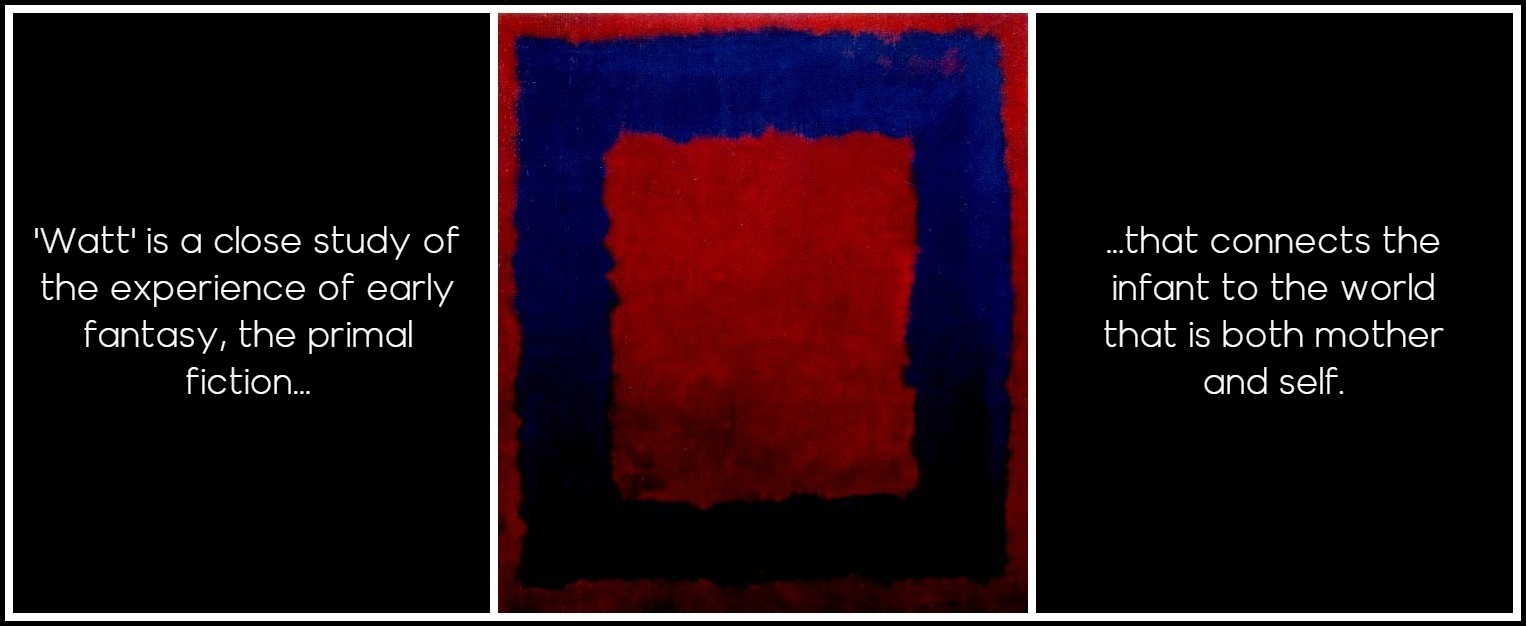
Mark Rothko, Seagram Mural Sketch, 1958
Barnard sees in all of Beckett a powerful expression of the subjective experiences of schizophrenia. His recognition of the core importance of Watt’s relationship to Knott upon meaning, is close to the present study. Meares also examines the experience of schizophrenia in Watt, particularly the relationship between anxiety and indecision, Watt’s tendency to become overwhelmed by stimuli, and the loss of personal boundaries. Levy notes that some readings of Watt tend to see it as an expression of the failure of Logical Positivism, or as an exploration of the implications of the structuralist tenet that reality is linguistic: ‘Watt’s predicament as a kind of post-structuralist yearning for a place where naive faith in the power of language to explain external phenomenon can once more be satisfied’. He quotes Bernal: ‘There is nothing as disturbing in modern literature as Watt’s nostalgic desire again to seize language and prevent it from failing him’. Levy also points out the importance of Watt’s being verified by the other: ‘If he is not witnessed, or feels ignored by a witness, then he has no assurance of his relation to the outside world’, and also feels the narrator attempts to express a subjective experience of nothingness. The present study also recognizes the centrality of authentic language, which depends upon an enduring bond to the mother-as-primal listener, and Levy’s recognition of the importance of ‘witnessing’ for self-development is further elaborated. Finally, there is nothing as disturbing in modern literature as Watt’s failure to connect with the mother, and the consequence of this failure to establish the most central, enduring bond of the human condition—a fractured foundation of the child-self.
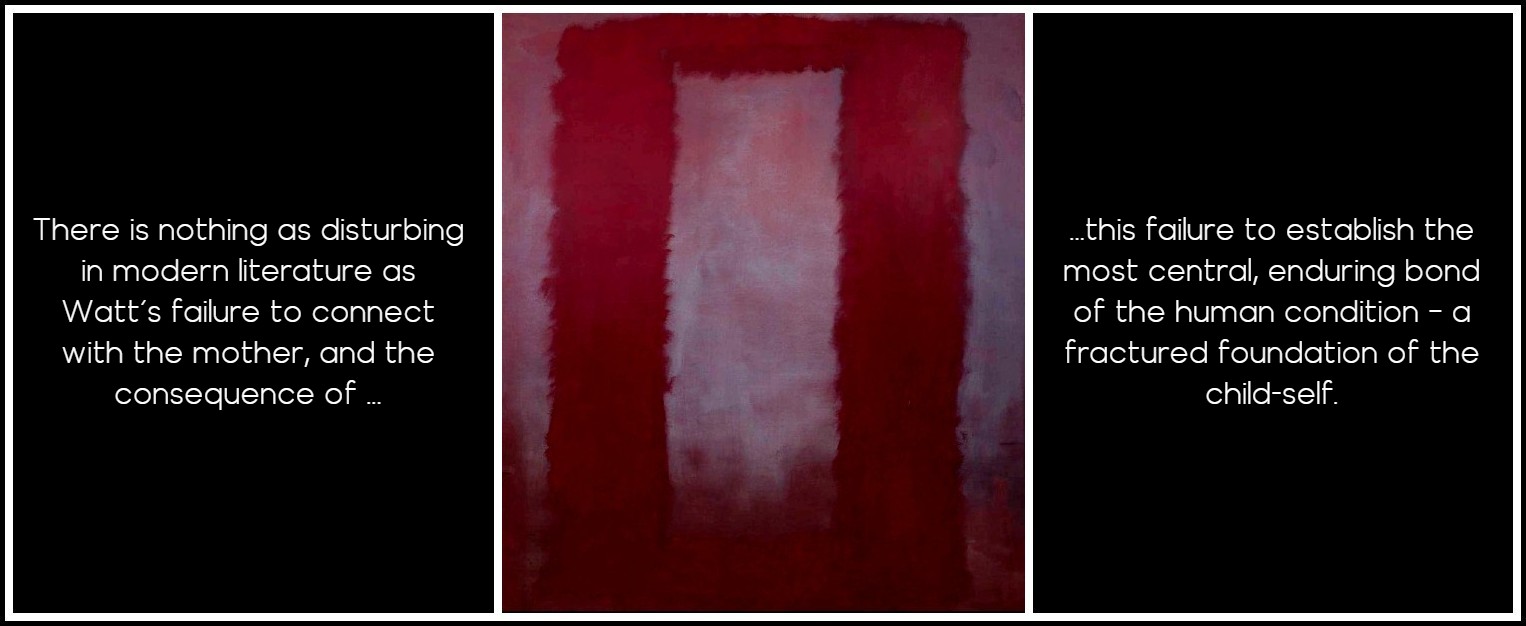
Mark Rothko, Red on Maroon, 1959
Hill feels the novel probes the ‘precarious effects of a larger network of inconsequence, arbitrary coincidence, and self-defeating discontinuity’, laying more emphasis on the nature of the relationship between Watt and Knott as underlying the novel’s fragmentation and loss of meaning: ‘The figure of Knott has the effect on Watt of demolishing the already fragile structure on his identity as a subject of filiation’. Knott is seen as a ‘figure of paternal indifference, engulfment and indeterminacy, apathy, and invisibility’, ‘the still core of indifference at the centre of the novel’. Hill also stresses Watt’s yearning for fusion with Knott and his anxiety about engulfment, seeing this dichotomy as important to Beckett’s work in general. This study develops these points within the concept of the mother–infant matrix, and the fusion/engulfment dichotomy forms a pole of the unwitnessed infant’s early schizoid dilemma. Finally, in his study of psychoanalytical ‘mythologies’ surrounding Beckett, Baker notes aspects of the novel’s ‘infant subtext’, such as orality and abandonment. He describes some of the birth-imagery in the novel, and of the Knott-experience writes: ‘On one level it involves leaving the mystical realm, but also suggests a weaning-like Fall from oceanic “belonging”, and a loss of primordial fusion’. The present study develops and integrates these notions into the overarching thesis concerning the narrative-self’s struggle to connect to the mother. It hopes to correct Baker’s suggestion that ‘the schizoid confusion of Watt far exceeds the major myths of psychoanalysis’.
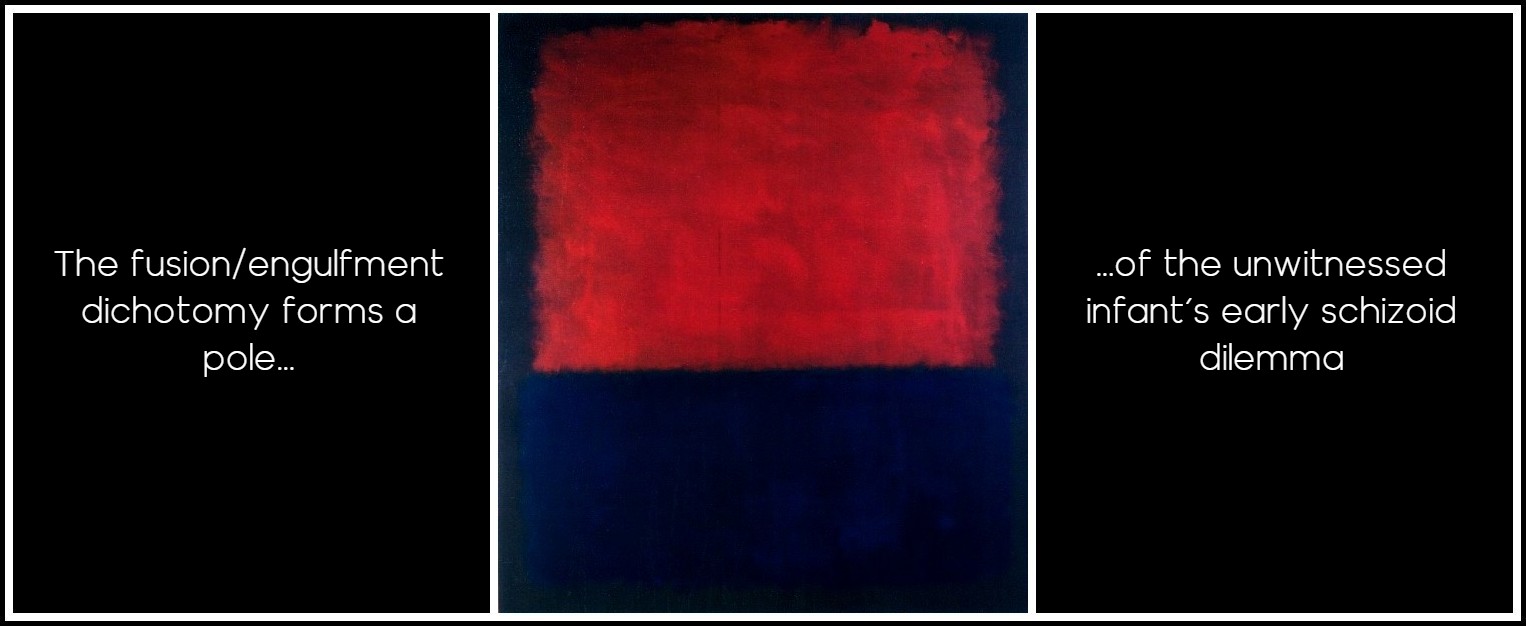
Mark Rothko, No. 207, 1961
The nature of Watt’s relationship to Knott is the central organizing principle of the novel; it is a relationship predicated upon emotional unavailability, neglect, and disregard. This novel explores the inter-relationship between the child’s experience of the mother’s love and its ability to understand the world; Watt cannot know Knott because Knott-as-mother’s inability to love disables the possibility of knowledge, of both persons and the world. It is the early knowledge of the mother’s body, being lovingly contained within her mind, that would ‘bring Watt the peace’, the freedom from early disintegration anxieties that allows self-integration. The entire text, like a psychoanalytical session or a dream, reveals the predominant themes of abandonment depression, psychosis, yearning for connection and love. The text contains the narrative-self’s internal state and re-enacts foundational experiences with early objects. The work is not pathological, but explores aspects of early human experience. Watt’s final disintegration is perhaps as eloquent a cry as there can be for an appreciation of the importance of those aspects of human life—connection, respect, love—upon which all else depends. This study looks at early scenes that reflect failed psychic birth: the actual birth of Larry Nixon, and Watt’s own arrival into the fiction. Next, there is a detailed reading of Arsene’s speech to Watt (as the former prepares to leave Knott’s house for the last time) that suggests early anxiety situations. The next section examines Watt’s stay in the house, with particular emphasis on the emotional (non-)connection between the two characters, and Watt’s reaction to this failure in primary attachment. Finally, there is discussion of various symbols suggesting early maternal failure, of disruptions in nurturing, and of scenes that describe Watt’s need for containment by substitute maternal figures.
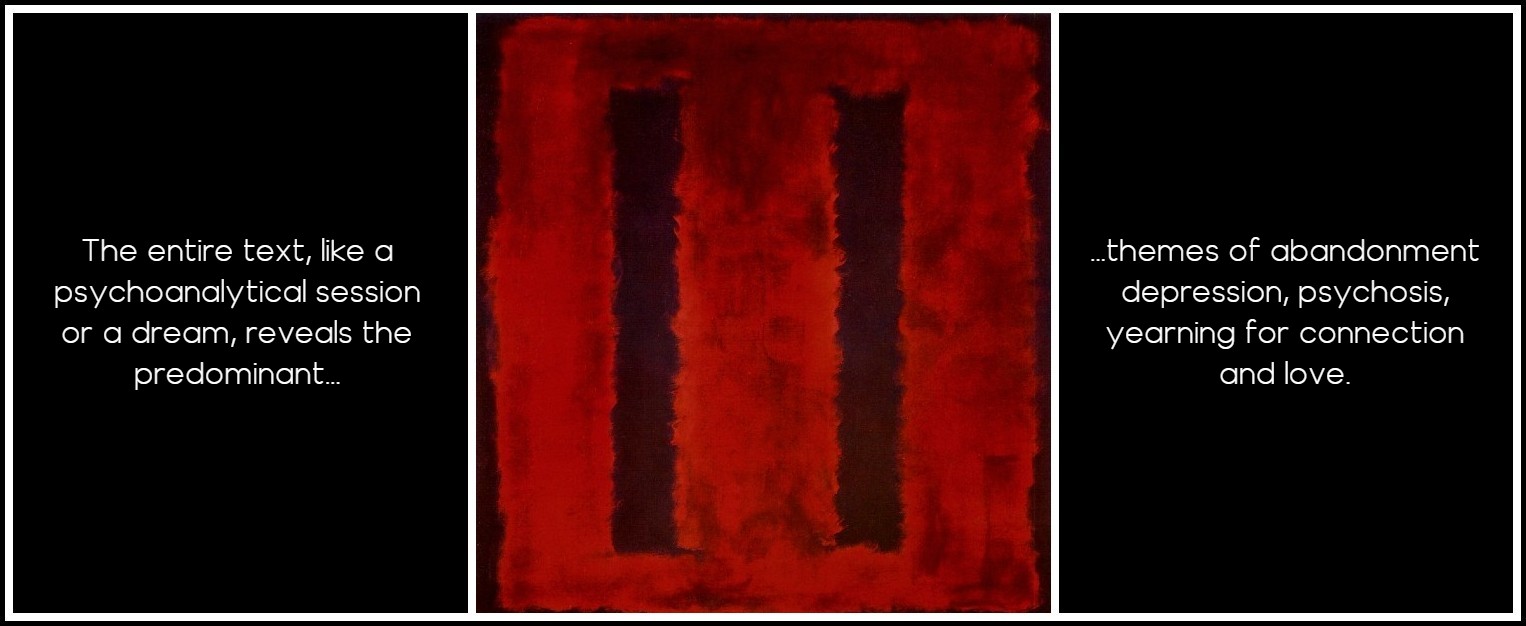
Mark Rothko, Seagram Mural Sketch, 1958
II. AN UNBORN SELF
A central scene in the novel occurs before Watt appears, and embodies an experience at the emotional core of the oeuvre. Mr Hackett is conversing with the Nixons, an elderly couple, and the lady describes the birth of her son, Larry, during a dinner party she was hosting: ‘The first mouthful of duck had barely passed her lips’, when she feels the child move inside her. She continues to ‘eat, drink, and make light conversation’, while no ‘trace of this dollar appears on her face’. Labour begins ‘with the coffee and liquors’, and when the men retire to the billiard-room, she climbs up the stairs ‘on her hands and knees’, in ‘anguish’ and ‘three minutes later she was a mother’. The birth is accomplished without assistance (the cord is ‘severed’ with her teeth), the emotion she describes is ‘one of relief, of great relief’ and, as the child is separated from her body, there is a feeling of ‘riddance’. This vignette can be a satire of Irish middle-class mores, and certainly one can understand the woman’s sense of relief at having independently survived a difficult ordeal. There is a darker side to Larry’s birth, however: the father seems almost unaware of his wife’s pregnancy, certainly of the labour, and the atmosphere is one of emotional mis-attunement, abandonment, and neglect. The scene is devoid of joy; the mother seems emotionally disconnected from both the experience of birth and from her newborn infant. There is little to suggest the ‘oneness’ of Winnicott’s mother-child dyad, of the attunement so vital to the child’s developing sense of self. The entire bonding period is bypassed, the mother returns to her duties as hostess immediately after the birth ‘leading the infant by the hand’. The text’s associative movement continues to reflect a state of abandonment and its genesis in early dyadic ruptures—the passage that soon follows recounts Mr Hackett’s fall off a ladder, at the age of one:
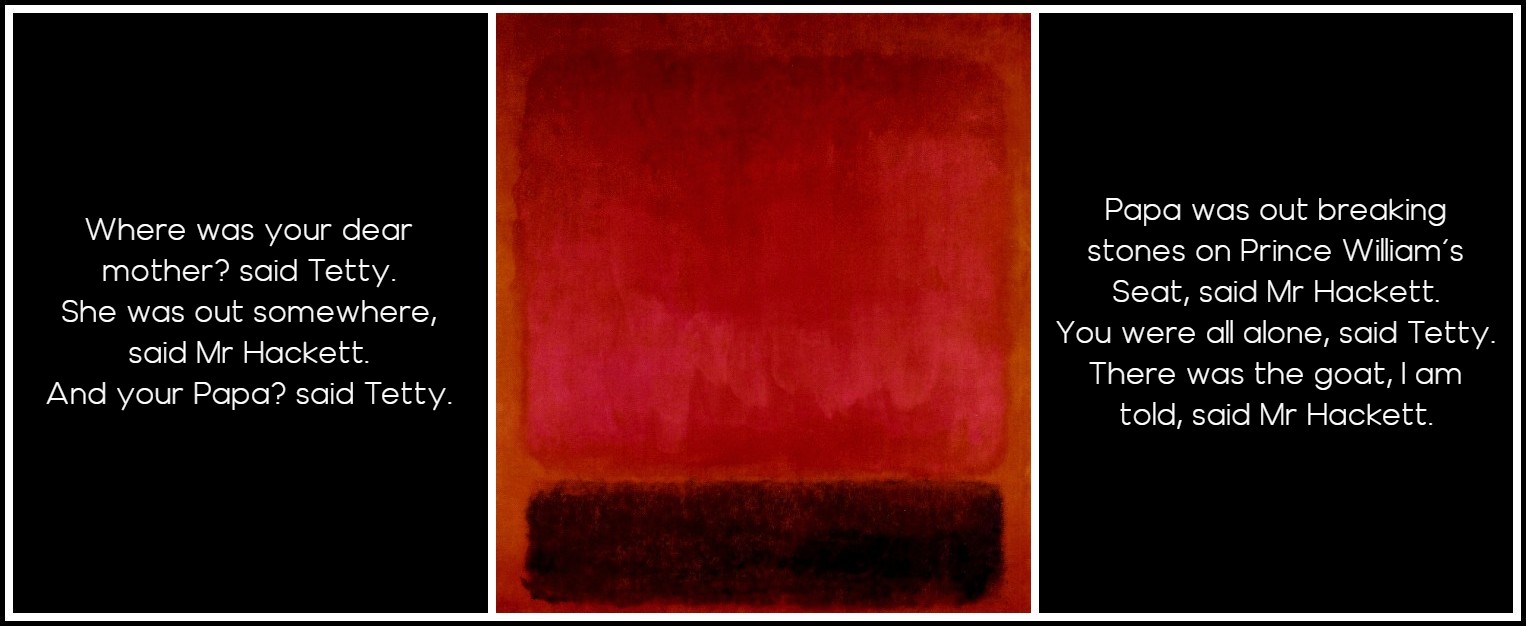
Mark Rothko, Untitled, 1967
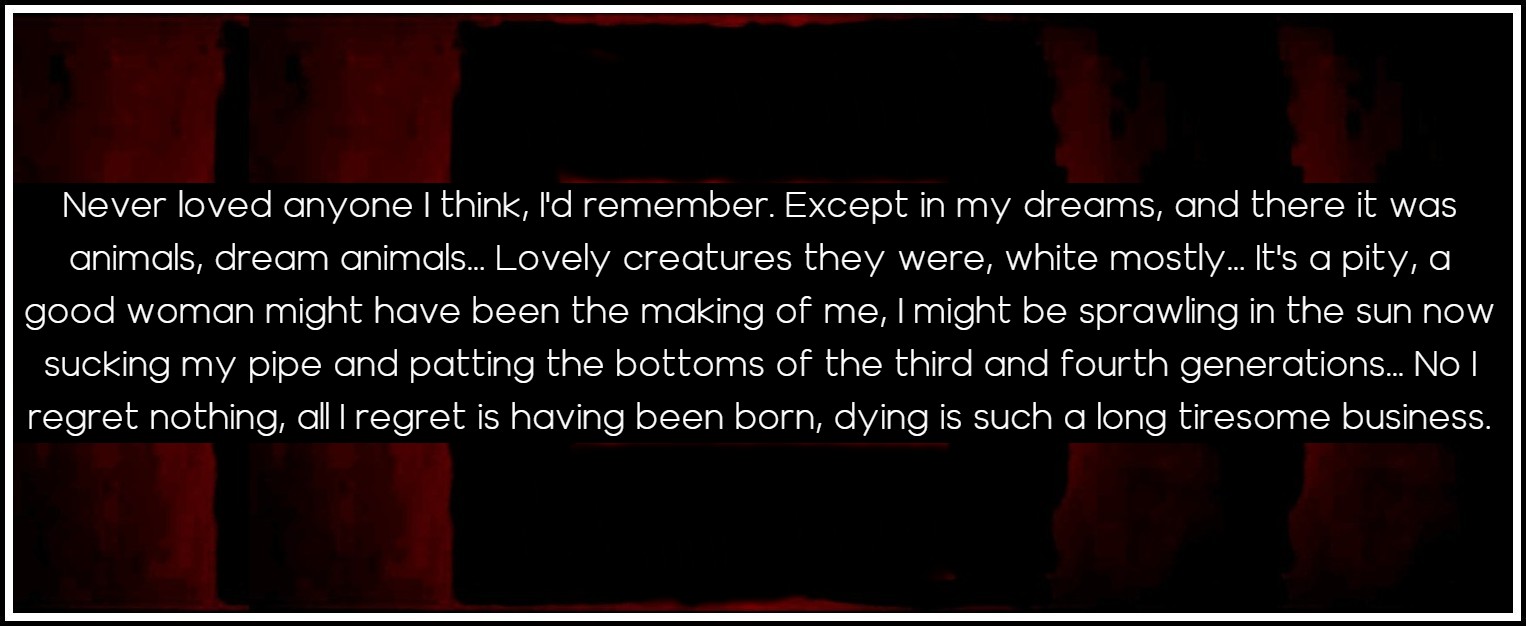
The associations and imagery remain centred on primary abandonment, as an emotional layering of neglect and loneliness develops. The child’s only witness, a goat, highlights the yearning for connection, and this image is often repeated within the oeuvre when characters attempt to attach to animals. The decrepit hero of ‘The End’, for example, survives on cow’s milk while resting in self-exile from the world, and the narrator of ‘From An Abandoned Work’ says:
Samuel Beckett, Watt, 1953
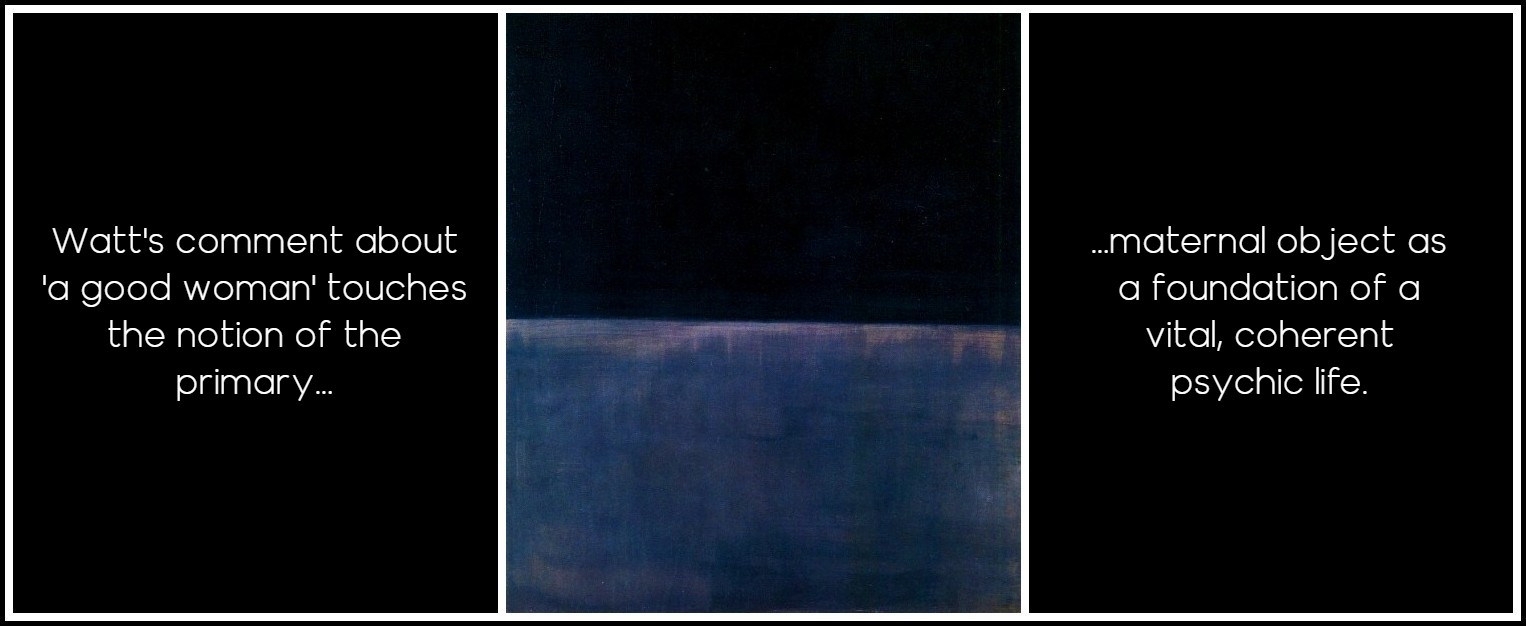
A feeling of primary disconnection manifests as an alienation from other persons, as the narrator can only dream of love with fantasy animals. There is a quick dismissal of his poignant, momentary realization that a loving relationship within a family may have allowed him to prosper. His comment about ‘a good woman’ touches the notion of the primary maternal object as a foundation of a vital, coherent psychic life. This is reflected in imagery suggestive of early experience (i.e. the ‘sucking’ of the pipe and the affectionate touching of children). In other words, within his fantasy he reveals the absence of a good maternal object, explaining his turn to internal, dream animals for love (as a replacement for a loving internal family). His belief that life is futile is a direct consequence of his difficulty in connecting to good external others, something which would require an internal template he is lacking.
Mark Rothko, Black on Gray, 1970
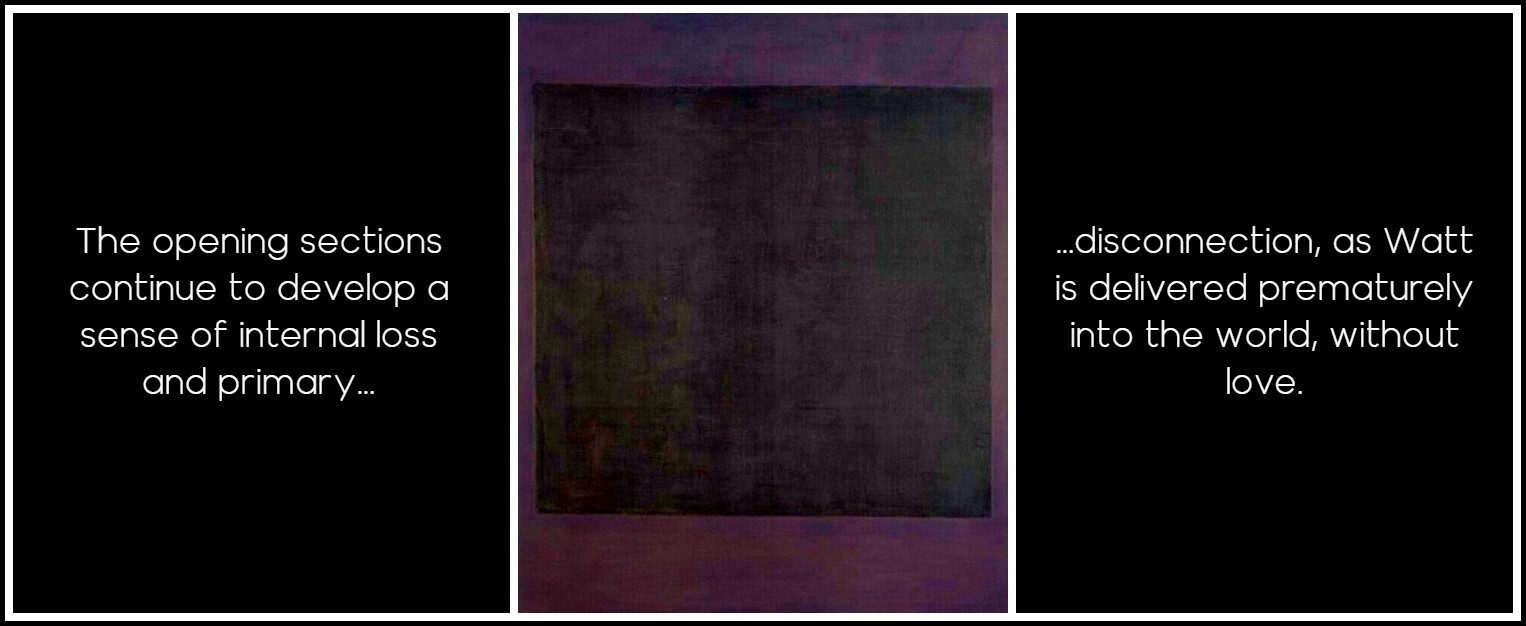
The opening sections continue to develop a sense of internal loss and primary disconnection, as Watt is delivered prematurely into the world, without love, experiencing a metaphorical birth by being forced to leave a tram before reaching his destination. Ejected by an angry conductor, he is left standing ‘motionless, a solitary figure’, a near stillbirth abandoned by the slowly receding lights of a tram that is a womb of (m)otherness. Immediately the underlying feeling-state of the narrative-self (and its objectification in the subjective world of Watt) begins to merge, and a dissociative aura develops. Described as an ‘it’, Watt is ‘scarcely to be distinguished from the dim wall behind’, and he can be viewed here as an embryonic, genderless self with no discernible human features, awaiting a mother (Knott) who will help to ‘create’ him. Indeed, Mrs Hackett is unsure of his gender, and Mr Hackett is ‘not sure that it was not a parcel, a carpet for example, or a roll of tarpaulin’. A mist of ‘unknowability’ is cast, Mr Hackett ‘does not know when he had been so intrigued’ feeling an unusual ‘sensation’ which he does not think he can ‘bear for more than twenty minutes, or half an hour’.
Mark Rothko, No. 7, 1964
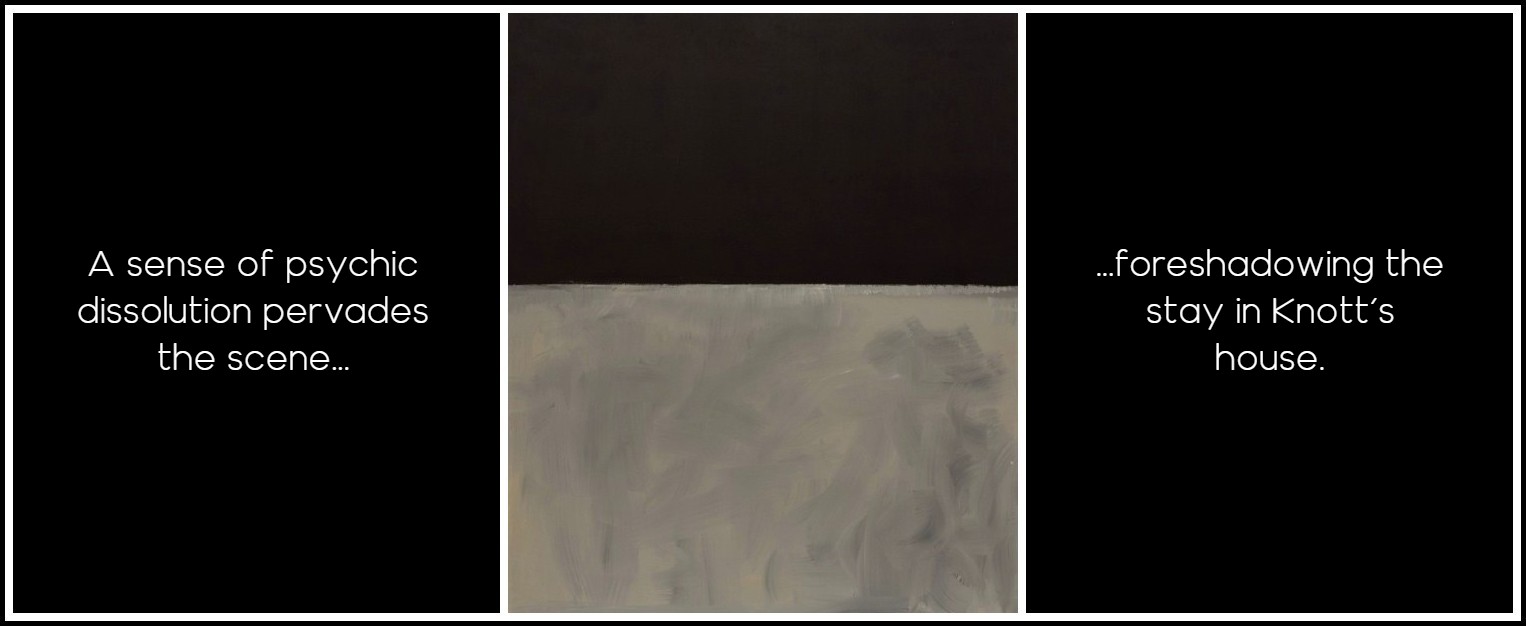
A sense of psychic dissolution pervades the scene, foreshadowing the stay in Knott’s house, and there is an urgency for Hackett to ‘know’ Watt just as Watt will feel an urgency to ‘know’ Knott. The boundary between objects and persons dissolves as Mr Nixon says to Hackett: ‘When I see him, or think of him, I think of you, and when I see you, or think of you, I think of him’. To Hackett’s urgent clamouring for information Nixon pleads ignorance, ‘nothing is known’, despite apparently knowing (in the weak sense) Watt all his life. This inchoate sense of ‘knowing’ Watt is reflected by Nixon’s statement that he does not remember their first meeting ‘any more than I remember meeting my father’, as we enter a pre-symbolic realm that exists before identity and conscious memory, where the earliest subjectivity is formed.
Mark Rothko, Untitled, 1969-70
After leaving the group, Watt continues towards his destination via the railroad terminus, and the sense of disconnection from a loving primary object is highlighted by the song Watt ‘hears’, which appears in the addenda: ‘With all our heart breathe head awhile darkly apart the air exile of ended smile of ending care darkly awhile the exile air’. This suggests a primary rupture, the infant’s whole world, merged with its mother (‘all our heart’) lasting only too briefly before separation (‘darkly apart’) into a world of loveless exile (‘of ended smile’), and a schizoid withdrawal that reflects the primal loss (‘of ending care’). The result of this loveless, darkened internal exile is Watt’s withdrawn passivity, apparent when, after falling over a milk can, he does not pick up his hat because he does not feel free to do so ‘until the porter had finished abusing him’. He survives by remaining inoffensive, adopting a submissive demeanour in situations where he stumbles into others’ affairs. This is characteristic of many Beckettian figures—Molloy’s bumbling with the police, the travails of ‘she’ in Not I, or of O in Film, all of whom, like Watt, seem content to circumvent society in the hope of existing in peace on the periphery.
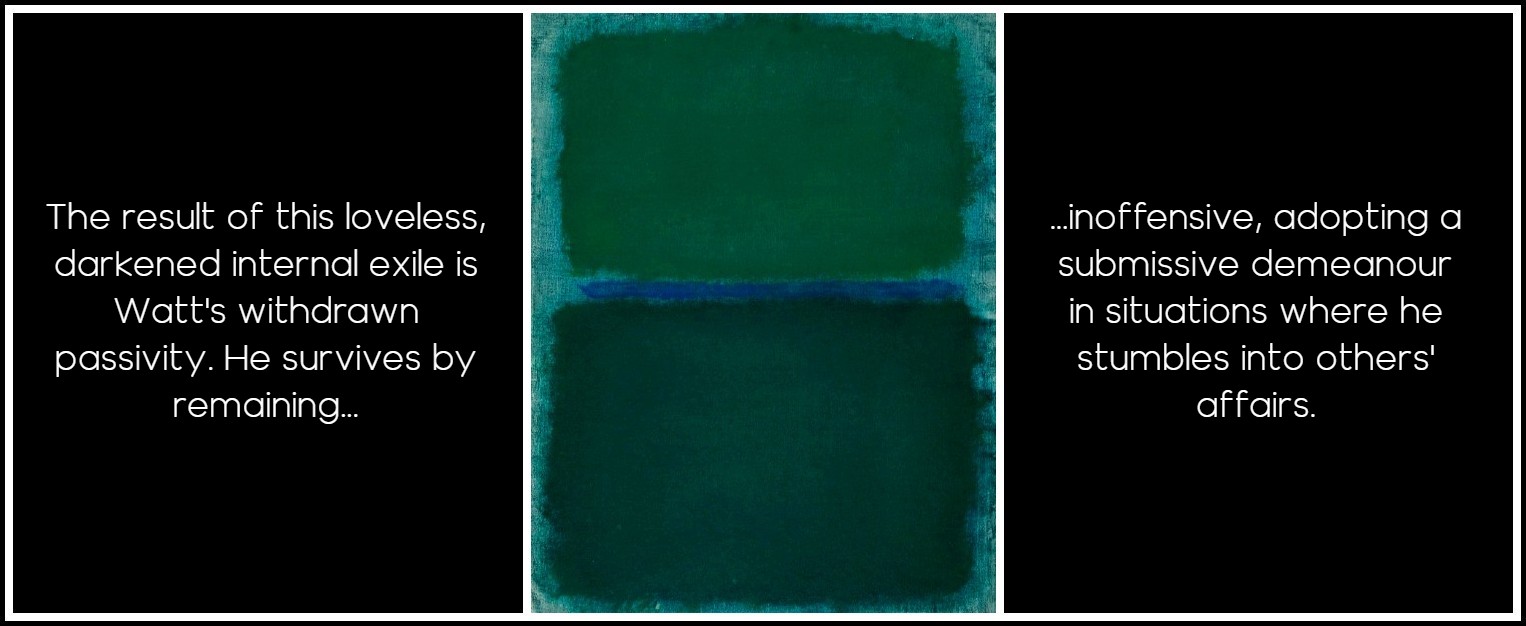
Mark Rothko, Untitled, 1967
Watt’s socialization is actually severely disturbed: ‘He had watched people smile and thought he understood how it was done, but some little thing was lacking, and people who saw it for the first time, and most people who saw it saw it for the first time, were sometimes in doubt as to what expression exactly was intended. To many it seemed a simple sucking of the teeth’. He is unable to articulate one of the earliest gestures, a smile, a biologically wired reaction essential both to early mother and child bonding and to the growth of the child’s sense of personhood. His inability to smile with authenticity suggests an enduring disruption in his ability to be with others in any meaningful way, reflecting the depth of his disconnection from the mother. His tooth-sucking implies a regression to early stages of mother–infant relating—Watt seems to be self-nurturing by sucking at a nipple within his own body, and it also parodies the ‘sucking reflex’ of the newborn that communicates hunger.
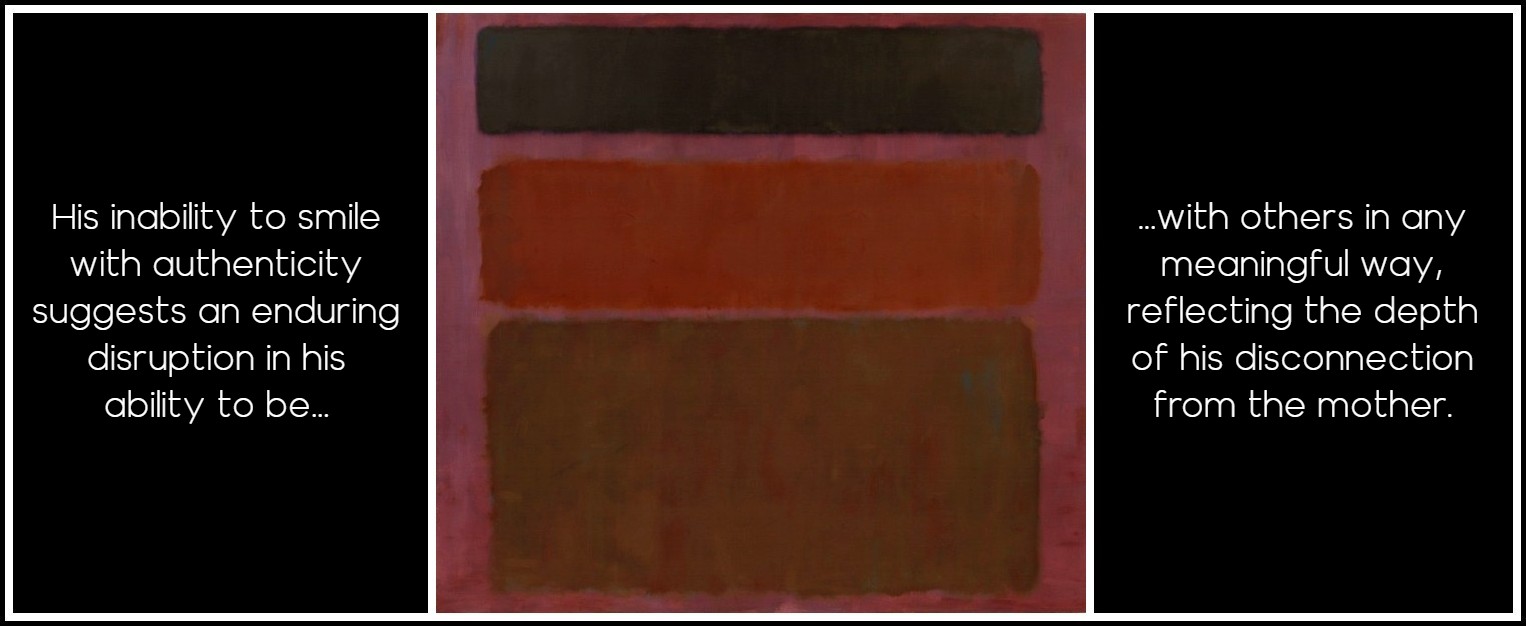
Mark Rothko, No. 16 (Red Brown and Black), 1958
Given this legacy, Watt’s journey becomes a search for an emotional connection he has never known. On the train, the aura of reality begins to shift—no longer aware of the other passengers, Watt withdraws into an internal world: ‘He heard nothing of this, because of other voices, singing, crying, stating, murmuring, things unintelligible, in his ear’. In concert with this, the narrator presents the first of a number of long ruminative descriptions that appear in the book: Now these voices, sometimes they sang only, and sometimes they cried only, and sometimes they stated only, and sometimes they murmured only, and sometimes they sang and cried, and sometimes they sang and stated, and sometimes they sang and murmured [etc.]. These types of passage sometimes run for several pages, providing complete, logical enumerations of the possible arrangements of the qualities of an object or of a situation. In this particular passage, it is the nature of the voices that Watt hears—later examples will be Mr Knott’s appearance, the arrangement of his furniture, and the ways five committee members can look at each other in sequence. These passages create within the reader a sense of the closed intrapsychic space central both to Watt’s experience and to the text’s underlying emotional reality, as words themselves run on obsessively. This experience is often explored in the oeuvre as, for example, in Molloy’s description of his ‘sucking stones’: And the first thing I hit upon was that I might do better to transfer the stones four by four, instead of one by one, that is to say, during the sucking, to take the three stones remaining in the right pocket of my greatcoat and replace them by the four in the right pocket of my trousers, and these by the four in the left pocket of my greatcoat, plus the one, as soon as I had finished sucking it, which was in my mouth.
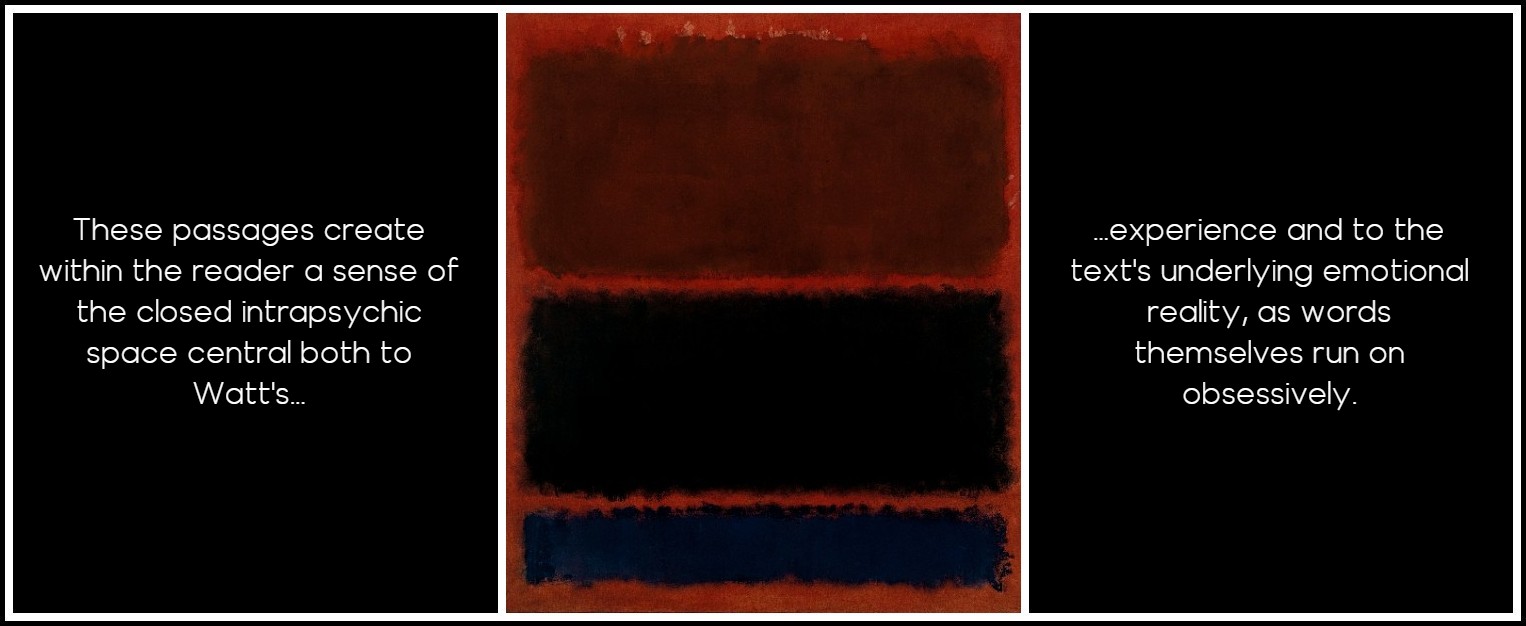
Mark Rothko, No. 24 (Brown, Black, and Blue), 1958
These passages have an autistic sense, reflecting the experience of certain patients described by Tustin; they prefigure Beckett’s continuing exploration of autistic aspects of early experience by using words as ‘autistic objects’, actual objects used by a child to soothe himself, replacing real interactions with persons. A child may grip a hard toy car, becoming entirely absorbed in this sensation to the exclusion of all external reality, and Tustin suggests these objects soothe by sparing the child the reality of separation from the primary love object. These children, oblivious to the world, have suffered a traumatic, early disruption in their core, primary psychological bond to the mother: A sad situation which often seems to be the starting place for autistic withdrawal, is a mother and baby who experience bodily separateness from each other as being torn violently apart and wounded. Pathological autistic objects seem to staunch the ‘bleeding’ by blocking the wound. They also seem to plug the gap between the couple so that bodily separateness is not experienced.
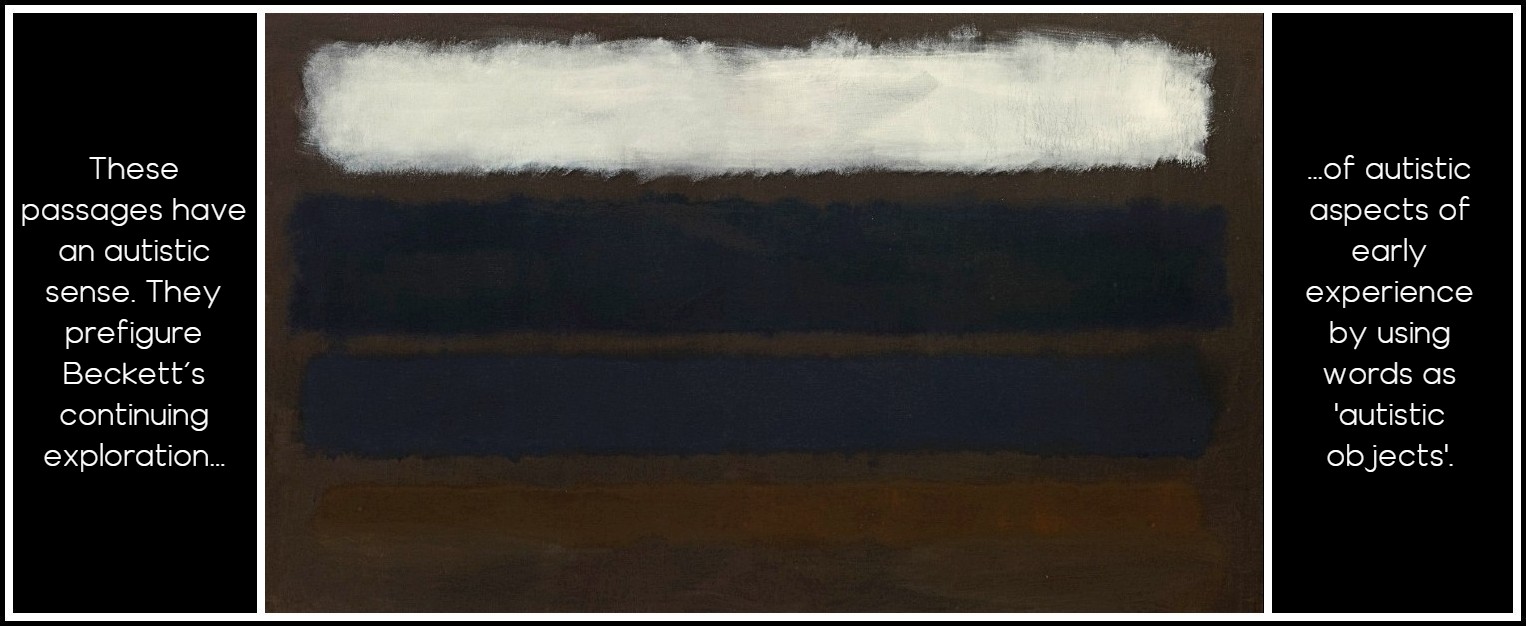
Mark Rothko, No. 14 (Horizontals, White over Darks), 1961
In Beckett’s work, birth is often represented as a painful, violent separation, and when viewed metaphorically as premature psychological birth, these images become extremely potent. The heroine of Not I, ‘out into the world too soon’ with ‘no love’, Hamm relying on his ‘old stauncher’ as he suffers the realization that Clov-as-mother (or as child) may be gone (i.e. he suffers a ‘bleeding’ loss of part of himself), and Watt, born from the tram a station too soon, and forced to leave Knott’s house without the emotional sustenance he seeks, all retreat into the autistic world Tustin explores clinically. In this light, Molloy’s stones are deeply symbolic objects that, like Watt’s tooth-sucking, allow him to reconnect to early experiences of feeding from the mother’s body. The autistic object also serves a protective function, creating the illusion of an impenetrable barrier to the external world, and words themselves can be used in this fashion. In an analytical setting, a patient may present a barrage of words, often impenetrable and without pause; words function as things, without emotional referent, and block awareness of the separate analyst/mother by shrouding the self in a protective ‘second skin’.
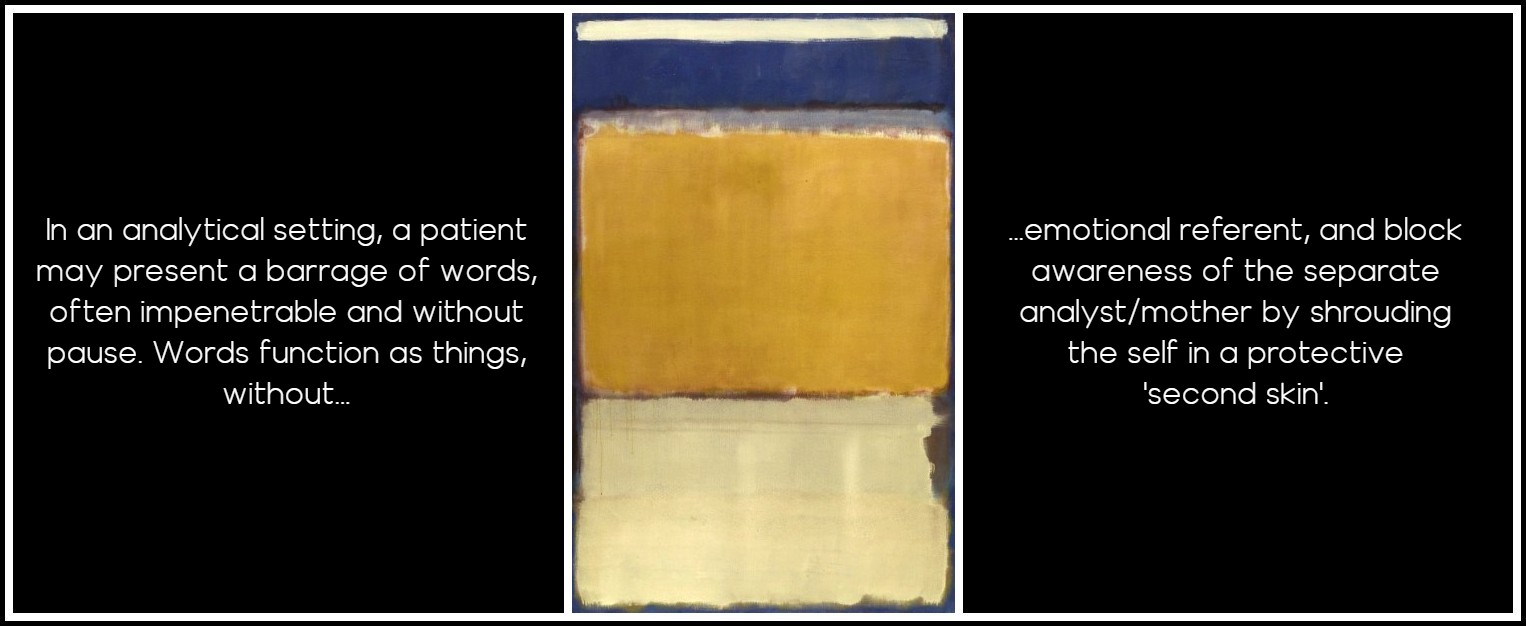
Mark Rothko, No. 10, 1950
In Watt, Beckett begins to explore this aspect of words, as the long, obsessional passages reflect Watt’s own experience, enclosing him in a self-contained world. The effect is shared with the reader: the passages create a sense of claustrophobic encasement, with words literally forming a dense barricade of ink that edges towards a loss of meaning, as the reader becomes frustrated, bored within a closed psychic space. These passages have another important quality, since their content reveals the underlying cause of Watt’s schizoid withdrawal to be a failure in primary emotional connection. He re-experiences a traumatic situation where Knott is unavailable for repair, and his ruminations both defend against the deep depression engendered by this absence, and reveal it—they can be viewed as attempts to create feelings of connection within the self. The core obsessional passages are Watt’s attempts to know Knott by locating him, or by imagining his personal belongings or his appearance. Likewise, in the long passage concerning the five committee members at Louit’s ‘dissertation’, who never meet each other’s gaze, the primary importance of recognition is demonstrated. The ruminations about the Lynch family’s chances of perfect numerical harmony suggest a need for a complete, enduring group of internal objects. Overall, these passages create feelings of non-experience, exhibiting an active destruction of knowledge that protects the self from a persecutory, chaotic mother/world, perhaps reflecting an identification with a mother who herself used such obsessional devices to control the world or her child.
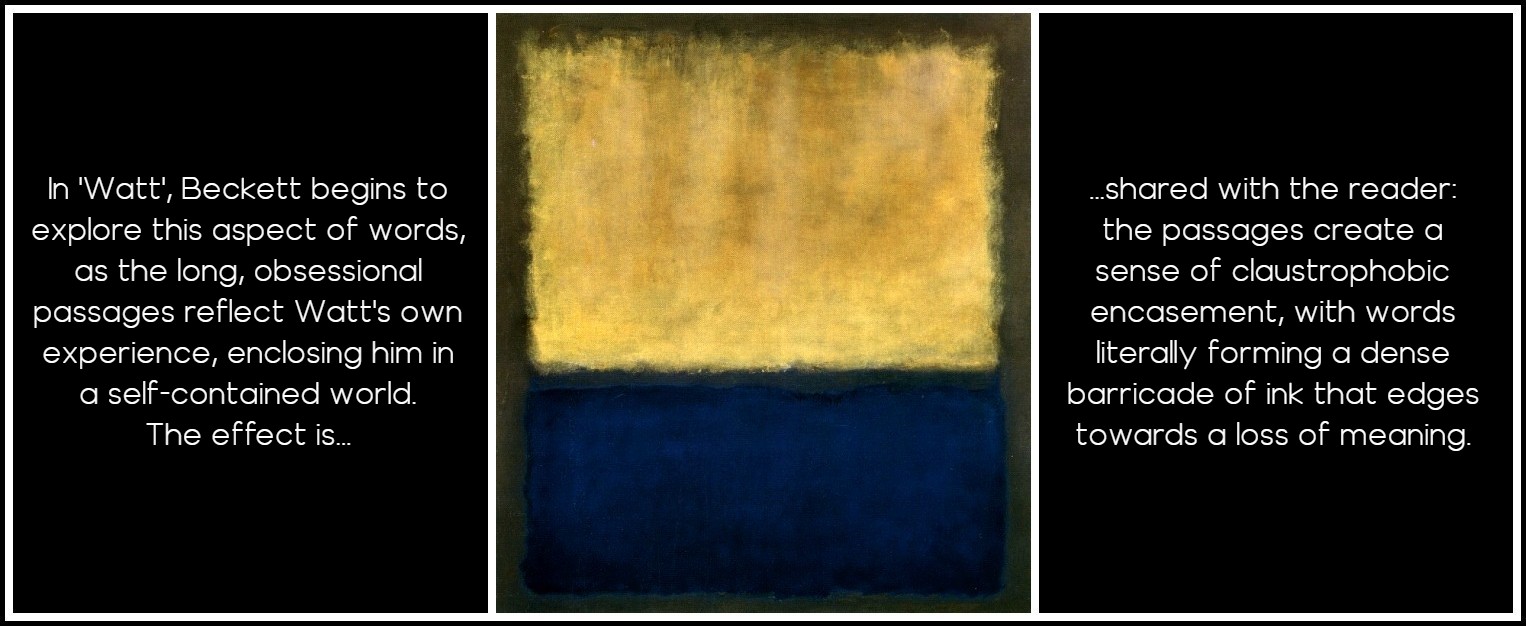
Mark Rothko, Light Earth and Blue, 1954
Watt represents the part of the narrative-self that feels itself a pariah on the world’s margins: wandering toward Knott, an elderly lady throws a stone at him, and so complete is his divorce from his own body, this violence raises no emotion. Resting under the night sky, he becomes uncomfortable with the moon’s shining upon him ‘as though he were not there’. The moonlight creates a sense of depersonalization, he is unrecognized, absent, his sense of himself is compressed, and there is no home in the world—he dislikes both the moon and the sun, the earth and the sky. The image of the bright, round moon ‘face’ connects to early feelings of seeing the mother, of being seen by her. The infant can, from virtually the earliest moments of life, begin to identify the human visage, and this appears to be hard-wired neurologically. Watt’s disconnection from such primary contact underscores his isolation from the mother and the world, his dislike of celestial bodies may be an introjection of his feeling of being unwitnessed and unloved by heavenly faces. Curling up into the ditch, burying himself, as Molloy will do, into mother earth, Watt engenders himself, becoming his own creator, though now enclosed in an autistic world.
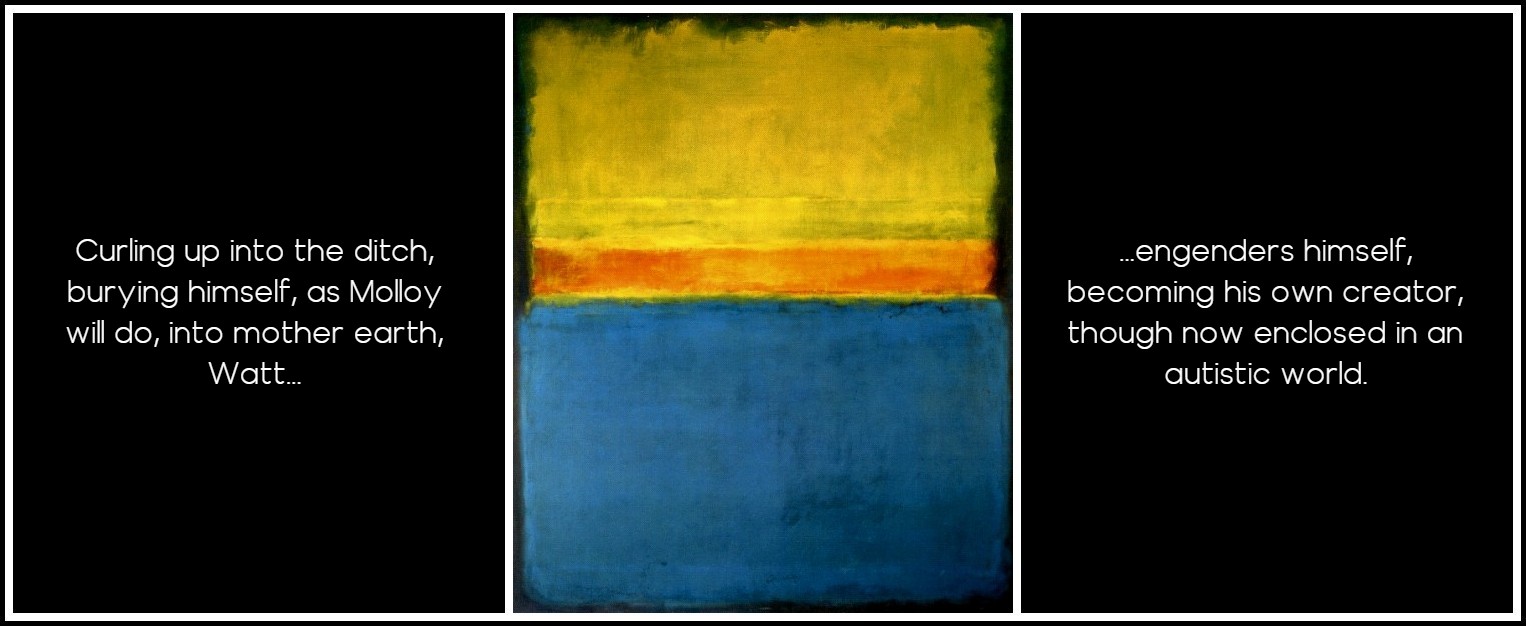
Marl Rothko, Number 2, 1953
The deepest human anxiety mounts, Watt hallucinates the singing of the long repetitive number, ‘Fifty-one point one/four two eight five seven one/four two eight five seven one’, strikingly reminiscent of autistic children described by Tustin, for whom numbers become enclosing, encapsulating objects that protect them by creating a shell that prevents seepage of the self into the world. In this way, the autistic number ‘enwombs’ Watt by holding him together intrapsychically. The internal voices also sing verses to him: ‘Greatgran / ma Ma / grew how / do you / do blooming / thanks and / you drooping / thanks and / you withered / thanks and / you for / gotten thanks and / you thanks for / gotten / too greatgran /ma Ma’. Despairing parts of the self view ageing as irrevocably, exclusively linked to emotional loss (i.e. the Great Mother, old and forgotten) and, as so often in the oeuvre, the life cycle is compressed and devitalized, becoming a hopeless decline that ends without meaning: ‘grew… blooming… withered… drooping… withered… forgotten’. A second verse that Watt hallucinates demonstrates the despair that develops from an experience of maternal unavailability, and its effect on feeding:
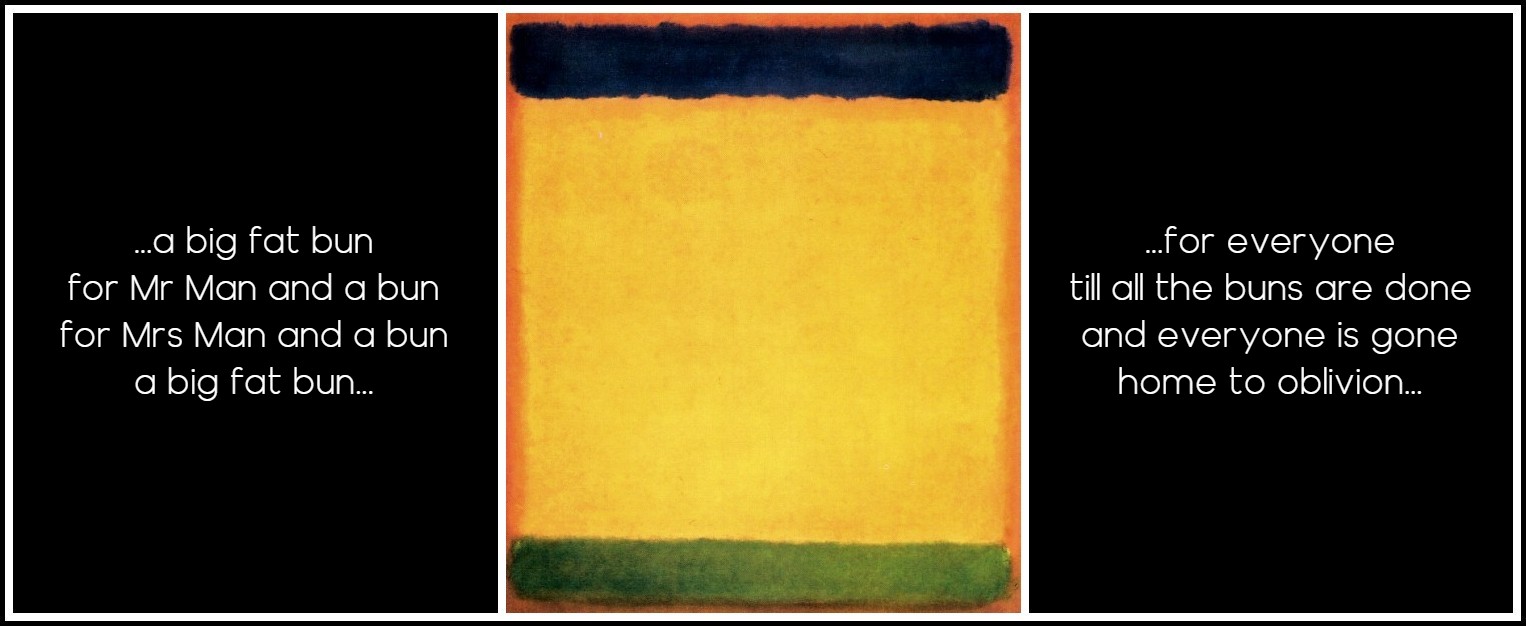
Mark Rothko, Untitled, 1954
This ‘song’ is Watt’s core hope for an unimaginable bounty of feeding for all (‘a big fat bun for everyone’, i.e. all ‘Man’-kind), and for a happy, ‘full’filled internal family living together in loving harmony. This fantasy is catastrophically drained, the source of nutrition is depleted or withheld, and total annihilation results (‘everyone is gone’). Watt is unable to maintain an enduring image of a good, loving mother/nutrient-giver; rather, his internal world is dominated by an imago that is withholding, sadistic, or depleted by greedy, sadistic infantile demands, and the final paradoxical line (‘home to oblivion’) reflects a return to futile entrapment.
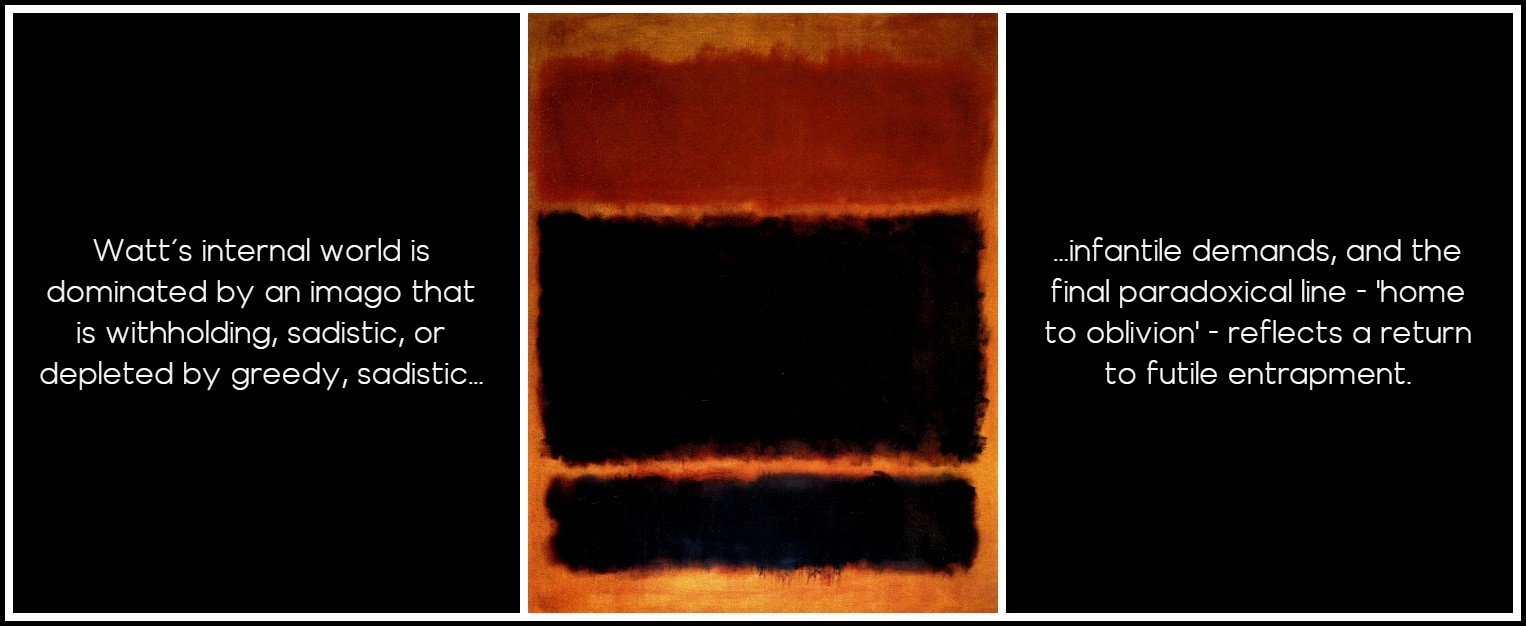
Mark Rothko, Black and Deep Red, 1957
MARA, MARIETTA: A LOVE STORY IN 77 BEDROOMS – READ THE FIRST CHAPTER
A literary novel by Richard Jonathan
RICHARD JONATHAN, ‘MARA, MARIETTA: A LOVE STORY IN 77 BEDROOMS’ — READ THE FIRST CHAPTER
AMAZON & APPLE BOOKS

RICHARD JONATHAN, ‘MARA, MARIETTA: A LOVE STORY IN 77 BEDROOMS’ | AMAZON PAPERBACK OR KINDLE

RICHARD JONATHAN, ‘MARA, MARIETTA: A LOVE STORY IN 77 BEDROOMS’ | APPLE iBOOK
MARA, MARIETTA: A LOVE STORY IN 77 BEDROOMS
A literary novel by Richard Jonathan

Available from AMAZON (paper | ebook) & iBOOKS, GOOGLE PLAY, KOBO & NOOK (see LINKS below)
RELATED POSTS IN THE MARA MARIETTA CULTURE BLOG
CLICK ON THE IMAGE TO GO TO THE POST

By Richard Jonathan | © Mara Marietta Culture Blog, 2026 | All rights reserved
Comments