
Samuel Beckett
THIS EMPTIED HEART: WATT’S UNWELCOME HOME – PART 2
John Robert Keller
Posted by kind permission of John Robert Keller, MD M.Litt. PhD., psychoanalyst in private practice in Toronto.
From John Robert Keller, Samuel Beckett and the Primacy of Love (Manchester University Press, 2002) pp. 100-109
This study does not use any biographical information. It is a textual study.
Readers who wish to track the bibliographic references in this study and the page numbers for citations from the novel,
or to consult the notes, are referred to the book, which is (was?) available in an Open Edition version.
THIS IS PART 2 OF THE POST – READ PART 1 FIRST
Hideaki Yamanobe, The Peak 2025-3, 2025
III. ON THE PRIMITIVE EDGE OF KNOTT
Watt’s stay with Mr Knott is an attempt at self-reparation, a tragic search for the mother’s mind in the hope of creating an enduring, coherent sense of self. Winnicott describes the child’s need for ‘good-enough’ mothering by a caretaker able to attend to its basic needs, allowing for the development of the self—it is the failure to recognize such needs, and the deleterious consequences of such failures on human development, that shall be enacted in the house. Watt’s desire to be ‘fully born’ is suggested by his immediate motivation for leaving the ditch where he lay with the ‘voices’ prior to his arrival at Knott’s: ‘The earth […] he felt it, and smelt it, the bare hard dark stinking earth. And if there were two things that Watt loathed, one was the earth, and the other was the sky. So he crawled out of the ditch. The possibilities of life are compressed, for between earth and sky there is no home for Watt, and no chance for an existence in which he is not suffocated within a neither-/ non-space between two bad objects. Thus he begins his quest to be reborn, though he ‘never [knows] how he got into Mr Knott’s house’, the backdoor mysteriously becomes unlocked, as his entry becomes steeped in a sense of contingency. Sitting by the kitchen fire, playing with the ashes, using his hat to give them life, he watches the embers ‘greyen, redden, greyen, redden’, and while absorbed in this ‘innocent little game’ the servant whom he is to replace, Arsene, enters the room without his knowledge. A beautifully lyrical passage illuminates Watt’s central struggle to master his sense of isolation from the world, something reflected by Arsene’s unpredictable (non-)arrival. The passage stresses this mystery, reflecting Watt’s ‘fort-da’ ash-game, as he controls a myriad of losses by manipulating the embers: his tenuous grasp on the external world, his fragmentary sense of self, his absent internal mother, and the ‘light’ of reason:
Samuel Beckett, Watt, 1953
This description of Watt’s interior landscape suggests an isolated-self incapable of maintaining enduring links to its internal objects. The ‘comings and goings’ are unknowable, and the sense of lost attachment suggests an elusive, internal universe in incomplete contact with the self. The scene foreshadows the desperate sense of lost primary love described in Embers:
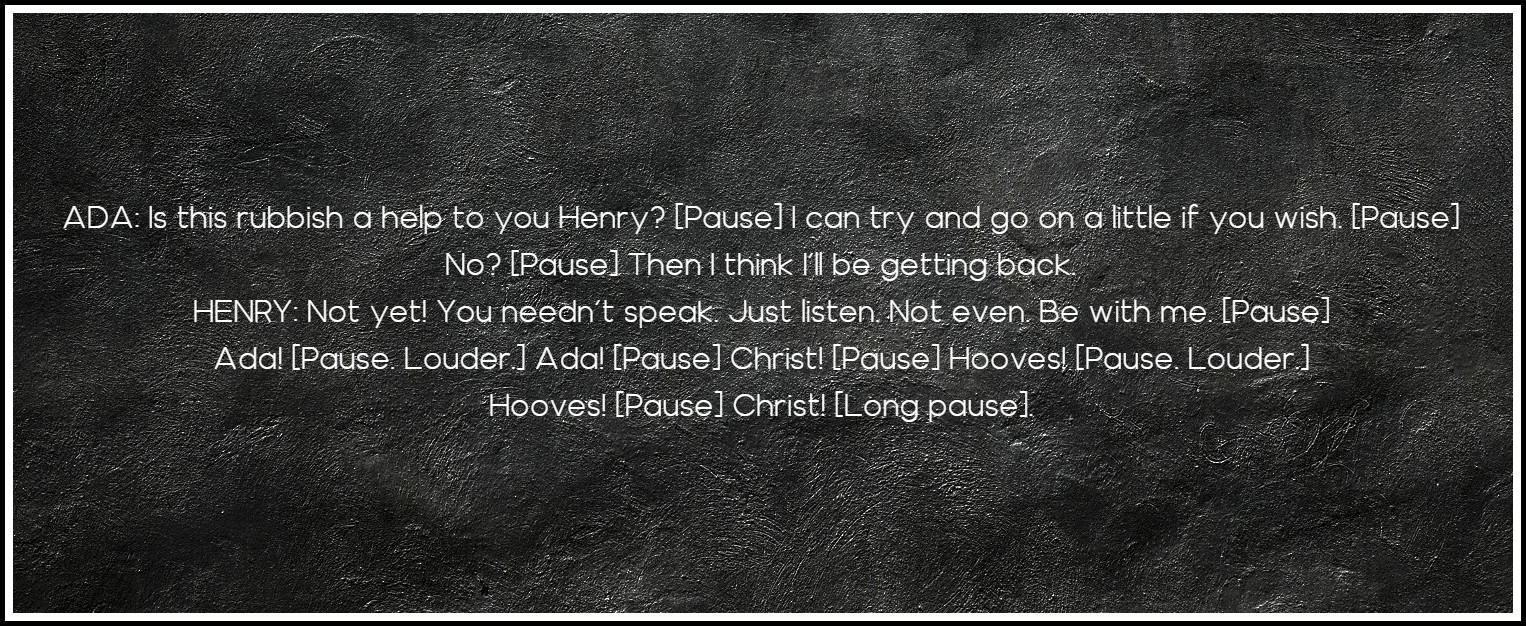
Samuel Beckett, Embers, 1957
Like Watt, Henry’s grasp on his internal world (here represented by the hallucinated voice of his dead wife) is tenuous, ever ready to leave without warning, remaining beyond his ability to recall it, fading and glowing like gently dying embers. Henry’s only need is for her presence, she need not speak nor even listen, he only desires to be alone in the presence of the mother. Winnicott felt a momentous developmental stage for the emerging-self is the ability to be alone, something made possible by the infant’s ability to lose itself in play while in proximity to the mother, who acted in a transitional manner to contain the child as a felt, background presence. Watt’s little game with the ashes is, perhaps, a doomed attempt to play in this way. Like the female images in …but the clouds…, Footfalls, and so forth, the female visage in Embers reflects a primary imago that binds the internal world, but which is only tenuously felt and not enduring. Left alone again, Watt’s ember-game ends, they ‘would not redden anymore, but remained grey, even in the dimmest light’. His fort-da game lost as contact with the external world ebbs, his ability to retain his internal universe becomes tenuous, and he begins to ‘[masturbate] his snout’ like many autistic children who turn to self-stimulation to avert the black hole of nothingness. The servant Arsene returns, aware his days with Knott are over and, in a long, rambling speech, he reveals the nature and impact of the intrapsychic consequences of his stay in the house.
Hideaki Yamanobe, Through the clouds 2022-1, 2022
Arsene begins, as if coming out of a trance, ‘Haw! how it all comes back to me, to be sure’, and what comes back is a remembrance of his self-state, prior to his Knott-experience, a condensation of schizoid experiences:
Samuel Beckett, Watt, 1953
It is possible to view the house as mother’s mind, in which the anxious, fragmented infantile-self hopes to be contained; the house is Knott is the mother, and Watt hopes to rest here (as Murphy did in the ‘third zone’) to escape the darkness ‘all within his head’. Arsene and Watt are lonely, isolated men, fleeing a dark world for refuge, but there is also the intrapsychic world of the infantile-self fleeing deeper into Guntrip’s ‘lost heart of the self’, a place of sanctuary, almost beyond yearning, past the ‘comings and goings’. Guntrip saw this as the mind’s last desperate retreat, into which it is driven by the despair of being unable to enter into a loving, genuine relationship, and it is this place into which Watt withdraws for reparation, hoping his damaged sense of himself will be recognized and nurtured. In relating such hopes, Arsene speaks of arriving in the house ‘after so long, here, and here, and in my hands, and in my eyes, like a face raised, a face offered, all trust and innocence and candour’. Like the infant seeking the mirroring, self-affirming smile of the mother, he comes to Knott hoping to find an emotional attunement that will allow a move beyond his inner fortress.
Hideaki Yamanobe, Indigo Light No. 1, 2020
Knott, and his house, too, offer such sanctuary, the ‘fit is perfect’ between infant and mother, as a merged sense of loving containment binds the sensual world: ‘The sensations, the premonitions of harmony are irrefragable, of imminent harmony, when all outside him will be he, the flowers the flowers that he is among him, the sky the sky that he is above him, the earth trodden the earth treading, and all sound his echo’. The world loses its terrifying aura, and here, with what Winnicott calls the stable, nurturing ‘background mother’, Watt has the chance to rest ‘without misgiving’, to be ‘as he is’, for the first time since ‘in anguish and disgust he relieved his mother of her milk’. This captures the ambivalence of early infantile experience—there is ‘anguish’, the desperate sense that it is the infant who is damaging the mother, draining her, possibly causing the ruptures in early feeding. Alternatively, there is a sense of disgust reflecting, perhaps, an anxiety about dependence on the breast for survival. Now, though, with Knott, there is an opportunity to move back beyond the ‘basic fault’ to a mental place where one is held psychically by the mother, and where one can begin to feel oneself into the world. One can begin to be, feeling disparate sensations coalesce into a coherent self, fragments which are, at first, held together by the mother’s containing function—mother and child create each other—Watt will ‘witness and be witnessed’.
Hideaki Yamanobe, Snow Noise, 2019
Watt’s experience with Knott begins with this hope of being at one with a caring, nurturing mother, able to soothe her infant, to merge with it in a mutual witnessing; it will end with the devastation of this hope. Thus, Arsene speaks of the Fall, that ‘terrible day’ that begins with a sense of calm, primal merger with the world: ‘I was in the sun, and the wall was in the sun. I was the sun, need I add, and the wall, and the step, and the yard, and the time of year, and the time of day, to mention only these’. Basking in the glow of the background Knott/mother, Arsene experiences a oneness with the external world, as a timeless lack of boundaries pervades his experience. This approximates a primary monadic bliss, beginning in utero, a vital part of early experience carried through the life cycle as a sense of internal well-being. Soon, however, a catastrophic change occurs that alters the world for ever. It reflects a premature psychological separation from the mother that is experienced as overly traumatic, overwhelming an infantile-self that is psychically unprepared; if the separation is precipitated by an unempathic or depressed mother, the results can be a depleted sense of self, a depressed or anxious attitude, or even frank psychosis.
Hideaki Yamanobe, Piano Phase – Sound Stiftung IV, 2020
Arsene sits in the garden, merged with the universe, with the ‘background object of primary identification’, the ‘Knott/mother, supplying a sense of belonging and security, when the change occurs. He puffs at his pipe in great contentment, like a babe at the breast, his own breast swelling. The boundary between self and mother blurs, there is a feeling of primary rupture, ‘let us not linger on my breast’, just as the separation begins. Birth images abound—the change lies ‘hymeneal still’, there is an image of maternal depletion, he says ‘bugger these buttons!—as flat and—ow!–as hollow as a tambourine’. This imagery is central to an understanding of both Arsene’s and Watt’s Knott-experience, for there is substantial clinical and experimental evidence that the infant’s ‘rooting’ for the nipple is innate, and is a primary focus of early sensuality.
Francis Tustin, Autistic States in Children, 1981
In one of the central clinical vignettes of her work, Tustin describes a young autistic boy, John, whose terrified sense of dissolution centred around feelings that a ‘button’ was gone or broken. The ‘button’ was a clear referent for the mother’s nipple and was the boy’s ‘present day formulation for the previously undifferentiated, unformulated, insufferable experience of sensuous loss which had precipitated the autism’. Thus, the button symbol, for both the autistic child and Arsene, comes to represent the entire experiential world of premature, catastrophic separation from the mother, and this is tantamount to a loss of fundamental containment for a fragile sense of self. This loss leads to feelings of fundamental disconnection, attendant feelings of panic and despair, and fears of annihilation and fragmentation. Just as the ‘broken button’ experience accompanies John’s autistic withdrawal into a protective psychic shell, it is at this point in his telling that, for Arsene, ‘suddenly somewhere some little thing slipped, some little tiny thing’. What slips is Arsene himself, away from the illusory security of the Knott-mother, now feeling alone, separate, and frightened by his smallness in the world:
Samuel Beckett, Watt, 1953
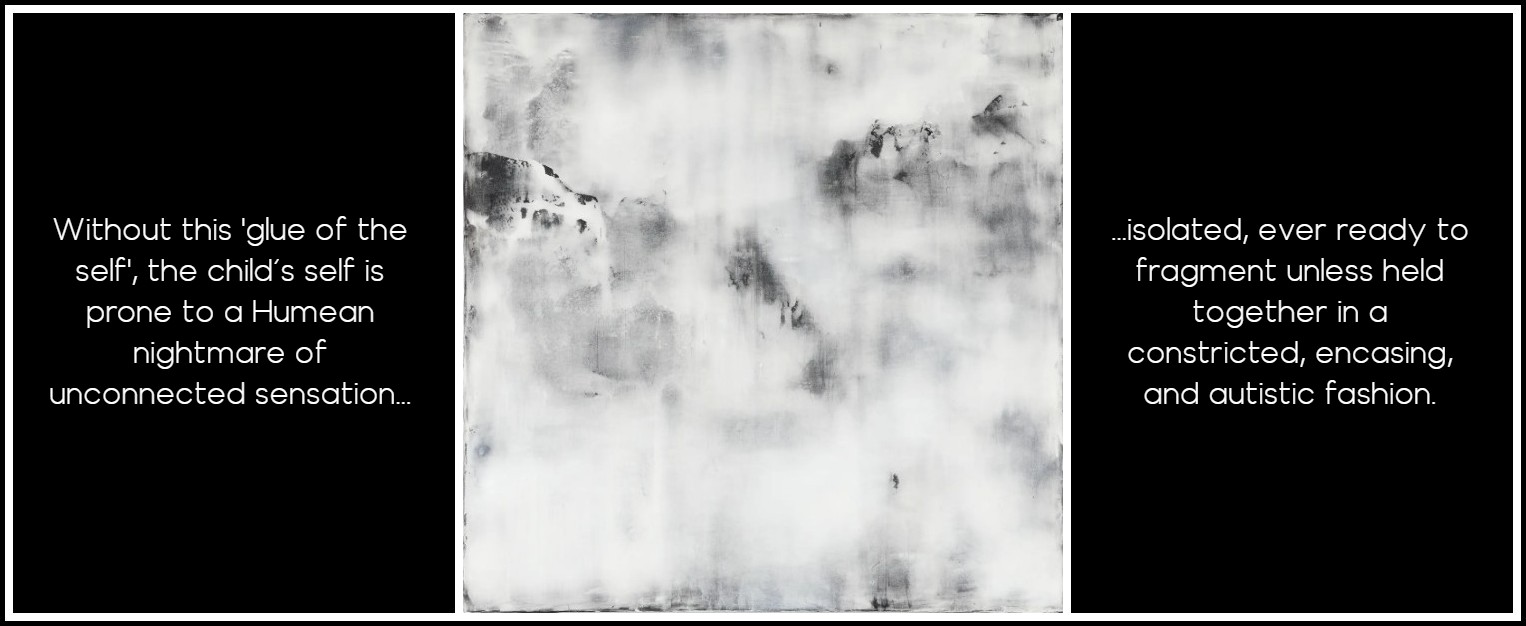
This passage is ripe with imagery of separation and fragmentation—the ‘great alp of sand’ can symbolize merged experience, both psychically and physically, within the mother/infant dyad. The alp is both the infantile-mind, and a containing, maternal mind, holding together, in unindividuated fashion, the experience of the infant-with-mother. Breast-like in shape, the alp echoes the primary imagery Arsene employs to describe his experience in the garden/mind of Knott. It suggests an experience of, or wish for, holding and containment within the Knott/mother, but also suggests the tenuous, ‘sand-like’ nature of that bond. When there is no one to witness, as Knott does not witness, the particles are blown asunder, as the infantile-self is ‘untimely ripped’ from the maternal mind. Again, the image of the moon suggests an early experience of the mother’s face, but in this case it is on a moonless night, when the alp-as-infant mind is unseen and unheard, that the disintegration occurs. Arsene’s sense of self now fragments, a few particles amidst an overwhelming universe, and these scatter, blown about, much as Murphy ends amidst the sawdust. The sand is a highly condensed metaphor for a self-state both constricted and scattered, both bound by the other and alone, and as prone to fragmentation as sand. These particles of self (memory complexes of feelings and thoughts) are bound together in the child by the mother’s containment, something the child eventually internalizes and makes his own. Without this ‘glue of the self’, the child’s self is prone to a Humean nightmare of unconnected sensation, isolated, ever ready to fragment unless held together in a constricted, encasing, and autistic fashion, something often suggested by the oeuvre’s imagery of ashcans, bottles, and enclosed rooms.
Hideaki Yamanobe, The Peak 2025-3, 2025
It is this separation that Arsene experiences, the slippage of multitudinous parts of himself that were ill-seen, ill-heard in Knott’s mind, parts not processed: ‘millions of little things moving all together out of their old place, into a new one nearby. I was the only person living to discover them’. It is just at this point that Arsene experiences himself in a state of blissful merger with the universe, with the Knott/mother, in a place without boundary, without a sense of demarcation of the self: ‘My personal system was so distended the distinction between what was inside it and what was outside it was not at all easy to draw. Everything that happened happened inside it, and at the same time everything that happened happened outside it’. In this state, premature rupture is catastrophic for the developing self, since the child’s pre-symbolic mind takes in the world directly, in a manner closer to feeling than thought. Arsene perceives so sensuously that ‘the impressions of a man buried alive in Lisbon seem a frigid and artificial construction of the understanding’. Arsene demands maternal containment, and the intense vivaciousness of the experience is compared to the terrorized thoughts of a man buried alive, a claustrophobic encasement the later prose and drama will develop.
Samuel Beckett, Watt, 1953
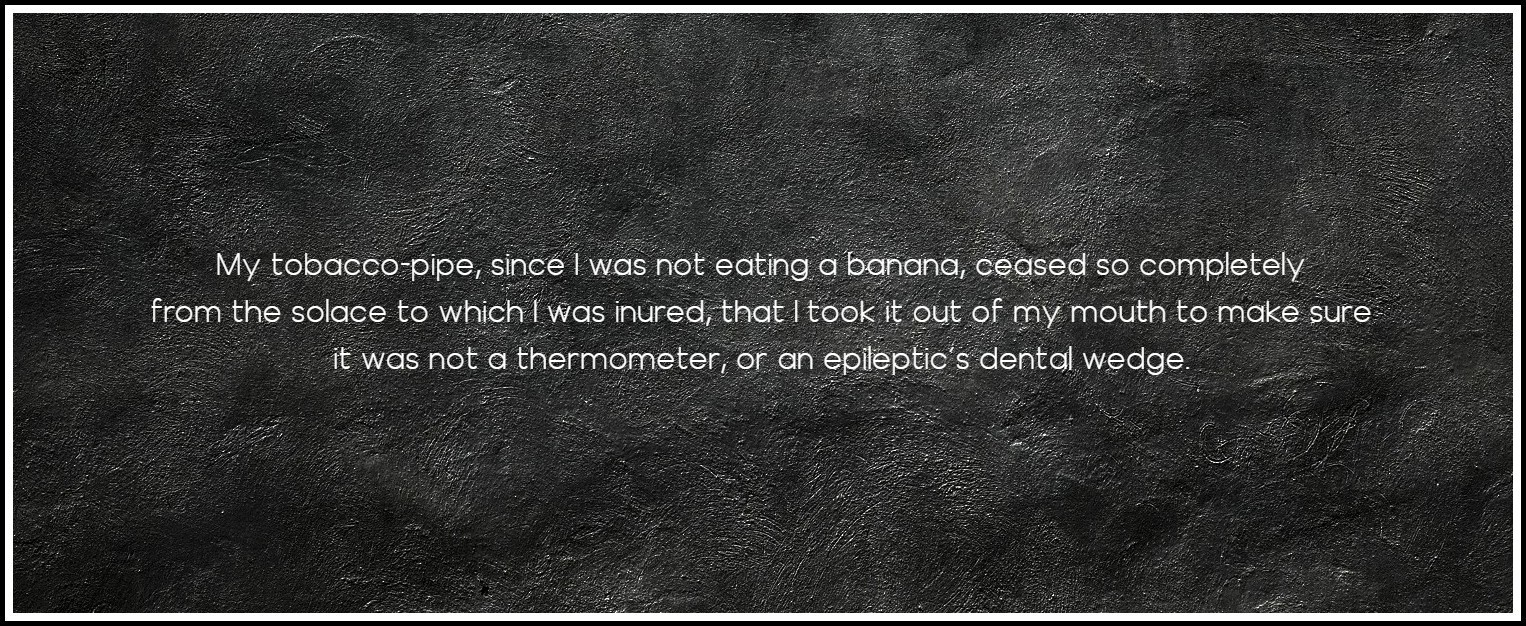
After ‘the slip’ the world undergoes, like the sun, a ‘radical change of appearance’. Arsene is frozen in a pre-symbolic, Autistic Contiguous world, with no demarcation between things, no names to bind the sensual world: ‘my tobacco-pipe, since I was not eating a banana, ceased so completely from the solace to which I was inured, that I took it out of my mouth to make sure it was not a thermometer, or an epileptic’s dental wedge’. This oral, ‘solace’ giving nipple/pipe no longer calms, or nurtures, and this catastrophe is highlighted by the fact that virtual newborns can distinguish between objects within their mouths. Like the pre-representative infantile-mind, Arsene cannot name, nor remember, what he does not see—the pipe in his mouth is unseen, and must be lost. He is ripped away from the good breast, the containing mind, and from meaning, something Watt will soon experience himself.
Samuel Beckett, Watt, 1953
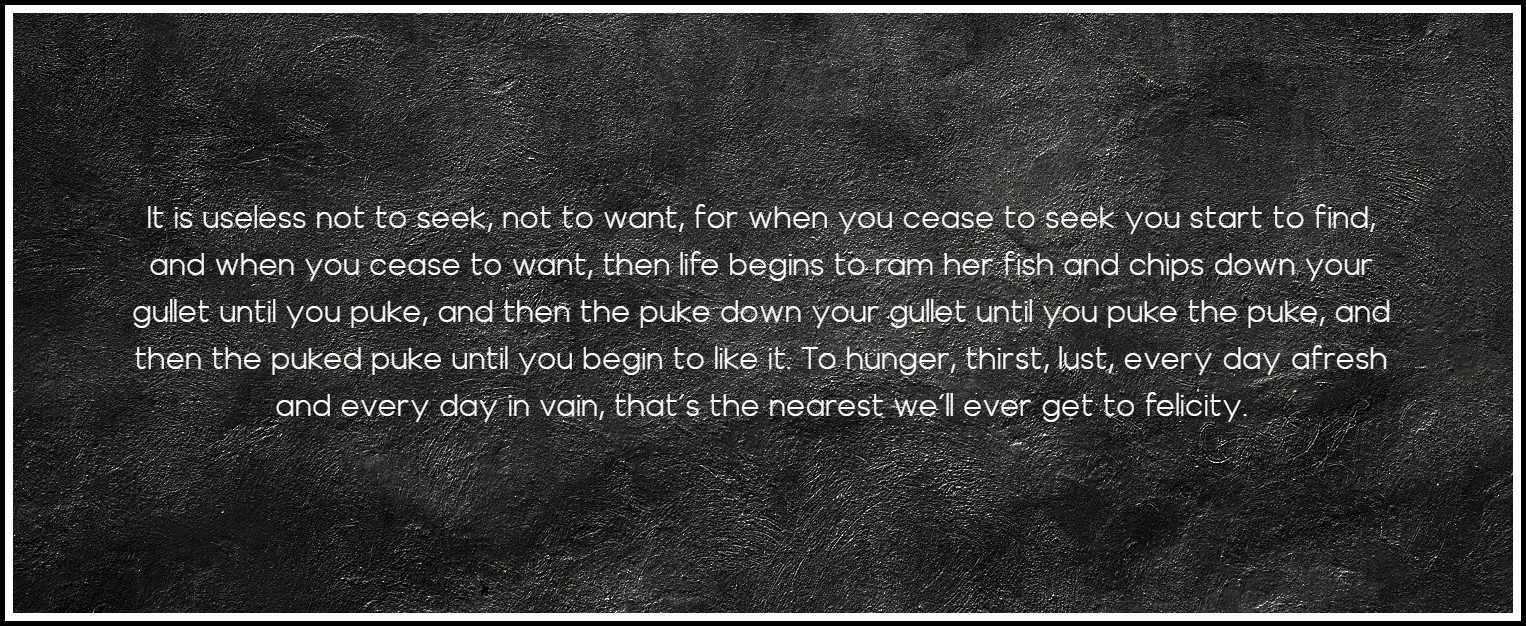
Arsene describes the change as a separation: ‘What was changed was existence off the ladder. Do not come down the ladder, Ifor, I haf taken it away’, like Ifor, he is left without a connection to another, and now feels his world is changed forever. He experiences this premature separation as an overwhelming, disorganizing loss, ‘As when a man, having found at last what he sought, a woman, for example, or a friend, loses it’; yet he acknowledges the human need to strive for satiation of instinctual drives such as food and sex:
Samuel Beckett, Watt, 1953
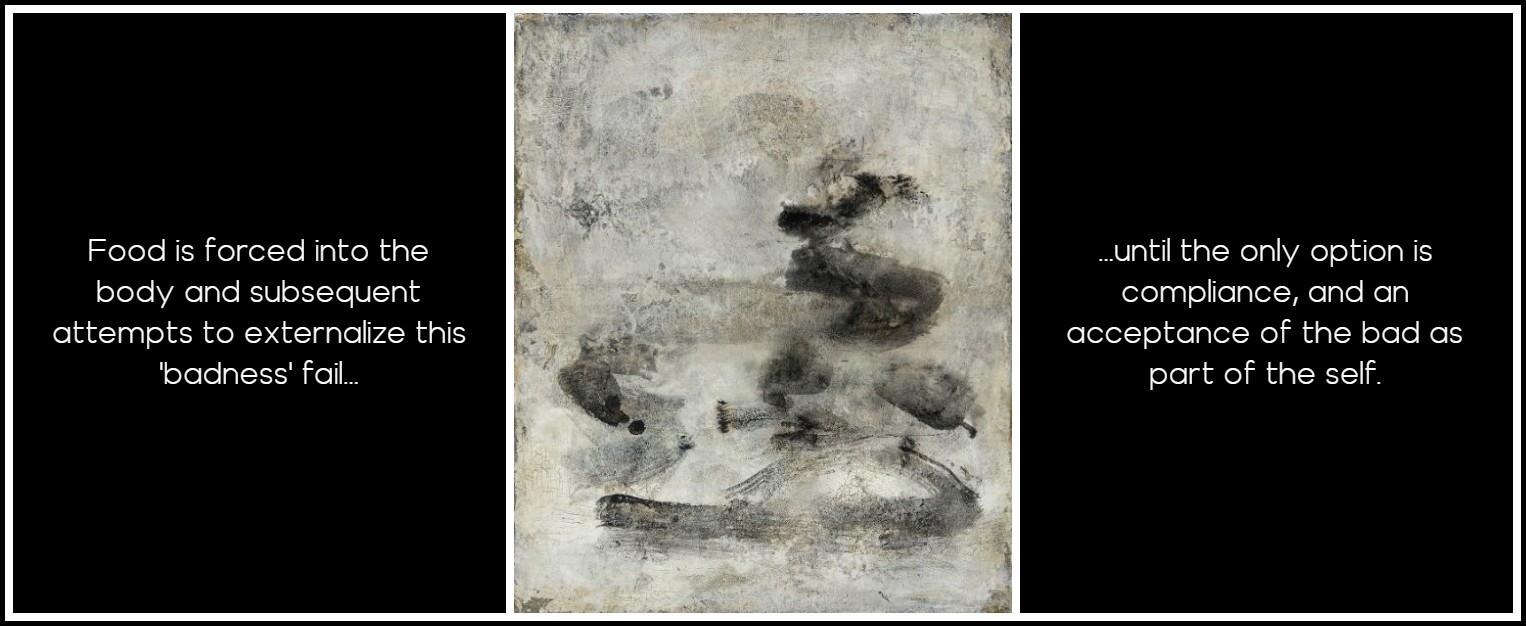
Experience is generalized from his relationship with Knott, whose only need is for an audience to contain him in his isolation. The all-encompassing intrusiveness of this demand is as an invasion of the self: food is forced into the body and subsequent attempts to externalize this ‘badness’ fail, until the only option is compliance, and an acceptance of the bad as part of self. Kohut saw the breakdown of nurturing and empathic ties between the mother and child (particularly the mother’s ability to allow the child to use her as a mirror) as leading to fixation on more primitive needs, which are breakdown products of unattuned parenting. This passage highlights this from the child’s point of view—mirroring needs are forever unmet, since love is unattainable (just as the love of the Knott is unattainable) and Arsene is left forever longing. He describes this absence as ‘the presence of what did not exist, that presence without, that presence within, that presence between’. This ‘presence’, the sense of being that is the core of authentic subjective experience, is found within the mother’s love, and so the boundaries of the world, ‘within, without, between’, collapse into a dead, empty despair. Knott is absence incarnate—there is no presence without, and no possibility to take the ‘presence within’ by incorporating the mother as a valued, calming, and mirroring part of the self.
Hideaki Yamanobe, Be-Around No. 18, 2024
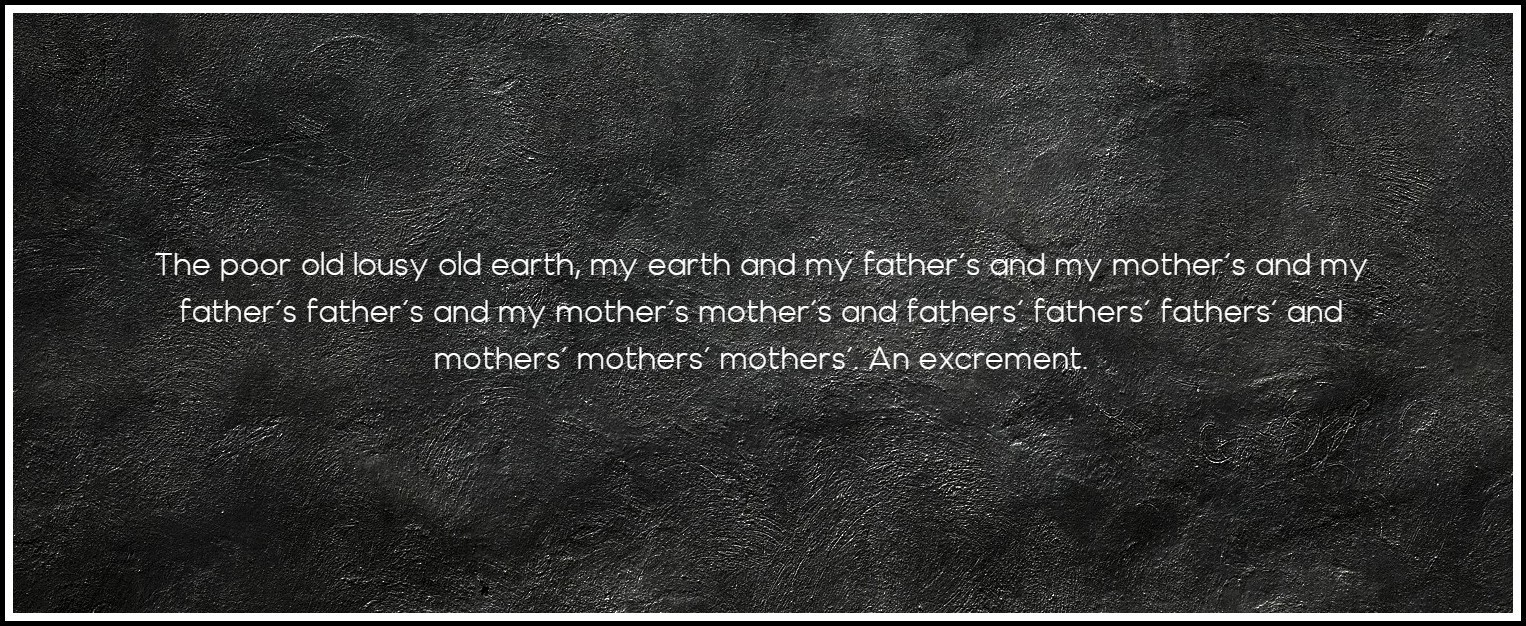
This absence and premature separation leaves Arsene in hopeless despair: ‘Not a word, not a deed, not a thought, not a need, not a grief, not a joy, not a girl, not a boy, not a face, no time, no place, that I do not regret, exceedingly’. This is, in Bion’s terms, negative K, the absence of libido, and Arsene’s entire world becomes depleted of meaning, much like the world of the painter friend of Hamm’s in Endgame, who sees only ash. A similar sentiment is described in a passage dozens of lines long: ‘The poor old lousy old earth, my earth and my father’s and my mother’s and my father’s father’s and my mother’s mother’s and fathers’ fathers’ fathers’ and mothers’ mothers’ mothers’. An excrement’. Arsene universalizes despair—everyone’s world becomes meaningless, his entire inner world of progenitors, his internal family, is left joyless. It is an utter hopelessness, since all persons must share the same ‘lousy earth’ or internal world, and there is no chance of an alternative reality. This long, ruminative passage both encases and reveals his feeling-state; this denigration of possibility is also a defensive, envious attack on life, since by turning the world into ‘an excrement’ there can be nothing left for Arsene to desire.
Samuel Beckett, Watt, 1953
The entire life cycle is also devalued: ‘The crocuses and the larch turning green every year, the pastures with the uneaten sheep’s placentas and the children walking in the dead leaves and the larch turning brown and the endless April showers and the crocuses and then the whole bloody business starting all over again. A turd’. This imagery reflects Arsene’s internal world—depleted of meaning, hopeless, condensed and, like the life represented in Breath, there is neither space nor time for joy or rebirth. Worst of all there is no possibility of change: ‘And if I could begin it all over again a hundred times, knowing each time a little more than the time before, the result would always be the same’. It is an eternal recurrence of Hell, a depleted, regressed self with no contact, nor any hope of contact with good or calming internal (or external) objects that could help effect psychic change. It is a feeling of such desperate sorrow that he imagines his ‘weary little legs’ carrying him away from this ‘state or place’, with ‘tears blinding his eyes’, ‘longing to be turned into a stone pillar’, where perhaps a ‘lonely man like himself’ might come and rest against him. The stone image reflects his dead self-state, and the fantasy that he might provide comfort to another is poignant in its yearning for contact, but his sympathy is withdrawn from the world, since he is in ‘no fit state to trouble his head’ about the difficulties of others. Like a helpless child, he imagines his departure will be catastrophic, and he leaves Knott without ‘a hope, a friend, a plan, a prospect’ to trudge off into a loveless world until he falls, and ‘unable to rise’, will be ‘taken into custody black with flies’. There remains, to the end, a small sense of mercy and hope within the world, as Arsene, an orphan in the world of the living, seems destined for maternal containment within an institutional setting.
Samuel Beckett, Watt, 1953
Fundamentally, then, Arsene leaves Knott in the Depressive Position, able to experience a sense of loss and mourning. He sees a bleak future, is ‘sadder, but not wiser’ and has been an Ancient Mariner for Watt, warning his replacement of his lost contact with the world. The tenuous tie to Knott broken, Arsene cannot maintain a sense of calm, self-nurturing, as life itself becomes loss. He tells Watt: ‘Another night will fall and another man come and Watt go, Watt who is now come, for the coming is in the shadow of the going and the going is in the shadow of the coming.’, echoing a famous passage by Freud, in Mourning and Melancholia. Following the loss of a loved person: ‘The free libido was not displaced onto another object; it was withdrawn into the ego, where it served to establish an identification of the ego with the abandoned object. Thus the shadow of the object fell upon the ego’. Since Knott is absent from the beginning, there is nothing but shadow to bring within, and because the proper work of mourning cannot be done Arsene remains chronically depressed, experiencing life as a fusion between coming, going, and varying forms of separation, with no real point of contact or possibility of loving engagement. There is no sense of human presence, and therefore, in leaving Knott, he is truly alone, since nothing can be taken from the experience. His inner world is condensed into a ‘budding withering’, a ‘coming and being and going in purposelessness’ where any feeling of hope is ‘dead’.
Hideaki Yamanobe, Daylight No. 22, 2011
Before leaving Watt in the dawning light, Arsene gives him an idea of the master he is to serve. Knott is an isolated, withdrawn figure about whom it is ‘rumoured’ that he ‘would prefer to have no one at all about him’. His desire for complete self-sufficiency is thwarted by his infantile nature, in that ‘he is obliged to have someone to look after him’. Knott’s narcissism is extensive, he has but two needs: ‘not to need, and a witness to his not needing’. This equation sets up the dynamics at the heart of the novel, and of Watt’s suffering, for though Knott needs the other, it is only by default, as a denied admission of failed omnipotence. The other is but a mirror of Knott’s illusory self-sufficiency, and any yearning for genuine connection is doomed to fail, since the world acts only as a source of recognition and need fulfilment. Knott and his endless entourage of servants fluctuate between two poles, with Knott as absent, self-fulfilled mother and the servants, ‘big bony shabby seedy haggard knockkneed men’ or ‘little fat shabby seedy juicy or oily bandylegged men’ as yearning, love-starved infants, ‘eternally turning about him in tireless love’. Alternately, Knott can be seen as an ever demanding, never grateful infant, about whom hovers an endless parade of very good mother/servants, and it is into this world that Arsene ushers Watt, leaving him as suddenly and quietly as the Ancient Mariner leaves the wedding guest. Watt, like the guest who must face the ‘morrow morn’, waits for Knott in the slowly dawning ‘day without precedent’. But whereas the Rime yields up a hope for love from an embracing God who ‘made and loveth all’, Watt is doomed to seek where it cannot be found—from a being that loves only itself.
Samuel Beckett, Watt, 1953
MARA, MARIETTA: A LOVE STORY IN 77 BEDROOMS – READ THE FIRST CHAPTER
A literary novel by Richard Jonathan
RICHARD JONATHAN, ‘MARA, MARIETTA: A LOVE STORY IN 77 BEDROOMS’ — READ THE FIRST CHAPTER
AMAZON & APPLE BOOKS

RICHARD JONATHAN, ‘MARA, MARIETTA: A LOVE STORY IN 77 BEDROOMS’ | AMAZON PAPERBACK OR KINDLE

RICHARD JONATHAN, ‘MARA, MARIETTA: A LOVE STORY IN 77 BEDROOMS’ | APPLE iBOOK
MARA, MARIETTA: A LOVE STORY IN 77 BEDROOMS
A literary novel by Richard Jonathan

Available from AMAZON (paper | ebook) & iBOOKS, GOOGLE PLAY, KOBO & NOOK (see LINKS below)
RELATED POSTS IN THE MARA MARIETTA CULTURE BLOG
CLICK ON THE IMAGE TO GO TO THE POST

By Richard Jonathan | © Mara Marietta Culture Blog, 2026 | All rights reserved
Comments