Samuel Beckett
THIS EMPTIED HEART: WATT’S UNWELCOME HOME – PART 3
John Robert Keller
Posted by kind permission of John Robert Keller, MD M.Litt. PhD., psychoanalyst in private practice in Toronto.
From John Robert Keller, Samuel Beckett and the Primacy of Love (Manchester University Press, 2002) pp. 109-117
This study does not use any biographical information. It is a textual study.
Readers who wish to track the bibliographic references in this study and the page numbers for citations from the novel,
or to consult the notes, are referred to the book, which is (was?) available in an Open Edition version.
THIS IS PART 3 OF THE POST – READ PART 1 FIRST
Elvire Ferle, Untitled XLVI, 2010-2018
IV. AN IMPERFECT WITNESS
The unfolding non-relationship between Watt and his master is a dramatic representation of early schizoid experience, with the characters forming aspects of a coherent narrative-self. It is an internal world, in which the central feeling-state is that of a helpless, hopeless child struggling to maintain an attuned, intimate relationship to its mother. There are several key scenes that reflect this central dynamic organization as Watt, representative of a depleted, fragmenting aspect of self, vainly seeks a nurturing ‘background object of primary identification’ to contain him. He encounters Knott instead, and exists only as a witness to illusory self-sufficiency, finding that outside of this function he does not exist. A clinical example may set the stage: The patient entered analysis complaining of binge-eating, excessive compliance, and the inability to think independently. An unwanted child, she served only two functions for her single mother, to mirror her grandiosity and to care for her when she suffered from her many depressive episodes. The patient’s sense of herself was founded on her ability to provide an illusory sense of independence for her mother, something for which she received neither affection nor gratitude. As an adult she vainly attempted to find affection, and allowed herself to be used for the other’s gratification and aggrandizement, as she had done earlier for her mother. Ultimately, she experienced an extended period of dissociation, and wandered from city to city in a haze, drifting from one relationship to another with abusive, selfish men. She felt she could be sure of nothing without the input of such men, and could not make decisions, nor have a clear sense of reality without them. There are many similarities between this woman’s experience and Watt’s: difficulties in linking thoughts, repressed feelings of rage, abandonment depression and so forth, all linked to an experience of lost contact with a good, nurturing mother. Watt’s story is both a recreation of this internal experience and a revelation of his attempt to repair himself through a failed attempt to discover the mother’s love.
Elvire Ferle, Untitled LXIII, 2019
Watt’s entry into a matrix of early experience within Knott’s house/mind begins quietly enough—he has no direct dealings with his master, though he imagines, wrongly, that he would some day. He works ardently at his chores, seeing little of Knott, who himself ‘saw nobody, heard from nobody’, and indeed, the house is itself a sort of autistic shell. Intrusions are rare occurrences—‘fleeting acknowledgments… like little splashes on it from the outside world’, and the house is a rigid, nearly impenetrable barrier to the world metaphorical of a mind structured on exclusion. This isolation is more abstract and complete in the published version of Watt. In the first draft, Poor Johnny Watt, Knott is a sixty-year-old man, living alone, abused by two servants, and quickly dismissed by the narrator as never having ‘been properly born’. His father, a musician, was a suicide. By the time the third draft was written Knott’s father is no longer mentioned: his past remains speculative, and he has become more abstract in his role as an absent other.
Elvire Ferle, Untitled XXIII, 2023
Thus, in his initial conception, Knott’s person is formed in a relationship with a lost primary object, his dead father, and it is he, not Watt, who has not been born properly. In fact, the story of Larry Nixon’s birth is an amplification of the story of the birth of Knott in the first draft. Within the development of the novel, through the draft stages, there is a blurred sense of an unborn self shifting between Watt and Knott, and this confusion mirrors their relationship in the final version. In Watt, both men are damaged, unable to form enduring connections with others, and this underlies the futility of Watt’s seeking an identification and love with an object, Knott, who is himself incapable of such a bond. The loss becomes ‘intergenerational’, in that Knott, product of parental absence and a victim of abuse in the first draft, recreates the unavailability of his own dead father, and apparently absent mother, in his own relationship with Watt—this opens the possibility that within Watt the narrative-self is attempting to make sense of its progenitors’ own internal experiences with primary objects.
Elvire Ferle, Untitled XLVI, 2010-2018
It is only by obsessive rumination that Watt feels any connection to Knott: there is no possibility of a genuine evocative memory of the relationship, he must constantly hold Knott in his mind at the risk of losing him altogether. So fragile is this hold that there is no definitive image, but rather a series of speculations as his master, like an elusive electron, is knowable only in his uncertainty. By maintaining an image of him through all-encompassing fantasies, Watt fulfills Knott’s own primary need to be witnessed in his not-needing, to be held in the maternal mind:
Samuel Beckett, Watt, 1953
Watt, with his own experience of maternal absence, and his need for containment, is the perfect candidate to provide Knott with faulty mirroring (i.e. ‘to witness its absence… ill’ in Knott—the lack of internal connection), though he also attempts to provide, and to receive, love. This allows Knott a tentative connection to Watt that does not become threatening, but holds both men just shy of total dissolution. Knott exists without experiencing an enduring sense of the world’s permanence, ‘moving about the house he did so as one unfamiliar with the premises’, and walking ‘in the midst of his garden as one unacquainted with its beauties, as though they, or he, had been created in the course of the night’. This explains Knott’s dependence on his servants, including Watt, who act as Winnicott’s ‘object mother’ to provide, with perfect anticipation, for Knott’s every physical need. Knott is enmeshed in omnipotent self-sufficiency and not-needing, but cannot tolerate separateness since he needs to be held psychically by the other, to avoid abandonment to psychic death. Watt experiences Knott as elusive, unfixed, and emotionally unknowable—even in his room, where he ‘seemed least a stranger’, Knott’s location is uncertain: ‘Here he stood. Here he sat. Here he knelt. Here he lay. Here he moved, to and fro, from the door to the window, from the window to the door; from the window to the door, from the door to the window [etc.]’. This passage runs on for several hundred words, creating a hypnotic, derealizing effect in the reader that echoes Watt’s experience.
Samuel Beckett, Watt, 1953
It is one of many in the work that creates a primal uncertainty, reflecting underlying loneliness, and disconnection; the style embodies a pervasive isolation, as well as an obsessive need to make contact. The significance of such passages becomes clearer towards the end of Watt’s stay with Knott, when are told that he does not experience, consciously, a deep emotional need for his master: ‘Watt suffered neither from the presence of Mr Knott, nor from his absence. When he was with him, he was content to be with him, and when he was away from him, he was content to be away from him’. After he actually leaves Knott’s house, though, he begins to cry, and is surprised by this reaction, not believing such a thing possible, ‘if he had not been there himself’. However, the next obsessive passage makes clear that any sense of true connection with Knott is an illusion, describing Watt’s inability to fix a solid image of Knott’s appearance in his mind: ‘For one day Mr Knott would be tall, fat, pale and dark, and the next thin, small, flushed and fair, and the next sturdy, middlesized, yellow and ginger [etc.]’. This primary, unresolvable distance between Watt and his master provides the novel’s emotional force, as Knott never firmly becomes fixed within his servant/child’s internal universe. Watt remains enclosed in his autistic shell, unable to bring into himself an enduring, permanent image of Knott, who refuses to engage his servant with the type of meaningful contact that would make such an internal experience possible. This is reflected in the clinical situation by patients who are unable to maintain a recollection of the analyst’s physical appearance, or of the appearance of the office setting, until they feel connected to a safe, maternal aspect in the analyst.
Elvire Ferle, Untitled XXXI, 2015-2025
The visit of the Galls, two piano-tuners, whose entry into the Knott-world is seen as a ‘fugitive penetration’, makes clear the centrality of early dyadic experience in Watt. The elder Gall, who is sightless, depends on his son, whose devotion parallels that of Watt to Knott; Watt clearly identifies with the son, and, in fact, seems to admire him. Alas, the piano they come to tune is in tatters, the mice having returned:
Samuel Beckett, Watt, 1953
This incident is important for Watt, and is the beginning of his own ‘slip’. In the Galls, Watt sees co-operative contact between a father and son, in contrast to the absence of contact he experiences with Knott. The piano is metaphorical of Watt’s inner experience—a communicative tool that relates emotional experience to the world, it has come to grief, lying broken and useless. Watt’s own need for authentic communication is thwarted in a house where there is no recognition; his mind, like a broken piano, begins to fragment as he withdraws from the world. The interplay of the Galls has the music-hall cross-talk quality that foreshadows sections of Waiting for Godot, and there is some sense of co-operative merger between the Galls that contrasts with Watt’s own deep isolation from his primary object. Their dialogue has a catastrophic quality that reflects the hopeless despair Watt is beginning to feel and, in fact, it is communication and relatedness that are now in jeopardy, as Watt sinks inwards into a ‘non-correspondence’ from others.
Elvire Ferle, Untitled XL, 2000-2010
The incident with the Galls becomes a model for Watt’s experience during his stay with Knott, since it ‘continued to unfold, in Watt’s head, it gradually lost its sound, its impacts and its rhythm, all meaning, even the most literal’. The incident with the Galls ‘became a mere example of light commenting bodies, and stillness motion, and silence sound’. Watt slips into a pre-symbolic realm, where the symbolic tie to the outer world is ruptured, as representations are sent adrift with no verbal organizations to hold them together. He is drowning in a sea of isolated meaninglessness, unable to connect representations to internal emotional meaning: ‘The fragility of the outer meaning had a bad effect on Watt, for it caused him to seek for another, for some meaning of what had passed, in the image of how it had passed’. Living on the edge of meaning, ‘miserably’ among face values, he can recall, without any undue significance, ‘the time when his dead father appeared to him in a wood, or the time when in his surprise at hearing a voice urging him to do away with himself’. These traumatic memories are disconnected from emotional significance, and his current trauma evokes both his own absent, dead father and the sense of primary maternal loss he is now reliving with Knott.
Elvire Ferle, Untitled LIV, 2018
The incident with the Galls is a watershed, however, that quickly disintegrates into displacement, so that ‘it seemed rather to belong to some story heard long before, an instant in the life of another, ill told, ill heard, and more than half forgotten’, and in this is an echo of Winnicott’s concept of the breakdown that has already occurred, the rupture of the primary mother–infant bond. Watt’s sense of himself as a coherent ‘I’, which can attach mental representations of past events to itself, can ‘own’ its past, is dissolving as he disconnects from himself, falling apart ‘in tatters’ like the piano-mind. Watt’s experience of dissociation from a triggering event (i.e. the Galls) resembles the speaker’s experience in Not I; for both a disconnection from a primary object leads to a dissociated, fragmentary experience of life. The Gall experience, screening a darker reality of loss, has itself become ‘Not-I’, and the incident has a dream-like quality, its significance remaining unconscious, reflective of Watt’s own inner experience in both its form (the merged relationship of father/son) and its content (the Galls’ diagnosis of primary disconnection in the piano).
Elvire Ferle, Untitled LXVIII, 2022
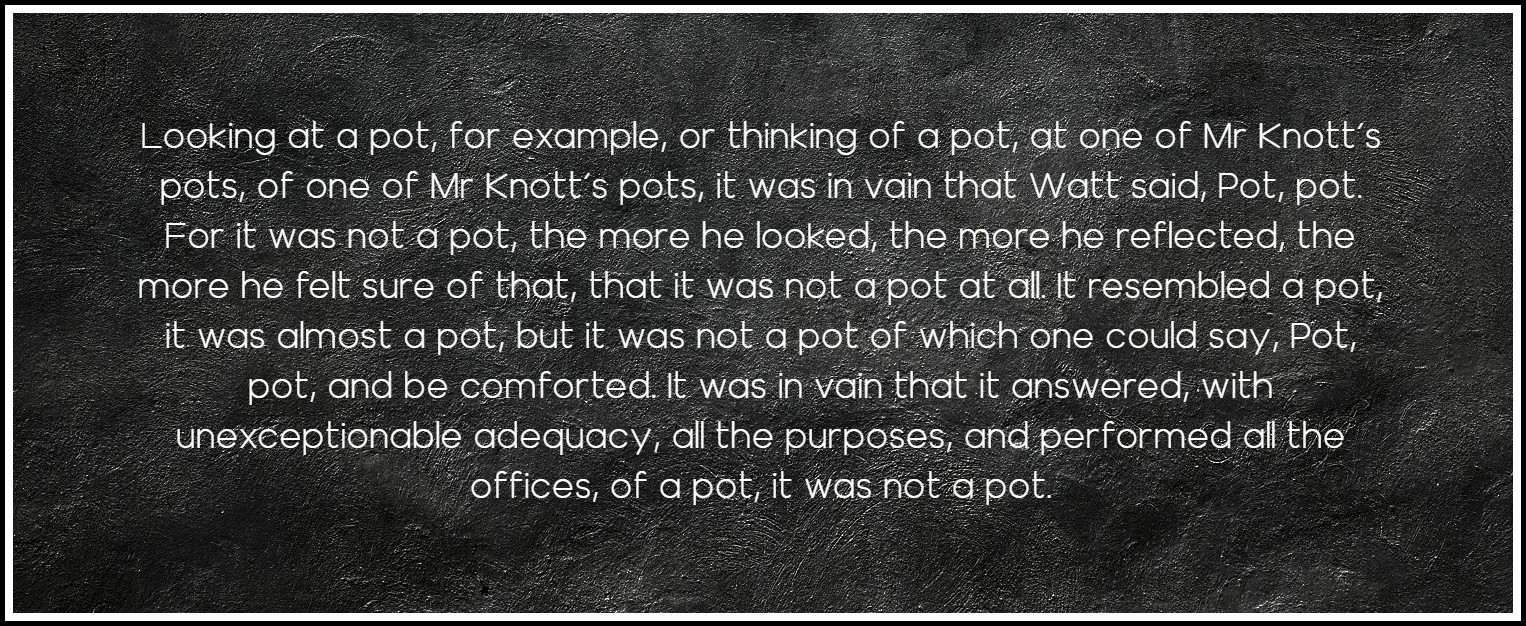
Watt does not give up the world of meaning without a fight, since it is not easy for him to let a piece of his own history (of which the incident with the Galls is one example) dissolve into nothingness. The loss of these object representations, tied to his sense of himself as an intelligent, feeling observer, would also mean the loss of the links of meaning that hold the intrapsychic world together. The struggle to elicit meaning from the world of sensation is the stuff of life itself: ‘Watt considered, with reason, that he was successful when he could evolve, from the meticulous phantoms that beset him, a hypothesis proper to disperse them, for to explain had always been to exorcize, for Watt’. Unfortunately for Watt, his efforts to exorcize the spectres of meaningless sensation begin to fail, he finds himself in a state where the world ‘resisted formulation in a way no state had ever done’. Now the signifiers have been cut loose, and the world is full of unnamables:
Samuel Beckett, Watt, 1953
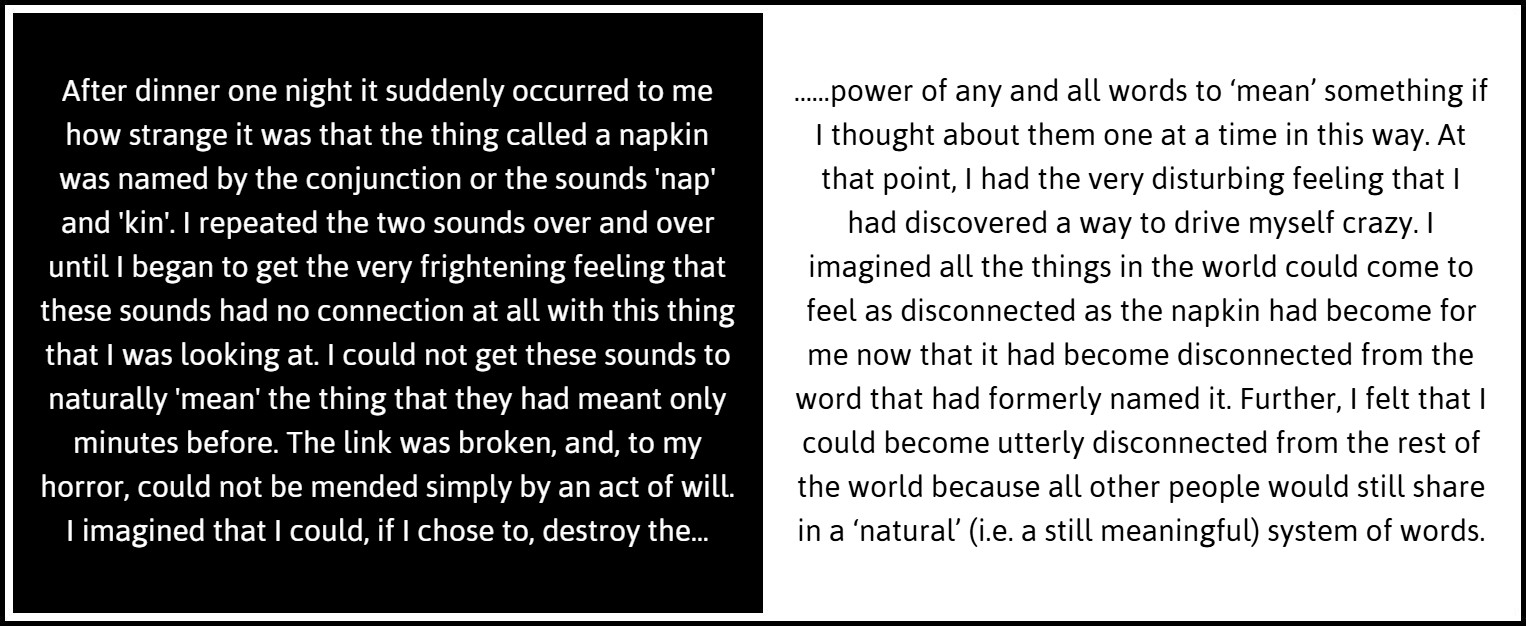
This derealization couples with an alienation from the world not only of physical objects, but of persons, since he feels sure that the pot remains a pot for everyone but himself. This is related to a deep sense of depersonalization, for he begins to decouple from a sense of existing as a living, sentient being, since ‘he could no longer affirm [of himself] anything that did not seem as false as if he had affirmed it of a stone’. The deepest of human anxieties besets him: psychic annihilation triggered by the loss of one’s loving internal objects, and because these anxieties are not contained, he loses the sense of living. Despite his chronic sense of withdrawal, Watt likes to be able to say of himself: ‘Watt is a man, all the same, Watt is a man, or, Watt is in the street, with thousands of fellow-creatures within call’ and clearly the breakdown of meaning is engendered by Watt’s losing contact with persons. He becomes overwhelmed by a sense of abandonment and intense loneliness, feeling ‘greatly troubled’ by this change, and ‘more troubled perhaps than he had ever been by anything’. Ogden describes a similar experience in terms of a collapse from the Depressive Position, in which one can experience an object as whole with ambiguous mixtures of emotion, to the Autistic Contiguous Position, which is pre-verbal and sensation dominated. This results in a tyrannizing imprisonment in a closed system of bodily sensations that precludes the development of potential space. He describes a personal experience akin to Watt’s:
Thomas Ogden, The Primitive Edge of Experience, 1989
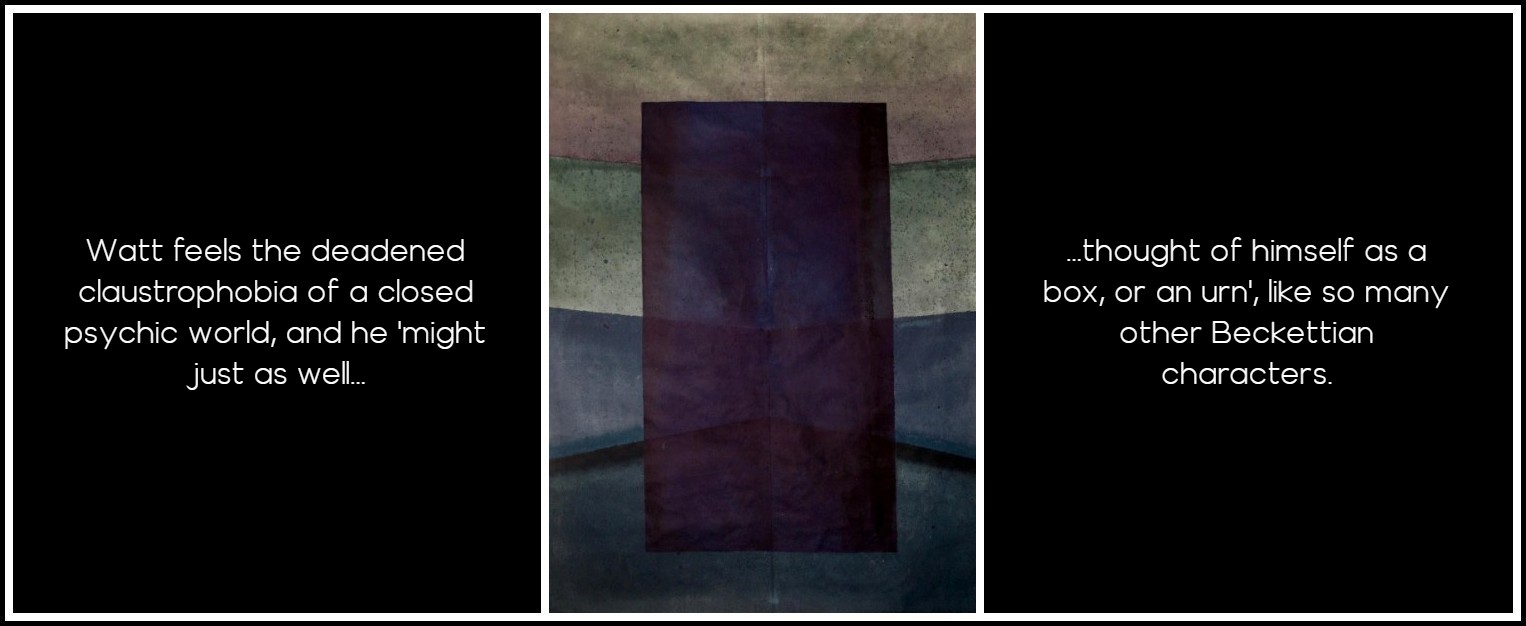
Ogden, like Watt, realizes the central importance of symbolized thought to the core self; the terrorizing realization that without language all connection to others is lost and, more importantly, without a primary connection to others there can be no authentic language in the first place. Unable to experience himself as human, in spite of recalling images of his mother’s teaching him to view himself as such, Watt feels the deadened claustrophobia of a closed psychic world, and he ‘might just as well thought of himself as a box, or an urn’, like so many other Beckettian characters who lose the sense of potential internal space. Unlike Ogden, this is not merely an experiment for Watt, who cannot maintain a core sense of self because he lacks a strong, stable internal object that could counter his fragmentation in times of stress, since neither the image of his mother, nor any sense of connection to his ‘current’ mother, Knott, can enliven him. Watt’s deep fear of abandonment, and his loneliness, are triggered by the Galls’ visit, which retraumatizes him, causing a deep, permanent regression to a pre-symbolic, disorganized experiential world.
Elvire Ferle, Untitled XLIII, 2000-2010
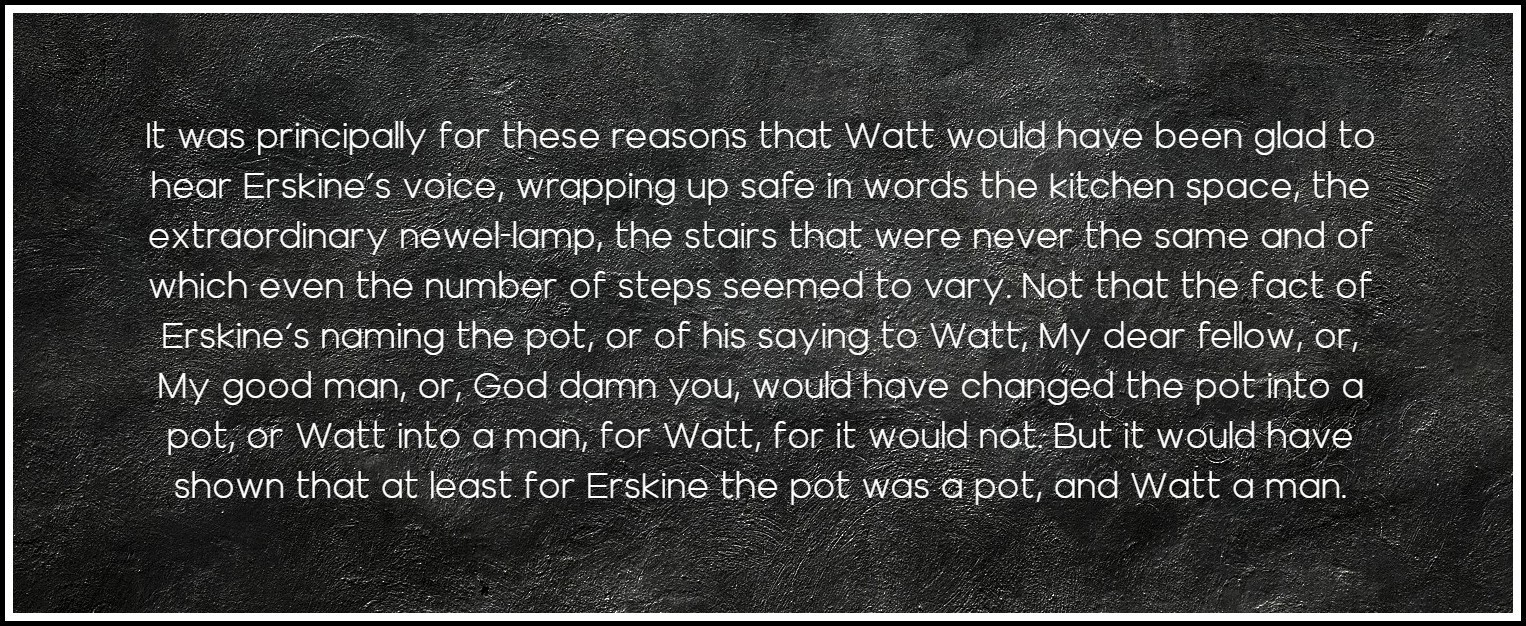
Watt’s desperate need for a soothing, containing core maternal introject is also demonstrated by his yearning for someone to ‘hold’ the world for him. He needs a mother to ‘wrap up safe in words’ the world of primary sensation, to help define and outline his experience by establishing a self as subjective, enduring and delineated. There is the feeling that if the world is real for others, if it can be named and made real for them, then his own experience can be amended and brought into a symbolic realm. The entry into the symbolic realm is not sufficient (nor properly possible) without the core connection to an enduring, loving mother whom the infant wants to reach, and Watt’s body is indeed in an ‘unfamiliar milieu’, in that he remains, as an infant at birth, in an unbounded world of sensation, without the mother to contain and bind the chaos.
Samuel Beckett, Watt, 1953
The possibility that he has lost the world does not entirely create despair or panic in Watt, for whom ‘there were times when he felt satisfaction at his being so abandoned by the last rats’. The rats, metaphorical inhabitants of his inner world (as they were in Murphy’s), tend to be experienced as invasive and disturbing, and there is a regressive pull towards complete schizoid withdrawal: ‘It would be lonely, to be sure, at first, and silent, after the gnawing, the scurrying, the little cries’. This attraction to the loss of his inner world, at times so appealing, is always overpowered by a need for the mother to drive off the terror of complete psychic annihilation: he often longs to hear Erskine’s voice ‘speak of the little world of Mr Knott’s establishment, with the old words’. Watt still strives for connection, a sense of being that can only come with belonging, and for the relatedness that, creates subjectivity. There remains, when the world is dissolving into unnamable fragments, the core acknowledgment of the human need to relate, an acknowledgment Watt ‘would have appreciated more if it had come earlier, before his loss of species’.
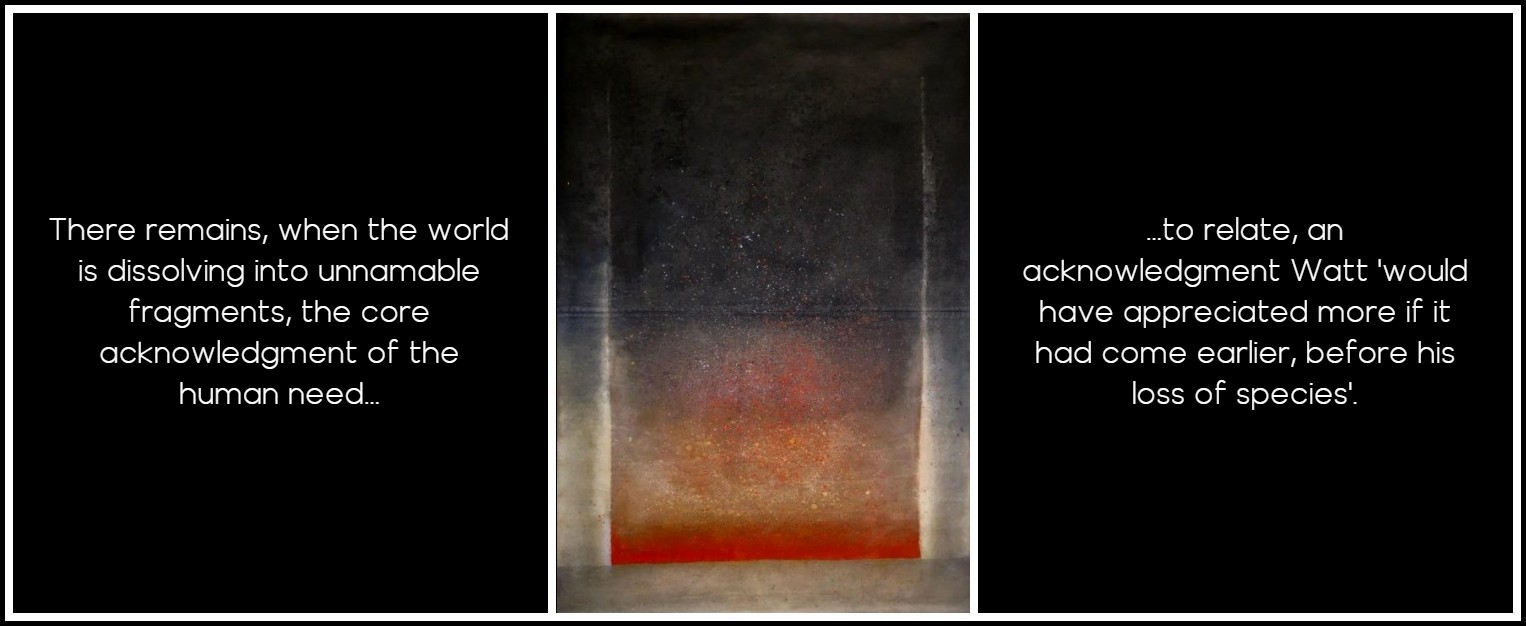
Elvire Ferle, Untitled LIX, 2010-2020
MARA, MARIETTA: A LOVE STORY IN 77 BEDROOMS – READ THE FIRST CHAPTER
A literary novel by Richard Jonathan

RICHARD JONATHAN, ‘MARA, MARIETTA: A LOVE STORY IN 77 BEDROOMS’ — READ THE FIRST CHAPTER
AMAZON & APPLE BOOKS

RICHARD JONATHAN, ‘MARA, MARIETTA: A LOVE STORY IN 77 BEDROOMS’ | AMAZON PAPERBACK OR KINDLE

RICHARD JONATHAN, ‘MARA, MARIETTA: A LOVE STORY IN 77 BEDROOMS’ | APPLE iBOOK
MARA, MARIETTA: A LOVE STORY IN 77 BEDROOMS
A literary novel by Richard Jonathan

Available from AMAZON (paper | ebook) & iBOOKS, GOOGLE PLAY, KOBO & NOOK (see LINKS below)
RELATED POSTS IN THE MARA MARIETTA CULTURE BLOG
CLICK ON THE IMAGE TO GO TO THE POST

By Richard Jonathan | © Mara Marietta Culture Blog, 2026 | All rights reserved
Comments