Samuel Beckett
THIS EMPTIED HEART: WATT’S UNWELCOME HOME – PART 4
John Robert Keller
Posted by kind permission of John Robert Keller, MD M.Litt. PhD., psychoanalyst in private practice in Toronto.
From John Robert Keller, Samuel Beckett and the Primacy of Love (Manchester University Press, 2002) pp. 117-129
This study does not use any biographical information. It is a textual study.
Readers who wish to track the bibliographic references in this study and the page numbers for citations from the novel,
or to consult the notes, are referred to the book, which is (was?) available in an Open Edition version.
THIS IS PART 4 – READ PART 1 FIRST
Thilo Heinzmann, O.T., 2023
V. HUNGRY FOR LOVE
Watt is subjected to a reversal of the normal ‘holding environment’ during his stay with Knott, as he becomes the mother who attends to Knott’s physical and psychological needs for nurturing. Knott, for example, is a sort of omnivore—his weekly allotment of seven luncheons and seven dinners is prepared on Saturday nights in one large pot, and consists of a very long list of ‘all the good things to eat, and all the good things to drink’. This ‘mess’ must be boiled for four hours and becomes a sort of primal nutrient, transcending the basic ‘goodness’ of its individual ingredients, ‘a quite new good thing’. The preparation of this ‘good food’, a most precious and fulfilling mother’s milk, falls on Watt who has himself come to Knott seeking sustenance and security. It is a ‘task that taxed Watt’s powers, both of mind and body’– tears and perspiration fall from his face and body as he labours over the sacred pot. It is a profound emotional ritual for Watt, one that provides Knott ‘the maximum of pleasure compatible with the protection of his health’. So deep and destructive is Knott’s narcissism that even here he denies Watt the opportunity to experience an emotional closeness—the dining times are constructed such that he is never seen by his servant during the meals. Watt is deprived of the love, resonance, and attunement that might accompany the sharing of meals, and the primary intimacy of the nursing couple is lost, robbed of its emotional intensity by Knott’s self-enclosure. Watt’s failure to repair this disconnected internal nursing relationship results in fragmentation and depression, and a deeply repressed rage, something he enacts in a reversal after he leaves the house:
Samuel Beckett, Watt, 1953 | Thilo Heinzmann, O.T., 2024 (detail)
Primitive rage and envy are at work in Watt, now clearly feeling abandoned and unwitnessed by the mother. Displacing his attacks, which continue, he and Sam sometimes seize ‘a plump young rat, resting in our bosom after its repast, we would feed it to its mother, or its father, or its brother, or its sister, or to some less fortunate relative’. This is a reversal, as Watt becomes a loving mother to the rats, only to change without warning into the polar opposite, a violent, sadistic mother who initiates a nightmarish, cannibalistic feast, in which families devour themselves. This enactment also suggests his raging jealousy of the other servants, baby rats/birds left behind to continue a fantasized relationship with Knott. Watt exists in a confused, borderline state, where the mother is felt to be as unpredictable as the self, oscillating rapidly between a nurturing, all-embracing love and a violent, sadistic withholding. The case of Mr D. reflects this type of rage; the patient felt a deep, primal disconnection from his mother—she was a monster who withheld food from him. During a Christmas break early in our work, he experienced deep rage at me-as-mother for abandoning him, and he drowned seven of his pets. He stated he felt ‘sorry for them’ and wanted to put them out of their misery, they must be sad and lonely. Only years later was he able to experience the fury he felt at this time, and realize he was killing himself out of despair, murdering his mother/myself out of anger.
Thilo Heinzmann, O.T., 2013
While with Knott, Watt also learns about a long-departed servant, Mary, one in the long series of workers drawn into service only to be discarded as others come along. The emotional absence that permeates the house has a bad effect on Mary: Little by little the reason for her presence in that place faded from her mind, as with the dawn the figments of the id, and the duster, whose burden up till now she had so bravely born, fell from her fingers, to the dust, where having at once assumed the colour (grey) of its surroundings it disappeared. Mary responds to the house’s emotional vacuum by becoming psychically disorganized—her conscious sense of herself fades along with her sense of purpose, and like her duster she begins to dissolve into the background greyness. Her isolation prompts a regression, a re-emergence of the core caretaking function of feeding, and as Mary deteriorates physically her appearance resembles other Beckettian heroines (e.g. May in Footfalls or the heroine of Rockaby), also representatives of the ‘lost heart of the self’. Mary is propped up in a kind of stupor against one of the walls in which this wretched edifice abounds, her long greasy hair framing in its cowl of scrofulous mats a face where pallor, languor, hunger, acne, recent dirt, immemorial chagrin seemed to dispute the mastery.
Thilo Heinzmann, O.T., 2024 (detail)
She is in a catatonic state—she has a ‘dreaming face’, her body acts as an automated feeding machine as her hands flash ‘to and fro’, like ‘piston rods’ from a food sack to her mouth, while not a muscle stirs that is not intimately involved in the process of self-nurturing that occupies her every waking hour. That Mary’s face still reflects her hunger is not surprising since the food she ingests is a symbolic replacement for the emotional responsiveness and love she really craves. Guntrip describes such a ‘love-hunger’ in one of his patients, a woman, who felt compelled to eat whenever her husband came into the house, realizing she was ‘hungry for him’ and his love but could not show it. She dreamt ‘she was eating an enormous meal and just went on endlessly. She is getting as much as she can inside her before it is taken away. She has no confidence about being given enough’. For Mary, a ruptured internal nursing relationship leads to somaticized enactments of inner despair; as a despairing, withdrawn part of the infantile-self, she tries to symbolically reconnect to a loving mother in the hope of reparation.
Thilo Heinzmann, O.T., 2024
VI. SHIPS IN THE NIGHT
A number of symbols reflect the primary dislocation between Watt and his master. Once his isolation from Knott becomes fully apparent, Watt tries to develop a relationship by peripheral means. Aware that Knott sometimes rings for Erskine late at night, Watt spends long hours ruminating on the nature of this communication system, its mechanisms, and the reasons for its establishment. His thinking becomes terribly convoluted, obsessional, and paranoid and he decides to examine Erskine’s room, but has difficulty with the lock, thinking, ‘obscure keys may open simple locks, but simple keys obscure locks never’, and one could see Watt as the simple (infantile) key that cannot gain access to the obscure (maternal) lock that is Knott. He cannot fix any value to this thought in his mind, oscillating cruelly between regretting the thought, and finding comfort in its clarity. Unable to form a judgment, having lost the ability to attach emotional foundations to thought, he continues in this paralyzed state, until, by means unknown, he finds himself in Erskine’s room, with a broken bell symbolic of a communicative access to Knott for ever beyond his ken. Like a ruptured synapse, the bell no longer functions, and Watt’s dream of communicating with Knott, even indirectly, is shattered.
Thilo Heinzmann, O.T., 2018
The bell is a central symbol whose significance is formed by the role it plays in linking Knott and his servants. It is reminiscent of a vignette in Kohut’s Analysis of the Self, which describes a patient intensely enmeshed with his mother, who ‘controlled him in a most stringent fashion’; his eating times were ‘determined by a mechanical timer which she used as an extension of her need to control his activity’. Knott also experiences his servants as extensions of himself, and the entire house is designed to place strict limits on their actions, in order to control them, guaranteeing fulfilment of his needs in a safe, predictable way. Knott, just as the mother in the clinical vignette, reverses the roles of child and mother when it suits his needs, and both discourage individuation of their child/servants. The patient’s mother, as Knott has done (with the bell), installs a buzzer in the child’s mom: ‘From then on she would interrupt his attempts at internal separation from her whenever he wanted to be alone; and she would summon him to her, more compellingly (because the mechanical device was experienced as akin to an endopsychic communication) than would have been her voice, or knocking, against which he could have rebelled’. Knott also controls his servants by means of the bell, again blurring the roles of mother and child: the servant/mother is summoned to attend to the helpless Knott/child, but it is Knott who dominates the relationship. There is a distortion of normal maternal attunement, both the child in Kohut’s vignette, and the servant, lose their autonomous boundaries. The normal dyadic relationship becomes parasitic in both cases and, as a consequence, Watt really begins to lose his mind, just as Kohut’s patient ‘felt increasingly that he had no mind of his own’.
Thilo Heinzmann, O.T., 2018
Alone in Erskine’s room, Watt observes the ‘only other object of note’ to be a picture on the wall: A circle, obviously described by a compass, and broken at its lowest point, occupied the middle foreground, of this picture. Was it receding? Watt had that impression. In the eastern background appeared a point, or dot. He struggles to grasp the painting’s meaning, particularly the relationship between the circle and the dot, wondering how long it will be ‘before the point and circle enter together in the same plane’. That they are in a vital, significant search is not in doubt: Had they sighted each other, or were blindly flying thus, harried by some force of merely mechanical mutual attraction, or the playthings of chance. He wondered if they would eventually pause and converse, and perhaps even mingle, or keep steadfast on their ways, like ships in the night. The painting represents the possibility of communion between two distinct and separate objects, destined to meet, or to go on for ever, silently, in their aloneness. Watt finally settles on the following formulation, the dot now transformed into a ‘centre’, it was perhaps ‘a circle and a centre not its centre in search of its centre and its circle respectively, in boundless space, in endless time’. The painting symbolizes the relationship to his Knott/mother: alone and fragmented he seeks a centre to his being, a strong, cohesive sense of self. His internal world is empty, there is a break in his sense of self, just as there is a break in the circle without its centre. Both Watt and the circle are searching for something to enter them, to make them whole, and he yearns for an enduring, internalized mother to hold him together.
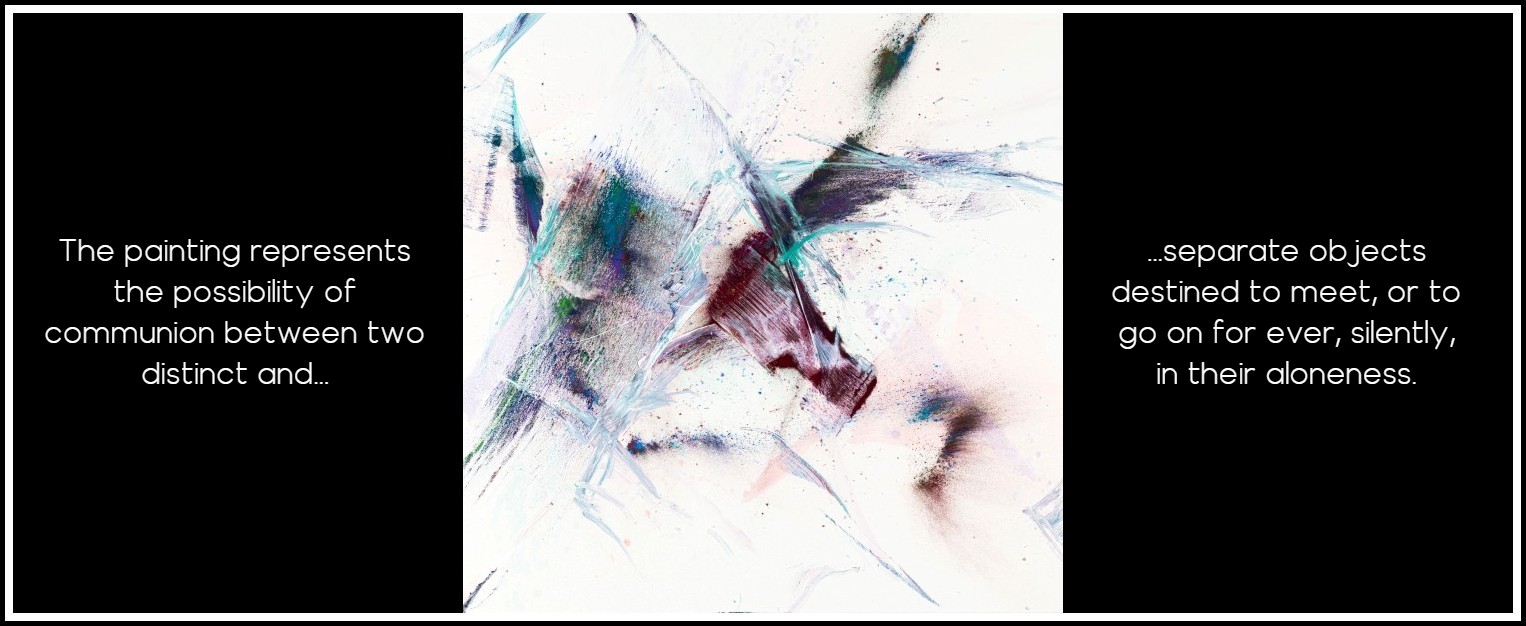
Thilo Heinzmann, O.T., 2023
Conversely, though, the circle is Knott, and in Watt’s fantasy it is the mother/circle who is looking to contain something that is both a part of herself, and not a part of herself—her child—and to hold it internally/psychically, as she once held it physically within her own body, allowing it the secure freedom to begin to create a world for itself. Alone and unheld by the mind of a mother who does not witness him, and with no hope of containment, Watt is left adrift like the dot, breaking apart under annihilation anxieties, and continuing a doomed attempt to contain Knott in order to maintain the dyadic bond. He enacts his fantasy of merger with Knott in his reading of the painting, and the desperate hope that somehow, magically, this reading connects to, and will shape, the real intentions of Knott himself. Tustin also speaks of the circle’s importance to the withdrawn child: ‘I began to realize that the ‘shapes’ the autistic children were talking about to me were not these objective geometrical shapes which we all share. They were entirely personal shapes which were idiosyncratic to them, and to them alone, the circle being an especially comforting one for all of them’. There is something about the circle that binds sensation for the child, protecting it from the terrors of an indigestible world, and Watt dwells on his circle that is both Knott and Watt, yearning for completeness and loving containment. As he thinks about the centre and the circle in their search for each other ‘in the boundless space, in the endless time’ that are the domain of pre-verbal experience, he mourns the reality of his own loss in the house of Knott, ‘and his eyes filled with tears that he could not stem’, another example where a realization of the fantasy nature of an attachment to an unreachable internal imago creates a powerful emotional experience.
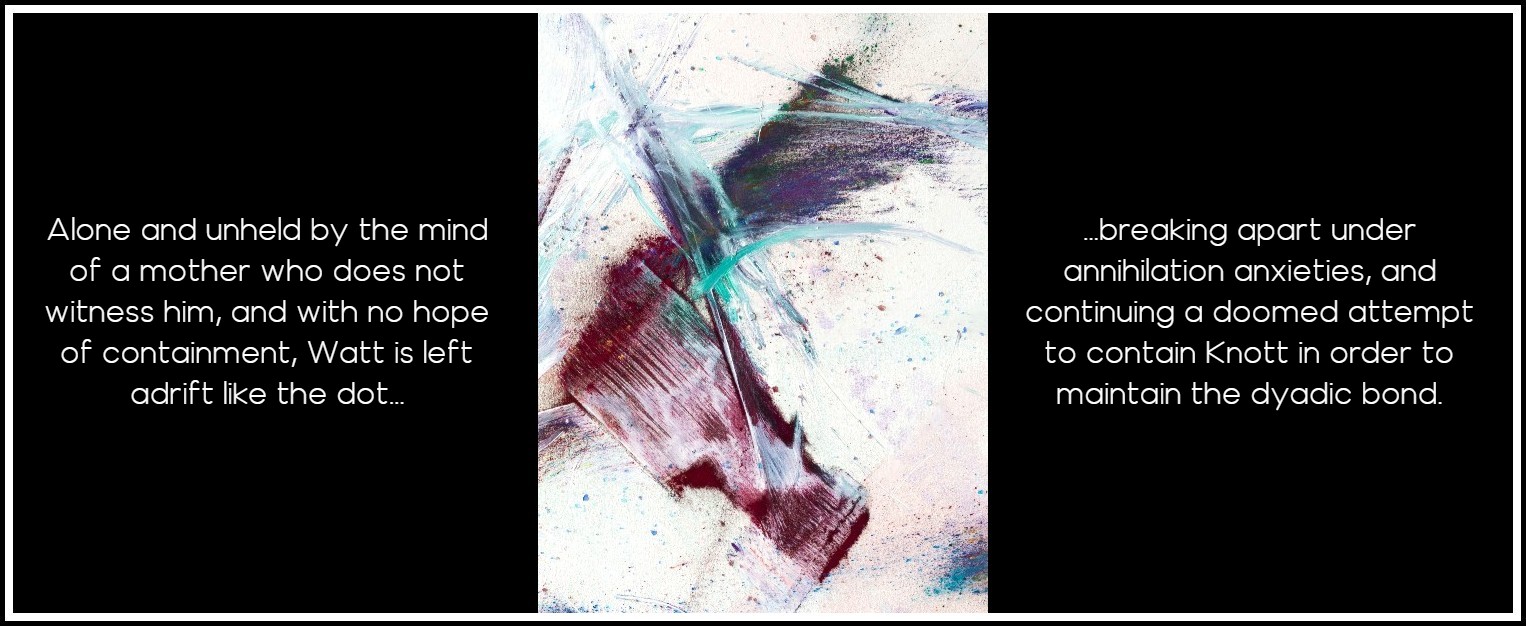
Thilo Heinzmann, O.T., 2023 (detail)
In Knott’s house, all is ‘a coming and a going’, there is no space for a living presence or genuine relatedness. Watt struggles to maintain the illusion there is some sense to be made of his stay with Knott, thinking that if it appears to be arbitrary it is really a ‘pre-established arbitrary’. He cannot tolerate the idea that Knott is entirely detached, unconcerned with his servants’ worlds: ‘For otherwise in Mr Knott’s house, and at Mr Knott’s door, and on the way to Mr Knott’s door, and on the way from Mr Knott’s door, there would be a languor, and a fever, the languor of the task done but not ended, the fever of the task ended but not done’. This door imagery is reminiscent of Beckett’s poem ‘neither’, and the wandering ‘to and fro’ again suggests the homelessness, a self isolated between inner and outer worlds, itself and (m)other. To the end, Watt maintains his view of Knott as a sanctuary, a saviour who will hold and heal him: ‘Mr Knott was a harbour, Mr Knott was haven, calmly entered, freely ridden, gladly left’, imagery reminiscent of Margaret Mahler’s ‘safe anchorage’ within its mother’s mindful care. This is the heart of Watt’s fantasy—being held by Knott would allow him a peace in the world, and in himself, he has not known in a lonely, despairing life in which he has been driven by both ‘the storms without’ and ‘the storms within’. In coming to Knott, he hoped to find ‘in the need, in the having, in the losing of refuge, calm and freedom and gladness’, a wish for primary containment that would allow him to leave this refuge, when he is ready, as a whole, sane person. Later, while thinking ‘of all the possible relations between the various series’ that he has ruminated over in his attempt to ‘know’ Knott, Watt’s mind drifts to a distant time when he was young, lying ‘all alone stone sober in the ditch, wondering if it was the time and the place and the loved one already’. He hears the croaking of three frogs, at intervals:
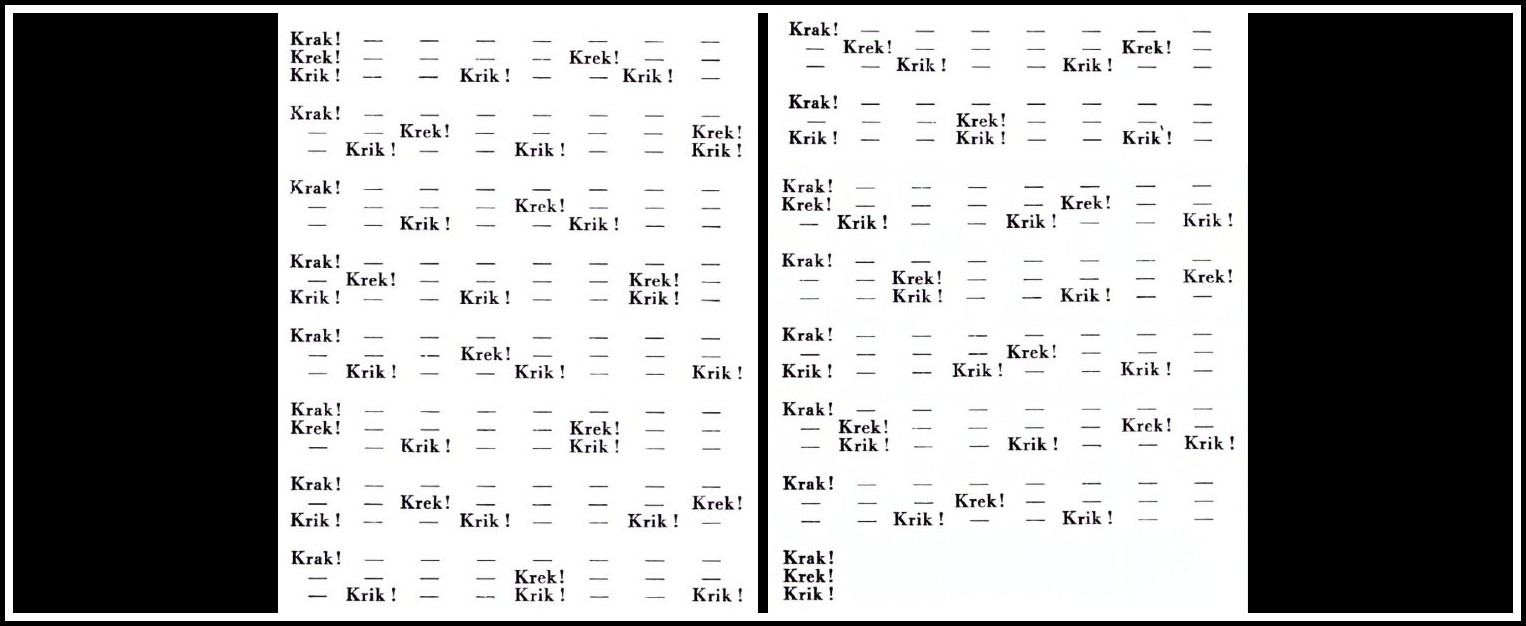
Samuel Beckett, Watt, 1953
The pattern continues until all three voices are aligned as in the first instance, and this image is another powerful metaphor of Watt’s need for connection with the mother, of his yearning for a sense of being in an intimate harmony. The frogs’ voices go out of sequence as they separate, but return ‘home’ to be as one, as a child wanders from the mother to return to her side in safety, eventually coming home to the ‘background mother’ internally even when alone. The voices begin together, separate, and explore their individuality within a community, finally returning to the source and to a unity. It is this very early type of mirroring that the mother provides for the child, bringing him into the community of minds, and it is here that Knott fails Watt.
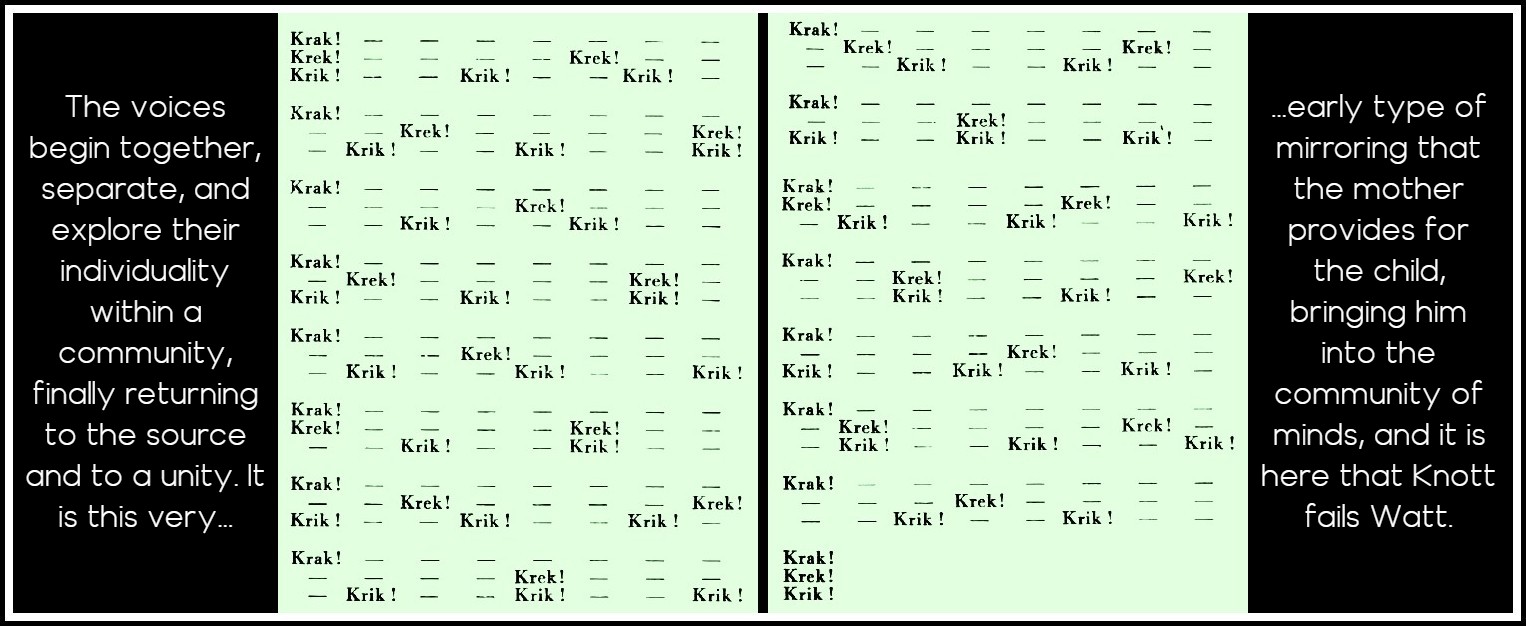
Samuel Beckett, Watt, 1953
VII. ALIV NOT DED NOT
Watt’s inability to engage Knott results in ego-failure (loss of language, hallucinatory voices), in his defensive strategies (obsessive ruminations, intellectualization), and in his schizoid relationship with the world. He lives in a dead universe, entrapped by ruminative speculation about a world to which he does not connect emotionally. Watt is beginning a process of repair when he enters the house, the ‘wild dim chatter’ he occasionally hears coming from Knott’s lips is comforting, and he grows ‘exceedingly fond’ of it. Living only in the moment, his experience is uncoloured by enduring emotion: ‘Not that he was sorry when it ceased, not that he was glad when it came again, no’. However, burgeoning emotion begins to link various states of Knott’s absence and presence, and Watt edges towards a Depressive Position—there is a both a sense of loss and of joy that emerges in the metaphors surrounding the experience: ‘But while it [Knott’s voice] sounded he was gladdened, as by the rain on the bamboos, or even rushes, as by the land against the waves, doomed to cease, doomed to come again’. The experience of hearing Knott’s voice is likened to a variety of soft, natural sounds, images that are evocative of the quiet, gentle murmuring of the mother with baby. There are many similar allusions in the oeuvre: Krapp’s gently rolling bliss with the girlfriend/mother among the rushes; Vladimir and Estragon’s mistaking ‘the wind in the reeds’ for Godot, and so forth, all reflecting an early experience of recognition and connection to the Mother.
Thilo Heinzmann, O. T. Diptych, 2012 (left panel)
There is a sense of this in Sartre’s conception of the gaze, which became a starting point for Lacan: Of course what most often manifests a look is the convergence of two ocular globes in my direction. But the look will be given just as well on occasion when there is a rustling of branches, or the sound of a footstep followed by silence, or the slight opening of a shutter. The images used by Sartre are found in Beckett: ‘footfalls’ appearing in the short play of the same name, as well as in Murphy, suggesting in both an early sense of connection to a mother who recognizes the infant. The opening, closing doors that appear in Beckett’s poem ‘neither’ and in Watt echo the ‘shutter’ imagery that reflects the polarity of acceptance through, and exclusion from, love. These sounds are not always ones that elicit a sense of security. In Waiting for Godot, the tramps mistake the sound of ‘the wind in the reeds’ for a terrifying arrival, and later, in fast-paced cross-talk, speak of ‘all the dead voices’ that rustle like leaves, reflecting disconnection from a benevolent primary object. As Acrisius said: ‘To him who is in fear everything rustles’, in the paranoid state there can be no proper, loving recognition behind the sounds, only emptiness or hostile intent. This is the inherent ambiguity of the Paranoid Schizoid Position, that the same object, or its representation, can elicit both good and bad feelings, depending on the internal state of mind of the infant self.
Thilo Heinzmann, O. T. Diptych, 2012 (right panel)
Watt hovers close to mourning, almost able to experience Knott’s absence as a loss. His general indifference to the world begins to melt away as contradictory states of pleasure/displeasure, love/hate, merge into a coherent sense of self-with-other linked by an emotional bonding. He is at the edge of the Depressive Position, able to tolerate ambivalence. Unlike Arsene, however, who appears to be entering into a mourning process as he leaves the house, Watt cannot tolerate the confusion and overwhelming emotions that the rupture with the Knott precipitates—he regresses back into a severely autistic position. After leaving the house he travels to a sanitarium of some kind, where he relates his story to the narrator of the novel, Sam, while they walk together on the grounds. In this telling, Watt’s need for connection is made manifest, as he makes use of Sam as a containing mother to hold him together in the face of terrorizing anxiety and rage.
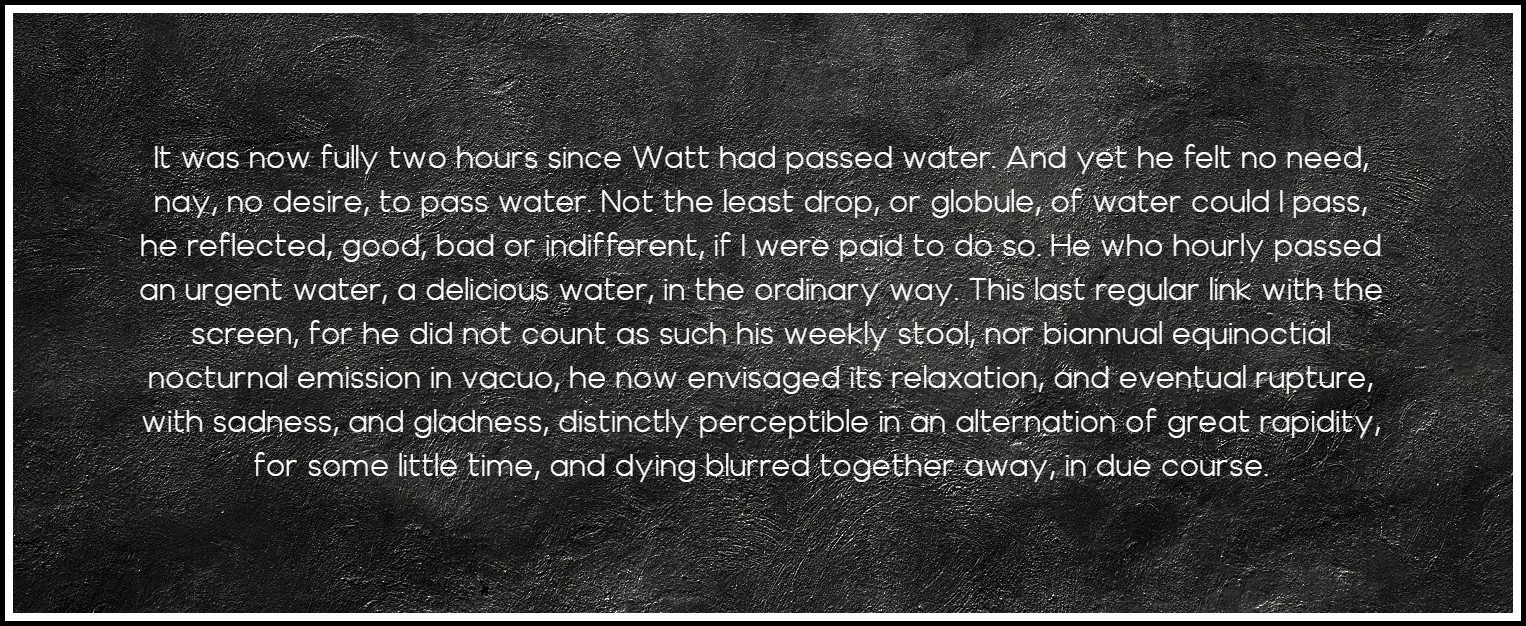
Samuel Beckett, Watt, 1953
While recounting the last part of his stay with Knott, Watt is in a kind of somnambulistic delirium, his voice rapid and low, and he begins to invert his use of language, sentences, words, and letters. From these descriptions of his non-relationship with Knott comes an emotional climax that expresses the schizoid longing for contact with the mother:
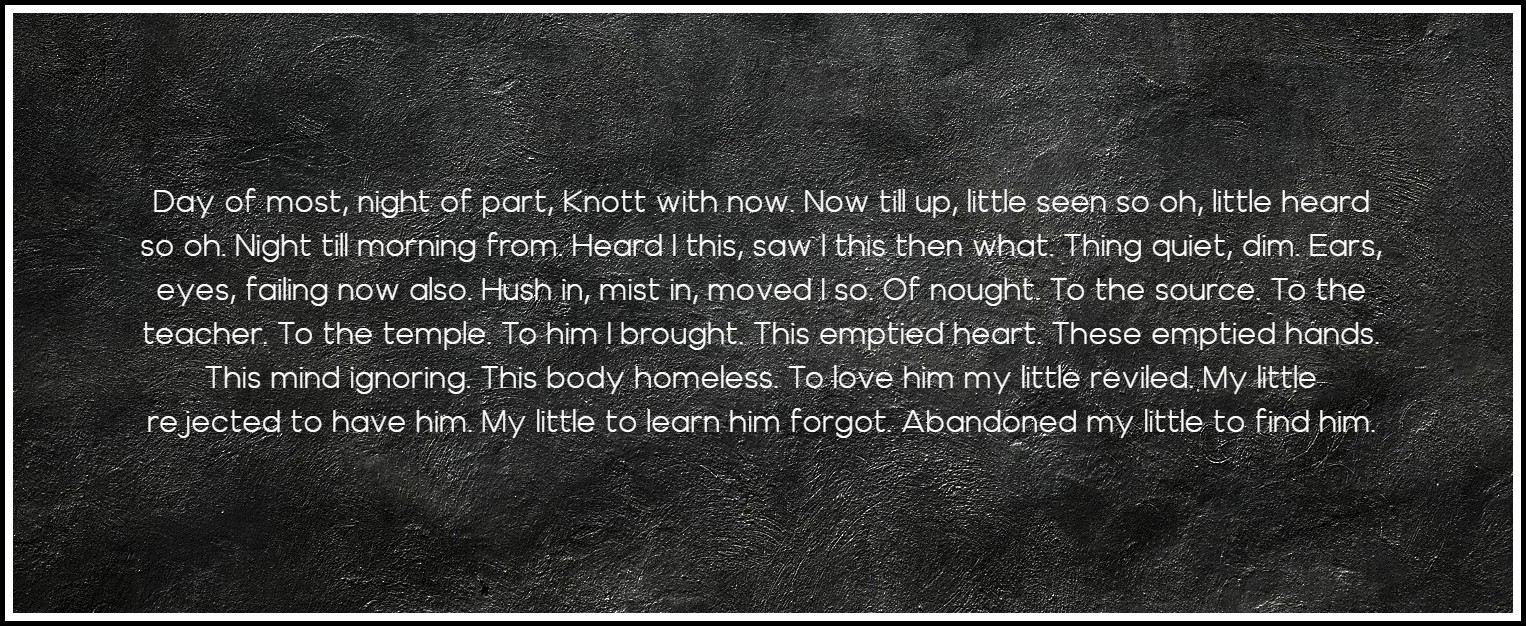
Samuel Beckett, Watt, 1953
Finally, toward the end of his stay, Watt spends more time with Knott, but this merely physical presence does not provide a deep emotional connection. He has not seen or been seen for so long, moving in a world of ‘mist’ and ‘hush’, abandoning his living sense of himself to be near Knott. He comes to the house in a state of deep, dependent humility, with his body made ‘homeless’ by a premature, incomplete birth, with an impoverished internal world closed off to experience by schizoid withdrawal, and a sense of himself as barren of love. Knott is a ‘temple’, as the mother’s body is a holy place that embodies the world to the infant and, as mother Knott is a ‘teacher’ who could show Watt how to create the world. These passages demonstrate the core emotional dynamic that exists between Knott as a maternal figure and Watt as an emerging infantile-self.
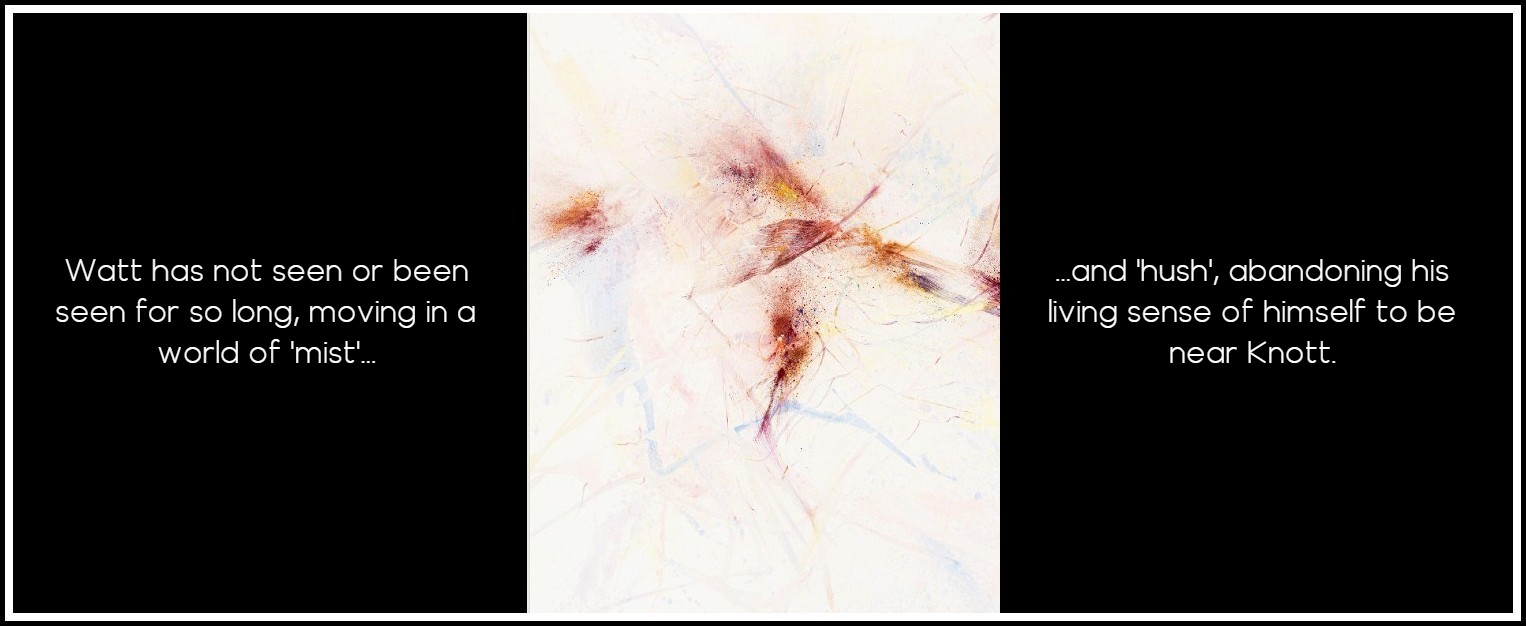
Thilo Heinzmann, O.T., 2024 (detail)
Towards the end of his stay with Knott, a primitive merger-experience develops, but it is a gross distortion of the normal maternal ‘concern’ that is found in a union held together by love and reverie: Go to, cam day lit. Knot not, Watt not. Sprit not, bod not. A ded not, aliv not. Awak not, aslep not. Gay not, sad not. Tim for, lived so. This reads like a ‘death in life’ nightmare, a disembodied, depersonalized account of ‘neither’ experience [‘neither’ is a poem by Beckett] diametrically opposed to the warm, loving experience of a holding oneness that leads to experience. Like the dot and circle in Knott’s painting, the two of them, Knott and Watt, exist together in isolation, and Watt is truly alone ‘in the presence of the mother’, without any internal sense of her presence to protect him from the terrors of nothingness. In the final passages, Watt relates to Sam about these times together with Knott, the full impact of neglect becomes apparent. In addition to demonstrating the breakdown of his core ego functioning, these passages reveal the failure of maternal attunement. Watt does not exist for the mother, and attempts to maintain the threads of a relationship by remaining close to the source of absence. The experience of ‘niks, niks, niks’ is made somehow less annihilating if he remains close, but there is quite clearly a cry for primary containment through sensual touch, something Watt expresses through the hope that the ‘niks’ will envelop him as a ‘skin’.
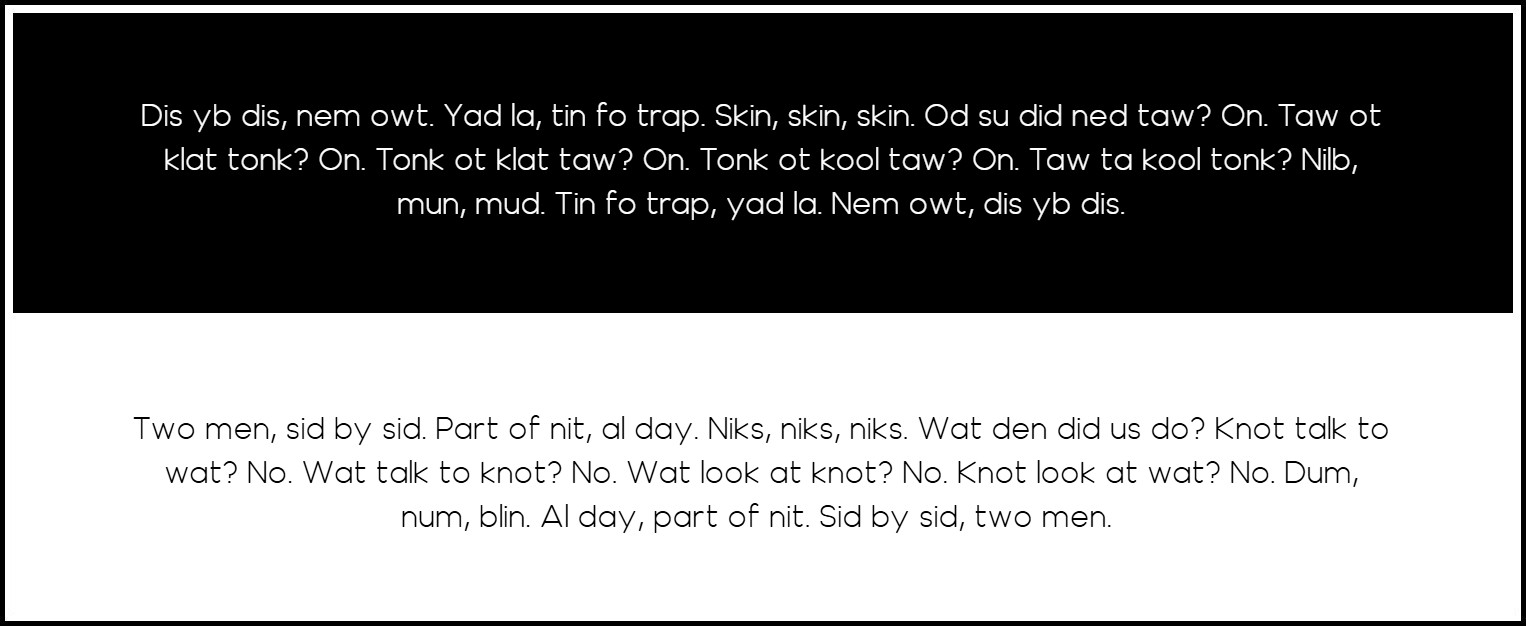
Samuel Beckett, Watt, 1953 (top row only)
Watt’s relationship with Sam provides a complement to his Knott-experience. On one occasion during their stay together, while walking in the garden behind his residence, Sam comes upon the fence that separates him from the garden belonging to Watt’s residence. The isolation of the men wandering alone in their gardens recalls the theme of psychic separation that dominates the work, but in this setting there is a passage between the two worlds. Sam spies Watt, now fully regressed, walking towards him, backwards, through brambles and briars: he is bloodied, but oblivious to the pain. As he turns to retrace his steps, Sam gets a look at him: ‘Suddenly I felt as though I were standing before a great mirror, in which my garden was reflected, and my fence, and I, and the very birds tossing in the wind, so that I looked at my hands, and felt my face, and glossy skull, with an anxiety as real as unfounded’.
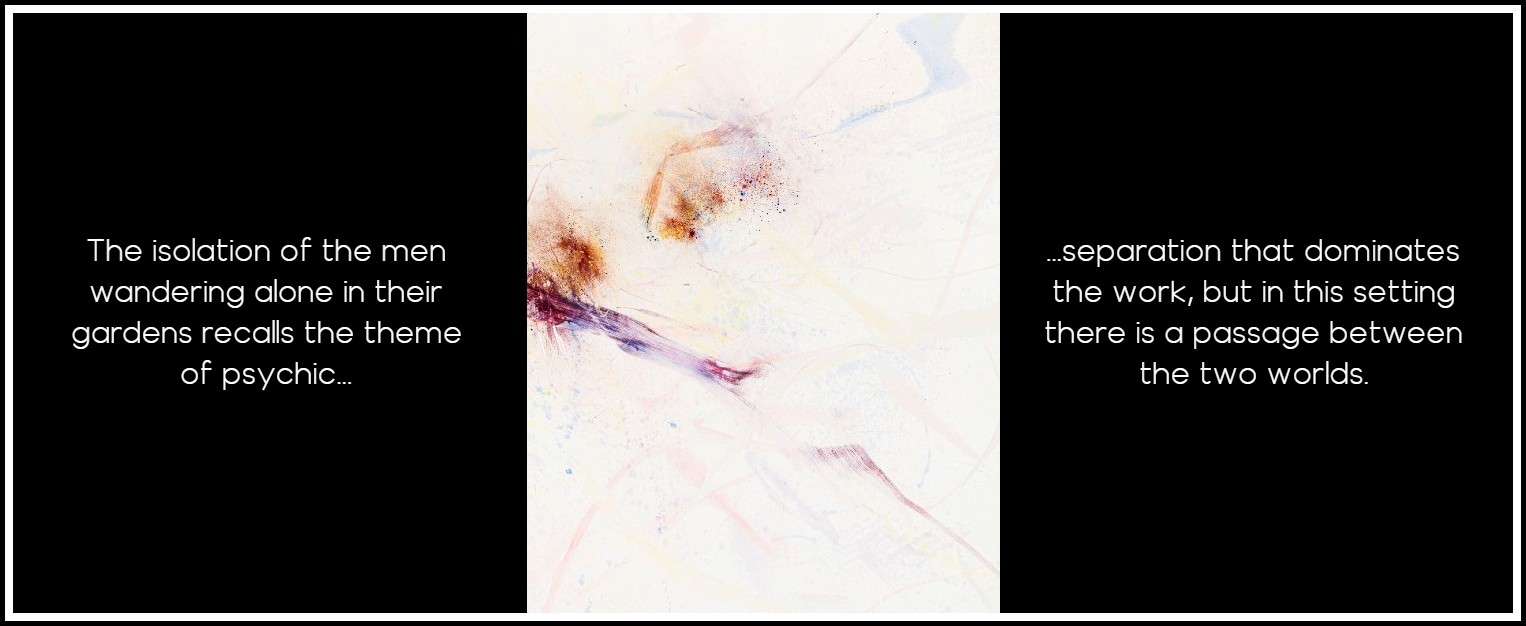
Thilo Heinzmann, O.T., 2024 (detail)
Sam’s experience of this mirroring depersonalization is a natural climax to the work, representing the narrative-self’s attempt at reparation, a last desperate grasp to keep Watt a part of a shared world, though, as noted, this is ambivalent. Sam has a deep affection for his friend; he quickly goes to Watt’s aid, telling us: ‘In my anxiety to come to Watt then I would have launched myself against the barrier, bodily, if necessary’. Sam struggles to get to his friend, accepting a position in direct contrast to Knott. He becomes a caring mother who, seeing an infant in distress, experiences an empathic attunement and attends to the pain. The mirroring experience can be viewed as Sam experiencing himself in Watt, sharing a mutuality, or experiencing a projection, so that he is motivated to take action. Once he reaches Watt, he dresses his wounds, cleans him, and grooms him, in a word, heals his body and gives him a sense of human dignity. This contact takes place in between their respective gardens/minds, in a sort of intersubjective potential space:
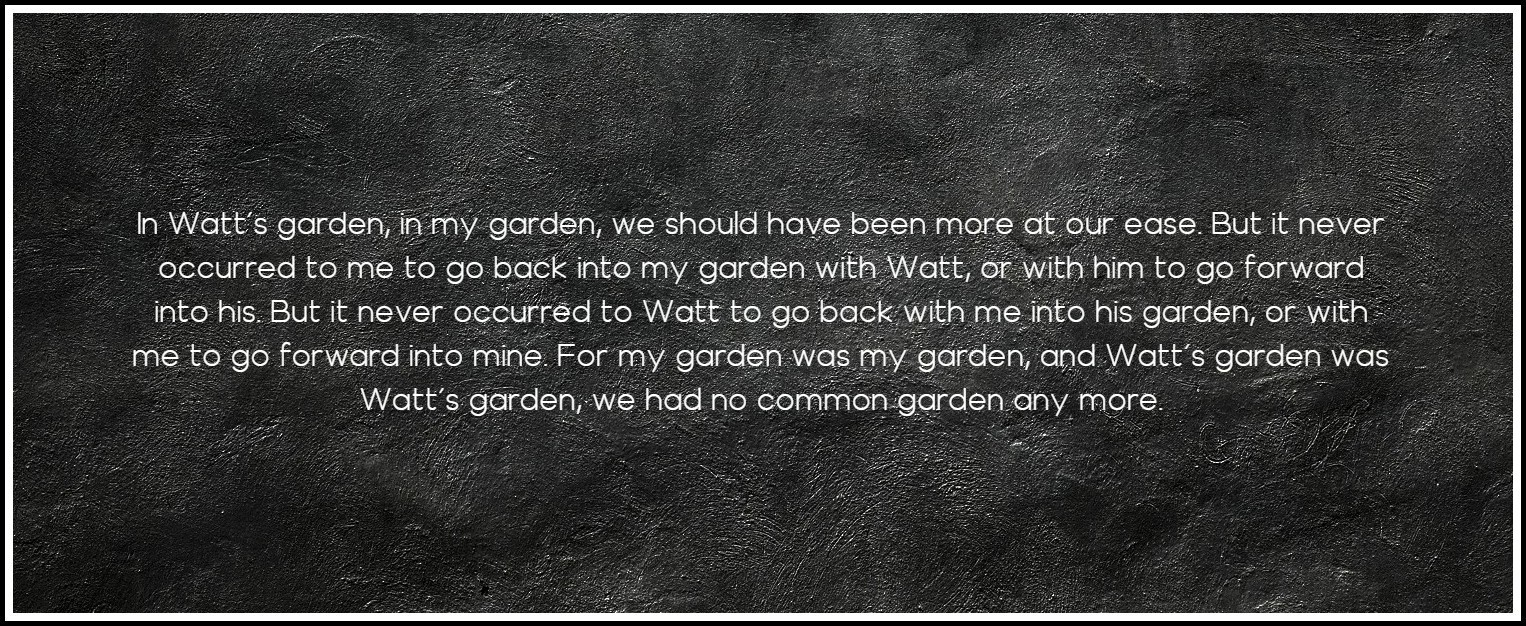
Samuel Beckett, Watt, 1953
There is development within this passage, as both men appear secure to meet within an intersubjective space, despite feeling a greater sense of security within their own containing gardens/minds. Sam turns Watt to face him, places Watt’s hands on his shoulders, and begins a beautiful, richly metaphorical ‘mirror dance’:
Samuel Beckett, Watt, 1953
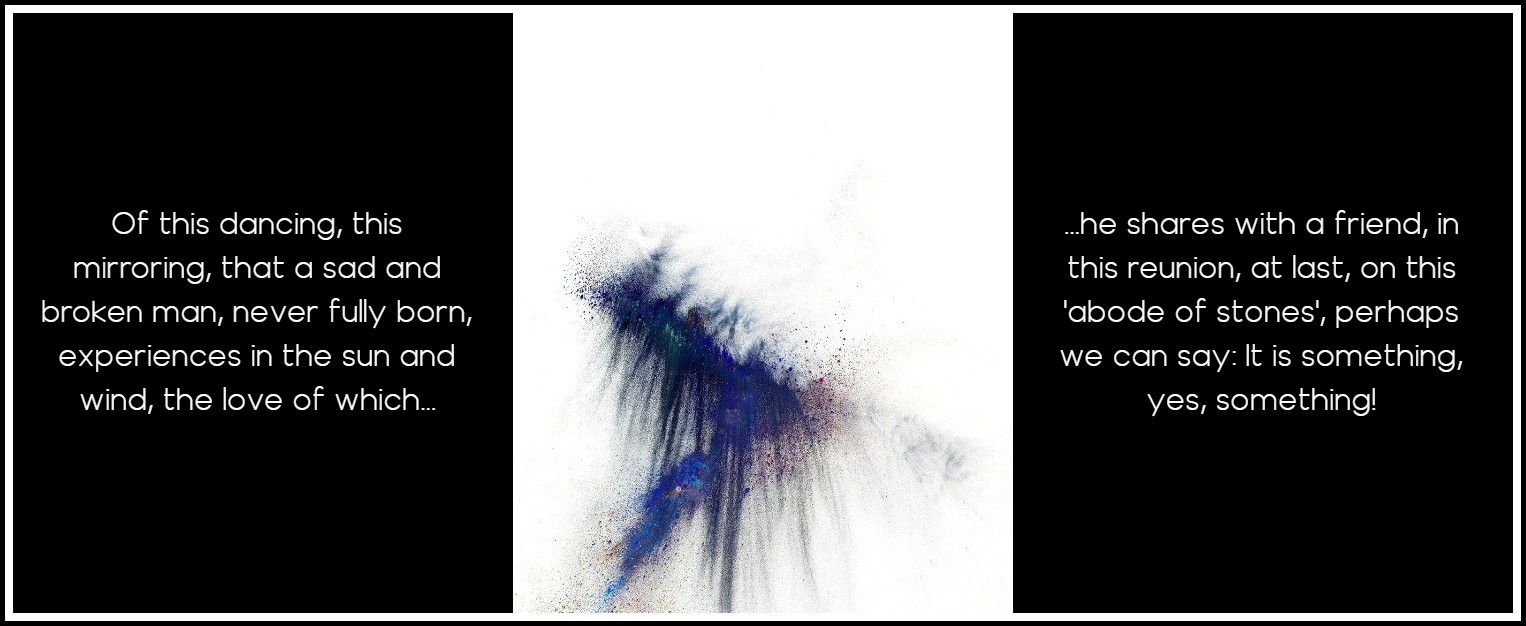
In this mirroring, a ray of loving attunement and hope shines through in a world of despair. Sam’s love for Watt is expressed literally in his concern for his friend’s physical safety, and metaphorically as a perfectly empathic movement of two selves working together as one. As mother and child, they play together, blurring between the one who leads the dance, and the one who follows, between the mother who teaches life, and the child who learns it. Watt has found a mother to hold him in a selfless containment of his pain and confusion, allowing him to feel himself into the world as part of her body and its movements. It is his sad fate, as a lost part of the narrative-self, that this relationship cannot endure, for Watt is soon transferred from the pavilion never to be seen by Sam again. But of this dancing, this mirroring, that a sad and broken man, never fully born, experiences in the sun and wind, the love of which he shares with a friend, in this reunion, at last, on this ‘abode of stones’, perhaps we can say: It is something, yes, something!
Thilo Heinzmann, O.T., 2013
MARA, MARIETTA: A LOVE STORY IN 77 BEDROOMS – READ THE FIRST CHAPTER
A literary novel by Richard Jonathan
RICHARD JONATHAN, ‘MARA, MARIETTA: A LOVE STORY IN 77 BEDROOMS’ — READ THE FIRST CHAPTER
AMAZON & APPLE BOOKS

RICHARD JONATHAN, ‘MARA, MARIETTA: A LOVE STORY IN 77 BEDROOMS’ | AMAZON PAPERBACK OR KINDLE

RICHARD JONATHAN, ‘MARA, MARIETTA: A LOVE STORY IN 77 BEDROOMS’ | APPLE iBOOK
MARA, MARIETTA: A LOVE STORY IN 77 BEDROOMS
A literary novel by Richard Jonathan

Available from AMAZON (paper | ebook) & iBOOKS, GOOGLE PLAY, KOBO & NOOK (see LINKS below)
RELATED POSTS IN THE MARA MARIETTA CULTURE BLOG
CLICK ON THE IMAGE TO GO TO THE POST

By Richard Jonathan | © Mara Marietta Culture Blog, 2026 | All rights reserved
Comments