A Music of Siren Signifiers
ECHOES OF JAMES JOYCE IN ANTHONY BURGESS: ‘A CLOCKWORK ORANGE’
Nuria Belastegui
Posted by kind permission of Nuria Belastegui, PhD (English Literature); former associate, International Anthony Burgess Foundation; writer about literature, language, and art.
Readers who wish to track the bibliographic references and the page numbers for citations from the books cited in this study,
or to consult the notes, are referred to Academia, where they will find the paper online with the complete critical apparatus.
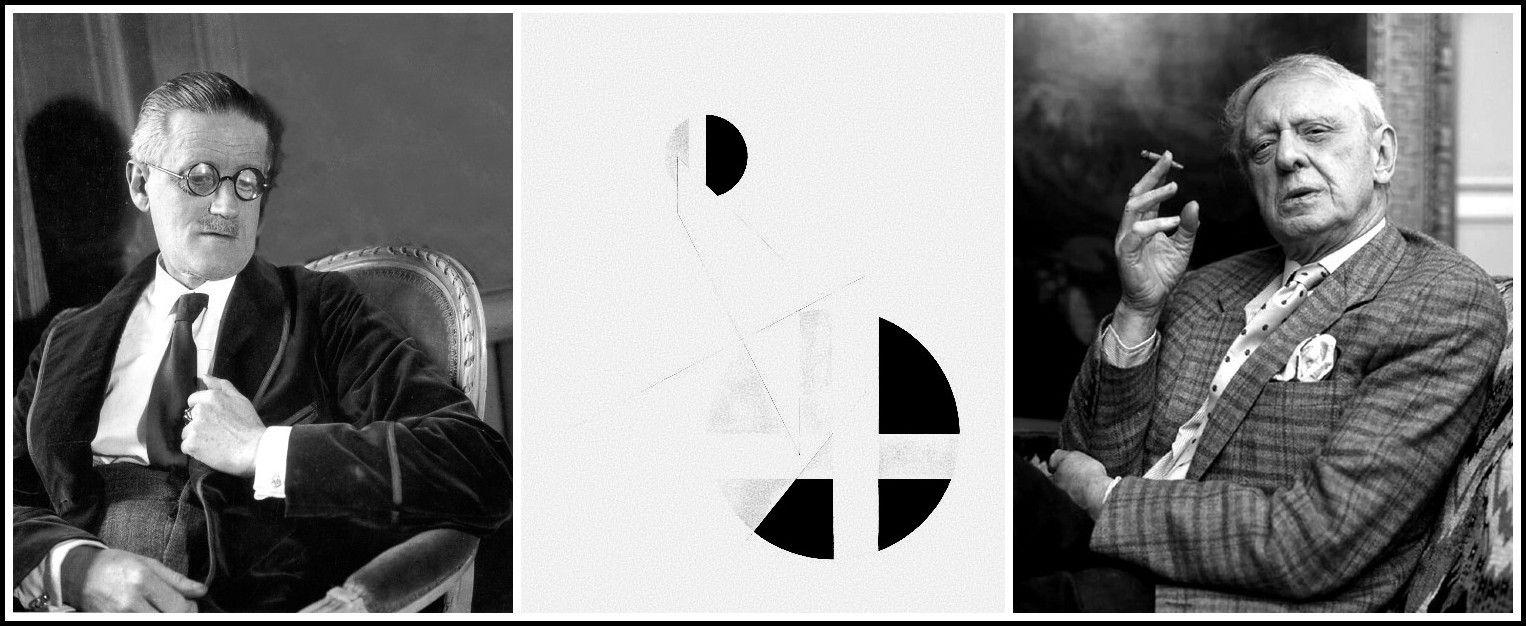
James Joyce (Unknown photographer, c. 1930) | László Moholy-Nagy, A-XX, 1924 | Anthony Burgess (Jonathan Player, 1983)
Anthony Burgess’s admiration for James Joyce is well known amongst scholars and critics. A keen and insightful reader of Joyce since his university years, Burgess devoted much of his life to the study and promotion of the Irish writer’s work. Two full-length critical studies, Here Comes Everybody and Joysprick: An Introduction to the Language of James Joyce, an edition of Finnegans Wake, A Shorter Finnegans Wake, as well as countless articles, essays and introductions to new editions of Joyce’s novels, attest to the extent and depth of Burgess’s engagement with Joyce. Burgess admired Joyce’s mastery of the novel form and was particularly drawn to what he perceived as their shared love of language and linguistic experimentation: ‘I was considered an accomplished writer who had set out to deliberately murder the language. It was comforting to remember that the same thing had been said of Joyce.’ Joyce’s stylistic and linguistic innovations also played an important part in Burgess’s development as a writer. As A. I. Farkas demonstrates in Will’s Son and Jake’s Peer, Joyce’s presence ‘haunts’ Burgess’s works, from narrative techniques, thematic preoccupations and ‘motivic borrowings’ to his poetic and aesthetic theories, which clearly developed from a close and sustained reading of Joyce’s texts.
László Moholy-Nagy, Z VI, 1925
The novels that Farkas explores in his monograph range from Burgess’s earliest, The Malayan Trilogy, to Dead Man in Deptford, paying particular attention to those works which engage directly with Joyce, like The Doctor is Sick, the Enderby Tetralogy, Nothing like the Sun and The Napoleon Symphony. One notable omission, however, is A Clockwork Orange, unquestionably Burgess’s most widely read and analysed work. Although few scholars have actually explored the novella’s specific relation to Joyce’s work—Andrew Biswell and Mark Rawlinson have respectively identified echoes of A Portrait of the Artist as a Young Man and the ‘Lestrygonians’ episode of Ulysses—many critics habitually use the adjective ‘Joycean’ to refer to its narrative form or language. Brian Lennon, for example, writes about the novella’s ‘broadly Joycean idiom’ while Randall Stevenson, in A Reader’s Guide to the Twentieth-Century Novel in Britain, mentions ‘its self-reflexive, Joycean concern with artifice and language.’ This ‘Joycean’ concern with language is also noted by Ben Masters in his review of A Clockwork Orange for The Times Literary Supplement and, more significantly, by Martin Amis, in his Foreword to the 2012 Restored Edition, where he calls attention to the joyful expressiveness and evocative power of Alex’s speech, features which ‘owe less to Nadsat and more to the modulations of Ulysses.’
László Moholy-Nagy, K-VII, 1923
Despite the critical consensus, the extent of A Clockwork Orange’s engagement with Joyce remains largely unexplored. Most of the references to Joyce’s presence in the novella are brief comments or quick insights; yet, their very diversity suggests a more complex picture. Melvyn J. Friedman, for instance, found striking similarities between Finnegans Wake’s complex idiom and Nadsat’s blend of languages and profusion of puns and portmanteau words. Robert O. Evans, on the other hand, described Burgess’s invented language as a simplified version of Joyce’s more sophisticated linguistic experiments in the Wake. Joyce scholar Robert Martin Adams also noticed Joycean elements in Nadsat’s multilingual puns and musical references, while David Hayman identified an echo of Finnegans Wake’s ‘horrasure’ in Alex’s ‘horrorshow’ (good, well), a word which Burgess always claimed to have adapted from the Russian ‘kharashò’ (good).
László Moholy-Nagy, Q VIII, 1922
Hayman’s reading, in fact, highlights an aspect of the novella’s language which has so far received very little attention: its intertextual relation to Joyce’s texts, particularly Ulysses and Finnegans Wake. David Sisk, in Transformations of Language in Modern Dystopias, traces the Nadsat term for ‘night’, ‘darkmans’, back to Joyce, remarking how ‘Burgess, a Joyce scholar, clearly borrowed the word from Ulysses.’ Sisk does not explore the significance of this Joycean allusion, if indeed it is an allusion or borrowing from Joyce, but his comment opens up a new line of enquiry into the novella’s relation to Ulysses. ‘Darkmans’ does appear in the Proteus episode, in the last line of ‘The Rogue’s Delight’, the traditional Dublin execution song intoned by Stephen as he watches the cocklepickers walking slowly down Sandymount Strand: ‘In the darkmans clip and kiss’. On the other hand, Burgess may have come across this word in the course of his philological research. As Andrew Biswell notes in his Introduction to the Restored Edition of A Clockwork Orange, some Nadsat terms owe much to Burgess’s interest in and knowledge of English slang; in fact, ‘darkmans’ as ‘the night’, along with its obverse ‘lightmans’ (the day), is a piece of thieves’ slang first recorded in the 1560s. And yet, it is not improbable or implausible that Burgess may have first come across this word in Ulysses; his first encounter with Joyce’s novel, as Burgess himself recalls, dates from the early 1930s, when he was still in the Sixth Form.
László Moholy-Nagy, Contruction 1280, 1927
Another plausible borrowing from Ulysses is ‘F. Alexander,’ the author of the moral treatise ‘A Clockwork Orange’ and one of Alex’s first victims. In his 1986 review of the novella, Earl Ingersoll traces the name to the Ithaca episode of Ulysses, where ‘F. Alexander’ is listed as the owner of ‘Throwaway’, the winner of the Ascot Gold Cup Race on 16th June 1904, the ‘dark horse’ which becomes associated with Leopold Bloom throughout the novel. Ingersoll’s analysis is brief, yet insightful: he finds a parallel between Bloom’s and Stephen’s ‘father-son’ relationship and the strange bond that develops between F. Alexander and Alex in Burgess’s novella, which suggests that Joyce’s presence in A Clockwork Orange is not limited to Nadsat’s Joycean inflections but can also have interesting thematic and structural ramifications. These, however, fall outside the scope of this paper. From an intertextual perspective, on the other hand, Sisk’s and Ingersoll’s findings show the ways in which Joyce’s texts are embedded in the novella’s textual fabric, creating significant connections and opening a dynamic, playful and complex dialogue between Burgess and Joyce.
László Moholy-Nagy, Composition, 1923
The beginnings of this playful dialogue can be discerned in the opening scene at the Korova Milk Bar, as Carla Sassi notes, when Alex, tired of listening to a drunken ‘chelloveck’s’ garbled parody of Finnegans Wake’s language—‘Aristotle wishy washy works outing cyclamen get forficulate smartish’—replies with a ‘horrorshow crack’ on the ‘chelloveck’s ooko or earhole’. For Sassi, Alex’s reaction clearly signals Burgess’s rejection of Joyce’s linguistic excesses in his last work, and can thus be interpreted symbolically as a ‘nonverbal and performative manifesto for a post-Joycean conception of literary art and language.’ Sassi reads Alex’s action as an expression of Burgess’s breaking away from Joyce; and yet, Burgess’s imaginative engagement with Joyce in this scene is even more subtle. While Alex’s ‘blow’ indicates his (and Burgess’s) rejection of linguistic abstraction, it also, and very effectively, calls attention to the presence of a number of Joycean echoes in the text and, more significantly, to Burgess’s deft manipulation of those intertexts. The most obvious Joycean intertext is the word ‘forficulate’, embedded in the chelloveck’s garbled mishmash, which alludes to Finnegans Wake’s Humphrey Chimpden Earwicker (HCE): ‘forficulate’ means literally ‘to have a creeping sensation, as if a forficula or earwig were crawling’ (OED). ‘Earwig’, as Joyce readers recognise, is one of the many names with which HCE becomes associated in the novel; it is also metonymically related to the word ‘insect’, which, as Burgess notes in Joysprick, is a metathesis of ‘incest’, the source of HCE’s ancestral guilt and the one word his dream refuses to ‘present him with.’
László Moholy-Nagy, Construction, 1922
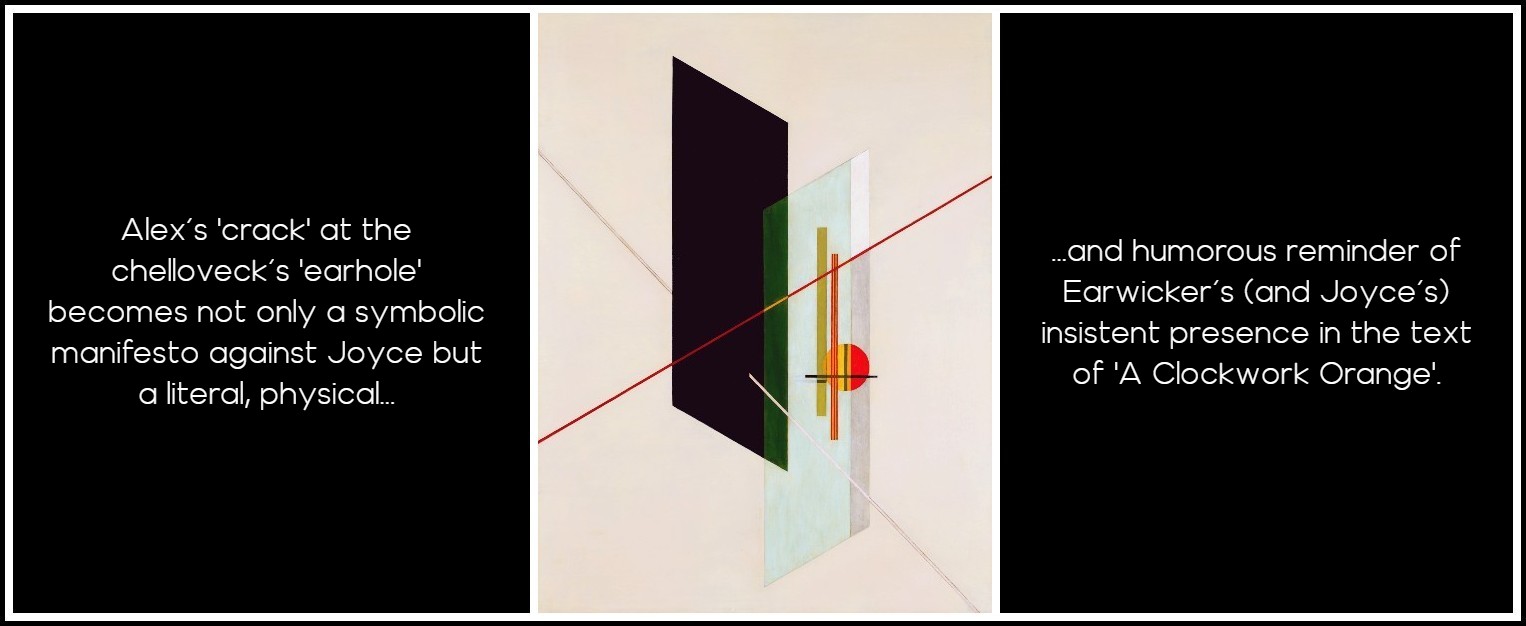
Burgess’s analysis of the wordplay between insect-incest is as insightful as it is jocular. The metathesis, he claims, ‘encourages the dermapteral to crawl out of [HCE’s] surname to such an extent that this Protestant Nordic innkeeper can present himself as the Irish patriot Persse O’Reilly. This is, of course, the French perce-oreille, meaning ‘earwig’.’ Similarly, the appearance of ‘forficulate’ in the speech of the drunken chelloveck signals the presence of an intruder—or, rather, ‘forficulate’ itself is the intruder, the overdetermined intertext which demands to be decoded. From this perspective, Alex’s ‘crack’ at the chelloveck’s ‘earhole’ becomes not only a symbolic manifesto against Joyce but a literal, physical (and humorous) reminder of ‘Earwicker’s’ (and Joyce’s) insistent presence in the text of A Clockwork Orange.
László Moholy-Nagy, A IX, 1923
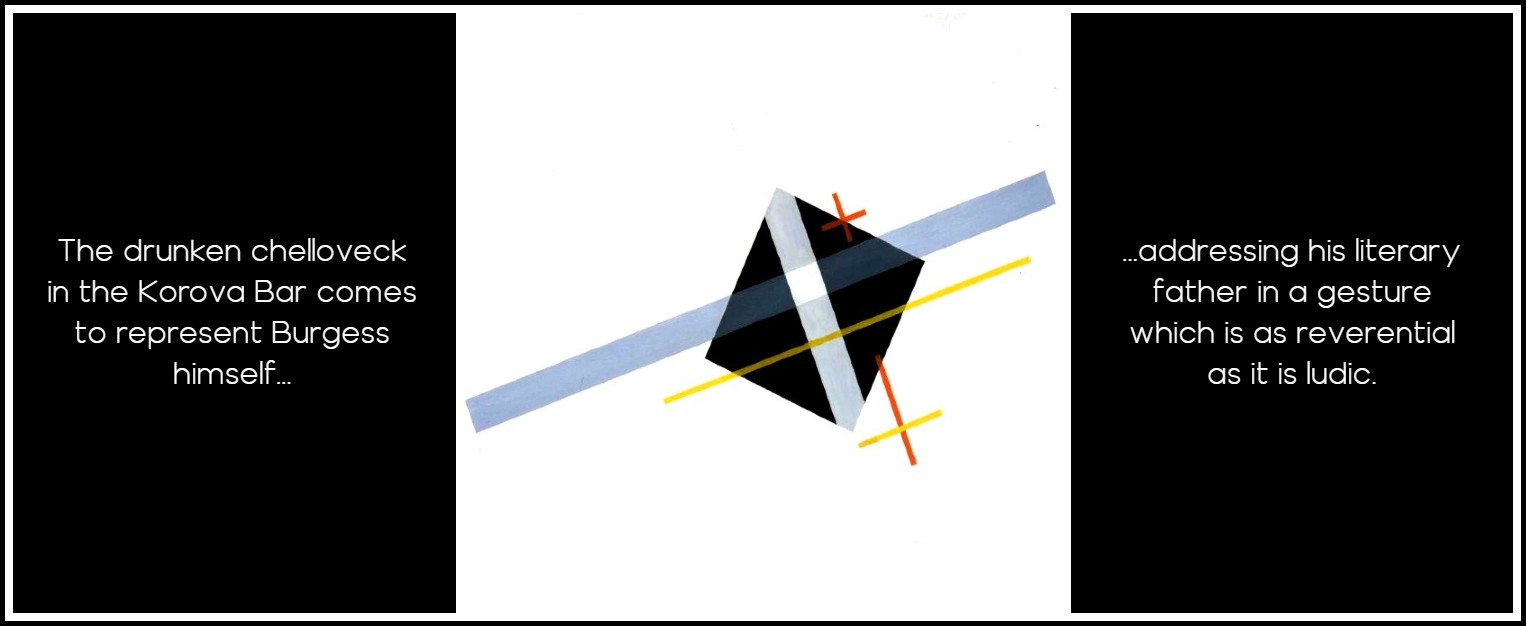
The ‘burbling’ chelloveck’s response, in turn, shifts the focus from rejection to communication and from Finnegans Wake to Ulysses. Ignoring Alex’s blow, the drunken man ‘go[es] on with his telephonic hardware’, a cryptic phrase which calls to mind Stephen Dedalus and his own ‘telephonic’ line of communication with Adam in the ‘Proteus’ episode of Ulysses. Like Stephen, the ‘chelloveck’ has lost touch with the external world; in fact, his attempt at communication parodies a scene in Burgess’s earlier novel The Doctor is Sick, where the protagonist, Edwin Spindrift, recasts Stephen’s esoteric ‘Aleph, Alpha: nought nought one’ as ‘EDEnville oooo’, thus opening up a line of communication with Joyce, who is not only his interlocutor but the reason for his existence: ‘“You”, he said, “got me into this. If you hadn’t existed, I wouldn’t exist.”’ Spindrift’s connection with Joyce is reinforced later in the narrative, when he identifies his obsession with language with Joyce’s love of wordplay: ‘He had lived too much with words and not what words stood for. James Joyce had been such another, with his choice of a sweetheart from a sweetshop.’ In a doubly (ir)reverent gesture, the text establishes a connection from Burgess to Joyce through the same Adamic line of filiation, while at the same time emphasising his literary debt to Joyce. Again, in a subtle and probably calculated move, the drunken chelloveck in The Korova Bar, whom Sassi identifies with Joyce, comes to represent Burgess himself, addressing his literary father in a gesture which is as reverential as it is ludic.
László Moholy-Nagy, K I, 1922
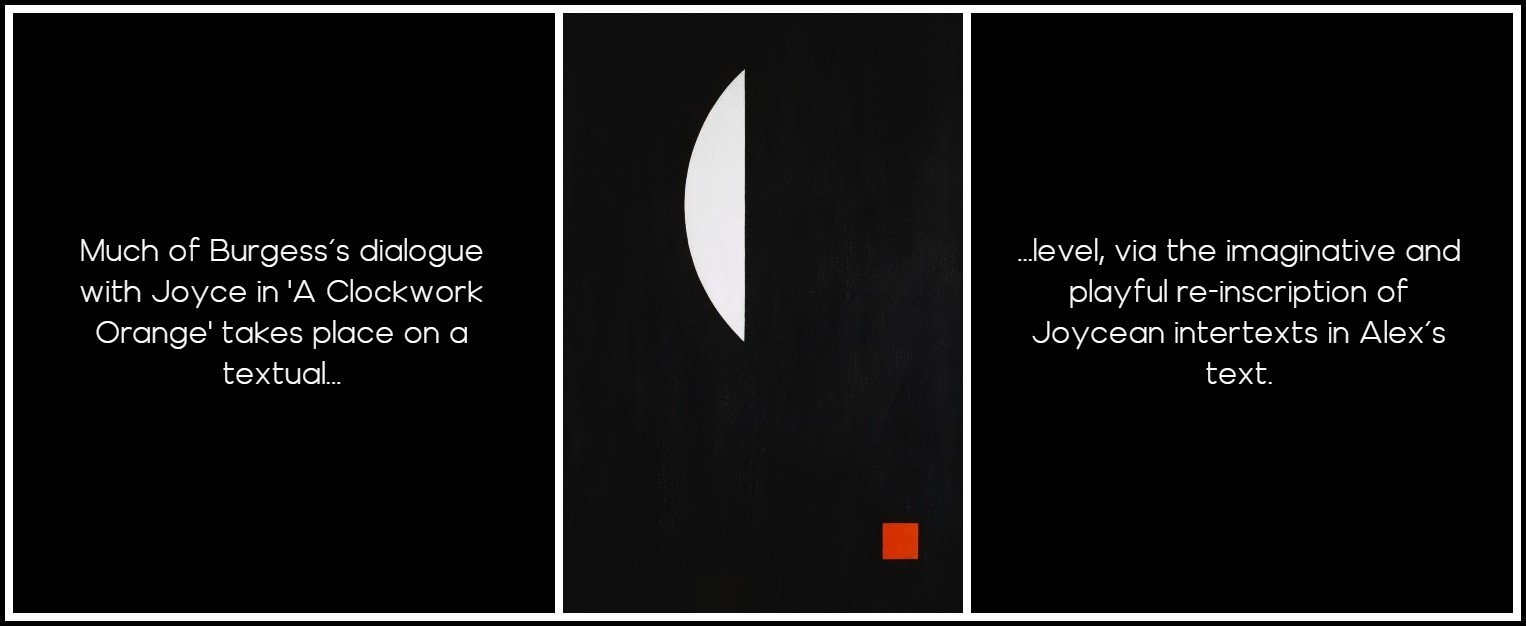
Much of Burgess’s dialogue with Joyce in A Clockwork Orange, as we can see, takes place on a textual level, via the imaginative and playful re-inscription of Joycean intertexts in Alex’s text. Some of these intertexts are also Alex’s most idiosyncratic Nadsat expressions, like ‘Bog’, ‘malchick’, ‘malenky’ and ‘pretty polly.’ ‘Pretty Polly’, Nadsat for ‘money’ through its rhyme with the English slang word ‘lolly’, is an interesting example. As Jonathon Green remarks ,’pretty polly’ does indeed rhyme with ‘lolly’ (money), but also with the phrase ‘jolly for polly’, sexually available for a price, ‘recorded in a gay lexicon of 1972’. Green finds no evidence before that year, which leads him to suggest that ‘the phrase is primarily dependent on assonance’. In fact, the expression can be found in Ulysses, in the ‘Circe’ episode, in Rudolph Virag’s exclamation ‘Pretty Poll’. ‘Pretty polly’ is mentioned early on in A Clockwork Orange and later used along with two other slang words for money, ‘cutter’ and ‘deng’. Its possible connection to Ulysses is suggested later on in the novella, when Alex, just released from jail, describes himself standing outside the State prison ‘with just this bit of pretty polly in my left carman, jinglejangling it and wondering; “What’s it going to be then, eh?’”. The obvious Joycean echo here is, quite aptly, ‘jinglejangling,’ an onomatopoeic expression which alludes to another ‘jingle,’ that of Blazes Boylan’s jaunting-car on its journey to his adulterous encounter with Molly Bloom in the ‘Sirens’ episode of Ulysses: ‘Jingle a tinkle jaunted’; ‘jingle jaunted down the quays’. In the same way that ‘jingle’ alerts Bloom (and the reader) to Boylan’s arrival, ‘pretty polly’ and ‘jinglejangling’ warn the reader of A Clockwork Orange about the presence of a Joycean ‘echo’ in Burgess’s text, an echo which is a prelude to many others, as we shall see.
László Moholy-Nagy, C II, 1921
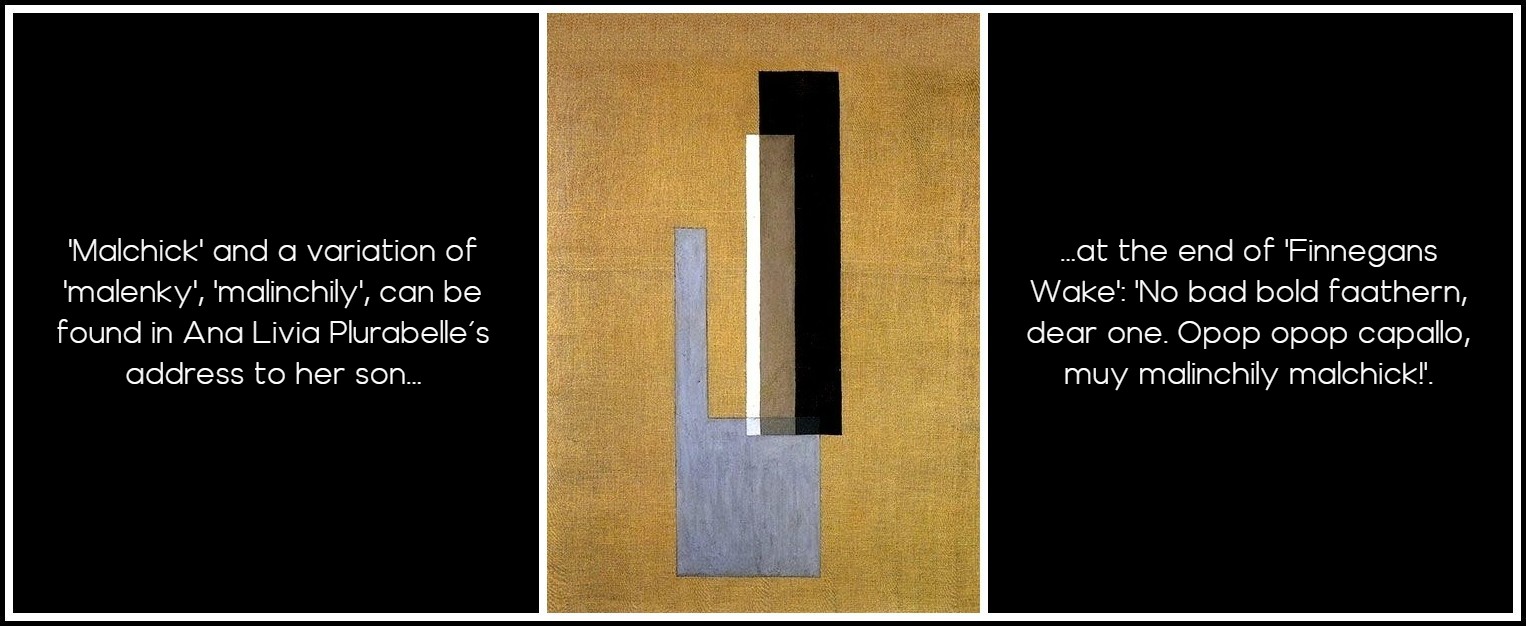
‘Bog’ (Russian, ‘God’) and ‘malchick’ (Russian, ‘youngster’) can also be connected back to Joyce, in this case to Finnegans Wake. ‘Bog’ appears once, with the same meaning, in ‘Whoforyou lies his last, by the wrath of Bog’. ‘Malchick’ and a variation of ‘malenky’ (Russian, little), ‘malinchily’, can be found in Ana Livia Plurabelle’s address to her son at the end of the novel, ‘No bad bold faathern, dear one. Opop opop capallo, muy malinchily malchick!’, as Burgess himself notes in Here Comes Everybody. There he remarks on the significance of Joyce’s use of Russian words in ALP’s speech. In fact, Burgess found these two words fascinating enough to mention them again in Joysprick, where he quotes the same passage as evidence that ALP’s origins are ultimately to be found in Russia: ‘Why else would she address her waking child as ‘muy malinchily malchick’!’ Burgess’s fascination, or plain obsession, with these two words continues in A Shorter Finnegans Wake, where he suggests , without providing any evidence, that Anne Porter or Anna Livia Plurabelle ‘seems to have some Russian blood in her’, an assertion which only makes sense in the context of Burgess’s earlier analysis in Here Comes Everybody. Finally, in his Foreword to the 1992 Minerva edition of the Wake, Burgess revisits the same passage, but now to comment on the difficulties that Joyce’s text poses for readers: “Nobody minds ‘silvamoonlake,’ where ‘silver’ and a Latin forest are fused, but one has to know Russian to understand ‘Muy malinchily malchick.’
László Moholy-Nagy, Construction, 1921
Whether Burgess borrowed ‘malchick’ and ‘malenky’ directly from Finnegans Wake is not at issue here. What is interesting is the trajectory of these particular words from Finnegans Wake through Burgess’s scholarly and creative work, as well as Burgess’s insistence (almost compulsion) on highlighting them, as if moved by a desire to trace and retrace the movements between A Clockwork Orange and Joyce’s texts. Like the drunken chelloveck who persists in his abstract Joycean reveries, the text of Burgess’s novella insists on calling attention to its own (or Burgess’s own) Joycean musings. To borrow a phrase from Roland Barthes, Joyce is Burgess’s ‘circular memory’, the ‘infinite text’ to which he constantly returns. In The Pleasure of the Text, Barthes describes Proust’s writing as his (Barthes’) ‘circular memory’: ‘Proust is what comes to me, not what I summon up; not an “authority”’. Joyce’s texts seem to have a similar hold on Burgess’s imagination, as his fixation on ‘malchick’ and ‘malenky’ suggests. In fact, these words, along with the other Joycean intertexts seemingly scattered through A Clockwork Orange, are an indication of Burgess’s efforts to acknowledge Joyce’s influence while, at the same time, marking his own critical and imaginative distance from him.
László Moholy-Nagy, Construction, 1921
Once again, Barthes provides an apt figuration of this ambivalence articulated in the novella. In his memoir Roland Barthes by Roland Barthes, Barthes uses the metaphor of the ‘siren text’ to explore this interplay between fascination and rejection shaping a writer’s relation to his or her precursor. The intertext is not, or not only, ‘a field of influences’ but also ‘a music of figures, metaphors, thought-words; the signifier as siren.’ Compulsion has given way to seduction, with its connotations of danger and threat. Barthes’s notions of ‘circular memory’ and the intertext as ‘siren’ offer a suggestive interpretive framework within which to situate an analysis of the intertextual dialogue that develops between Burgess and Joyce in A Clockwork Orange. In Burgess’s artistic imagination, Joyce’s texts are like a chorus of ‘siren’ signifiers: sounds, words, echoes (his ‘circular memory’) that return to him unbidden, seductive voices which stimulate his creativity not through imitation but through a dynamic process of adaptation and reinterpretation.
László Moholy-Nagy, Untitled, 1922
The idea of adaptation is not new. In his review of Blooms of Dublin, ‘Burgess’s Blooms’, Zack Bowen uses the word ‘collaboration’ to describe Burgess’s approach to Joyce’s text in his musical play. Burgess, according to Bowen, does not imitate or adapt from Ulysses but engages in ‘an artistic collaboration with Joyce himself to create a new Ulysses somewhat different from the original.’ The result is an ‘ingeniously creative textual explication’ which ‘conveys a strong sense of the presence of the explicator (Burgess) as well as the author.’ This sense of joint authorship or collaboration that Bowen discerns in Blooms of Dublin is already at work, though on a much smaller scale, in A Clockwork Orange. Here, ‘collaboration’ takes the form of a creative intertextual dialogue between Burgess and Joyce, a dialogue that is triggered by those ‘siren’ signifiers from Joyce’s texts, like ‘darkmans’, ‘horrorshow’ or ‘malchick’, interspersed throughout the novella. Read intertextually in this double sense, A Clockwork Orange emerges as ‘a music of figures, metaphors and thought-words’ from Joyce’s texts—a polyphony of ‘siren signifiers’ recast and reconfigured anew in the novella’s (and Burgess’s) idiosyncratic and imaginative language. Alex’s Nadsat (for he is the story’s narrator) is a ‘Joycean creation’ not because it imitates Joyce’s style but because it incorporates and re-inscribes Joyce’s language and techniques within itself, opening up a space for a creative and dynamic dialogue between Burgess and the writer who, in his own words, ‘meant more to me than I can well hope to express.’
László Moholy-Nagy, Construction VIII, 1922
One of the Joycean ‘siren’ signifiers incorporated in Alex’s speech, and in the text of A Clockwork Orange, is not a particular word or words but a technique: onomatopoeia. In Joysprick, Burgess praises Joyce’s innovative experiments with sound imitation and the notation of noise in Ulysses, ‘Joyce’s pleasure in the notation of noise is an aspect of his fascination with the magic of the whole semiological process.’ He is particularly interested in the way that Joyce manipulates onomatopoeic techniques in new and surprising ways, for example Bloom’s cat’s cry for milk in ‘Calypso’: ‘Mkgnao… Mrkgnao… Mrkrgnao’. Burgess notices how this example of onomatopoeia seems to be ‘addressed primarily to the eye’, conveying the growing intensity of the call, and only ‘secondarily’ to the ear; in fact, he concludes, this onomatopoeia is ‘a wholly visual device.’ Throughout Ulysses, Burgess observes, Joyce displays a clear delight in the manipulation of ‘non-auditory semiology’ (Derek Attridge refers to this device as ‘non-lexical onomatopoeia’ or sound without lexical sense). Other examples mentioned by Burgess are Stephen’s ashplant walking stick ‘squealing at his heels, calling Steeeeeeeeeephen’ and Bloom’s rendering of his great-grandfather’s call from the grave through an imaginary gramophone, ‘Kraahaark’. In both cases, Burgess argues, the reader is both amused by Joyce’s ingenuity in (apparently) imitating sound and ‘puzzled’ by these ‘strange signs on the page.’
László Moholy-Nagy, LIS, 1922
In A Clockwork Orange, Alex displays a similar ability to convey language’s aural and visual properties. As well as conveying his own joy in the production and notation of sound, Alex’s onomatopoeic games are also an expression of Burgess’s delight in working with and manipulating Joyce’s texts. Alex, like the poet Enderby in Inside Mr Enderby and young Shakespeare (WS) in Nothing like the Sun, takes great delight in playing with the sounds and texture of words: he, like their creator, is also ‘ruled’ by ‘the jingle.’ What critics have not noted so far are the similarities between Burgess’s and Joyce’s onomatopoeic techniques or the ways in which Burgess’s onomatopoeias mirror those found in Ulysses. Alex’s account of the break-in at the cat lady’s ‘Manse’ in the first part of the novella offers some interesting parallels, but also some differences. Alex’s description of the scene is punctuated by a myriad of sounds and noises which echo many of the sounds scattered through Ulysses: from the ‘mewing kots and koshas’ going ‘mare mare mare’; the ‘brrrrrr brrrrrr’ of the doorbell; the ‘flip flap flip flap’ of the slippers; or the ‘squeeeeeeeeeeak’ of the door. These unusually expressive cats call to mind Bloom’s idiosyncratic feline, but the echoes remain quite faint here since none of the sounds are a direct imitation of its highly individual cry ‘Mkgnao’. Joyce’s presence, however, is evident in the manifest ‘visuality’ of the onomatopoeias. As he notes in Joysprick, Joyce’s innovation—and his genius—lies in his creation of a type of onomatopoeia that is ‘addressed primarily to the eye.’ ‘Squeeeeeeeeeeak’ and ‘brrrrrr brrrrrr’ resemble ‘Steeeeeeeeeephen’ and ‘Kraahaark’ in their use of strings of letters to convey length and intensity of sound, but, most of all, their impact is wholly visual—an aspect of Joyce’s use of onomatopoeia remarked upon by Attridge.
László Moholy-Nagy, Segments, 1921
‘Squeeeeeeeeeeak’ actually replicates the ‘squealing’ of Stephen’s ashplant in a more ‘realistic’ way, which suggests that Burgess has used the repeated ‘e’ in this particular instance to call attention to his own playful manipulation of Joyce’s technique. Joyce’s presence is also apparent in the different cats’ cries scattered throughout the scene. The cats ‘going maaaaaaah for more moloko’ recall the cries of the children who Bloom, in Laestrygonians, imagines being born ‘every second, all washed in the blood of the lamb, bawling maaaaaa.’ Later in the scene, their cries change to ‘ptaaaa’, ‘grrr’ and kraaaaark’, the last one an adaptation (the ‘h’ is missing) of Bloom’s great-grandfather’s spectral call ‘Kraahaark.’ In a way, we can say that the whole passage is haunted by Joyce’s ‘spectral’ voices. Overall, Alex’s mimicking of the cats’ sounds seems intended less as imitation and more as a playful adaptation of Joyce’s techniques. In Alex’s narrative, Joyce’s experiments with sound are transformed into a playful and comical polyphony of cats’ voices, in a way that imitates but also goes beyond Joyce. Examined closely, each cat sound both mimics and at the same time deviates from Joyce’s texts through the addition of extra consonants and vowels—‘maaaaaa’ becomes ‘maaaaaaah’; ‘Kraahaark’ is turned into ‘kraaaaark’—to create a dizzying effect or stir of echoes that constantly leads back to Joyce. This echoing effect persists throughout the novella to the end: later, in jail, Alex describes the prisoners ‘shuffle out going marrrrre and baaaaaa like animals’ and, at the end of his narrative, he compares youth to an animal or a ‘malenky machine’ that ‘you wind up grrr grrr grrr’.
László Moholy-Nagy, Eccentric Construction, 1921
In fact, throughout the novella, Alex shows himself quite adept at mimicking sounds, particularly those emanating from the mouth: ‘They went haw haw haw’; ‘going boo hoo hoo with a very square bloody rot’; ‘wide big rots, smecking away’; ‘slurp slurp of peeting tea’; ‘all going yawwwww’. For the reader of Ulysses, these onomatopoeias are very familiar. While Alex’s speech focuses on mouths ‘wide big rots’, Joyce’s text emphasises lips and their sounds: ‘He seehears lipspeech’; ‘lips over the counter lisped’. In Proteus, Stephen takes great pleasure in the production of ‘suggestive sound by mouth and breath’ : ‘His mouth moulded issuing breath, ooeeehah: roar of cataractic planets, globed, blazing , roaring wayawayawayawayawayaway’, a pleasure that Alex (and Burgess) shares with him: ‘my mum boohoohooing’; ‘with a growwwwowwwwowwww’. Even his ‘shooms of lip-music brrrrrr’, articulating his defiant attitude, can be read as an expression of his Joycean delight in the sounds and noises of language.
László Moholy-Nagy, P27, 1927
As Robbie Goh suggests, Alex’s predilection for words imitating the movements of the mouth and teeth, particularly ‘chumbling shooms’, the sounds of the ‘starry prof’ being beaten by the droogs in the first part of the novella, are intended to convey not only the brutality of the act but also the ‘ineluctably physical basis’ of the words themselves and Alex’s delight in this physicality. Alex’s pleasure in sound extends to inanimate objects, which also develop their voices in the same way they do in Ulysses: ‘clink clink of plates’; ‘a bell going brrrrr’; splussshhhh and glolp she went’; ripping razrez razrez’; ‘clack clack clacky clack clack clackity clackclack’; ‘he dropped his nozh with a tinkle tankle’. In Sirens we find ‘Clap… clappyclapclap… clapclopclap’; ‘rain … diddle idle addle addle oodle oodle’, while Circe gives voices to the quoits of Molly’s bed ‘jigjag jigjag jigjag’, the kisses ‘Yummyumm Womwom’—not too different from Alex’s ‘gorgeosity and yumyumyum’—a yawn ‘Iiiiiiiiiiaaaaaaah’, and a cough, rendered by Alex as ‘kashl kashl kashl’.
László Moholy-Nagy, Red Collage, 1921
Not all the ‘siren’ signifiers in A Clockwork Orange are linguistic or musical; sometimes, descriptions of scenes and settings invoke similar settings in Ulysses. The ‘workers’ caff’ where Alex walks in after his release from jail in Part Three, bears striking similarities with the Burton restaurant scene in Laestrygonians, where Bloom is confronted by a vision of the diners’ animalistic appetites. Burgess expresses his fascination with Joyce’s depiction of disgust in Laestrygonians emphatically in Here Comes Everybody: ‘In this episode we have the most realistic evocation of disgust at the act of eating that literature has given us.’ Bloom’s description of the diners’ repelling eating habits is powerful: he observes men ‘wolfing gobfuls of sloppy food’; a man ‘spitting back on his plate: halfmasticated gristle; no teeth to chewchewchew it with’. Similarly, Alex’s depiction of the workers’ breakfast aims to convey some of the sense of disgust that Bloom’s language so precisely and viscerally evokes: ‘there were early rabbiters slurping away chai and horrible-looking sausages and slices of kleb which they wolfed going wolf, wolf, wolf and then creeching for more’.
László Moholy-Nagy, Telephone Painting, 1923
Another scene from Ulysses reimagined in Alex’s narrative is Stephen’s wanderings across Sandymount in Proteus, pondering on nature of reality and the ways to comprehend it: ‘Ineluctable modality of the visible… Signatures of all things I am here to read’. On his way home after the vicious attack on the writer and his wife, Alex walks past a ‘young malchick sprawling and creeching and moaning in the gutter’ and muses poetically on the ‘streaks of blood here and there like signatures, my brothers, of the night’s fillying’. Alex does not pause to reflect on the significance of the scene or on the meaning of his own perceptions, unlike Stephen. A closer analysis of this passage, however, reveals a more intricate web of intertextual connections to Proteus, oscillating between the serious and the parodic. Earlier, Alex had pondered on the nature of reality, prompted by the vision of the old drunken ‘chelloveck’ in the Korova Bar ‘burbling away’ incoherently about ‘platonic time weatherborn’. The rich visual (‘cut all lovely’; ‘sprawling’) and aural (‘sprawling and creeching’) qualities of his perceptions, in fact, suggest that Alex, like Stephen, has an Aristotelian awareness of the ‘ineluctable modality of the visible’ and ‘the audible’, though, not on an intellectual level. In this respect, Alex experiences the world in the same direct and unmediated way in which Leopold Bloom experiences it throughout Ulysses, in all its full visual, auditory, sonorous and tactile materiality; yet, without full emotional investment—in this, Alex resembles Stephen.
László Moholy-Nagy, Untitled, 1924
So, what appears as a weak Joycean echo, when examined closely, can reveal a subtle web of correspondences between Burgess’s and Joyce’s texts. This is the case with ‘darkmans’, the sixteenth-century slang word for ‘night’ mentioned earlier. As noted above, ‘darkmans’ also appears in Proteus, in the last line of ‘The Rogue’s Delight’, the song that Stephen intones as he watches the cocklepickers on Sandymount Strand. The intertextual significance of this word in A Clockwork Orange is not made readily apparent until we compare the passage in Alex’s narrative with that in Proteus. In Alex’s account, he is lying on the ground outside the cat lady’s mansion, after the bungled robbery, unable to see after being struck in the eyes by Dim. With the police sirens blaring in the distance, all Alex can hear is the sound of Dim’s ‘bolshy lumpy boots beating off, him going huh huh huh into the darkmans’. In Proteus, Stephen’s vivid imagination imparts mythical significance to the cocklepickers marching across the muddy sands, to the point that they come to embody the figures of the Wandering Jew, Odysseus, and ultimately Adam and Eve as they are escorted out of the Garden of Eden by the archangel Michael: ‘Across the sand so all the world, followed by the sun’s flaming sword, to the west, trekking to evening lands. She trudges, schlepps, trains, drags, trascines her load’. ‘Darkmans’ traces a connection between the old woman and Dim, one that is more parodic than serious, yet still significant. Both are figures in the periphery, both have physical and symbolic weights to carry: Dim is the target of Alex’s constant bullying. The parody also works in stylistic terms: Stephen’s polyglot, vividly onomatopoeic description of the gypsies dragging their cockle bags (‘trascines’ and ‘schleps’ are the Italian and Yiddish words for ‘drag’ respectively) finds its ironic echo in Alex’s more prosaic description of Dim walking away after their fight.
László Moholy-Nagy, D IV, 1922
Serious adaptation or irreverent parody? Burgess’s dialogue with Joyce in A Clockwork Orange is perhaps best understood as a dynamic movement or oscillation between the two. Burgess’s experiments with Joyce’s onomatopoeic techniques, his playful re-imagining of scenes or his seemingly random borrowings from Ulysses and Finnegans Wake in his most famous work seem motivated, most of all, by Burgess’s profound fascination and delight in Joyce’s writing. There is a clear sense of fun in Burgess’s manipulations of Joyce’s language and techniques, a sense of fun which is apparent in Alex’s joyful re-playing of onomatopoeic and iconic tropes from Ulysses or in the text’s ever-changing correspondences between Alex and Stephen Dedalus or Alex and Bloom. While Burgess clearly delights in manipulating the manipulator, he is also and tentatively moving away from Joyce’s influence, an influence which was already apparent in his early works and which he was yet to articulate more fully in his later creative and critical work, in order to develop his own individual artistic voice. In A Clockwork Orange, Burgess heeds the call of Joyce’s ‘siren’ texts but does so from the position of a fully-fledged artist in his own right, someone who has acquired a profound knowledge and understanding of Joyce’s artistic vision. In his subsequent work, Burgess would move further away from Joyce’s ‘siren’ call, engaging in a more complex critique of his precursor. In A Clockwork Orange, an early work, the dialogue remains open and fluid, full of imagination and playful irreverence: an expression of Burgess’s neverending delight in Joyce.
László Moholy-Nagy, Untitled, 1922
MARA, MARIETTA: A LOVE STORY IN 77 BEDROOMS – READ THE FIRST CHAPTER
A literary novel by Richard Jonathan
RICHARD JONATHAN, ‘MARA, MARIETTA: A LOVE STORY IN 77 BEDROOMS’ — READ THE FIRST CHAPTER
AMAZON & APPLE BOOKS

RICHARD JONATHAN, ‘MARA, MARIETTA: A LOVE STORY IN 77 BEDROOMS’ | AMAZON PAPERBACK OR KINDLE

RICHARD JONATHAN, ‘MARA, MARIETTA: A LOVE STORY IN 77 BEDROOMS’ | APPLE iBOOK
MARA, MARIETTA: A LOVE STORY IN 77 BEDROOMS
A literary novel by Richard Jonathan

Available from AMAZON (paper | ebook) & iBOOKS, GOOGLE PLAY, KOBO & NOOK (see LINKS below)
RELATED POSTS IN THE MARA MARIETTA CULTURE BLOG
CLICK ON THE IMAGE TO GO TO THE POST
By Richard Jonathan | © Mara Marietta Culture Blog, 2026 | All rights reserved
Comments