Paintings 2024-2025
TOMMASO FATTOVICH: THE ENCHANTMENT OF ABSTRACT ART
Richard Jonathan
Richard Jonathan is the author of the literary novel, Mara Marietta: A Love Story in 77 Bedrooms

Tommaso Fattovich
Taste is the last anarchist agent, being fed by desire. At its core, it’s fueled by pure feeling. Much of painting’s power derives from its potential for engendering desire, or refracting it, or just playing with it. Painting engages the beholder directly without presupposing special knowledge. It doesn’t matter if someone’s response to it is positive or defensive—what matters is that it activates engagement and people’s capacity to decide for themselves.
Charline von Heyl, Artist1
1 – In Isabelle Graw, The Love of Painting: Genealogy of a Success Medium, tr. Brian Hanrahan & Gerrit Jackson (Berlin, Sternberg Press, 2018) p. 127
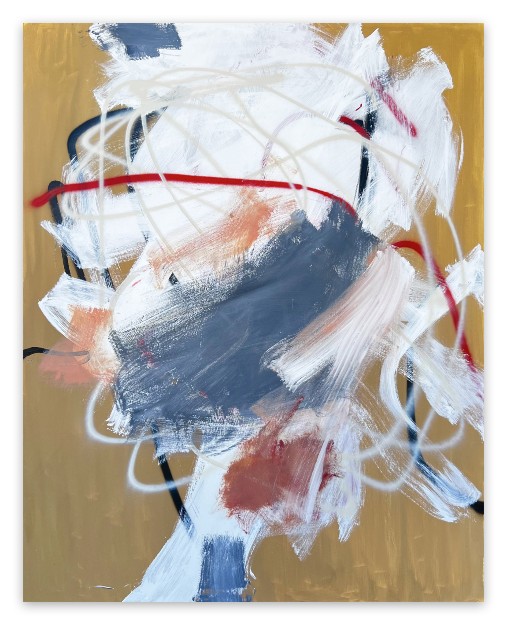
Tommaso Fattovich, 8 ½ Bit, 2026
Dear reader, put down your telephone and tell me truly: Are you not feeling somewhat empty, despite being ‘such a wonderful person leading a fabulous life’1 on Instagram? If so, take a look at the painting below.
1 – Robert Smith, The Cure, ‘Club America’, Wild Mood Swings (London: Fiction Records, 1996)
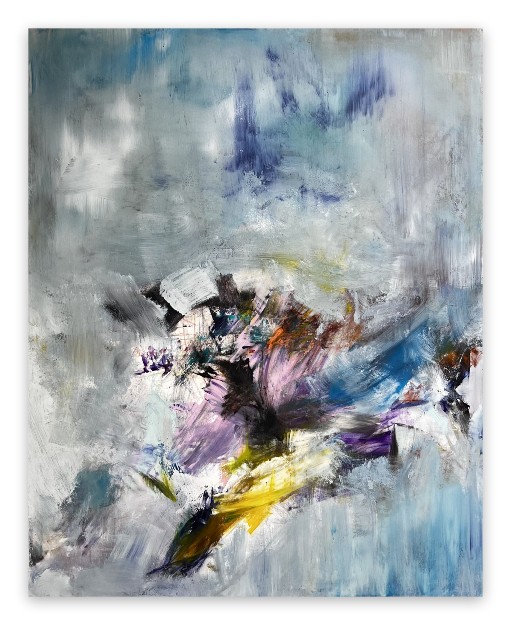
Tommaso Fattovich, There’s a Cat in the Sky, 2025
What do you feel, what do you think, what do you see? For my part, when I look at the painting I am immediately struck by its beauty. The beauty of the haze of blues and greys from which emerge the bristle marks of the brush: lilac, violet, blue and black; an off-setting orange and a tart citron that says, ‘All is not well in heaven’. (Fattovich is one of the finest colorists in painting today, and this work provides ample evidence of that.) And then, just as every infant is hardwired to configure into a face the two ovals that are his mother’s eyes, so I configure those ovals in the centre of the picture into faces. Of what? Two cats out incognito, maybe. And then I read the title of the painting and this hypothesis is confirmed. Which broadens my experience of the painting: I smile at the gentle humour, the refusal of the artist to take himself too seriously. And thus I find myself enchanted by the painting, beguiled by the blurred background that pushes to the fore the scratchy lines that recall cat’s claws, the dynamic tension of the diagonals that suggest these hoodlum cats—see the one in the hat, see the flying fur!—have been up to some nasty business. That citron yellow could even be the groin of the victim—mugged, maybe—running away. And then of a sudden this narrative evaporates, and I find myself basking once more in disinterested pleasure, beholding the beauty of the painting.
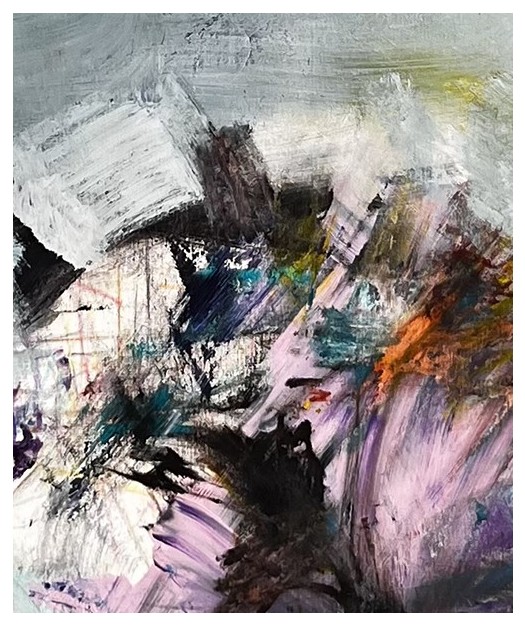
Tommaso Fattovich, There’s a Cat in the Sky, 2025 (detail)
Now you, dear reader, when you look at the There’s a Cat in the Sky, how do you respond? ‘Well, I’m not sure if my followers on Instagram would be wowed by that painting on my wall. What’s more, I need a work, no more than ten grand, that would complement the colors of my carpet and cool the heat of my crimson cushions. I’m not sure if…’. ‘Fair enough, gentle reader, fair enough: seeking art just for decoration is an entirely legitimate preoccupation. Now tell me, do you like beautiful women, or brawny men?’ ‘Yes, I do, but…’. ‘Well, what Fattovich gives you is a beautiful woman with brains, a brawny man with a big heart. His paintings easily slip into interior decoration schemes, but first and foremost they attain the status of art.’ ‘How so?’ ‘As I wrote in an earlier review, Fattovich succeeds in animating the inert surface of the canvas. In giving it life, he accomplishes the primary task of the painter: to create a ‘living’, independent space that is in the world but not of it, a ‘virtual space’ that is, as Susanne Langer argues, ‘the primary illusion of all plastic art that is good’. ‘Actual form’, she writes, is what an artist works with; what he works for is ‘perceptual form’: that which makes space visible and its continuity sensible.’ In other words, Fattovich’s paintings stand on their own two feet. They don’t need the fig-leaf of vacuous discourse that art critics pin to mediocre paintings to hide the fact that the artist-emperor has no clothes. My contention, then, is that Fattovich’s paintings—in their capacity as works of art, and not just as decorative objects—activate engagement and invite—nay, compel!—the viewer to respond. It is this process of engagement with the work, free of sterile preconceptions, that enables one to reconnect with what is authentic in oneself and thereby overcome ‘Instagram emptiness’.
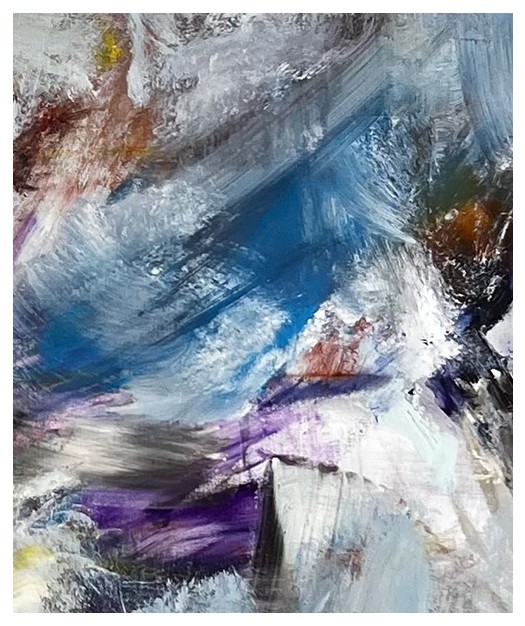
Tommaso Fattovich, There’s a Cat in the Sky, 2025 (detail)
Now take a look at The Barbarians of California. Do you see how the broad white brushstrokes ‘wall in’ the scene, pushing it into the background, whereas in There’s a Cat in the Sky, the haze of blues and greys pushes the scene into the foreground? This play between background and foreground, between conceal and reveal, is a recurring dynamic in Fattovich’s paintings. As a dynamic, it is active; it animates the surface of the canvas, and as such it is of a different order from that of the palimpsest effects one finds in colour-field paintings, effects that tend to be ‘passive’. Now, did you catch that tiny black oval in the lower center of the painting? And did you configure it into an eye, the ‘face’ of a bull, complete with horn extending from head? The painting has—literally, as it were—an animal energy that, rather than clashing with the background graffiti (animal vs. urban), complements it. Again, we sense there’s something going on here, some form of violence, but what it is we can only speculate. And that’s the point! The painter, as Charline von Heyl puts it, activates the space between picture and viewer: That space is external and internal at the same time. It exists only as long as the viewer looks at the picture, for the duration of the act of contemplation, of shifting thoughts, of alternation between attention and letting one’s mind wander, between abundant opinions and the absence of words. The mental picture that emerges in this process isn’t really something you can integrate into your consciousness and ‘take away’, simply because it’s never just one picture. If you’ve felt a genuine connection with the painting, you’ll want to come back to it again and again to update your recollection. The love of painting is also a love of one’s own ability to make a picture one’s own in this way.1
1 – Charline von Heyl in Isabelle Graw, The Love of Painting: Genealogy of a Success Medium, tr. Brian Hanrahan & Gerrit Jackson (Berlin, Sternberg Press, 2018) pp. 129-130
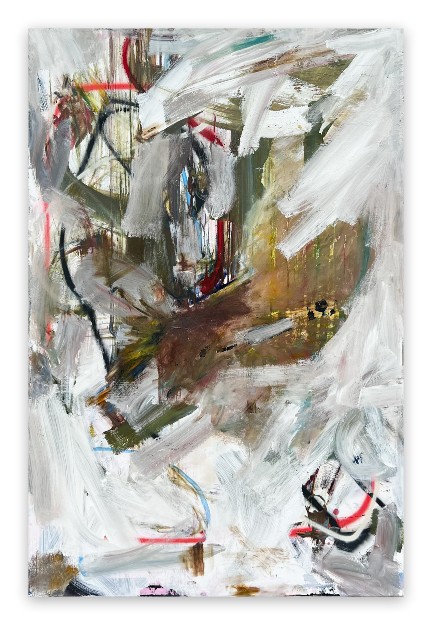
Tommaso Fattovich, The Barbarians of California, 2025
The ludic dimension of Fattovich’s work, the game of hide-and-seek he plays with the viewer, comes through transparently—literally so—in Bull Chasing Blue Rabbit. The painting exhibits the kind of whimsy one finds in Paul Klee, as if the artist, in adopting the mannerisms of children’s art, is affirming that his visual intelligence has no need of the art-critical pretensions that all too often accompany the marketing of art. ‘Open your eyes and see, open your heart and receive’, may strike one as a naïve stance for an artist to adopt in our post-postmodern world. Again, that is precisely the point! We now live in a ‘liquid modernity’, as Zygmunt Bauman terms the tenor of our times— fluidity of social structures, individualization, precarity and uncertainty, consumerism as identity formation, erosion of long-term commitments, time-space compression and mobility, weakening of political institutions, continuous change and reflexivity, fear and insecurity as social conditions, separation of power and politics—and in this environment Fattovich’s touchstone is simply ‘be true to myself’. He is an unschooled painter, he opts for emotion over intellect, and his ‘genius’ is to have understood that it would be self-defeating to adopt any other stance than the one he has: ‘be true to myself’. Are you still with me, dear reader? Let’s now explore what, for Fattovich, ‘being true to myself’ means.
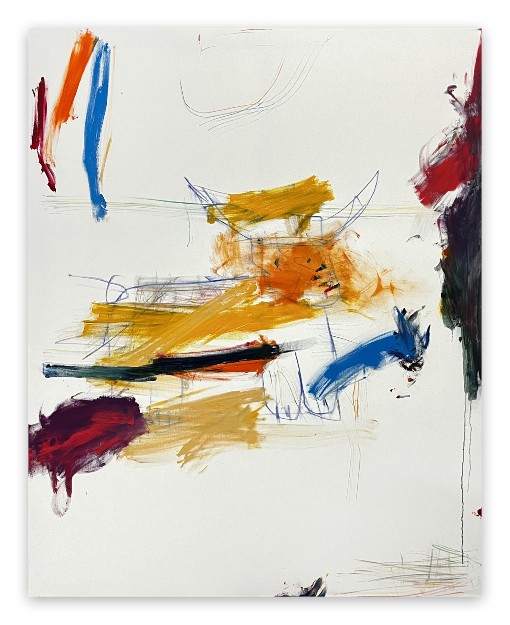
Tommaso Fattovich, Bull Chasing Blue Rabbit, 2025
The more technical know-how an art form requires, the more schooling is essential. The skyscraper of an unschooled architect would not get very far off the ground. Painting since the Impressionists is not a high-technicity art form, yet many painters working today went to art school. An analogy: Writers who take creative-writing classes rarely venture out of the box they’ve put themselves in; painters who go to art school rarely get beyond reshuffling the same stack of cards. In both cases, that inner reserve of selfhood from which creativity springs is never fully tapped. Another analogy: Iván Fischer, a conductor and composer, tells the following anecdote: When my father proudly announced to the great composer, Zoltán Kodály, that I was starting to learn the piano, Kodály said, ‘An instrument is just a tool. You must sing.’ It is this insight that, mutatis mutandis, Fattovich has understood. Intuitively, he knew that having technique but having nothing to say is precisely what clutters the walls of the art supermarkets of the world. He felt impelled to express visually what he drew from his reserve of selfhood. Nothing as elaborate as a philosophy, but rather an attitude to life and a hygiene of living. And so, before learning to play the piano, as it were, he learned how to sing; before teaching himself technique, he had something to say. Thus it is that his art has evolved organically, an art of gestural, painterly abstraction in which attitude combines with technique to incarnate individuality. This is what, for Fattovich, ‘being true to myself’ means: I have something to say; I trust my intuition; I have confidence in my skill. Nothing extraordinary. But what a difference it makes compared to all the artists who, like a dog chasing its own tail, never achieve individuality. ‘Wild Strawberry’ perfectly exemplifies what I’ve been saying.
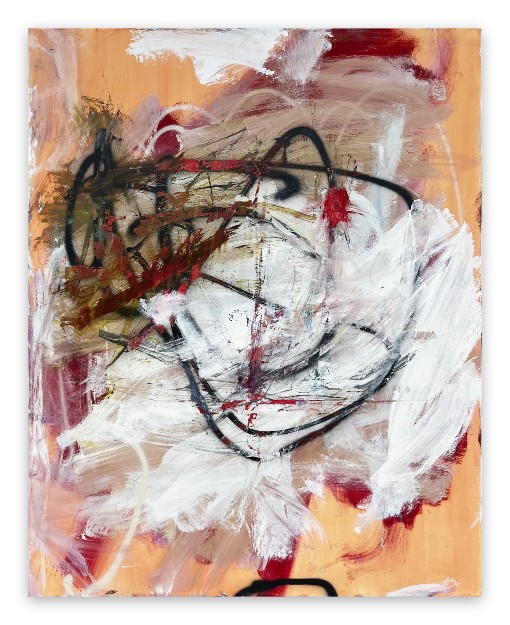
Tommaso Fattovich, Wild Strawberry, 2025
Do you see that, dear reader? Do you see that the painting was made ‘in the moment’, as jazz musicians say? Do you see the flirting with figuration that is a constant in Fattovich’s art? Do you feel how the painting seduces us with its impertinence? That is attitude. And do you see that it is precisely its ‘rudeness’ that makes it lovely? That is enchantment. If you want to push a narrative reading, you might say the broad white brush strokes figure a ballet dancer having a fit in her tutu, while the black lines are the sadistic traces of the instructor’s cane. Yes, unlike those of the ideologists of art, Fattovich’s paintings are open, they breathe the air of freedom. Charline von Heyl: I, as the author, make decisions that allow the painting to take on a life of its own—not literally, obviously, because it remains an object—but as a medium of visual information that’s loose and suggestive enough to give different viewers room for their individual perceptions, in which they follow their own imaginations more than mine. Once again, we see that Fattovich’s art doesn’t impose, it compels; it doesn’t force, it seduces. Technique serves attitude, and attitude individuality. And what is individuality if not the assumption of one’s own desire? In the face of the gangs of clones that liquid modernity engenders, Fattovich affirms his individuality. To quote, again, Charline von Heyl: Taste is the last anarchist agent, being fed by desire. At its core, it’s fueled by pure feeling. Much of painting’s power derives from its potential for engendering desire, or refracting it, or just playing with it.1 Engaging with Wild Strawberry, my feeling enters into a circuit of desire, and I feel my freedom, my individuality. Is there anything more noble than that that art can accomplish?
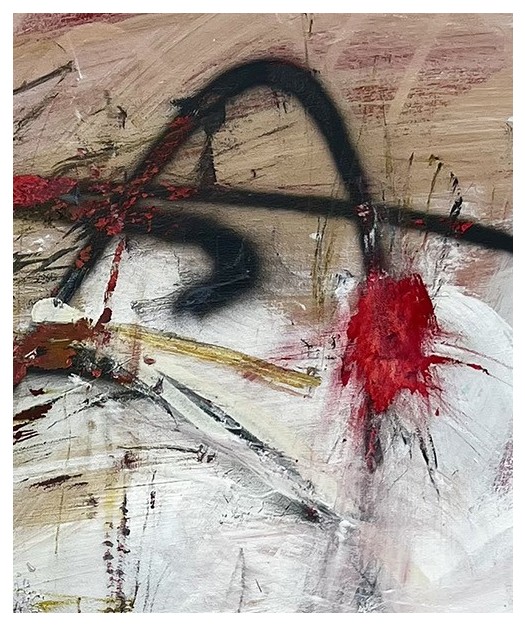
Tommaso Fattovich, Wild Strawberry, 2025 (detail)
Finally, let’s have a look at Violet Candy. For my part, I find my senses immediately aroused by the sensuality of the colours. The painting is not pretty—thank heaven!—but it is beautiful. There is a darkness to the sensuality that resists the temptation of the pink’s prettiness; there’s an echo of eros in that plum violet. Speaking of eros, do those broad white brush strokes not suggest the word ‘fuck’? There’s an elongated oval where the ‘c’ should be, irresistibly suggestive of that place of magic between a woman’s thighs. (Stand alerted, dear reader: Every painting is a Rorschach test.) Suddenly my feeling deepens, as the painting grows on me. Do you too, gentle reader, find what began as sensation becomes transformed into feeling? If so, that is the magic of an art such as Fattovich’s. As some ‘amuse themselves to death’ in liquid modernity, others find authenticity through engagement with art. And that is what Fattovich offers. But it’s up to us to accept the offer or not. And that acceptance or rejection is predicated on our own ethics, our own hygiene of living. As psychoanalyst Adam Phillips puts it, Thinking about a meal won’t make me full; but neither will eating a meal I have no appetite for. Only my hunger turns the food into a meal. It is appetite that makes things edible.1 So, dear reader, what’s it going to be then, eh? What’s your appetite for engagement with art? Are you going to continue to be ‘a wonderful person leading a fabulous life’ on Instagram, or are you going to get real and hang a Fattovich on your wall?
1 – Adam Phillips, The Beast in the Nursery (London: Faber and Faber, 1998) p. 4
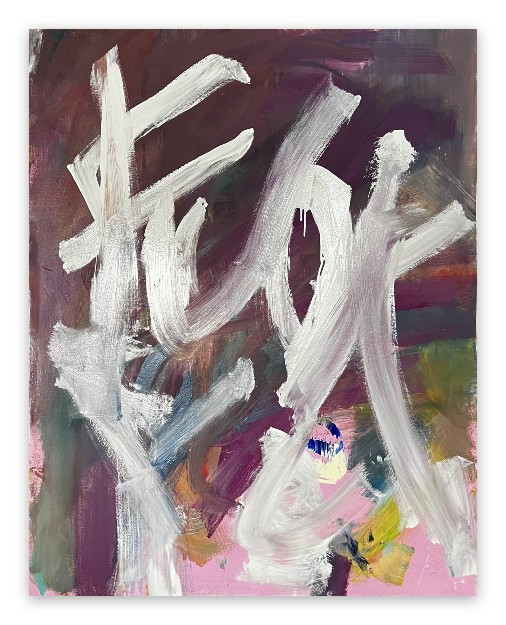
Tommaso Fattovich, Violet Candy, 2024
MARA, MARIETTA: A LOVE STORY IN 77 BEDROOMS – READ THE FIRST CHAPTER
A literary novel by Richard Jonathan
RICHARD JONATHAN, ‘MARA, MARIETTA: A LOVE STORY IN 77 BEDROOMS’ — READ THE FIRST CHAPTER
AMAZON & APPLE BOOKS
RICHARD JONATHAN, ‘MARA, MARIETTA: A LOVE STORY IN 77 BEDROOMS’ | AMAZON PAPERBACK OR KINDLE
RICHARD JONATHAN, ‘MARA, MARIETTA: A LOVE STORY IN 77 BEDROOMS’ | APPLE iBOOK
MARA, MARIETTA: A LOVE STORY IN 77 BEDROOMS
A literary novel by Richard Jonathan
Available from AMAZON (paper | ebook) & iBOOKS, GOOGLE PLAY, KOBO & NOOK (see LINKS below)
RELATED POSTS IN THE MARA MARIETTA CULTURE BLOG
CLICK ON THE IMAGE TO GO TO THE POST
By Richard Jonathan | © Mara Marietta Culture Blog, 2026 | All rights reserved
Comments