Challenging the Gloss and Glamour of the Image
GUY BOURDIN FASHION PHOTOGRAPHY: SUBVERSION OF EXPECTATIONS
Rosetta Brooks
From Rosetta Brooks, ‘Sighs and Whispers’ in Guy Bourdin, ed. Charlotte Cotton & Shelly Verthime (London: V&A Publications, 2003) pp. 127-133
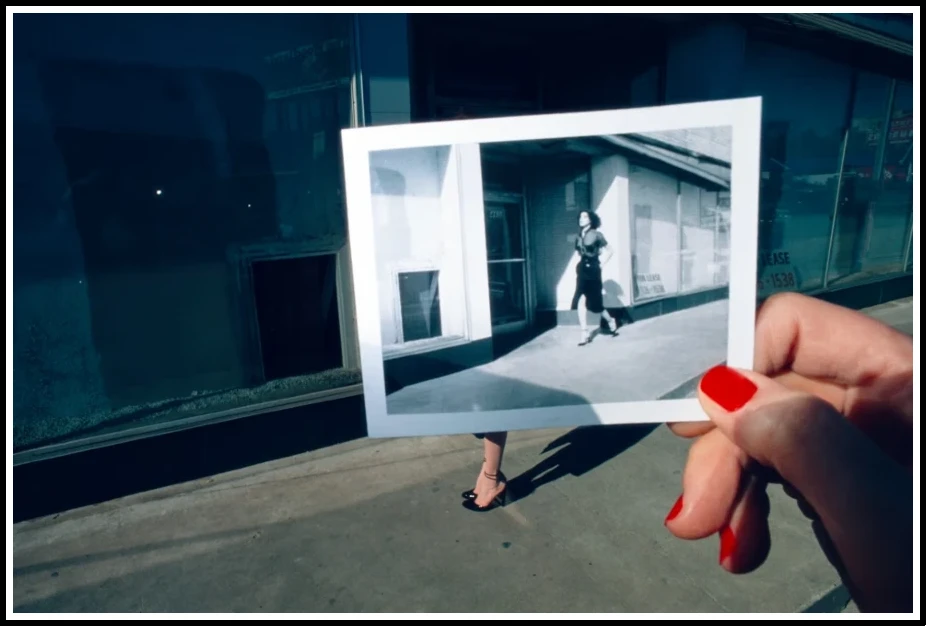
Guy Bourdin, Charles Jourdan Shoes, Spring 1978
There was a moment that began sometime in the mid-1970s and continued through the ‘80s when some of us believed that the arenas of fine art and popular culture were beginning to merge, to develop an interaction that lay beyond the formalism of modernism and the crassness of consumer capitalism: the idea that the best in fine art might co-opt the best in popular art, and vice versa. It was exhilarating. The tendency was particularly visible in fashion photography, the bodily centre of advertising, where the relationship between product-image and product (form and content) was changing dramatically. I still experience a sense of shock when I encounter the photographs of Guy Bourdin and other fashion photographers from the mid-1970s because their images continue to prove that advertising need not be an elaboration of a safe, prescribed fantasy: it can be a challenge. Their photographs suggest that given that the promises of advertising are clearly fake, it’s fair game to emphasize the falsity of the image and to challenge the threshold of our imaginary world. It was fashion at the brink: clothes to be raped in, shoes to be found dead in, a scarf to be strangled by. The promises of these photographs are often of violence, bestiality and death.
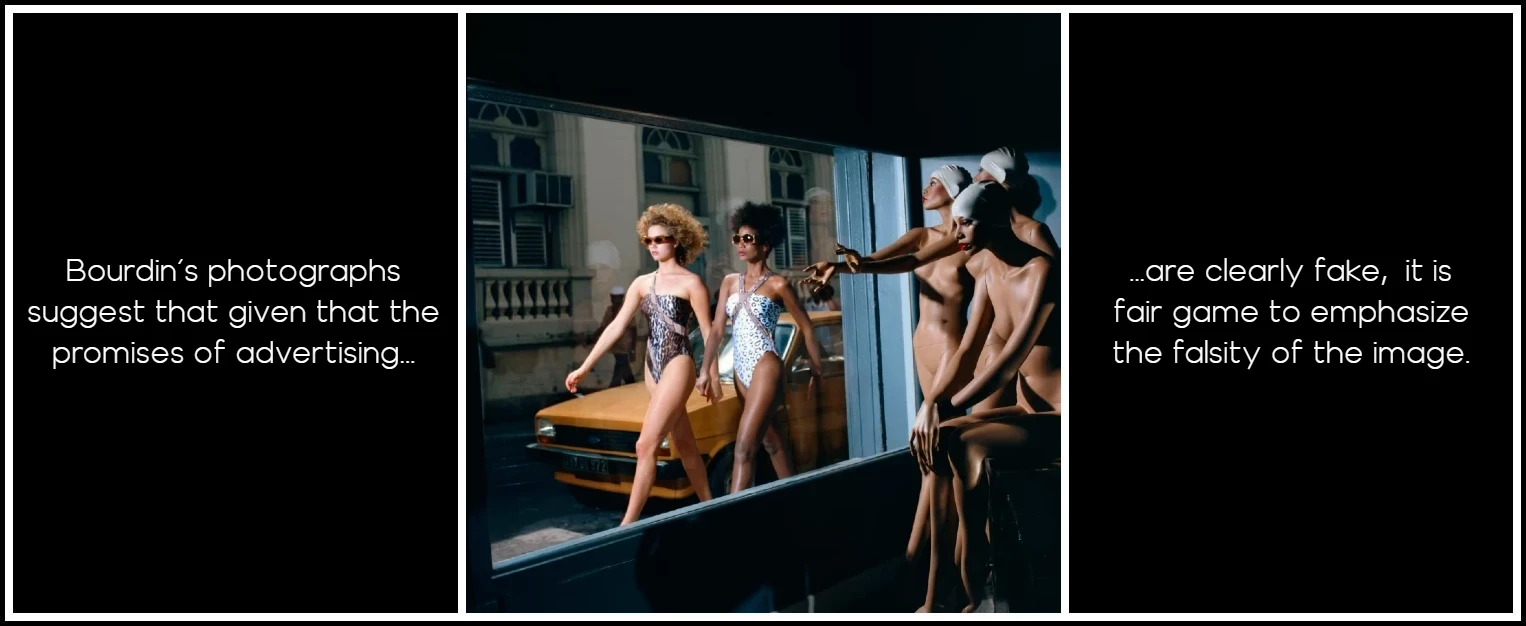
Guy Bourdin, Vogue Paris, May 1984
For fashion photographers like Guy Bourdin, Helmut Newton and Deborah Turbeville the product was less important than the product image. In fact, they all seemed almost indifferent to the details of the clothes or shoes they were shooting. It was the image they were after. Meeting their clients’ needs, whether the magazine’s or the fashion designer’s, might have seemed secondary—if their work had not been so widely sought after. What drove them was the degree of control they could wield in dictating the terms and content of the creation and consummation of fashion. Each, to varying degrees, focused the viewer’s attention on the fetishism, the power relationships, and the potential for sexual violence that have always been implicit in fashion photography.
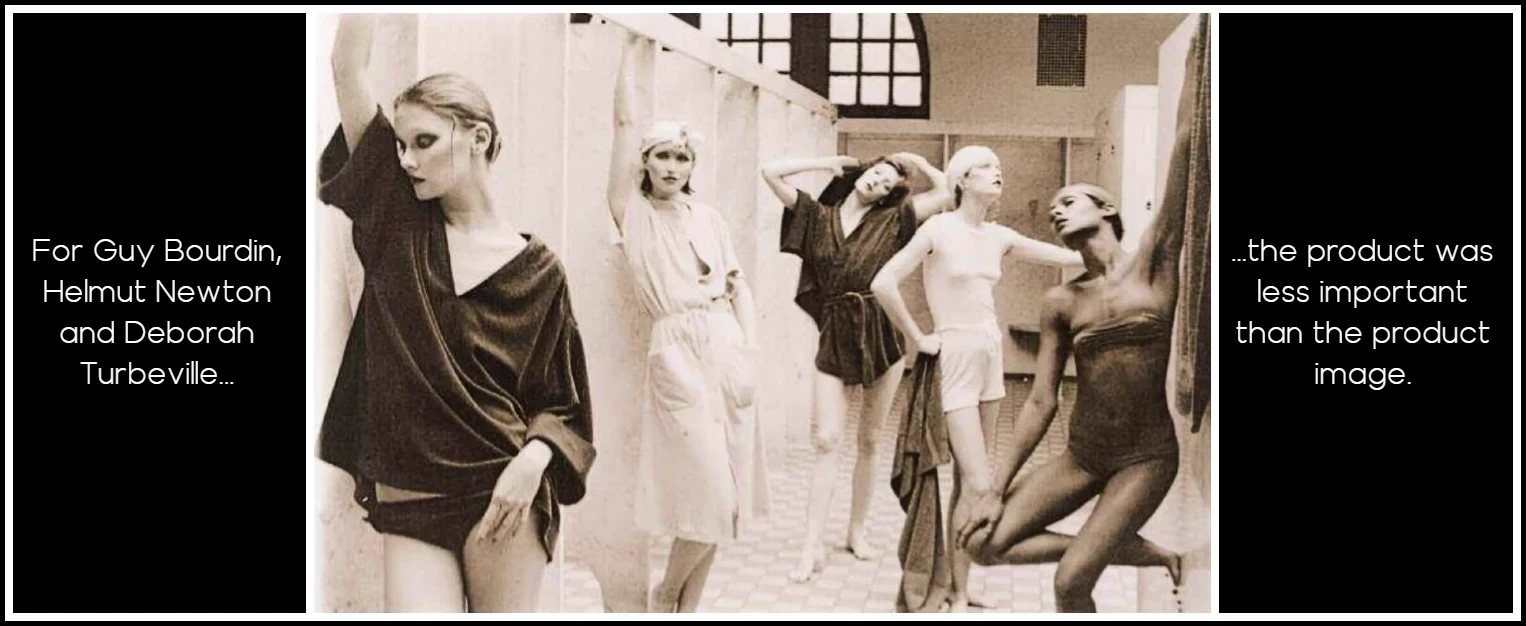
Deborah Turbeville, Bath House, American Vogue 1975
In one sense, fashion photography in the 1970s produced nothing particularly new, no recognizable icon like the 1960s’ Jean Shrimpton or Twiggy. No particular look seemed to dominate. The models could have come straight off an assembly line and represented more a physical norm than an ideal. The repression of any model’s distinctive individuality was conspicuous. There were no particular kinds of woman, not even kinds of models, just a single model-type. The decade was in fact distinguished by the emphasis the best fashion photographers explicitly placed on the female stereotyping that had always sustained the form. Stereotyping can only occur through the suppression of the awareness of the stereotype and by the cultivation of identification with the unique. The dynamics of fashion itself have always been embodied in this dualism: fashion is what is general and typical, and yet it is presented for consumption as individual and singular. The fashion photograph operates on the threshold between the world of the consumer public and the world of the mythic elite, an elite created in the utopia of the photograph. But in the 1970s, fashion photography converted this utopia into dystopia.
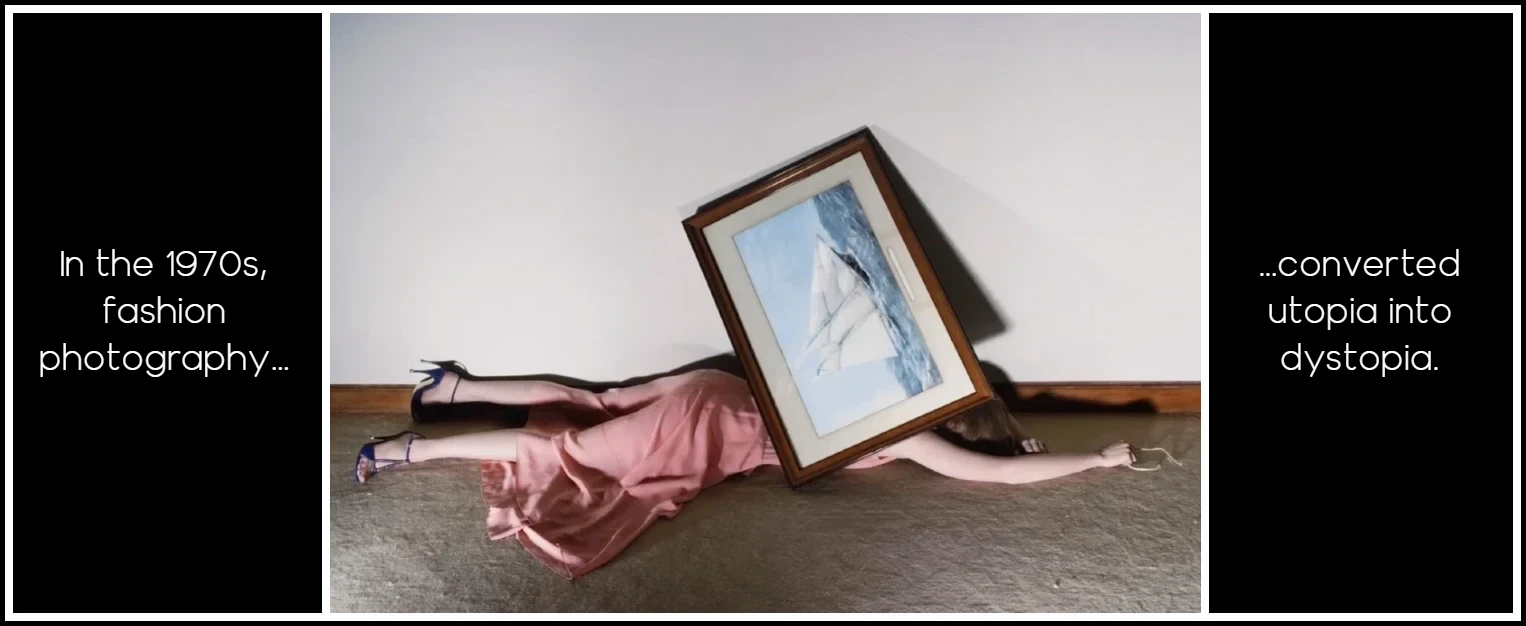
Guy Bourdin, Charles Jourdan, c. 1975
The most widely noted work of this time was produced by Helmut Newton. He promulgated the use of the model as one of a type, presented with the cold distance of an automaton. She was an extension of the technology that manipulated her and converted her into an object. Her veneer, which was at one with the gloss of the image, was to be flicked past and consumed in a moment. Newton further emphasized the inertness of his models by freezing them in struck poses. The suggestion that his models were props in an implied narrative continuum emphasized the discontinuous, fragmented nature of his images, which were like film stills isolated from cinematic flow.
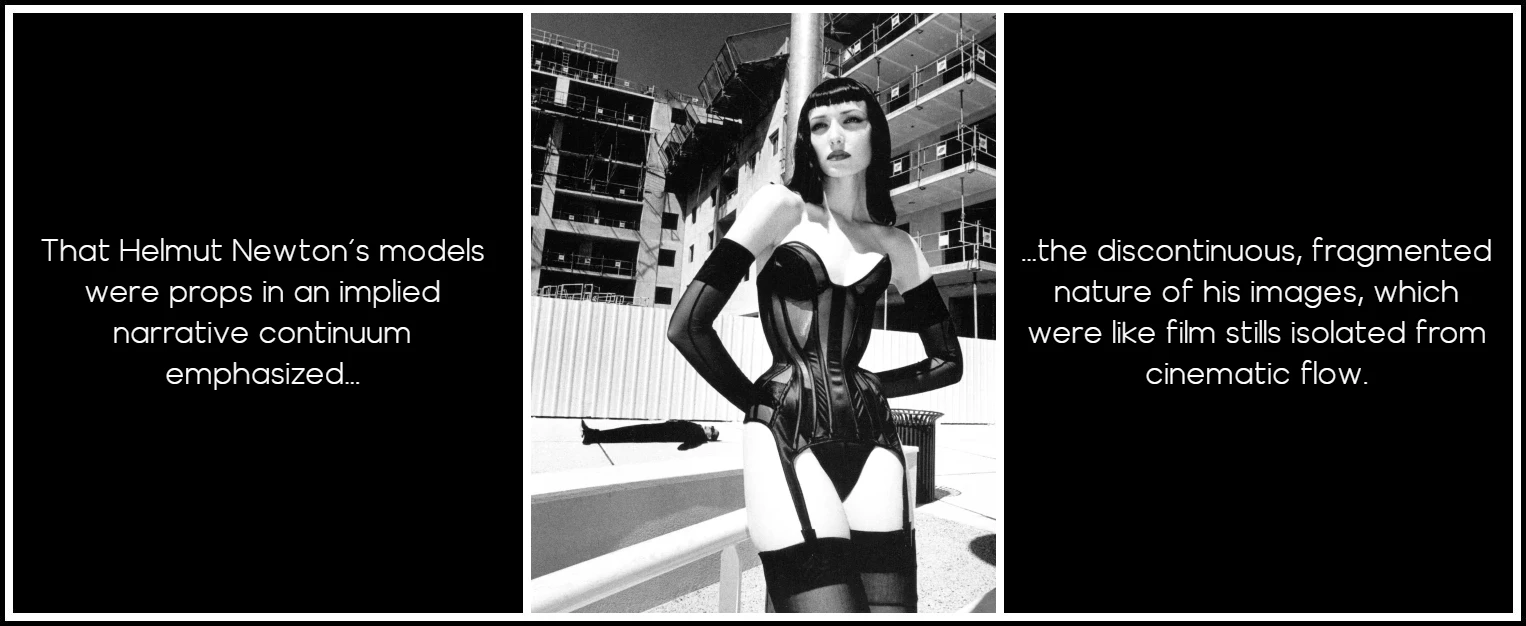
Helmut Newton, Thierry Mugler, Monaco 1998
Newton gained notoriety by outrageously exaggerating existing stereotypes. He accentuated his models’ outlandish qualities, and yet they were also vested with the attributes of eternal archetypes in a sexual drama. His passive woman offered no threat: she was completely malleable, a dummy made of flesh. The object of gratuitous sexual violence and violation, she offered no resistance, and as a result, she became unreal, like de Sade’s libertines. The process of sucking all signs of life out of the model neutralized the threat that all personalities, even glamorous ideals, may pose and transported her beyond the eroticism of the living to the fetishism of the inanimate object. She fitted into the dominant stereotypes so completely that she ceased to connote a reality apart from the images that constituted her life. By mixing store dummies with live models in the June 1977 issue of French Vogue, Newton made an unambiguous erotic response (from either sex) impossible. Instead, his sequences directed voyeuristic attention to the conversion point between object and flesh, and to their morbid reciprocity in the photographic act.
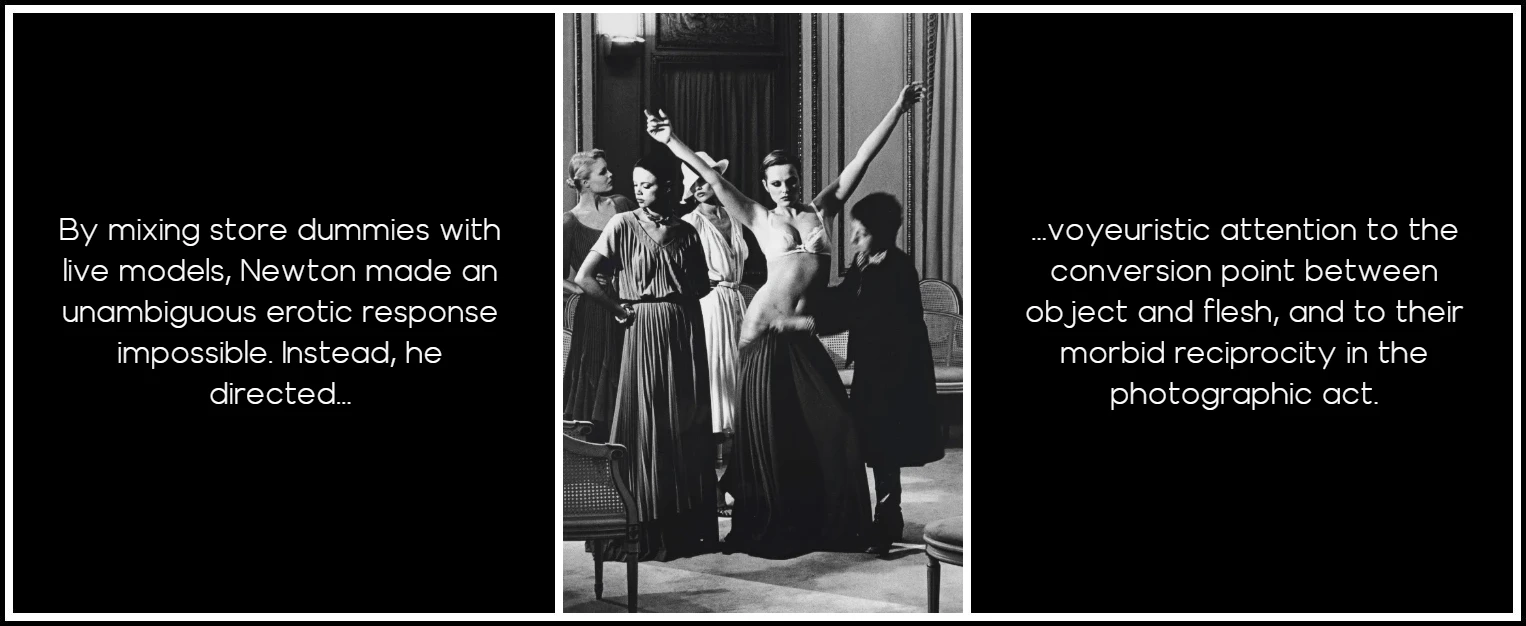
Helmut Newton, Chez Patou, Vogue Paris 1977
While Newton’s photographs were undeniably erotic, the eroticism was inextricable from the process of mediation itself, although his most successful photographs altered the terms of those manipulations upon which fashion photography had always relied. In Newton, the artifice and artificiality always present but previously suppressed in fashion photography, and in images of women generally, were exposed and foregrounded. His images were overtly crafted to be bizarre, and to constitute a threat as much as an invitation. By presenting stereotypes as patent fantasy, Newton’s photographs broke one spell and cast another.
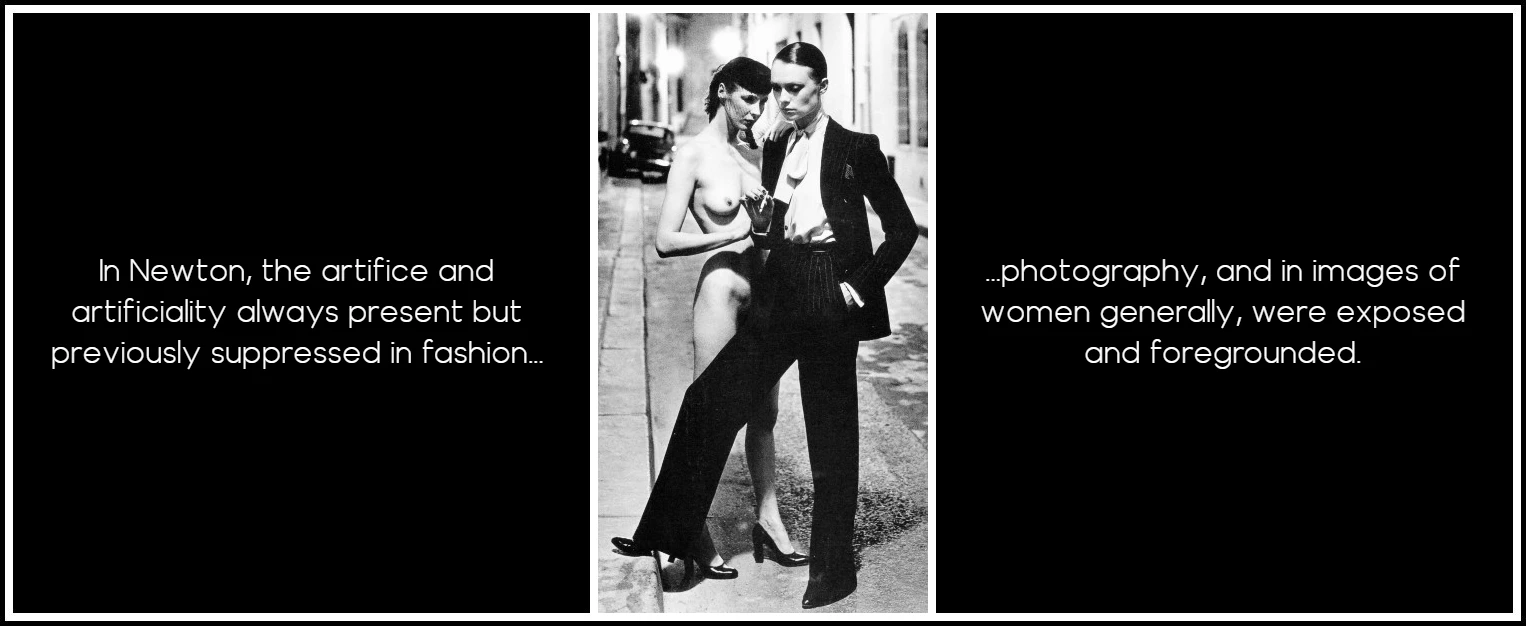
Helmut Newton, YSL le Smoking, Vogue Paris 1975
Despite the innovations he brought to fashion photography, it was Newton’s personal flamboyance as much as his attitude to the image that gave him the renown he enjoys today, and his images retain a certain conservatism. Guy Bourdin, on the other hand, was exploring the same terrain—the mediation of the fashion photo—but he ended up taking a much more radical direction than even Newton had. Both photographers created strange and unusual settings for the fashions they shot. They both emphasized the infinite doubling of the stereotype and the artificiality of the image, its gloss rather than its reality. Both understood that it was the deathly aura of mediation that coats everything in gloss. But this is where their common ground ended. Bourdin’s fascination with the image not only involved the mediation of its content but also embraced its formal issues. When Bourdin claimed to be an artist, among other things, he was laying claim to his confrontation of a specific type of formal problem encountered within a particular kind of form: the spread. He was not claiming that a magazine’s double-page spread was his canvas, but that the double-page spread by definition was not a canvas.
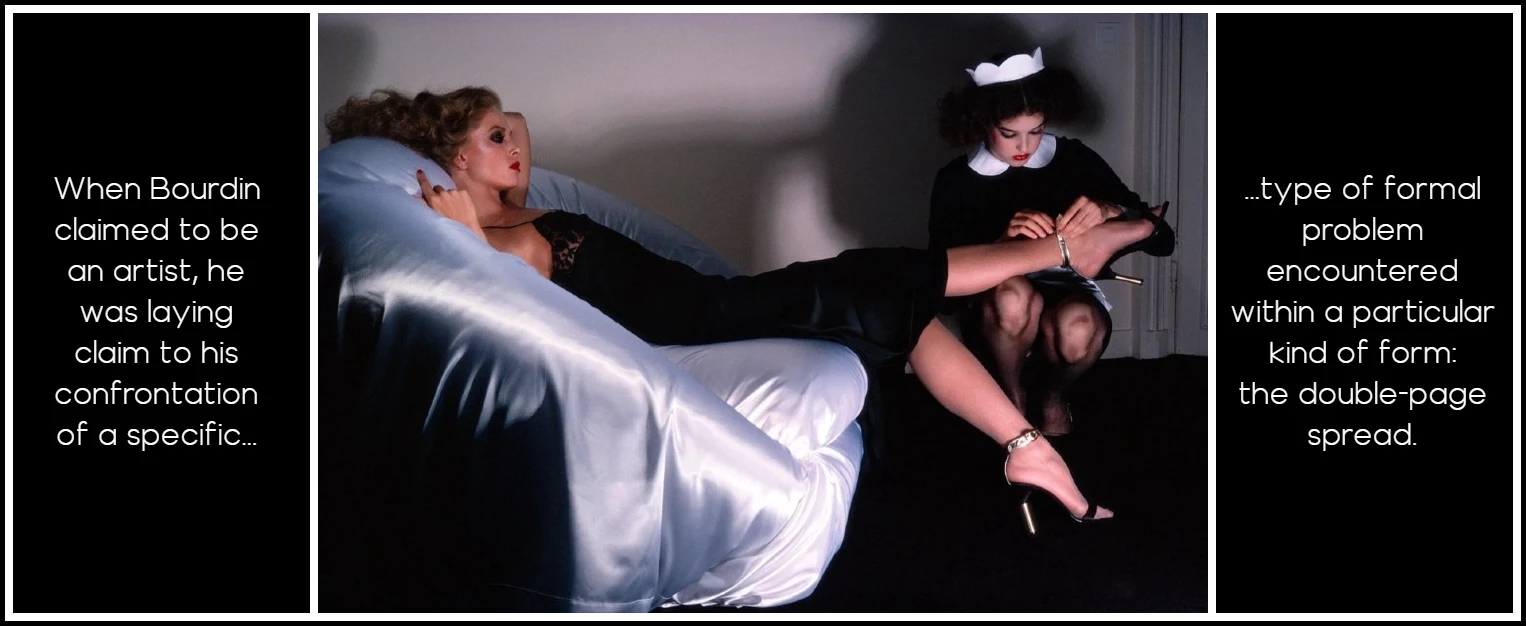
Guy Bourdin, Charles Jourdan, Autumn 1977
Bourdin’s ‘material’ was what canvas stands in antithesis to: the texture of mechanical reproduction. In his work, the double page was not the vehicle for communicating the image, it was a structural characteristic of a particular kind of encounter. He organized his images around their form of mechanical production, around both the gutter, dividing the two pages in a spread, and the turn of the page. In the March 1978 issue of French Vogue, a double-page Charles Jourdan advertisement depicted a model crouching on an urban walkway, one high-heeled foot and bare leg on each page. The model held a black and white photograph of herself—in pose towards the viewer, the perspective of this gesture obscuring her coloured body from below her eyes to above her crotch. To turn the page was not only to open and close the spectacle of the fashion spread—and to open and close her legs—but also to experience a witty pastiche of the centrefold. The animated model offered a resistance to the expectations of this conventional, pornographic, use of the magazine gutter. She was the possessor of the image and of its falsity and shared the joke with the predominantly female readership of the magazine. Bourdin used the double-page spread to insert a mirror into his conceptual and formal examination of dynamics of viewed and viewer. The process of reproduction itself was being reproduced, as the model holds up her black and white version for our scrutiny.
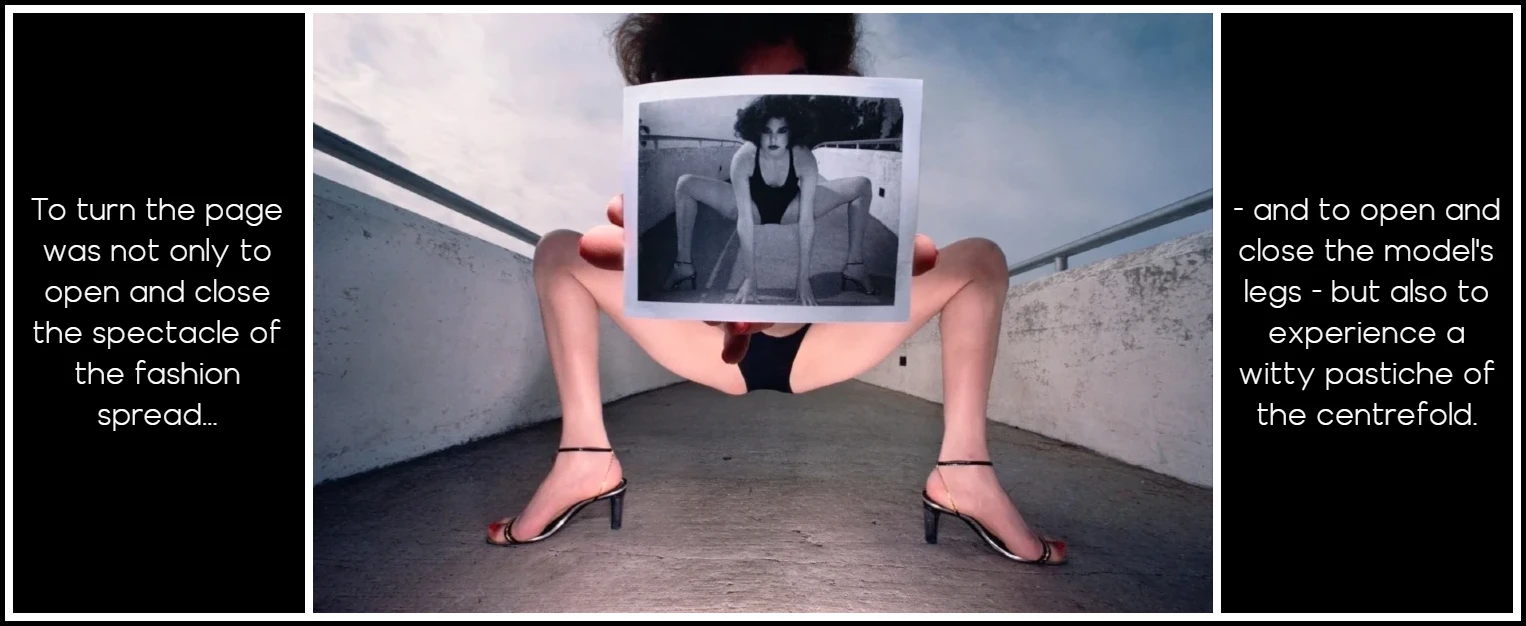
Guy Bourdin, Charles Jourdan, Spring 1978
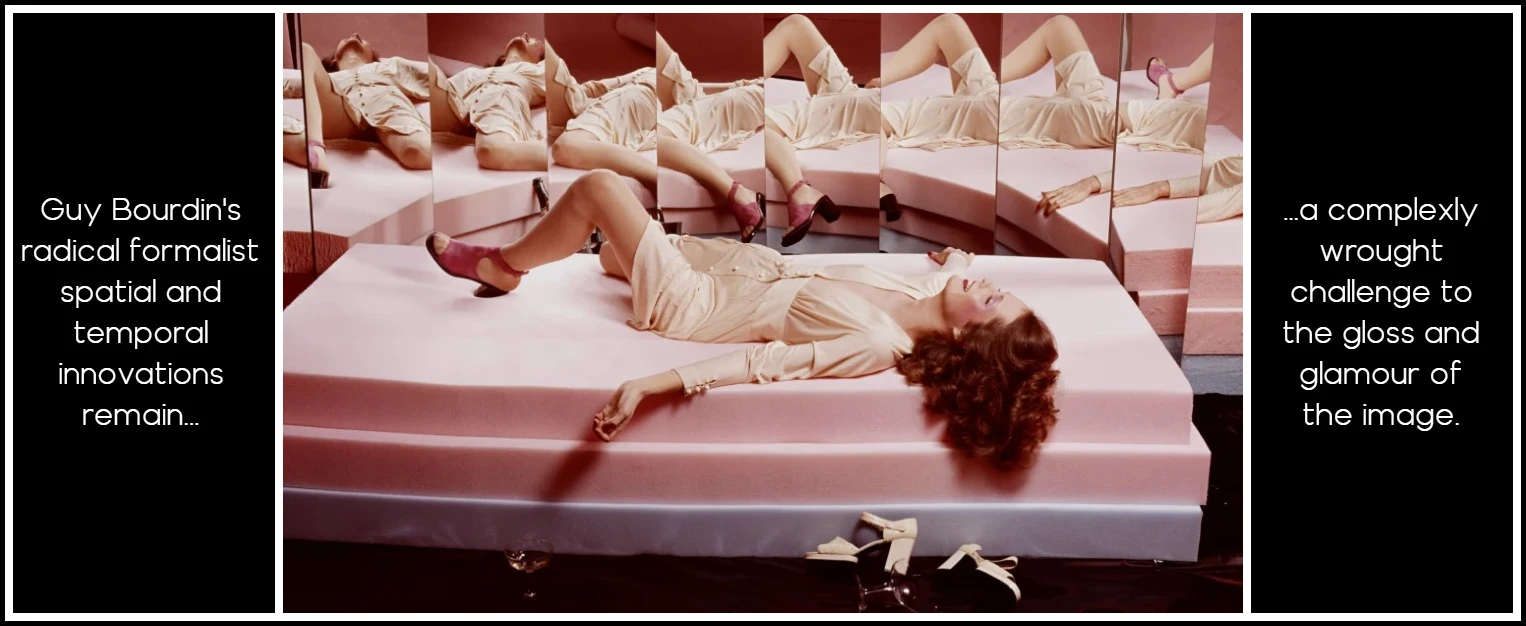
Within these dramatic formal devices, Bourdin set up spatial relationships within the picture that rebounded upon the strangeness of our ordinary encounter with the double page, the photograph, and the advertisement itself. The viewer was redirected from the object (the product) to the spatial ambiguities of its selling, which undermined the expectations built into encounters with photographs and with advertisements. Bourdin enhanced the peculiarities of conventional readings of space in a spread to accentuate the alienness of what unfolded across the horizontal continuum and on either side of the vertical division of the two pages. He used partition and alternation of shallow and deep spaces to juxtapose façade with depth, the frontality of the image with the three-dimensionality of the setting. At the heart of Bourdin’s picture-games was that moment of hesitation—the beat when the conventional turns unconventional, and vice versa—in which spatial and temporal expectations are undermined and the setting of both the product and the advertisement are rendered disquieting. Bourdin’s work signalled that Brechtian distancing and the formalist ‘exposure of the device’ had become mainstream rhetorical manoeuvres within mass circulation magazines.
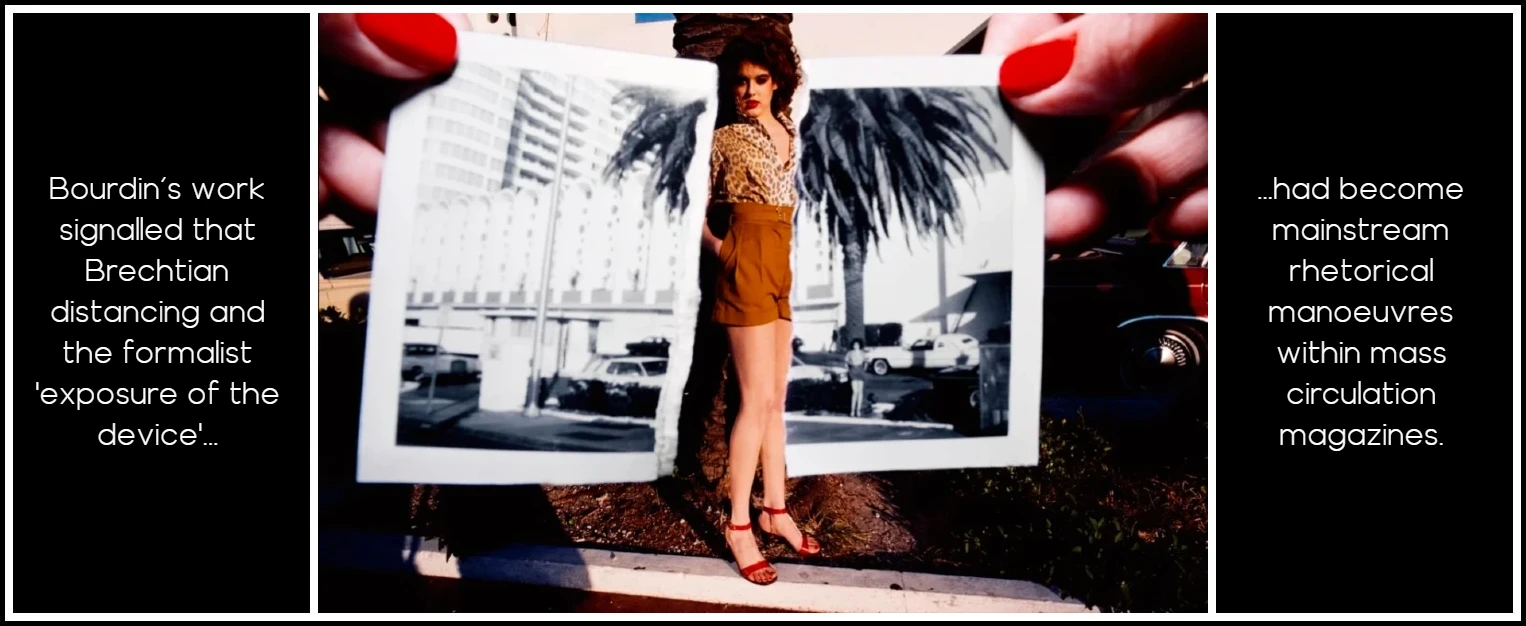
Guy Bourdin, Charles Jourdan, Summer 1976
The radicality of Guy Bourdin’s use of the fashion photograph was never more exploited and explored than when Bloomingdale’s commissioned him to take photographs for their lingerie catalogue in 1976. One might well assume that they were aware that it would become a collector’s item. The other major fashion photographers of the 1970s, Newton and Turbeville, had both been anthologized by then, but the Bloomingdale’s catalogue Sighs and Whispers became the only ‘book’ by Guy Bourdin and remained so until the publication in 2001, ten years after his death, of Exhibit A: Guy Bourdin. In reality the Bloomingdale’s catalogue was more of a pamphlet, only eighteen pages long, including front and back covers, and containing the same number of photographs. Guy Bourdin’s name appears only on the back page as a vertical photo-credit. Nonetheless, the double role of Sighs and Whispers as a photo-series by a uniquely innovative artist and as a common sales tool aimed at a wide market was an irony that would not have escaped either Bourdin or Bloomingdale’s.
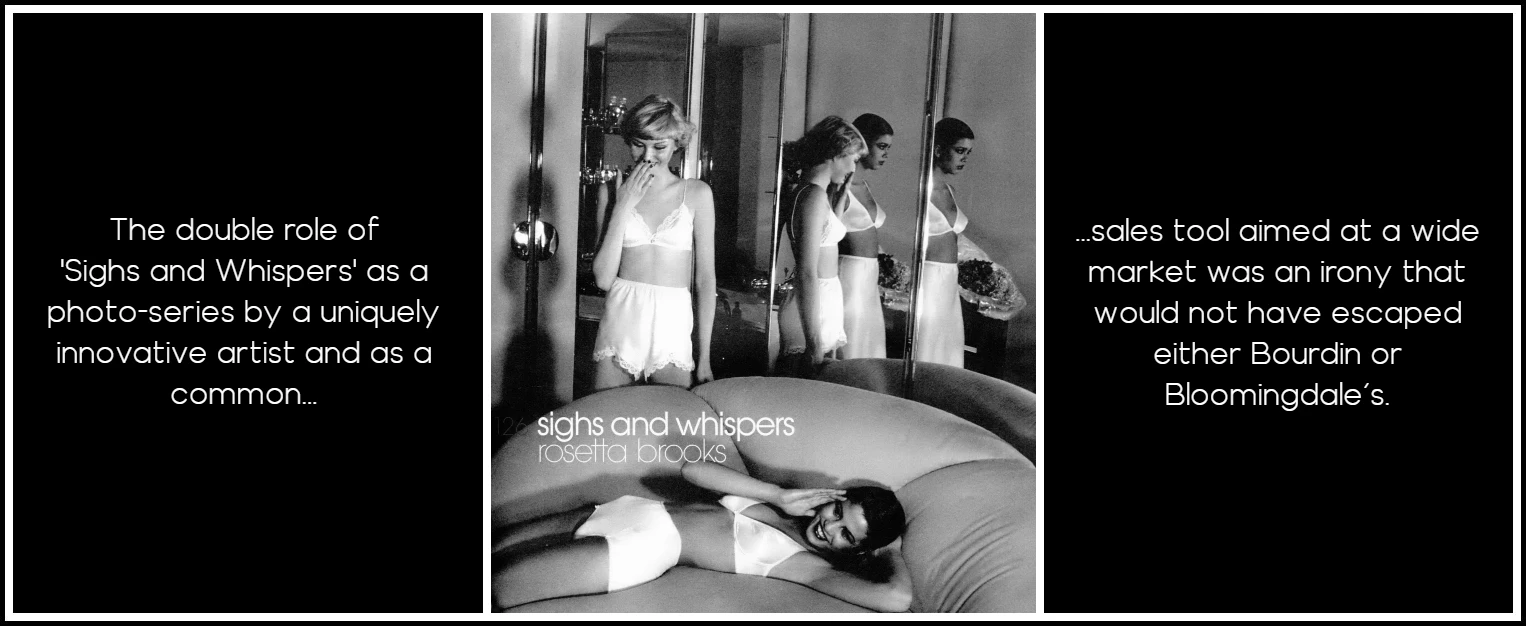
Guy Bourdin, Sighs and Whispers, 1976
In 1975, prior to the Bloomingdale’s catalogue, Guy Bourdin had created an advert for Charles Jourdan shoes in which the shoes lay discarded on the side of the road, at the site of what appears to have been a fatal car accident (from the chalk-marked outline of the body, one gathers that the victim had been wearing the shoes). Particular attributes of the shoes were more or less imperceptible in the double-page photograph: the gap between the product and product-image was at its most extended. By the late 1970s it had become usual to see a Bourdin spread advertised as such, at the beginning of the advert itself, with the product name at the end reduced to the size of a credit, almost as if the advertiser was taking on the role of patron for the fashion-photographer auteur.
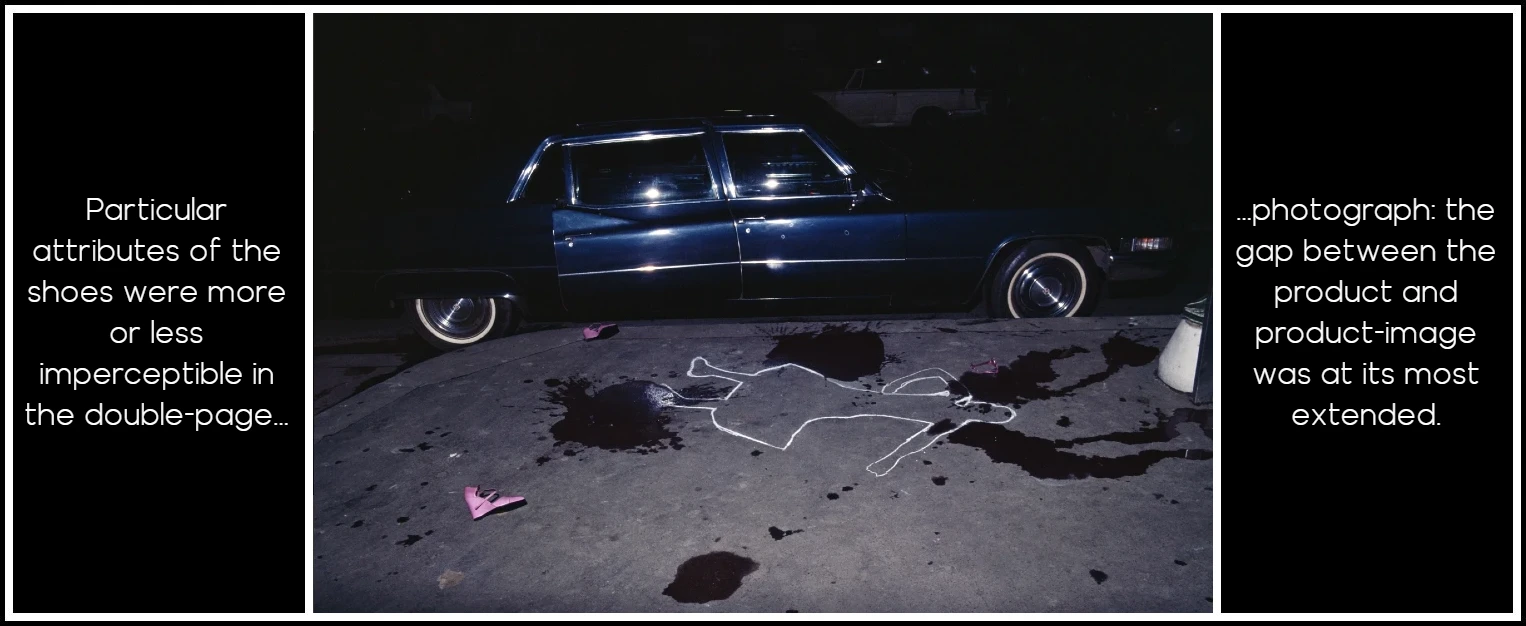
Guy Bourdin, Charles Jourdan, Spring 1975
As the role of the advertising image moved away from simple affirmation, so the relationship of the advertising photographer with the advertiser became more complex, and the demands each was able to make on the other shifted. In this context, Guy Bourdin achieved an unprecedented level of freedom. Like Newton, Bourdin worked in spreads, occupying sometimes as many as ten pages. But whereas Newton’s photo series were almost always unified by a story line, Bourdin’s were merely suggestive of a narrative, but they rarely told a story. His spreads tended to be unified by a formal interest, theme, or motif, explored across a sequence of double pages. In Sighs and Whispers the governing principle was the spatial divide.
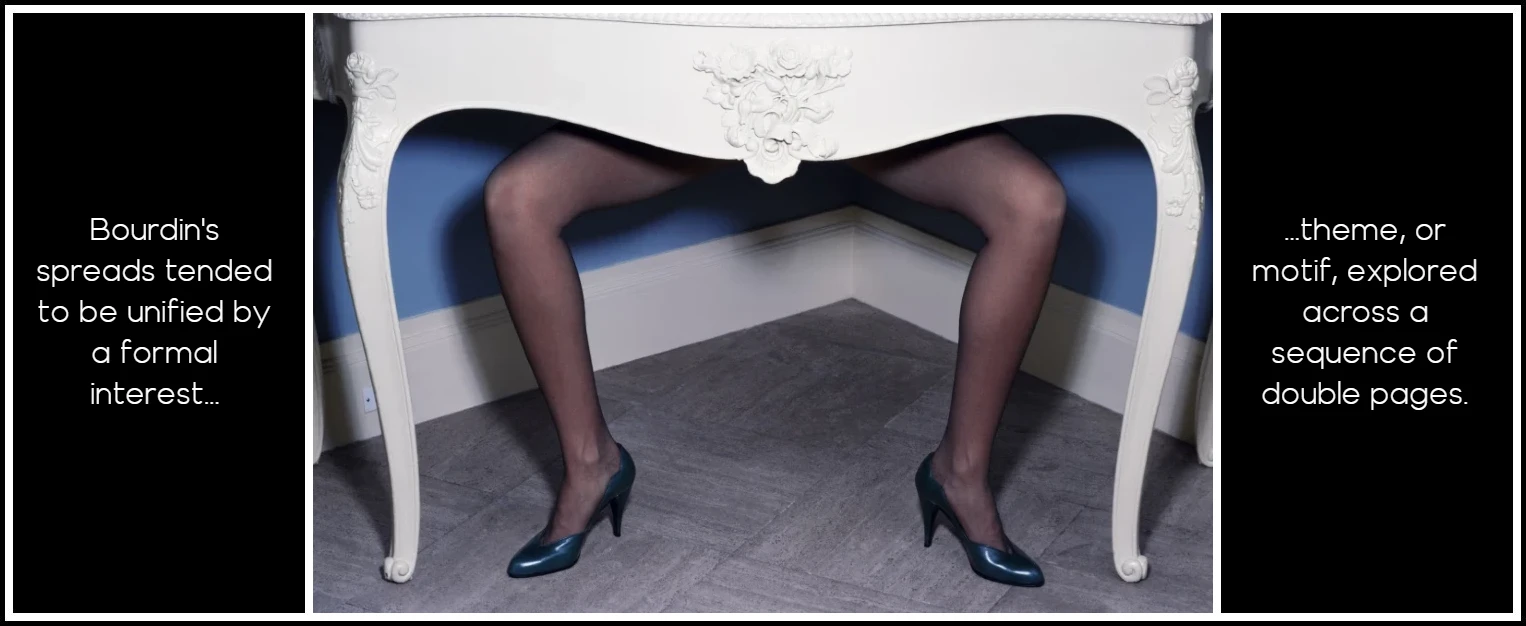
Guy Bourdin, Charles Jourdan, 1979
The setting of most of the photographs in the catalogue is the bedroom, and given that the book features lingerie, here Bourdin makes a ‘natural’, even conventional, choice. Individual pictures are almost always divided vertically at the centre by walls, doors, windows, and mirrors. The central cut is used to explore spatial and temporal continuities and discontinuities inside and between pictures, across the double pages. This decentering of the picture reinforces the act of scanning, of flipping through a magazine. The images themselves become metaphors for movement from space to space—from picture to picture and from page to page. We move from room to room (through a wall and door), from inside to outside (through a window), from reality to appearance (through a mirror). Double pages themselves often seem to be mirror reflections of one another. The turn of the page becomes a door. Bourdin’s use of pictorial space is both a response to the demand to get two outfits into one picture and a dramatization of what is at the root of such demands. Where other photographs of lingerie would use asymmetries of foreground and background to make a pair of women—one in a nightgown and robe, and the other in a gown alone—look somehow at ease in the peculiarity of the catalogue setting, Bourdin uses symmetries to dramatize the unreality of his presumably conventional setting. He then brings overtones of lesbianism and narcissism into play to emphasize the sexual implications of the female consumer’s vantage point on what is by implication her own image. Ultimately, instead of naturalizing the setting, Bourdin makes it and the image strange by imposing devices that keep the consumer at a distance from the ostensible content of the image, and therefore the product and herself as a consumer of the product.
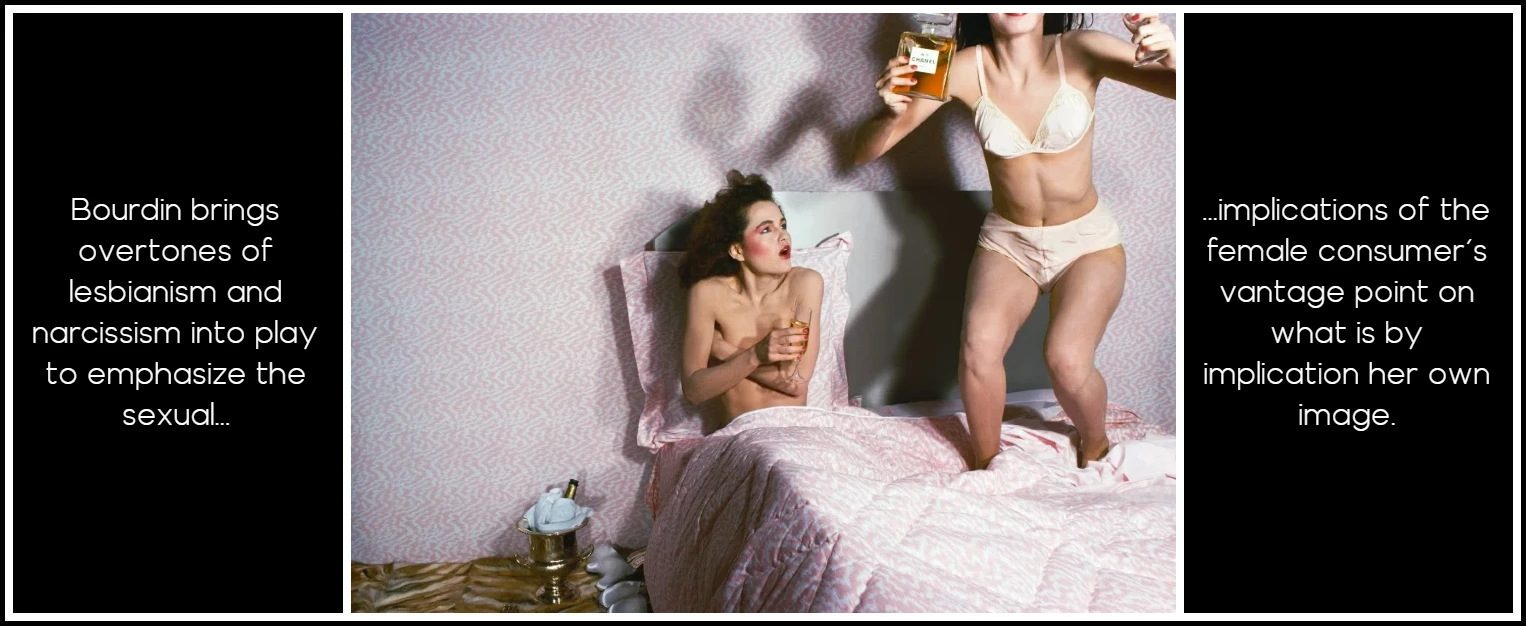
Guy Bourdin, Vogue Paris, December 1977
In the turning of the pages of slips and nightgowns, we go from reality to appearance, from the female double to the mirror reflection. Expectations are constantly being subverted; a simple relation of access to the picture space is constantly denied. The divide of a window frame in the centre of one picture becomes, at the turn of a page, the divide of a wall between rooms. Across the double pages a blank, intermediary frame is created, like a frame caught out of sync in a cine projection. The process of scanning is arrested. Directed from the centre, from the reality of the product, or from the body of the woman, the point of consumer attachment becomes the frames themselves—as the page and within and between pages—conventions of presentation that are normally seamlessly traversed in the transparency of the image offered for consumption. But Bourdin’s use of space and sequence makes what would be transparent suddenly opaque and in the process denies glamour its role as neutral index of sexuality by spectacularizing its falsity. The glossiness and glamour seem to merge in the images as points of closure, rather than as transparent openings upon the desired object(s). (Bourdin’s preoccupation with the female doppelgänger reflects this gulf between desire and desired object, whether commodity or woman.)
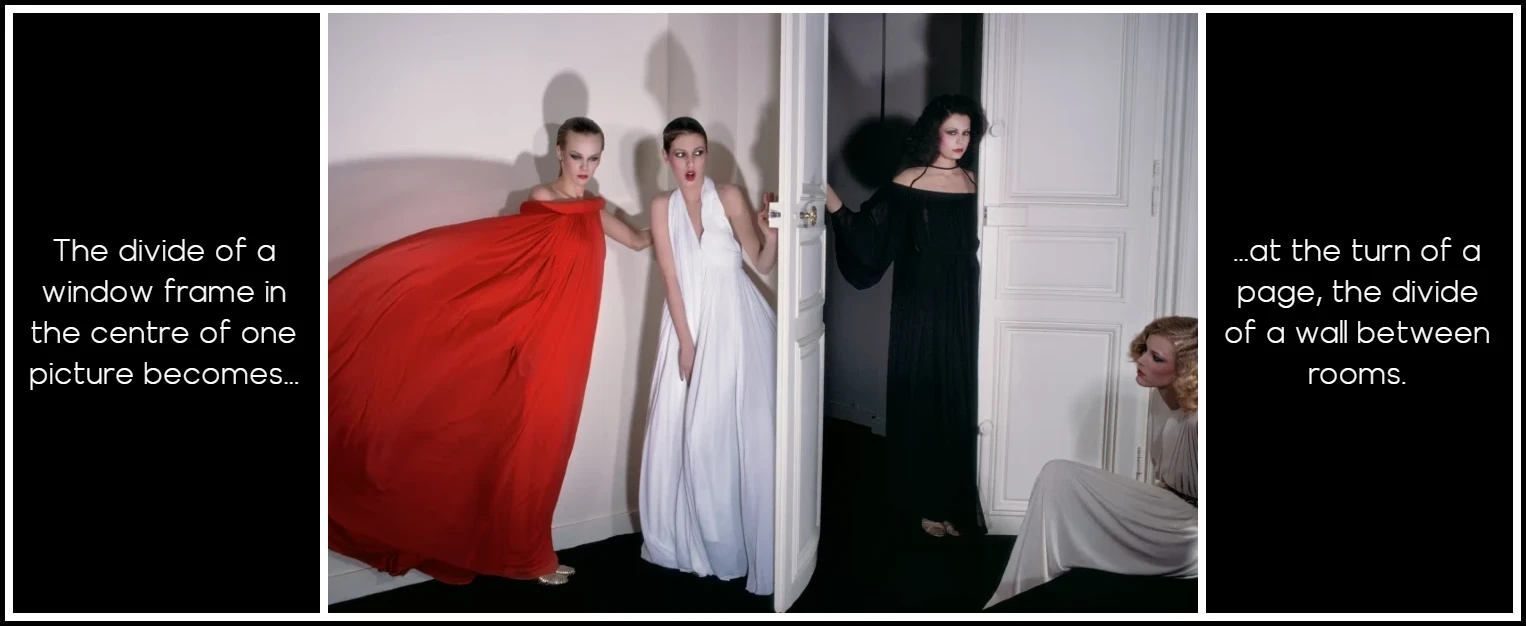
Guy Bourdin, Vogue Paris, March 1976
Fashion photography from the 1970s is infamous for its sexual explicitness, and Bourdin’s use of the model as type, as uniform and infinitely replicable, contributed to its character as much as Newton’s. But Bourdin’s use of lookalikes is calculated to make an immediate sexual response to his models even more remote. His netherworld of sexual enticement plays upon the ambiguity implied when sexual stereotypes of women are deployed for female consumption. Instead of presenting fashion models as real people whose individuality is asserted by the adoption of a fashion, Bourdin enhances the reduction of women to type. Any pretence to the dramatization of identity via style is ruthlessly subjected to the iron grip of the troika of fashion/image/consumption. The images are undoubtedly erotic, but their pervasive deathliness makes it an erotic attachment to the surface of glamour and gloss in all its explicitness. This is in contrast to the male-oriented norm of fashion photography (a norm Newton never really abandons), which for all its titillating illusion, still offers the female body up for male appropriation.
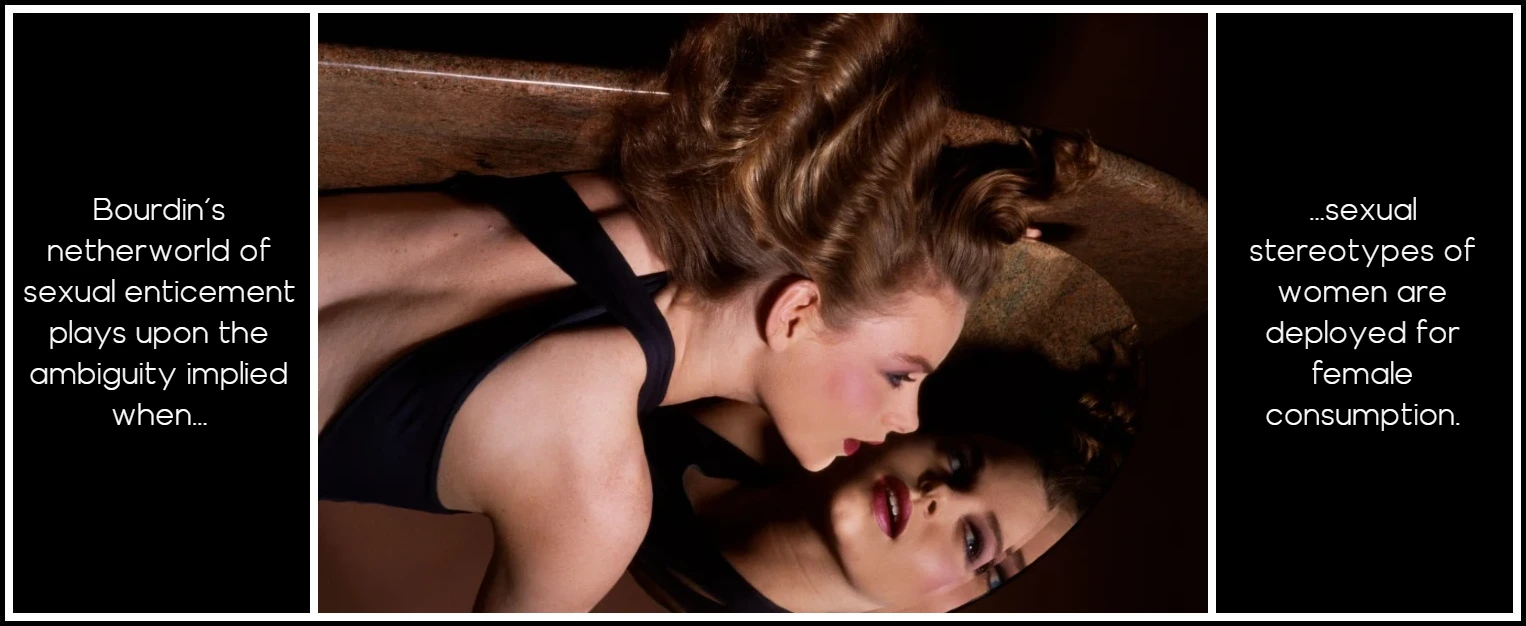
Guy Bourdin, Vogue Paris, c. 1977
Bourdin found a point of erotic attachment close to his own fascinations: an attachment with the photograph itself. Not that photo-fetishism is new to fashion photography, but in most photographers’ work this displaced eroticism remains at the service of the male-centred image of the female body, whereas in Bourdin, it displaces the body/commodity as the object of attention. Snapshots themselves are often featured in Bourdin’s pictures. [I have deleted six sentences here that examine an image that is not available.] Advertising begins to reflect upon itself through an incorporation of formalist devices (which in fine art lay claim to a higher order of perception in a suspension of the primacy of image content) into the economic centre of culture: the selling of the image.
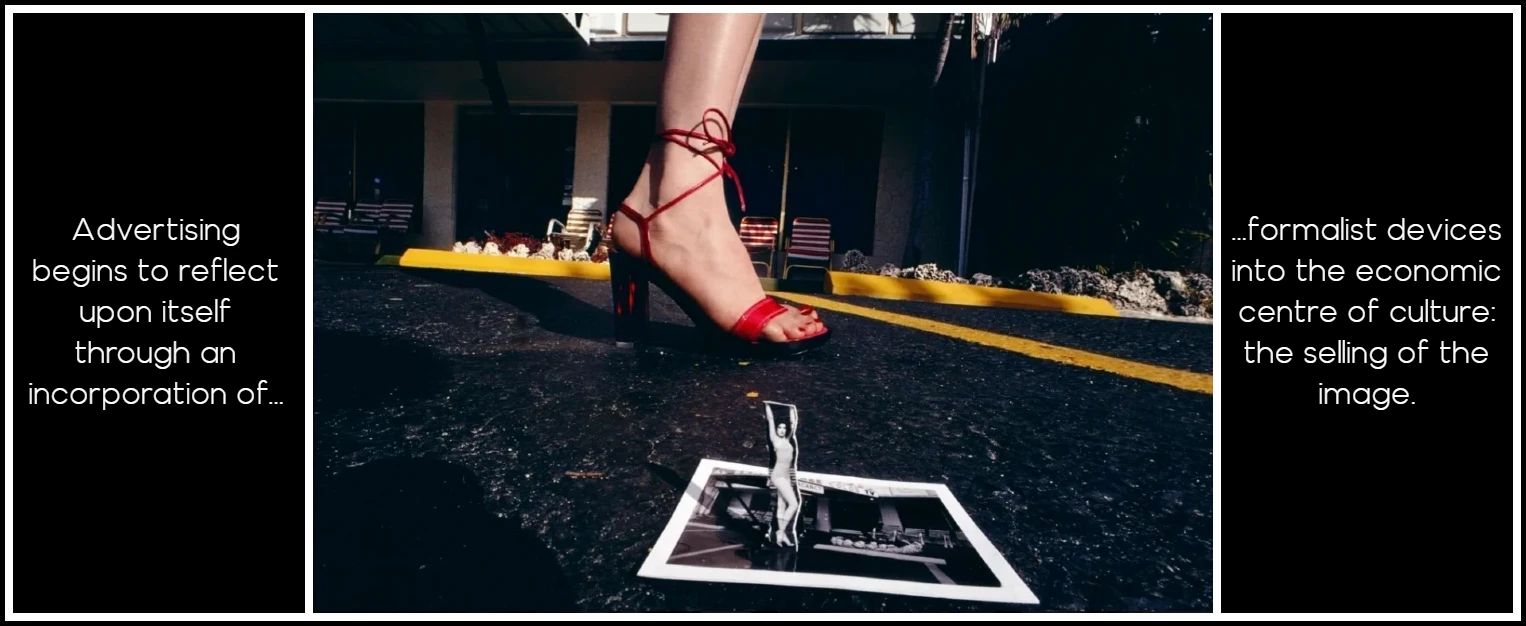
Guy Bourdin, Charles Jourdan, c. 1975
The tendency reflects a shift in consumer attitudes involving the aestheticization of consumption, an attachment to fashion as constraint, glamour as false representation, and style as repetition. With all this, it is interesting to note that in contrast to their mode of representation, the clothes advertised in the Bloomingdale’s catalogue are remarkably old-fashioned. It may be a characteristic peculiar to the 1970s—when media abundance and proliferation were set against a background of economic recession—that fashion photography should flourish with the decline and fragmentation of the industry to which it was attached. In the 1960s newness went hand-in-hand with a rhetoric of abundance. What seemed to become necessary in the 1970s was a rhetoric that could justify a consumer attachment to the old: new images for old products. Style ceases to be a matter of what you are wearing and becomes more about the way you wear it and the attitude with which you bear an image—your own image—while maintaining a disembodied stance toward self-presentation. In any case, the shift of emphasis from the product to the product-image is undeniable. Comparison of the thickness of 1960s’ and 1970s’ Vogue magazines reveals the new importance acquired by the advert in the 1970s. It became an independent, semi-autonomous element in the fashion industry, a form of entertainment in its own right and, perhaps, an art. It was in such circumstances of media abundance that Bourdin was not only accommodated, but was necessary. Bourdin’s subversion of the viewer’s expectations was at the very least a way of catching the passing glance in the midst of a superabundance of images.
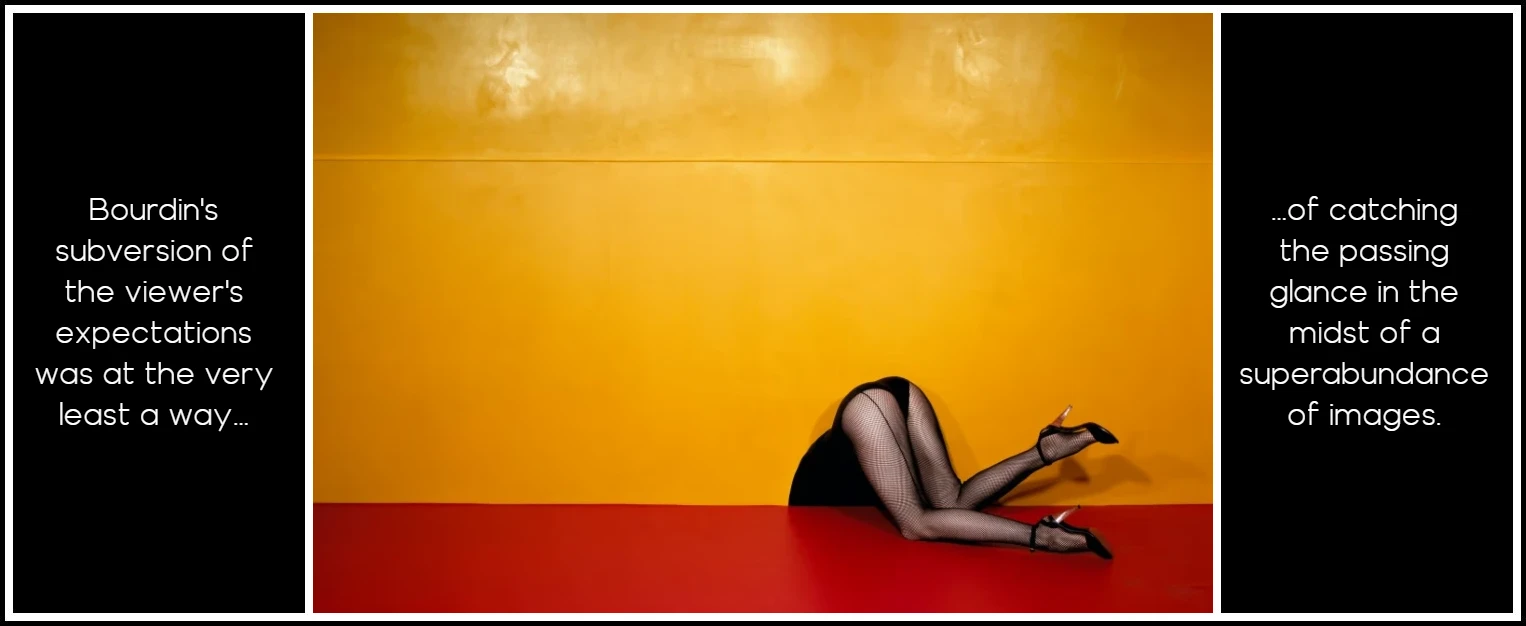
Guy Bourdin, Charles Jourdan, Spring 1979
By the late 1970s, it was no longer necessary simply to affirm the product along with its attendant secure fantasies; rather, it became crucial to short-circuit the entire mode of consumption. It became more important to halt the restless gaze than to keep it moving. Bourdin’s spatial devices operated as ‘traps for the gaze.’ Lacan used this phrase in relation to The Ambassadors by Holbein. He observed that what looks like a semi-abstract phallic shape hovering in the foreground of the painting reveals itself to the passing, sideways glance as an anamorphically distorted representation of a human skull. The appearance of the death’s head in the penis is an apt metaphor for Bourdin’s images. Dramatizing the act of photography as an arresting process, his pictures were ‘little deaths’, interruptions of the image flow of consumer desire.
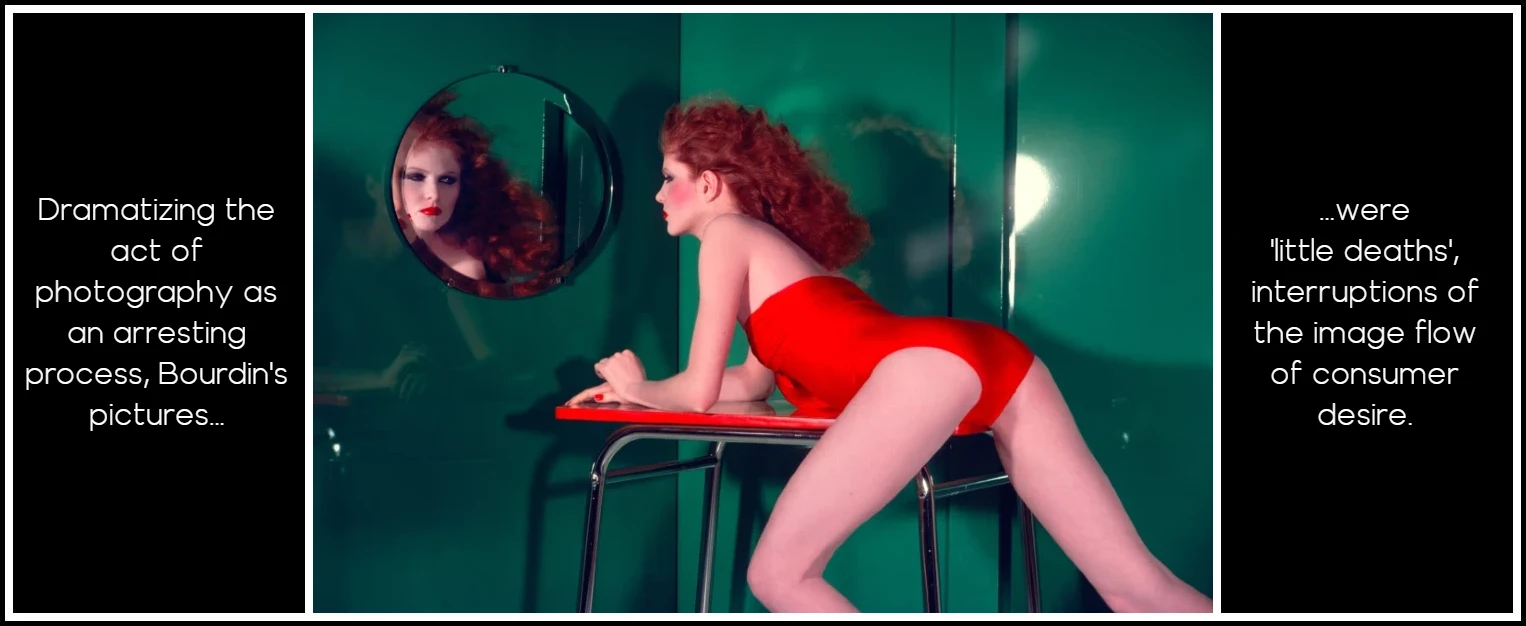
Guy Bourdin, Vogue Paris, May 1977
Since Bourdin’s death in 1991, much has changed in the realm of fashion photography. Sadly, the excitement and exhilaration in the air back then has given way to a gloomy re-entrenchment, a movement back to a conservative attitude toward making and experiencing the image. Photographers have put the fashion image back into the service of titillating illusion, where the body is, once again, the centre for male appropriation. Ironically, Bourdin’s radical formalist spatial and temporal innovations have been turned into superficial, trendy accessories, transformed into a simple part of the gloss and glamour of the image instead of a complexly wrought challenge to it. Which is why, despite superficial similarities to photographers working in fashion today, Guy Bourdin remains indeed one of a kind.
Guy Bourdin, Charles Jourdan, Spring 1972
MARA, MARIETTA: A LOVE STORY IN 77 BEDROOMS – READ THE FIRST CHAPTER
A literary novel by Richard Jonathan
RICHARD JONATHAN, ‘MARA, MARIETTA: A LOVE STORY IN 77 BEDROOMS’ — READ THE FIRST CHAPTER
AMAZON & APPLE BOOKS

RICHARD JONATHAN, ‘MARA, MARIETTA: A LOVE STORY IN 77 BEDROOMS’ | AMAZON PAPERBACK OR KINDLE

RICHARD JONATHAN, ‘MARA, MARIETTA: A LOVE STORY IN 77 BEDROOMS’ | APPLE iBOOK
MARA, MARIETTA: A LOVE STORY IN 77 BEDROOMS
A literary novel by Richard Jonathan

Available from AMAZON (paper | ebook) & iBOOKS, GOOGLE PLAY, KOBO & NOOK (see LINKS below)
RELATED POSTS IN THE MARA MARIETTA CULTURE BLOG
CLICK ON THE IMAGE TO GO TO THE POST
By Richard Jonathan | © Mara Marietta Culture Blog, 2026 | All rights reserved
Comments