‘La Chatte’: The Erotic Dimension
IMAGE & EROS: REFLECTIONS ON MORENA FORTINO’S ‘LA CHATTE’
Richard Jonathan
Richard Jonathan is the author of the literary novel, Mara Marietta: A Love Story in 77 Bedrooms
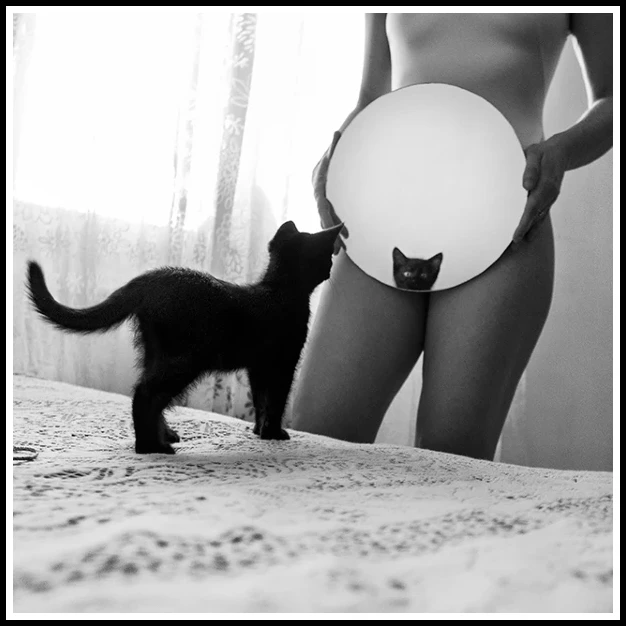
Morena Fortino, La Chatte, 2014
Morena Fortino’s La Chatte, for some, elicits a gasp of delight, a tingle of transgression; for others, a smile tending to laughter, with an undertone of the uncanny. For still others, it gives rise to a somewhat unsettling feeling of simultaneous intimacy and distance; for others still, it is a feminist affirmation of womanhood. The photo, for some, is a strangely classical throwback to fine-art and fashion photography; for others, it breathes forth the heady scent of sex. And then there are the cat-inclined females who, conjugating the X chromosome with everything feline, find echoes of sorcery in the photo, along with an evocation of the feminine, nocturnal rather than eternal. And let us not forget the nervous laughter of jittery males, fighting against the return of the repressed (castration anxiety). In the same vein, let us pity the poor fetishist who, when the cat moves away, will see only his own face, terror-struck in the knowledge that behind the mirror there is nothing. Finally, for some, La Chatte is nothing but a tease, a game of conceal and reveal, while for others it attains the dignity of a heraldic, totemic composition.
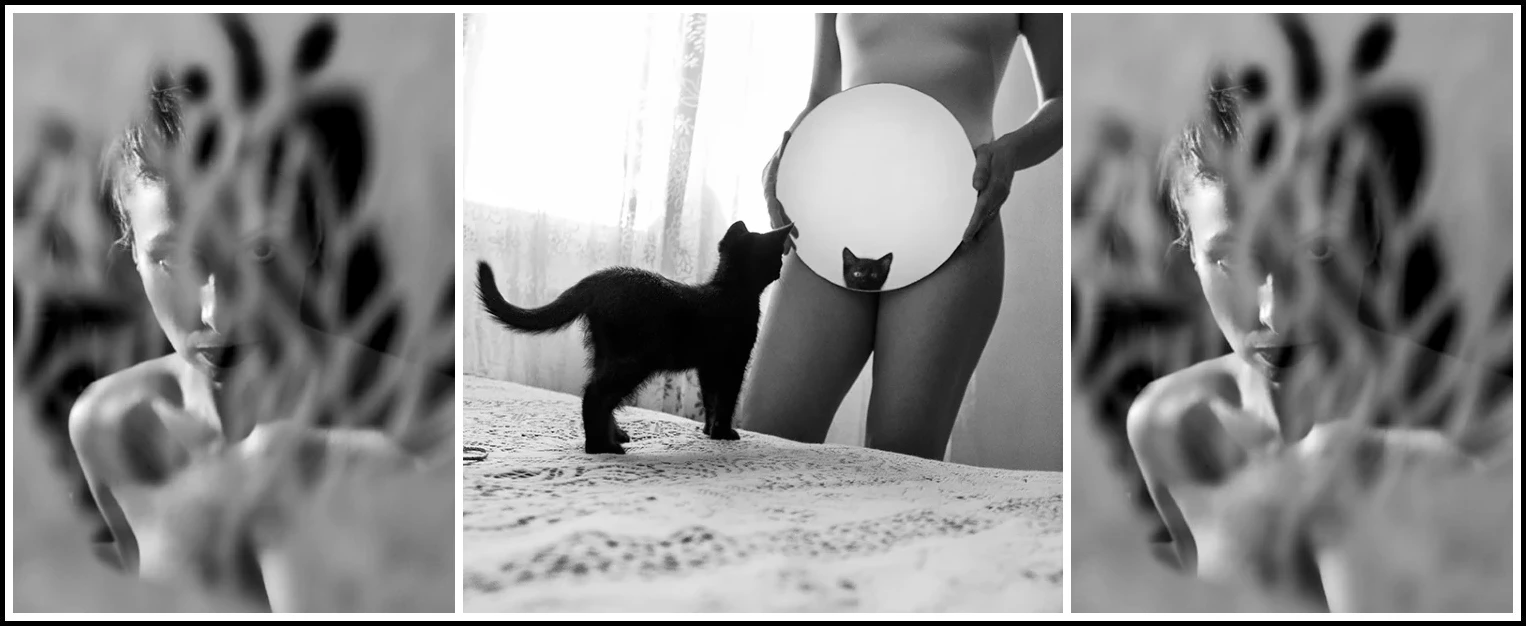
MORENA FORTINO
Self-Portrait | La Chatte
La Chatte, then, is an ambiguous image, and like the Mona Lisa, ambiguity is a large part of its appeal. As we have just seen, viewers’ responses to it vary widely. In this essay, I will focus on just one aspect of the image: its erotic dimension. Are you ready, dear reader? Let’s go!
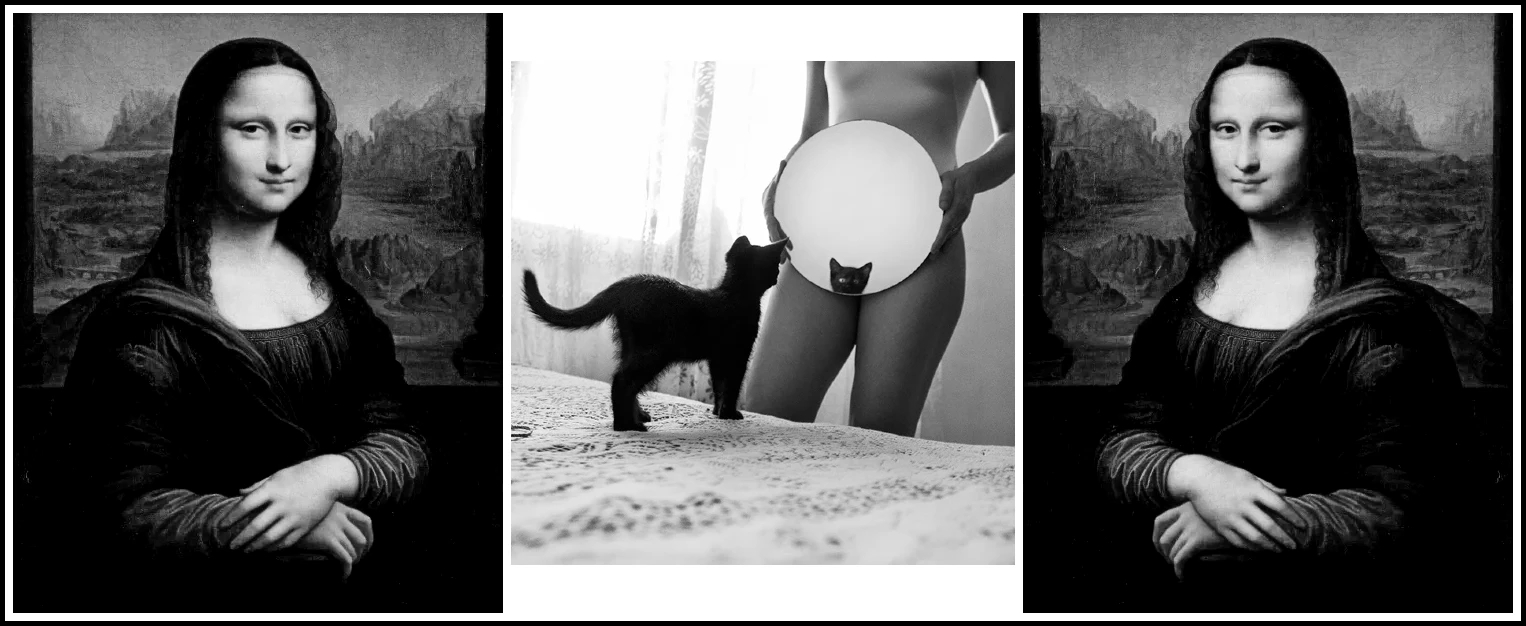
Leonardo da Vinci, Mona Lisa, c. 1650 | Morena Fortino, La Chatte, 2014
Morena Fortino had no ‘specific intention’ in the making of La Chatte: she only yielded to a ‘controlled randomness’ that gave rise to the ‘sensual coincidence’ captured in the photograph.1 The image, then, is the fruit of serendipity, of Morena’s2 ability to provoke a happy accident and capture a fortuitous moment. The photo conveys an air of insouciance; it comes across as a ‘slice of life’, an ephemeral instant of lived experience, spontaneous and natural. And indeed, that, as we’ve just seen, is exactly how it was made.3 In titling the photograph La Chatte (‘Pussy’), she acknowledged after the fact its erotic dimension: she did not set out before the fact to make an erotic photograph. And therein lies the difference between La Chatte and typical erotic photography: Morena’s photo was made spontaneously, whereas most erotic photography is staged. Now, before taking a look at the composite below of two photos by Guy le Baube, note that throughout this essay I am comparing only what is comparable: I am selecting ‘companion pieces’ for La Chatte, photos that at first glance are ‘cousins’ of Morena’s. My objective is to investigate how eroticism works through a study of the differences between La Chatte and its ‘companion pieces’, and so arrive at a better appreciation of ‘eros and image’.
1 – Morena Fortino, in her presentation of La Chatte on her website.
2 – The intimacy of the photo invites an intimacy of address.
3 – Morena, be it said in passing, is not a social media junkie; she is more interested in living her life than in curating it for Instagram.
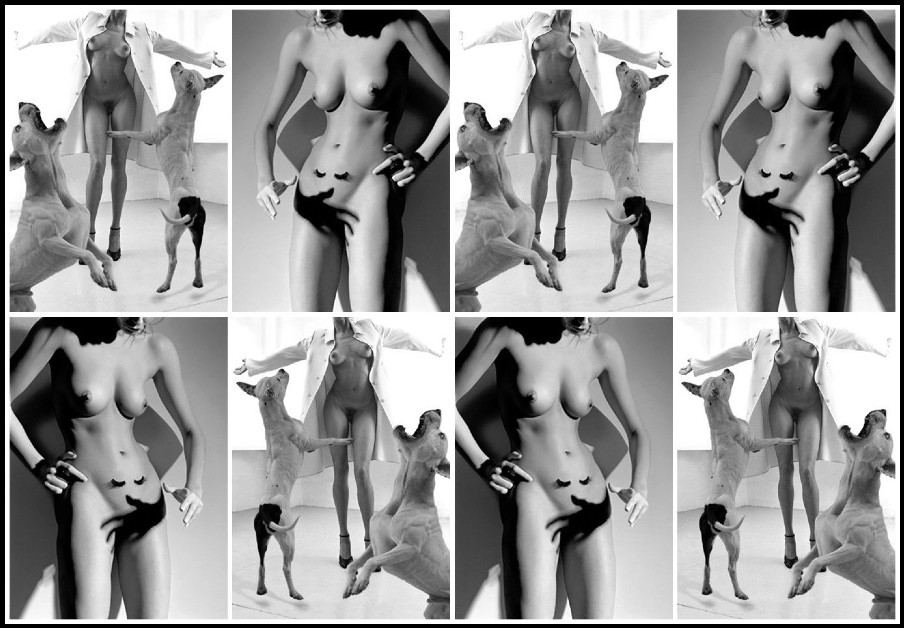
GUY LE BAUBE
Dogs, 2002 | Eyelashes, 2005
What is your response to these two photographs? Be you man or woman, are you turned on and tickled, admirative and amused? Or is there an ideological edge in your response—determined by your politics, sexual or civic—that makes you raise your hackles? For my part, I find the images highly erotic—what glorious tits, what stunning legs!—set in such a witty scenario. (If these photos are a man’s fantasy, cannot a woman share in the subject’s celebration of herself, of her sexuality?) The dogs can be seen as stand-ins for a male viewer, one hound on the scent, howling with desire; the other standing in futile supplication while the woman, arms outspread, sings, ‘If you want it, here it is, come and get it; make your mind up fast. If you want it, any time, I can give it, but you’d better hurry ’cause it may not last.’1 In this photo we have a frontal view of the woman’s crotch; in the other, as in La Chatte, it is the woman herself who plays conceal/reveal with her pussy, casting with her hand a Chinese-like shadow over it while the eyelashes say, ‘I’m going to sleep, but not with you’. All this, dear reader, is rather obvious, but what if we probe a little deeper?
1 – Paul McCartney, Come and Get It, 1969
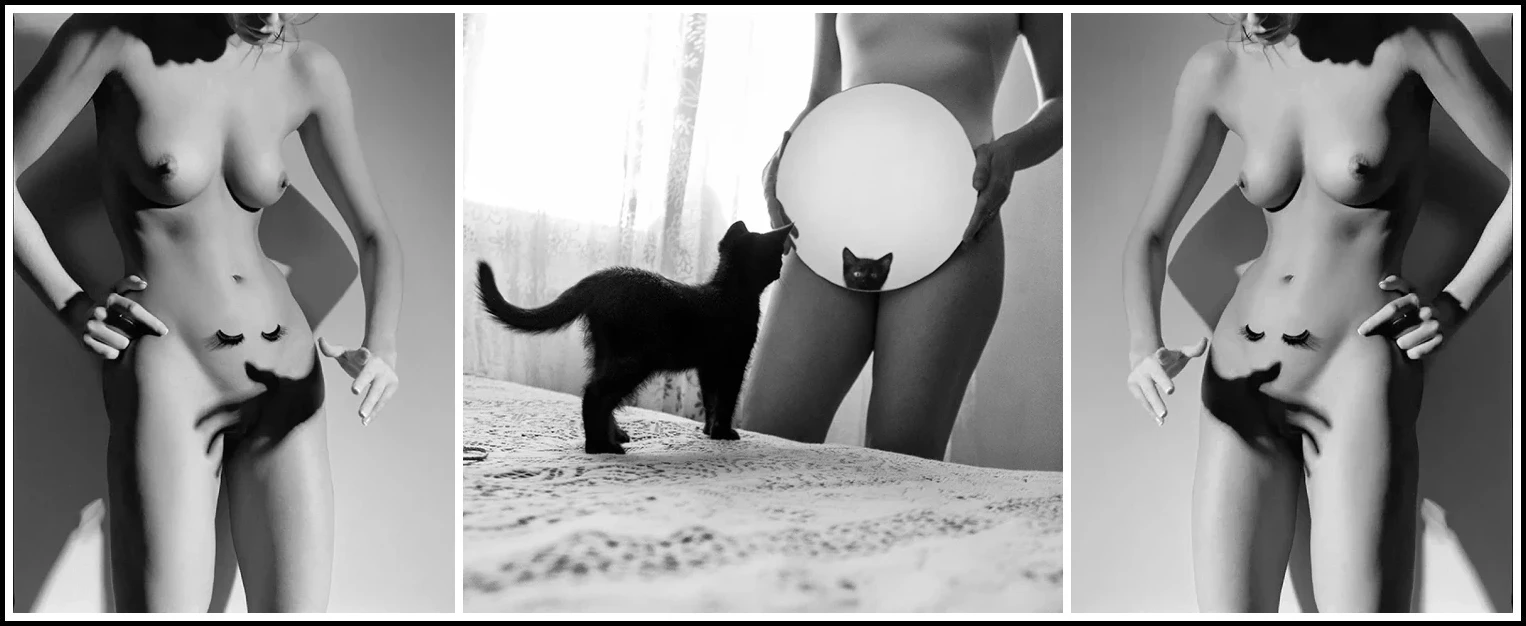
Guy le Baube, Eyelashes, 2005 | Morena Fortino, La Chatte, 2014
‘The erotic aspect of sexual relations consists in a game whose goal is to maintain sexual desire at its highest level for an optimal duration. The complementary partial drives,1 such as sadism and masochism, contribute to supporting this effort.’2 What is true of sexual relations is true of erotic photography: the partial drives sustain desire in that they entail transgression, and transgression—real or fantasized, play-acted or acted out—intensifies desire. Erotic photography is typically play-acting, theater, a scenario staged for the camera. Like sex-play, it walks a tightrope over the ridiculous and the sublime. Which is where the humour comes in: it pre-empts the ridiculous, while the aesthetic values of the image—composition, lighting, framing—aspire to the sublime. Consider Guy le Baube’s Dogs again. ‘In contrast to the relative simplicity of the masculine trajectory is the complex path followed by the feminine trajectory, which has, from the very outset, been compelled to accommodate the man haunted by his castration complex.’3 The woman in Dogs knows, subconsciously, that the men-dogs, like their egos, ‘are not masters in their own house’;4 she knows that they take themselves too seriously. So, to ‘accommodate’ them, she stages a fantasy that will enable them to ‘perform’. In a word, as Mick Jagger sings, ‘she’s the boss’.5 In terms of transgression, the dogs, despite an air of menace, are ‘masochistic’, while the woman, as a potential dominatrix, plays at being ‘sadistic’. In addition, then, to the woman’s exquisite body and the raging desire of the erect man-dogs, it is the dynamics of transgression, of ‘sadomasochism’, that give the photo its eroticism. These dynamics are absent from La Chatte. The cat, standing in for us, is fascinated by its reflection, but cannot penetrate its mystery: the mystery of the pussy that, as Courbet titled his painting, is the ‘origin of the world’. It is this more subtle dynamic that animates the eroticism of Morena’s photo.
1 – ‘In psychoanalysis, the partial drives designate the fundamental components of the drive that are not subordinated to genital reproduction or biological function. The concept of partial drives is central to psychoanalytic theories of sexuality, desire, and subject formation. Partial drives are termed ‘partial’ because each is organized around a specific bodily zone and mode of satisfaction rather than a unified sexual aim. They persist throughout life and continue to structure fantasy, symptom formation, and jouissance well beyond childhood. In this sense, so-called ‘adult’ sexuality is not the replacement of partial drives by genital sexuality, but their reorganization within a symbolic framework. The theory of partial drives marks a decisive break with biological and moral accounts of sexuality. It establishes sexuality as fundamentally non-natural, fragmented, and structured by repetition rather than by instinctual harmony.’ (From the page on Partial Drives in the now inactive Lacan portal on Wikipedia.)
2 – Isabelle Martin Kamieniak, ‘Denise Braunschweig: Éros au féminin’ in La Revue Française de Psychanalyse 90 (1) 2025: 69-80. This excerpt translated here by Richard Jonathan.
3 – Denise Braunschweig & Michel Fain, Éros et Antéros (Paris, Éditions In Press, 2013/1971). Translated here from the French by Richard Jonathan.
4 – Freud. None of us are ‘masters in our own house’, but some of us have the humility to recognize that while others don’t.
5 – ‘When I first met you, you looked so soft / So feminine, you looked so lost / What a fool I was, yeah. / You called me manly, so masterful / You called me manly, so powerful / Was I ever gullible, yeah / She’s the boss, she’s the boss.’ (Mick Jagger, She’s the Boss, 1985)
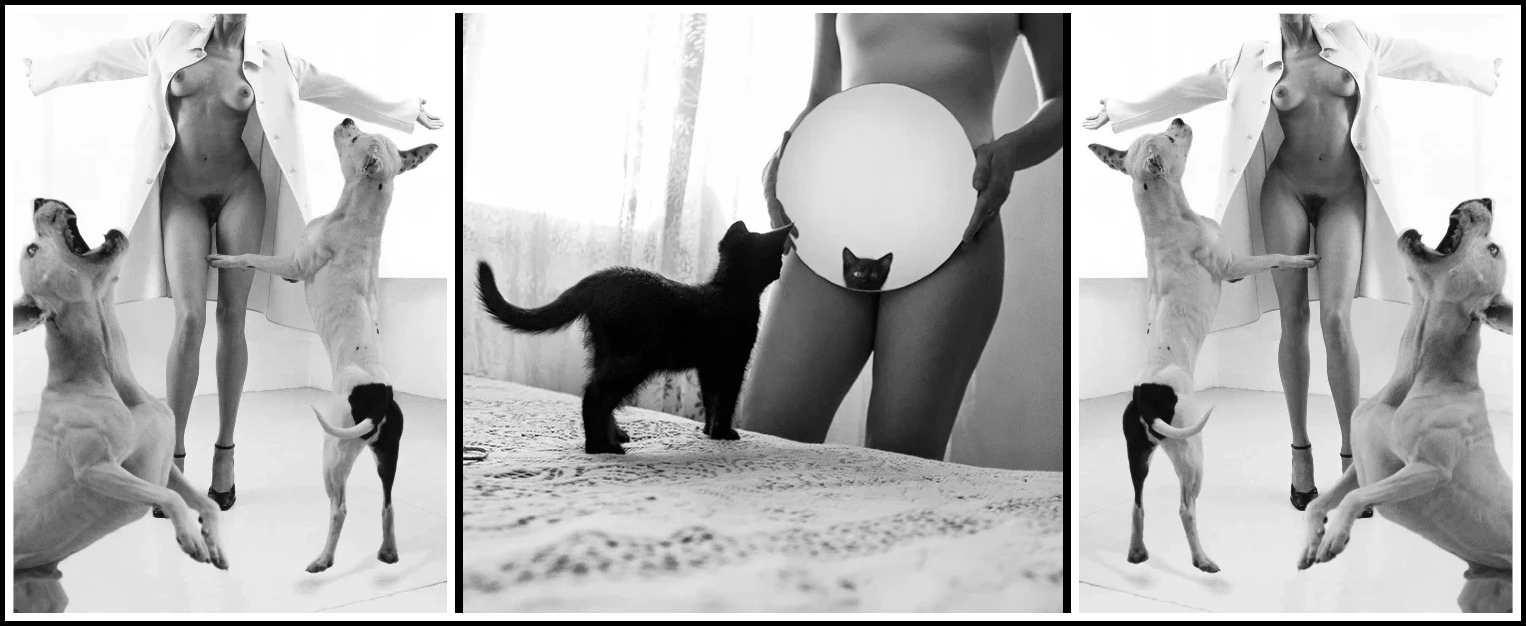
Guy le Baube, Dogs, 2002 | Morena Fortino, La Chatte, 2014
In terms of eroticism, then, we may say that La Chatte lies midway between Guy le Baube’s Dogs and Daria Strokous’ Self-Portrait with Dog.
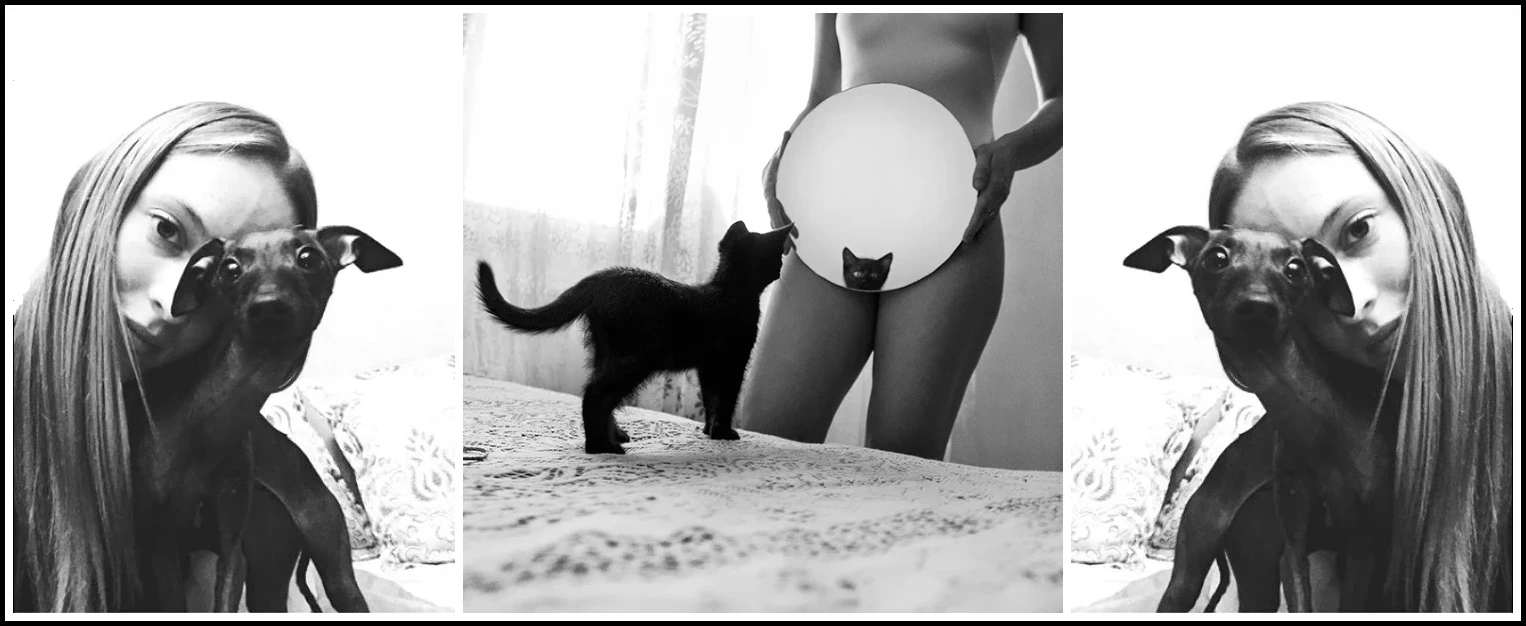
Daria Strokous, Self-Portrait with Dog, c. 2014 | Morena Fortino, La Chatte, 2014
Let us now compare Morena Fortino’s La Chatte with Irina Ionesco’s Femme au miroir. Both photos feature ‘pussy in a mirror’, but how striking the differences! La Chatte, with its easygoing charm, is a serendipitous instant extracted from the quotidian; thanks to the photographer’s ‘accidental’ art, it transforms time into the eternal. Effortlessly, it brings forth a smile in the viewer. For some, its soft sensuality is soothing; for others, the ‘fusion’ of cat’s head and cunt is disturbing.1 Airy, intimate, and luminous, the photo invites us into the privacy of the photographer’s bedroom (has she just dried herself down after a shower?), not as voyeur, but as spectator to an adventitious alignment of stars. One senses an affinity between the woman and the cat, a collaboration of beings who both believe ‘the present alone is our happiness’2 Now, everything that La Chatte is, Femme au miroir is not. The photo is elaborately staged, but to what end? The costume of makeup and mules, stockings and corset, choker and jewels—what’s the point? The props of vase and flowers, mirror and frame—who is the photographer trying to fool? ‘Some of you sit there with your cock in your hand / Don’t get you nowhere, don’t make you a man’3: John Lennon’s lyric makes it perfectly clear—beginning implied, middle and end stated. Note that the model herself is a prop for her pussy; its image in the mirror, meant to seduce, is but deadwood. Clearly, reshuffling clichés in a very seventies erotic aesthetic, Irina Ionesco is trying too hard. La mode se démode, le style jamais,4 said Coco Chanel. Femme au miroir is fashion; La Chatte is style.
1 – ‘In that he is an erotic animal, man is a problem for himself. Of all problems, eroticism is the most mysterious, the most general, and the least straightforward.’ Georges Bataille, Eroticism, cited in Peter Michelson, Speaking the Unspeakable: A Poetics of Obscenity (Albany: State University of New York Press, 1993) p. 1
2 – Goethe. The philosopher Pierre Hadot elaborates: We can stop projecting ourselves into the future, and instead consider our action in itself and for itself. We can stop considering the world to be the simple frame of our action, and instead look at it in itself and for itself. We can realize an action well done, for itself, with attention and consciousness; we can do it as well as possible. This, as I understand it, is exactly the spirit in which Morena Fortino made La Chatte.
3 – John Lennon, ‘I Found Out’, Plastic Ono Band, 1970
4 – Fashion passes, style abides.
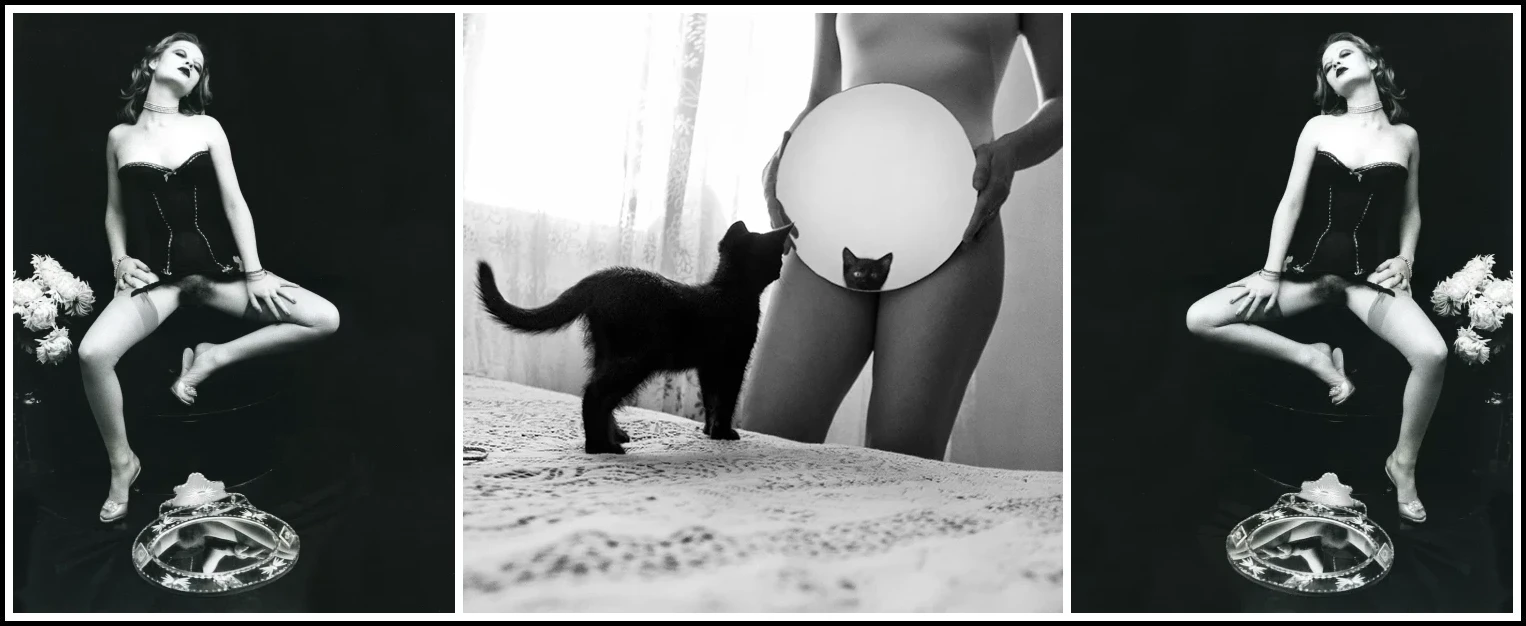
Irina Ionesco, Femme au miroir, 1975 | Morena Fortino, La Chatte, 2014
Now take a look at the image below. The woman playing the cello is an advertising photo by Jeanloup Sieff for Chaussures Carel. It is in the collection of the Musée d’Art Moderne de Paris. Justifiably so, in my opinion. The cello may be strung with cat gut, but it is not a cat; nevertheless, it is occupies tha same place the cat does in Morena Fortino’s photo. You may think it a far-flung leap to go, concerning the woman, from playing her cello to stroking her pussy, but that is the dynamic at work here (in the same way that ‘cat’ is ‘pussy’ in La Chatte). In psychoanalysis the phenomenon is known as displacement: the transfer of psychic intensity from an original object onto a substitute object, allowing unconscious feelings to appear in disguised form.1 We all know what lies between the woman’s legs. Some of us replace what has been displaced: the woman is indulging in autoerotic pleasure. Herein, of course, lies the eroticism of the photo, but there is more. The image is, I contend, a work of art. Composition, lighting and framing combine to make a photo that aesthetically is extremely satisfying. It has a stark beauty, ideal and pure; it evokes culture and induces contemplation. And yet, at the same time, it is irrevocably material: those long legs in sheer tights belong to a real woman; that f-hole in the cello is cut out of real wood. And thus it is that the material eroticizes the ideal, that the cultural configuration of the ‘scene’ is overcome by the ‘ob-scene’. The same tension, the struggle in our (subconscious) mind between ‘scene’ and ‘ob-scene’, also explains the eroticism of La Chatte.
1 – It is a classic trope in advertising, the association of girl and car being a timeworn instance.
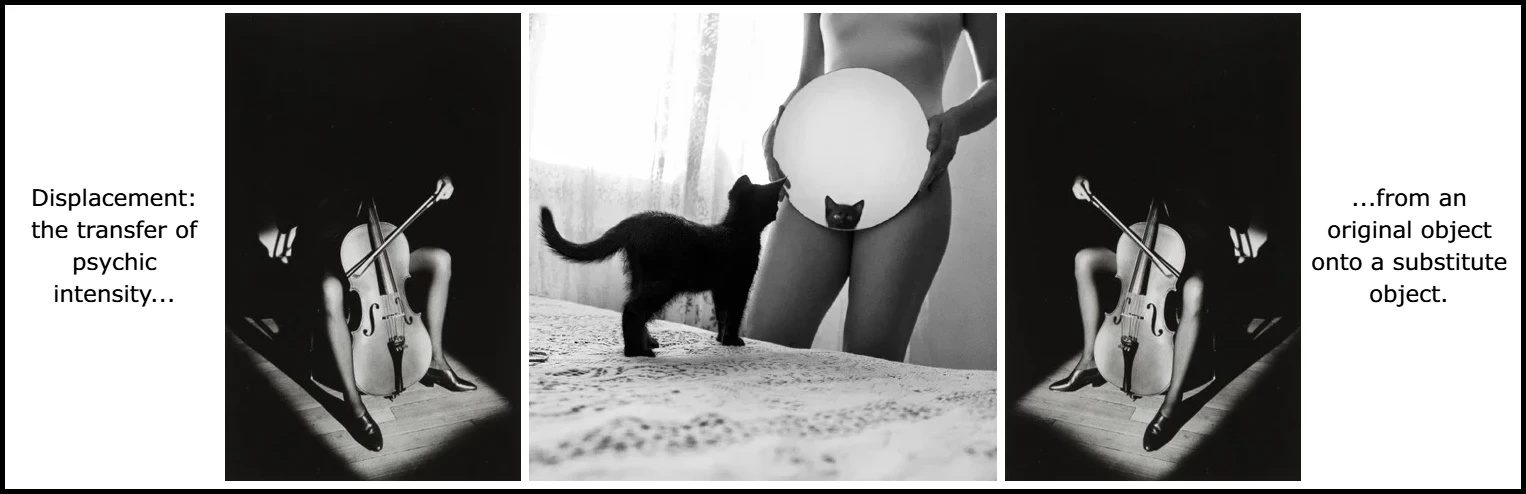
Jeanloup Sieff, Publicité pour Chaussures Carel, 1985
Let us now compare Morena Fortino’s La Chatte with Helmut Newton’s Celia. Elegance and artifice in the service of the natural and spontaneous: that is the feat Helmut Newton pulls off in this photo. Against a ground of reiterations—the window-grid of the apartment block echoing the push-button grid of the telephone; the coiled cord linking phone base and handset echoing the coils of hosepipe on the ground; the grid of railing bars and terrace wall echoing the apartment block and push-button grids—against this graphic ground the woman stands, imperial in her nudity, bold in her stilettoes. Scale and perspective give the woman—taller than the high-rise, bigger than the ocean—her sovereign presence. Her trimmed pubic hair is a metonym for her slim body, radiating a self-assured sexuality. ‘Eminently fuckable’, say males who take refuge from their vulnerability in the myth of animality; ‘I’ve got to meet her’, say males whose passion cancels their reason. Whatever their approach, the woman will only respond to the promptings of her own desire. This, I contend, is the miracle of the photo: a tall blonde in stilettoes is a hackneyed image, but here we sense that this woman is a true individual, and what is individuality if not the assumption of one’s own desire, however perverse it may be? La Chatte, in comparison, is a tame photo, an interior scene that bespeaks interiority. And, as we’ve seen, therein lies its loveliness. It offers a slow-burn eroticism, in contrast to the erotic charge that Celia immediately ignites.
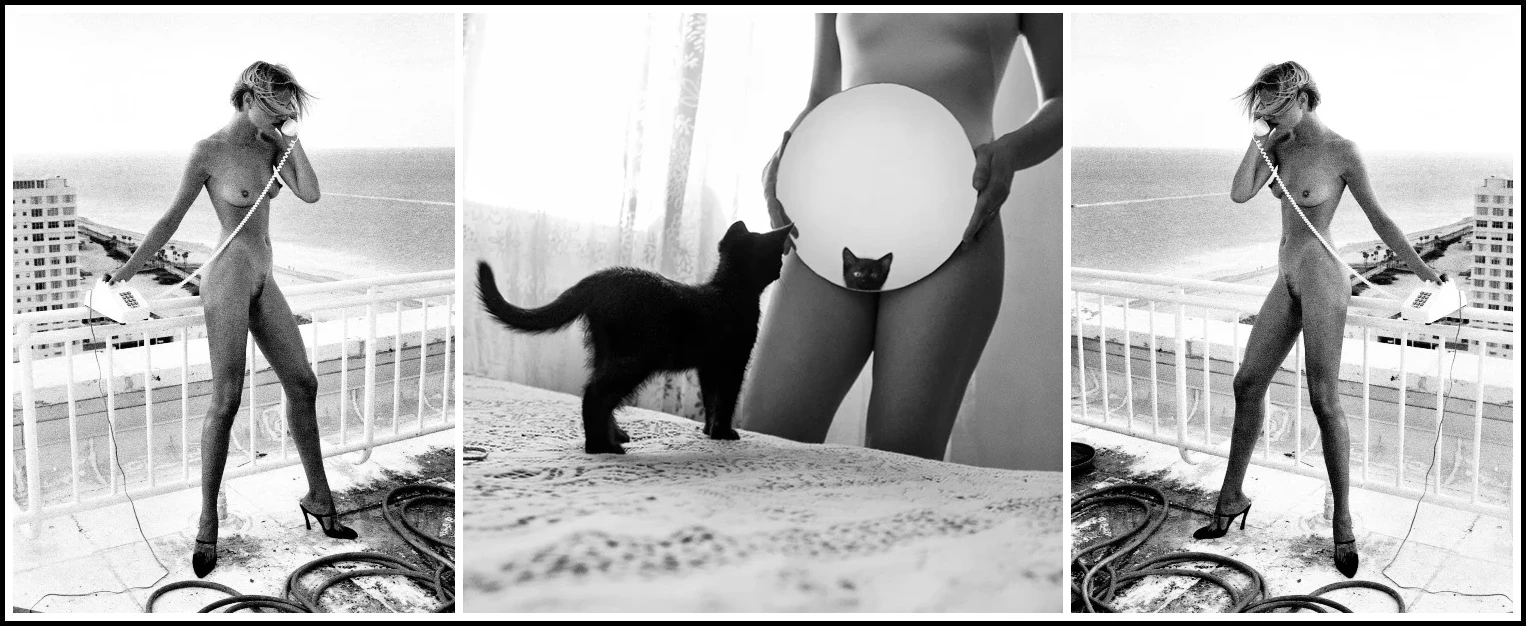
Helmut Newton, Celia, Miami 1991 | Morena Fortino, La Chatte, 2014
And now, dear reader, comparing Morena Fortino’s La Chatte to Bettina Rheims’s Anna Karina, the time has come to end this essay. Suspended in stillness, ingathered and eyes averted, ‘Anna’ comes across as pensive and poised. There’s something on her mind; she is actively experiencing her subjectivity. If pornography is ‘the representation of sexuality so as to make its obscenity conspicuous’,1 this image is anti-pornographic. Anna is not displaying her body for our pleasure, she is—as spirit infuses into matter—actively inhabiting it. Wherein, then, lies the image’s erotic charge? In the fall of Anna’s dark locks, free and wild; in the delta between her thighs, ready to soothe a troubled child. In the innocence of her breasts, passive yet alert; in the dignity of her bearing, appealing to be broken down. In the elegance of her hand, desperate to do something ‘dirty’; in the lambency of her beauty, begging to burst into flame. The eroticism of the image, then, derives from the dynamics of sexual relations: for his pleasure the man needs an object; for her pleasure the woman must overcome her ego and surrender to the demon inside her. The sobriety of Morena Fortino’s photo, the black cat in broad daylight, preclude such dynamics, as does the fact that we do not see the woman’s face. All the more’s the miracle, then, that La Chatte has such evocative power, activating our imagination and stimulating our fantasy.
1 – Peter Michelson, Speaking the Unspeakable: A Poetics of Obscenity (Albany: State University of New York Press, 1993) p. xii
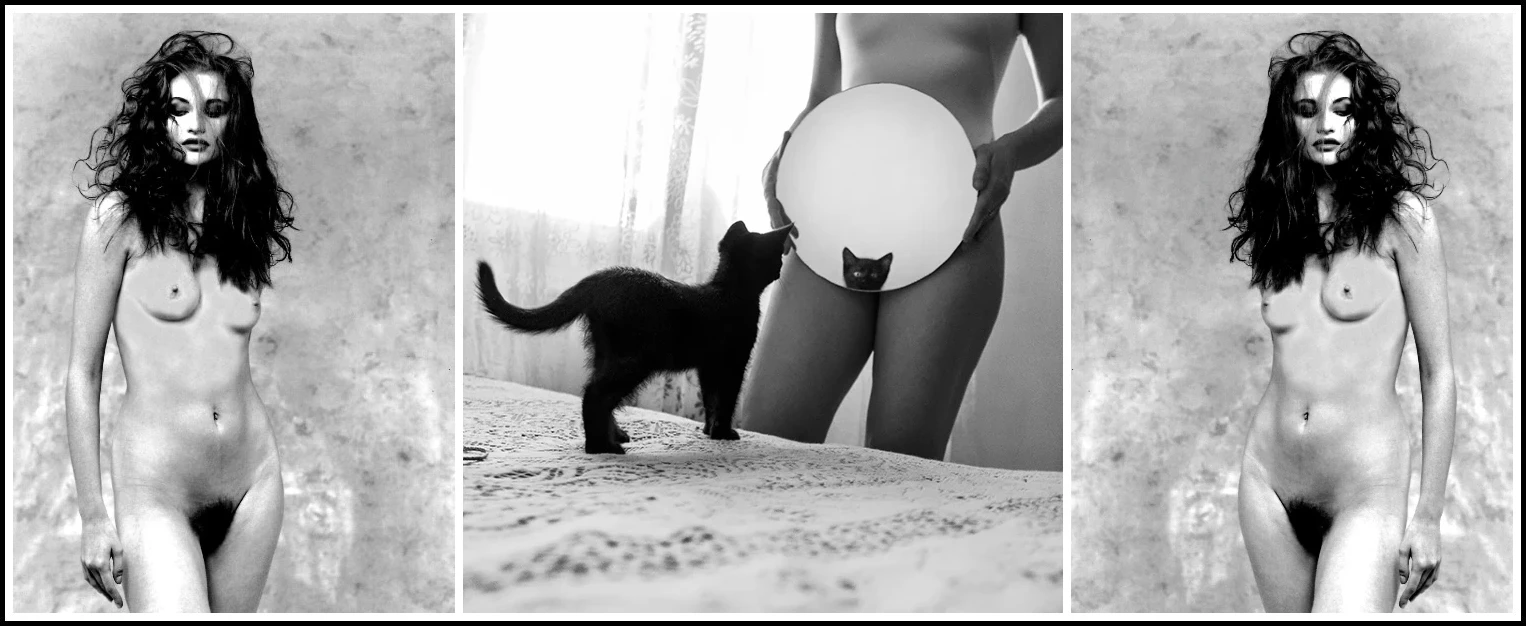
Bettina Rheims, Anna Karina, Lido Cabaret 1988 | Morena Fortino, La Chatte, 2014
The Secret Under the Skirt: That Obscure Object of Desire
CODA
Extract from an Interview with Guy Le Baube
From an interview conducted by Federica Belli and titled ‘Guy le Baube, Behind the Scenes’, published on 17 July 2019 on Musée Magazine.
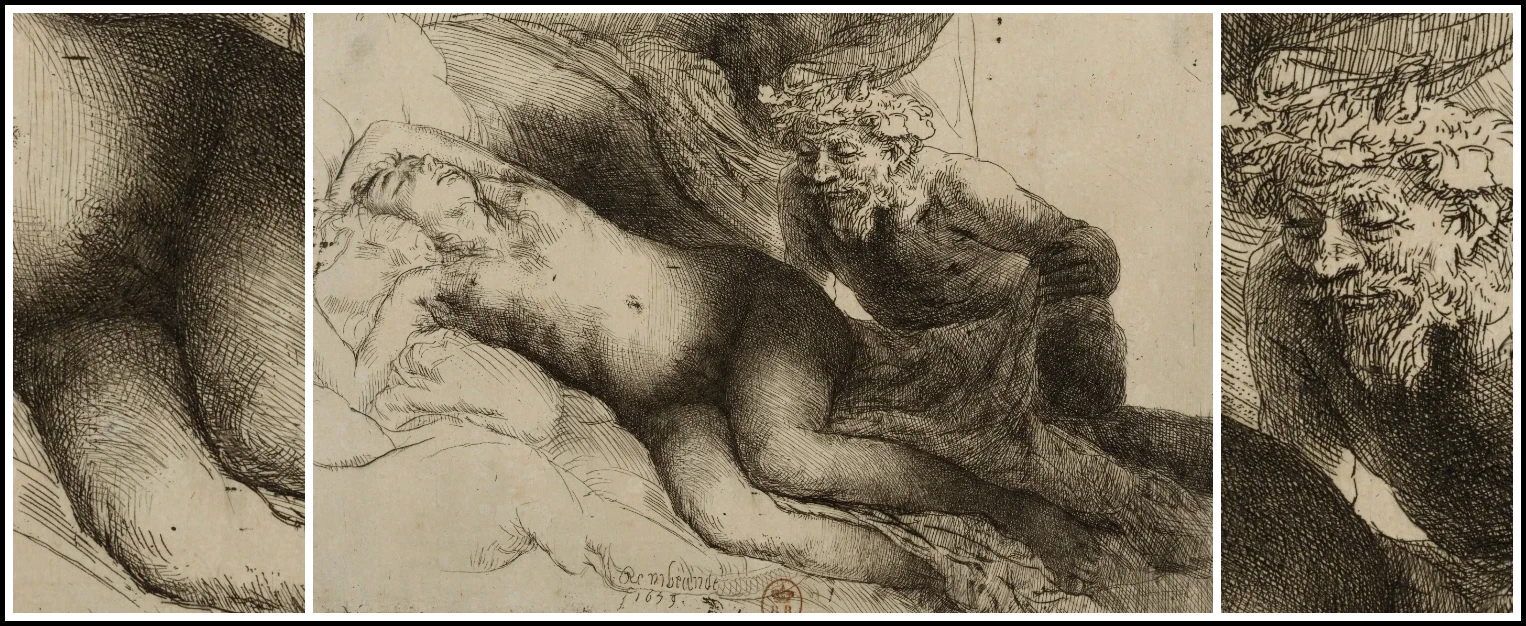
Rembrandt, Jupiter and Antiope, 1689
Guy le Baube: I was raised by women, by dancers. You could say I was an extra, in the backstage when I was only six years old. I smelled the wool, the sweat, the makeup. That’s when I discovered the mystery of girls. My aunts were young and pretty, I used to try to see them nude. But the secret under the skirt… I never pierced it.
Federica Belli: You never managed to get that secret? Not even later on, through photography?
Guy le Baube: No, I just showed off. I played the fanfaron [braggart, blowhard] character.
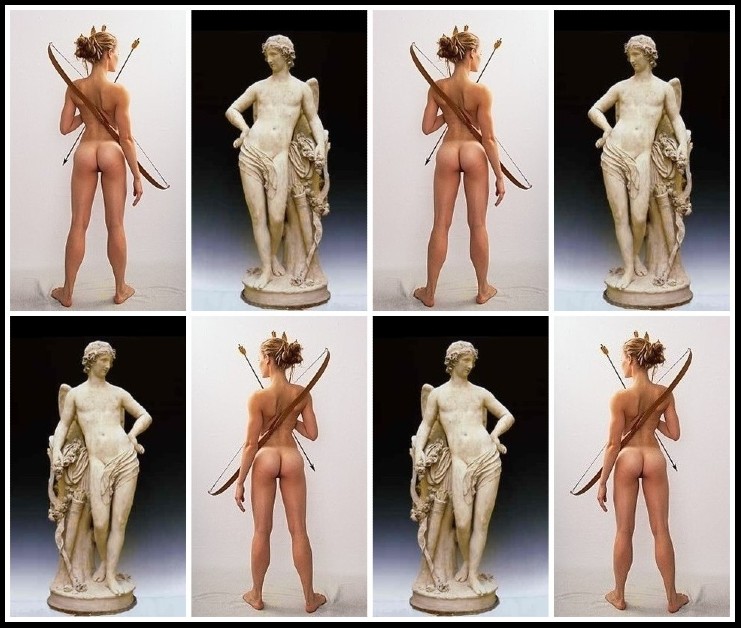
Guy le Baube, Cupidon, 2013 | Gilles Lambert Godecharle, Cupidon, 1804
MARA, MARIETTA: A LOVE STORY IN 77 BEDROOMS – READ THE FIRST CHAPTER
A literary novel by Richard Jonathan
RICHARD JONATHAN, ‘MARA, MARIETTA: A LOVE STORY IN 77 BEDROOMS’ — READ THE FIRST CHAPTER
AMAZON & APPLE BOOKS

RICHARD JONATHAN, ‘MARA, MARIETTA: A LOVE STORY IN 77 BEDROOMS’ | AMAZON PAPERBACK OR KINDLE

RICHARD JONATHAN, ‘MARA, MARIETTA: A LOVE STORY IN 77 BEDROOMS’ | APPLE iBOOK
MARA, MARIETTA: A LOVE STORY IN 77 BEDROOMS
A literary novel by Richard Jonathan
Available from AMAZON (paper | ebook) & iBOOKS, GOOGLE PLAY, KOBO & NOOK (see LINKS below)
OF RELATED INTEREST
CLICK ON THE IMAGE TO GO TO THE WEBSITE
RELATED POSTS IN THE MARA MARIETTA CULTURE BLOG
CLICK ON THE IMAGE TO GO TO THE POST
By Richard Jonathan | © Mara Marietta Culture Blog, 2026 | All rights reserved
Comments