
‘Hanging Fire’
HENRY JAMES, ‘THE TURN OF THE SCREW’: THE PRIMAL SCENE
Ned Lukacher
From Ned Lukacher, Primal Scenes: Literature, Philosophy, Psychoanalysis (Ithaca: Cornell University Press, 1986) pp. 115-132
Photo: Engin Akyurt, Unsplash
Of the critics of Henry James’s The Turn of the Screw, Shoshana Felman writes: ‘In repeating as they do the primal scene of the text’s meaning as division, the critics can by no means master or exhaust the very meaning of that division, but only act the division out, perform it, be part of it.’1 Here indeed is a text whose ‘polytonality’ cannot be mastered. Like the governess herself, the critic is thwarted whenever he or she tries to grasp the real and tries to wrest from the unmasterable tone of The Turn of the Screw a determinant or univocal meaning. At every ‘turn’ James invites his readers to make a construction and to attempt a solution. But as Felman’s essay ‘Turning the Screw of Interpretation’ definitively establishes, there is simply no way to avoid repeating the text’s fundamental division between the uncanny ghostliness of the governess’s visions and the hysterical mechanisms that inform them.
1 – Shoshana Felman, ‘Turning the Screw of Interpretation,’ in Literature and Psychoanalysis: The Question of Reading Otherwise, ed. Shoshana Felman (Baltimore, Md.: Johns Hopkins University Press, 1980), 113
Photo: Vitaliy Shevchenko, Unsplash
The point I would like to make here, however, does not directly concern the difference between the psychic and the sexual. While Felman is quite right to demonstrate how James implicates the reader in every effort by the governess to construct the primal scene, and to demonstrate that the governess’s dilemma as analyst is that of every reader, she does not pose the question of the precise nature of the governess’s constructions. It is one thing to say that, try as they may, critics can never demystify the governess’s mystification and are condemned to repeat it; it is quite another thing to say, as I shall, that James’s interest is as much in the specific nature of the governess’s process of construction as it is in the indeterminacy of the finished product. What neither Felman nor any other critic of The Turn of the Screw has analyzed is the specificity of the governess’s visions/hallucinations. Numerous details and many of the most extraordinary scenes in the story have gone unnoticed, or at least unexplained, because the critical focus has been on the governess’s state of mind rather than on the particularity of the vision in question.
Photo: Vitaliy Shevchenko, Unsplash
Once again, the Heideggerian principle that errancy is not simply non-truth but rather the primordial ‘counter-essence’ of truth has enabled me to recognize that the governess’s errancy preserves traces of the truth of the events at Bly House. The Heideggerian-Derridean position with respect to the truth is not a pluralistic one. Though interpretation is a non-finite process, this is not to say that all interpretations are equally valid, or that they are indeterminate in quite the same way. Interpretation is open-ended because interpretation is a kind of ‘remembering,’ a ‘remembering’ that has been made possible by a particular temporal conjunction. Interpretation is a kind of ‘remembering’ which, in the process of recovering what has been forgotten, keeps itself open to subsequent ‘memories’ in the future. It is this aspect of interpretation that Heidegger suggests by the word Andenken or ‘commemorative thinking,’ a remembrance that turns forward, toward thinking, andenken, in the very act of turning back. From where we are now, a ‘new’ reading of The Turn of the Screw is possible—or more precisely, a ‘commemoration’ of what has been forgotten in the text, a ‘commemoration’ of the text’s most fundamental level of concealment-disclosure.
Photo: Justin Ahlmann, Unsplash
The critical history of The Turn of the Screw reveals that there has been more interest in James’s figure of the analyst than in the constructions she makes. Like the critics Freud describes in From the History of an Infantile Neurosis, who believe that the fact that the analyst proposes the primal scene and the patient does not remember it decides the whole question, critics of James’s text have focused so myopically on either the hysterical projections of the governess or the possibility of psychic phenomena that they never consider the fundamental question posed by Freud’s construction of the primal scene: What is the relation of the phantasy to reality? Without forgetting that the real remains out of our grasp, I will attempt here to relate the governess’s constructions to the analyst’s construction of the primal scene, to determine what primal scene or fabula lies behind the sjuzet that is her narrative. Her narrative, like the wolf dream, contains within itself a fabula that, while not constituting the real, nevertheless brings us closer to it than we could otherwise reach.
Photo: Alexander Krivitskiy, Unsplash
The question, therefore, is not whether the governess’s visions involve sex or the supernatural but whether they compose an account of the events prior to her arrival at Bly House which, though still concealing the real, at least approximates it. In effect we are shifting what Felman calls ‘the text’s meaning as division’ from the sjuzet to the fabula. Through her visions the governess is trying to remember something that everyone else is trying to forget. But like an intemperate analyst, she comes to believe too vehemently in her own constructions of an event that remains rigorously unknowable. Because of the extent of her mystification, critics have focused solely upon her inability to distinguish reality from phantasy but have forgotten to consider the possibility that those phantasies are nevertheless related to the real. The critics of The Turn of the Screw have forgotten the story’s temporality, which is the pathway to the real. Only by reconstructing that temporality will we be able to move beyond mere indeterminacy. Like the ghosts of ontotheology, the ghosts of Peter Quint and Miss Jessel pose the question of the origin through the medium of the question of time. James’s ‘tone’ is an achievement that must be placed in conjunction with the Freudo-Heideggerian notion of the temporality of the non-originary ‘event.’
Photo: Alexander Krivitskiy, Unsplash
‘In so far as the analyst is supposed to know,’ writes Lacan, ‘he is also supposed to set out in search of unconscious desire.’1 The governess errs in setting out on this search with perhaps a little too much determination, though we might as easily say too much self-righteousness or prurience: ‘What it was least possible to get rid of was the cruel idea that, whatever I had seen, Miles and Flora saw more—things more terrible and unguessable and that sprang from dreadful passages of intercourse in the past.’ While an analyst would be concerned with the neuroses that might have developed in the children as a result of having witnessed the primal scene, the governess is concerned that the spectacle of coitus flagrante has placed the children within the diabolical power of the returning spirits of Quint and Jessel. (As we will see, for the governess the primal scene is literally a flagrant spectacle in the etymological sense of the word flagrante, ‘blazing.’) Though these ‘things’ are still ‘unguessable’ at this early point in the text, the governess will soon be making quite a few guesses, which Freud would call ‘suppositions’. Like the analyst, the governess cannot expect corroboration except for an occasional slip of the tongue from Mrs. Grose. Finally, like an analyst who succeeds only in driving the patient away, the governess will lapse from this salutary skepticism with regard to the limits of her knowledge into a grotesque certitude that will no longer admit any interdictions barring the way to the primal scene.
1 – Lacan, The Four Fundamental Concepts of Psychoanalysis, II 35
Photo: Alexander Krivitskiy, Unsplash
Suddenly confronted, in broad daylight, with the vision of the ghost of Miss Jessel at the writing desk—which reminds us that in this story the primal scene is always one of writing—the governess tries to grasp the vision in its entirety, to take it all in, only to discover that ‘even as I fixed and, for memory, secured it, the awful image passed away’. ‘Fixing’ her gaze and ‘securing’ an image in her memory are emblematic of the governess’s behavior. Convinced that the children, whether unconsciously or not, have been ‘fixed,’ or rather fixated, upon the primal scene, the governess turns all her attention to their fixation, which in turn becomes her fixation and thus that of the reader. In the following passage James goes out of his way to fix our attention on ‘fixing.’ Mrs. Grose and the governess are discussing Miss Jessel:
Mrs. Grose, at this, fixed her eyes a minute on the ground; then at last raising them, ‘Tell me how you know,’ she said.
– ‘Then you admit it’s what she was?’ I cried.
– ‘Tell me how you know,’ my friend simply repeated.
– ‘Know? By seeing her! By the way she looked.’
– ‘At you, do you mean—so wickedly?’
– ‘Dear me, no—I could have borne that. She gave me never a glance. She only fixed the child.’
– Mrs. Grose tried to see it. ‘Fixed her?’
– ‘Ah with such awful eyes!’
Photo: Kato Blackmore, Unsplash
Mrs. Grose’s response to this report of Jessel’s ‘awful eyes’ renders this scene a repetition and displacement of the very scene it describes: ‘She stared at mine as if they might really have resembled them.’ Mrs. Grose sees in the governess what the governess sees in her vision of Miss Jessel. She sees the same ‘fury of intention’ and the same desire ‘to get hold of’ the children. In Jessel’s desire to possess the souls of the children, the governess sees her own desire to seize upon the children’s unconscious desire. This is indeed an allegory of the analyst’s desire to know. It is the task of the Jamesian ‘tone’ to mark the distinct point where analysis becomes a kind of possession.
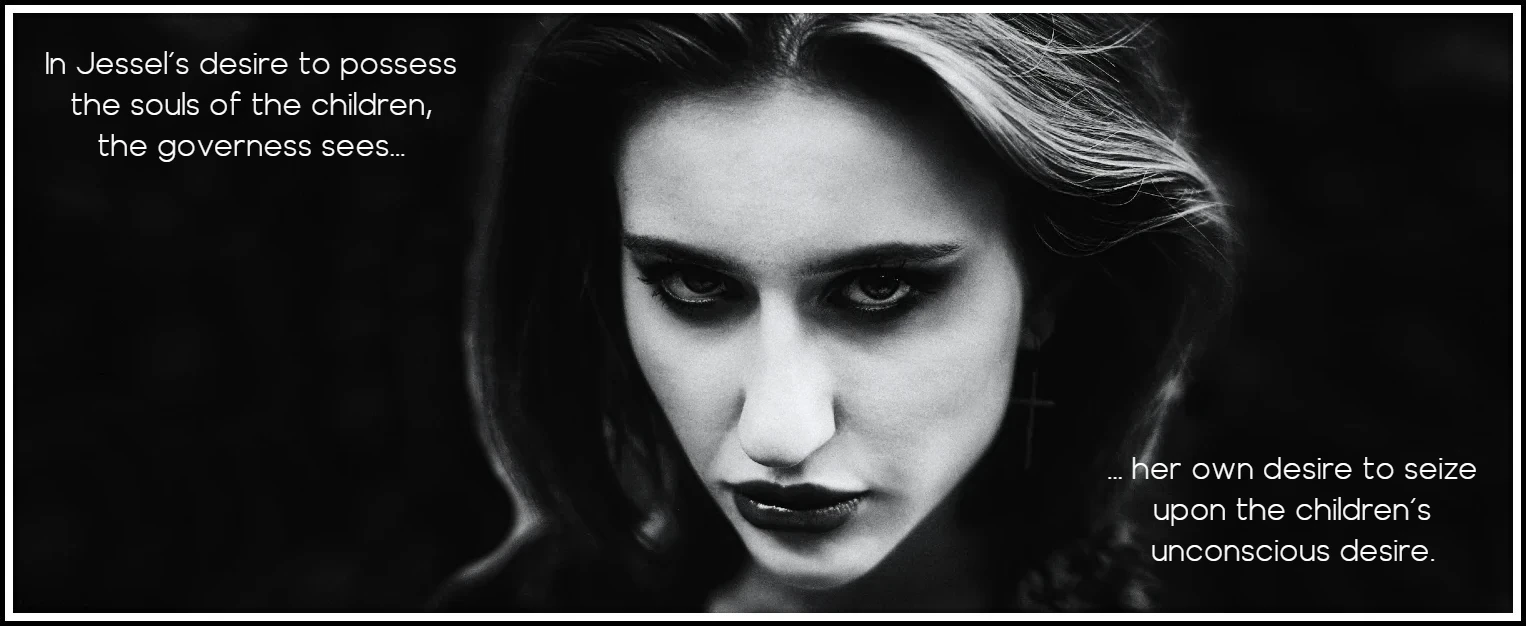
Photo: Vitaliy Shevchenko, Unsplash
No less than Freud, James too was ‘fixed,’ captivated by the voice of the hysterical woman. In a regrettably ignored article, Oscar Cargill suggests that The Turn of the Screw is a response to the ideas, if not the text, of Freud’s Studies on Hysteria and to the mental illness of James’s sister, Alice. In ‘The New York Preface’ to the story, James describes his effort as that of catching ‘those not easily caught; the jaded, the disillusioned, the fastidious’: that is, those who are not fooled by the supernatural trappings and who recognize that the governess’s visions are the result of hysterical repression. Such readers will be ‘caught’ if they assume that simply because the governess is phantasizing, her visions have no relation to reality. Nothing could be further from the Jamesian ‘tone’ than a reductive psychoanalytic reading. From his brother William, and from the family’s experience with mental disorder, Henry recognized that psychological analysis was situated somewhere between a reductive literality and an ambiguous figurality—which is to say that the Jamesian ‘tone’ is situated somewhere between the philosophical truth and the literary lie. It is situated in the psychoanalytic space that Freud and Lacan carved out between philosophy and literature.
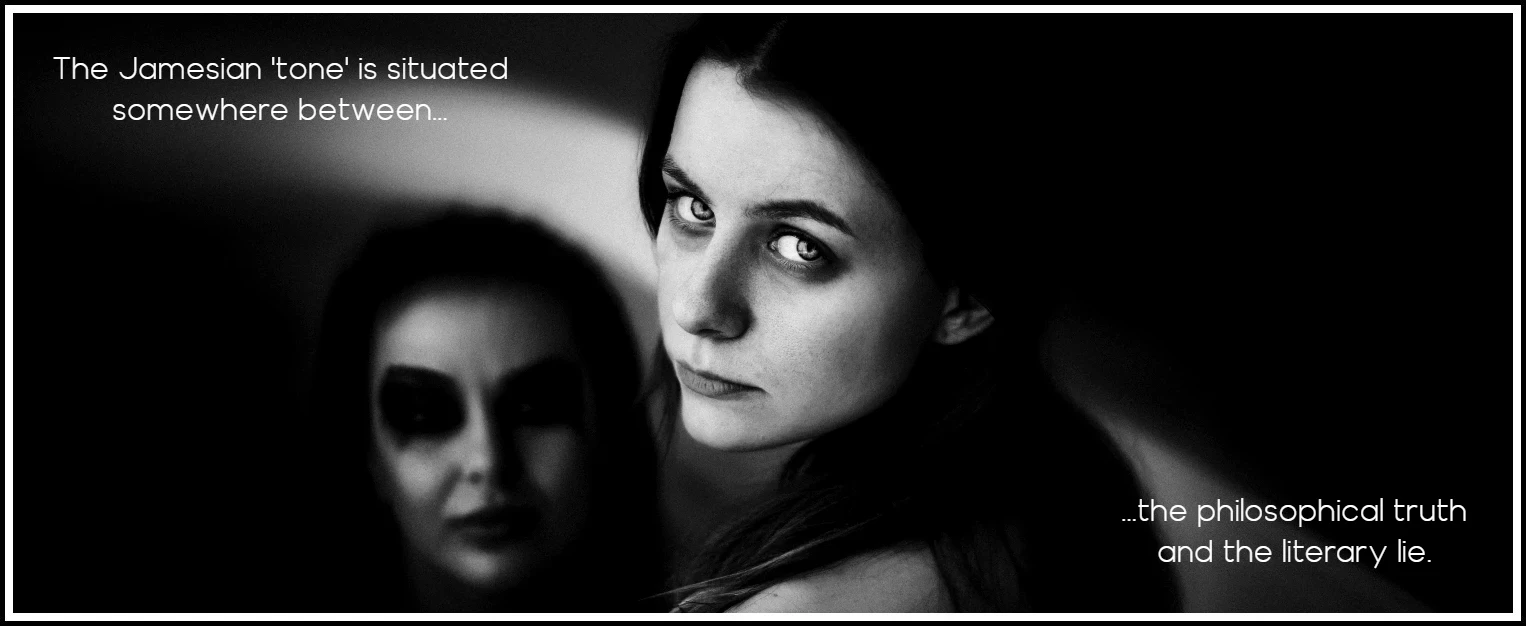
Photo: Vitaliy Shevchenko, Unsplash
The Turn of the Screw does not stage some putative overcoming of philosophy by literature, any more than it stages the overcoming of literature by analysis. James and Freud and Lacan are more radical, for what they stage is nothing less than the primal scene of philosophy, literature, psychoanalysis. The Turn of the Screw subverts those analysts who think of themselves as ontologists. James’s story also subverts those analysts who believe they have overcome ontology thanks to something called ‘literature.’ James makes a profound demand on our notion of reading. The ‘disillusioned’ reader who believes that everything is ‘literature’ believes that everything is demystified insofar as everything is a mystification. Such a reader, standing at the ‘end’ of metaphysics and in possession of ‘the truth,’ forgets that fundamental concealments persist. Such a reader believes that we have finished with the ghosts of ontotheology. James recognized, however—and he remains our contemporary because of this recognition—that we have not finished with these ghosts, and that the relation between phantasy and reality, though unreadable, continues to make its uncanny call upon our imaginations. James seems implicitly to have realized that deconstruction is neither an anti-ontology nor a post-ontology but a pre-ontology.
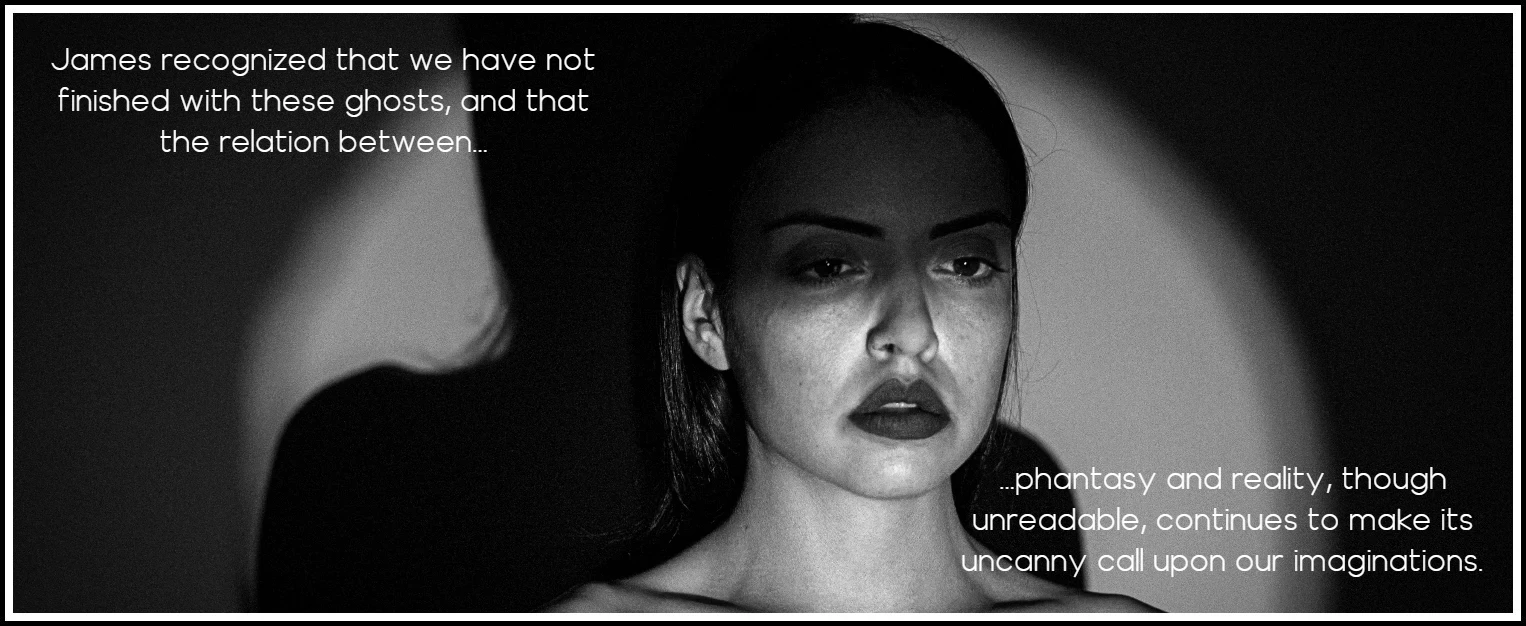
Photo: Stella Ntelimichali, Unsplash
The governess renders analysis a kind of possession by privileging the figurality of the ‘literary.’ An attentive reading can still discern the erased trace of the real within the governess’s phantasies. The achievement of the Jamesian ‘tone’ is that it grants ontological primacy to neither reality nor language, to neither the literal nor the figural. It ‘fixes’ us in the space where it itself is ‘fixed,’ in the space of the preontological, the ghostly space at the beginning of the end of metaphysics. Miss Jessel is at the heart of the governess’s construction of the primal scene. From Mrs. Grose she learns that Miss Jessel became pregnant with Quint’s child and was sent home, where she presumably died, as the result of either a miscarriage or an abortion: ‘She couldn’t have stayed. Fancy it here—for a governess! And afterwards I imagined—and I still imagine. And what I imagine is dreadful’. These revelations by Mrs. Grose enable the governess to rationalize her strange predisposition to despise her precursor. Her aggressive detestation of a woman she has never met is one of the most disturbing features of her illness. She even speaks, again by way of rationalization, of the ability of women to ‘read one another.’ Her propensity to believe the worst of Miss Jessel is in marked contrast to Douglas’s characterization of Jessel in the prologue to the story as ‘a most respectable person’:
– So far had Douglas presented his picture when someone put a question. ‘And what did the former governess die of? Of so much respectability?’
– Our friend’s answer was prompt, ‘That will come out. I don’t anticipate.’
– ‘Pardon me—I thought that was just what you are doing.’
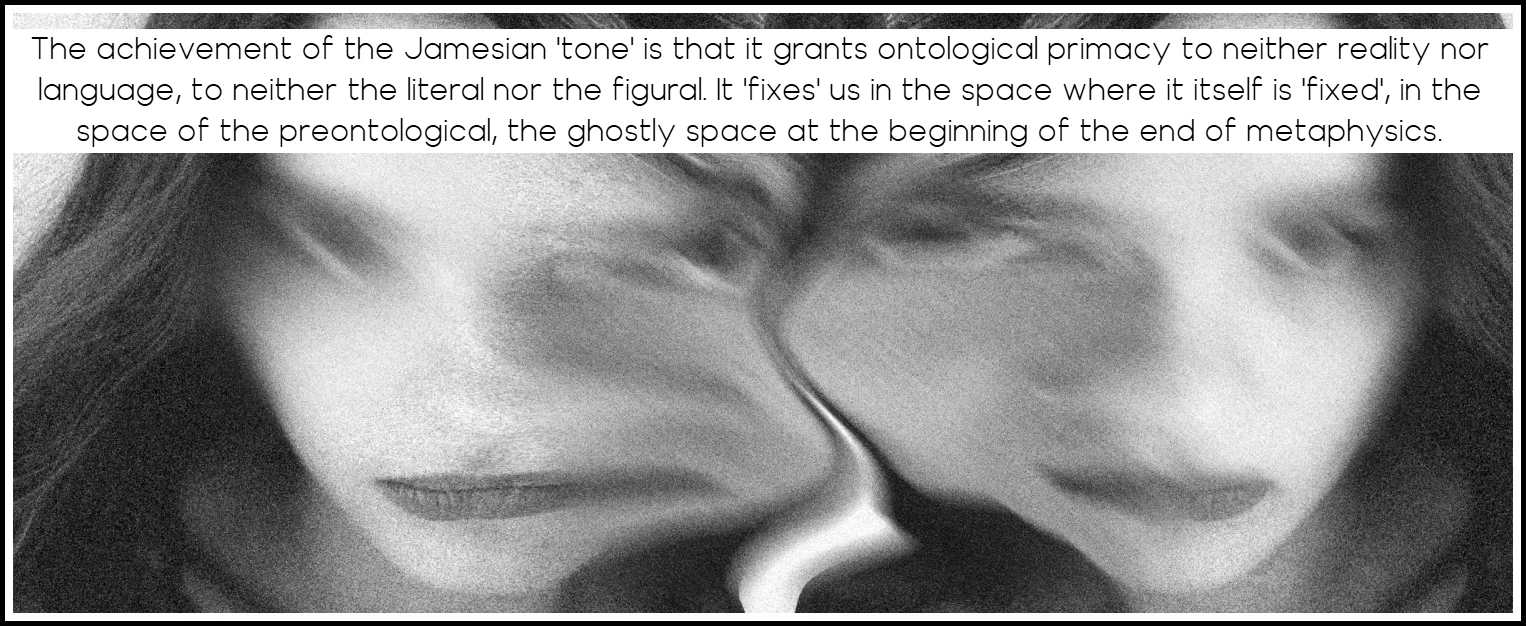
Photo: Samuele Giglio, Unsplash
Is Douglas misleading us in the very act of letting us in on the secret? If he is not, then he is undermining one of the governess’s major themes and in effect suggesting that her bitter recriminations against Miss Jessel are utterly delusional. Clearly, he is anticipating, despite his disclaimer. But that still does not make us any more or less certain of the reliability of his assurances of Jessel’s respectability. Here indeed is an exemplary instance of the Jamesian ‘tone’ at work: it directs us to a particular problematic at the same time that it calls into question both its own reliability and the significance of the very thing toward which it turns our attention. It is precisely by virtue of the hermeneutic interference it generates that the Jamesian ‘tone’ calls attention to itself. James questions Miss Jessel’s respectability by first establishing that this is a question that can never be resolved, a question whose answer will remain concealed, a question that both must be and cannot be answered.
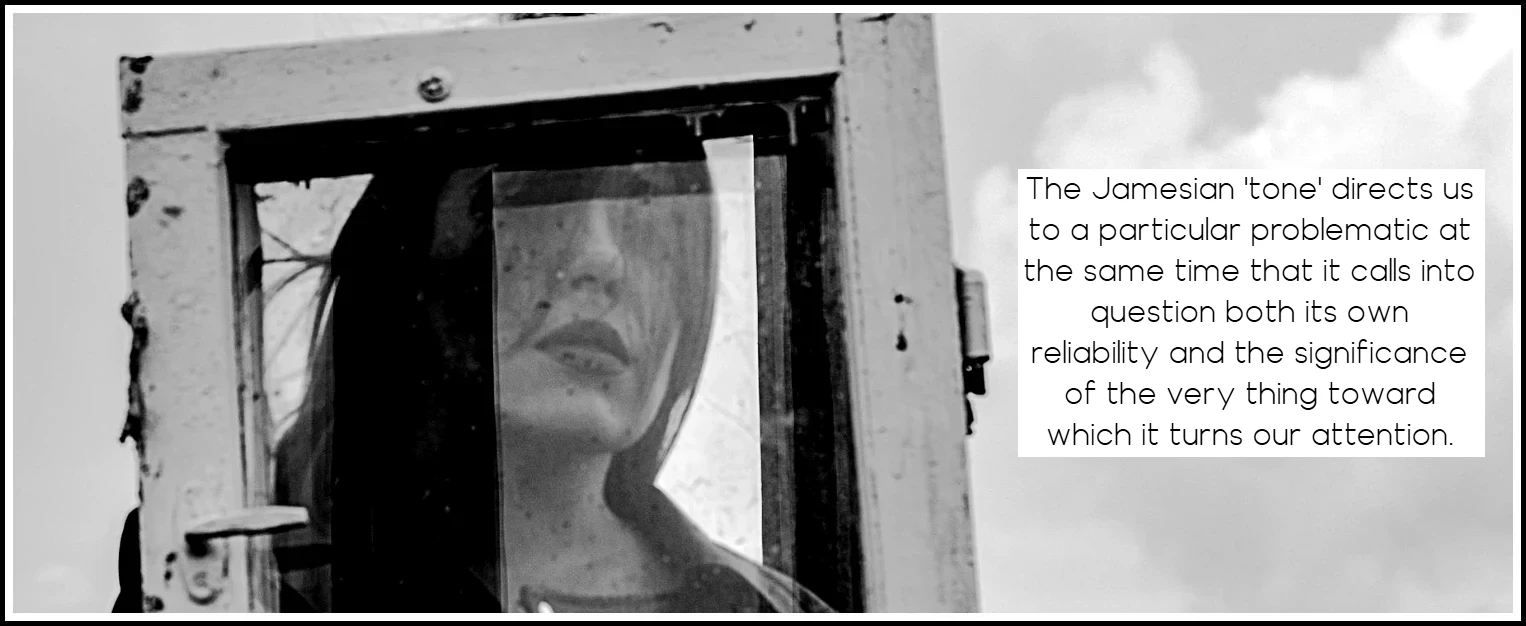
Photo: Vony Razom, Unsplash
‘Was there a ‘secret’ at Bly—a mystery of Udolpho or an insane, an unmentionable relative kept in unsuspected confinement?’. The governess’s question poses an interesting critical question about the relation between the reader of the Gothic novel and the psychoanalyst who constructs a primal scene. Is it because Ann Radcliffe and Charlotte Brontë construct their romances around a woman’s unhappy fate that the governess’s interest is so riveted on Miss Jessel? James certainly does seem to be suggesting something of the kind. The governess’s mind is full of Gothic stereotypes. In her visions of Miss Jessel, James presents a series of vignettes that recall the consummate villainess of Victorian melodrama, Lydia Gwilt, the antiheroine of Wilkie Collins’ very successful Armadale (1866). No less than those of Swinburne or William Morris, Collins’ heroines have often grotesquely fetishized tresses, which are always most striking against a mourning gown. Behind the governess’s vision of her predecessor in the schoolroom, James’s readers would doubtless have thought first of the fiery-haired Miss Gwilt, in mourning, furiously penning her interminable diary.
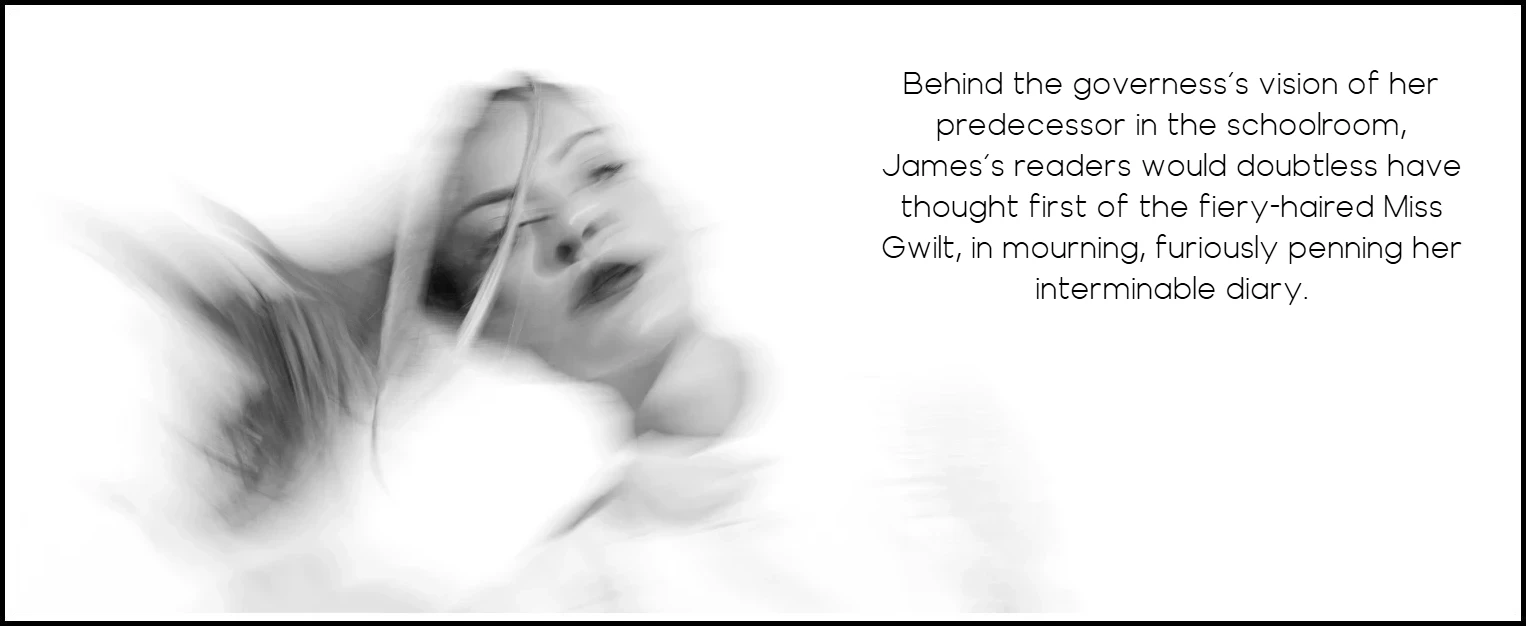
Photo: Felipe Ditadi, Unsplash
Unlike James, however, the Gothic tradition from Radcliffe to Collins often seems oblivious to its most glaring contradictions. As always, the effect of stereotype and cliche is to displace attention from contradictions. As readers of The Mysteries of Udolpho, for example, we suspect throughout that the heroine is in fact the daughter of an incestuous relation and that all her travails are the effects of an unforgiving God who punishes the children for the sins of the fathers. But Radcliffe hasn’t the heart to pursue the question she herself has posed, and we never learn why Emily’s father regarded the picture of his sister with such special affection. The Gothic text demands that we construct a primal scene but thwarts our ability to carry through with the effort. Likewise, in Jane Eyre we have no idea why Rochester keeps his mad wife in the attic of his main estate rather than on a neighboring estate he also owns. Rochester had claimed that it was unhealthy to live on his second estate but forgets those reservations when, after the fire, he and Jane move there. We are never let into the secret for this particular confinement, just as we never learn how Jane could have heard that mysterious, telepathic voice that marks the climactic point of the novel. The Gothic novel opens the space for the construction of the primal scene and in the same gesture bars access to it.
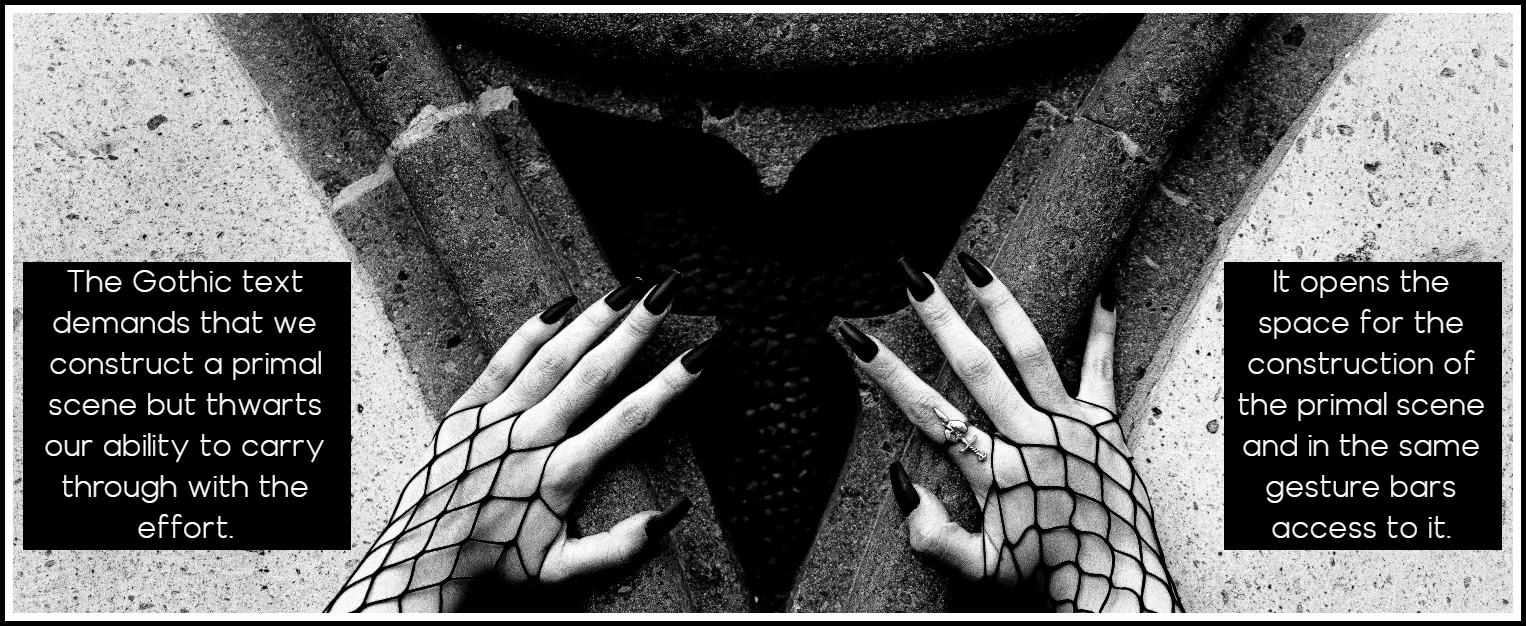
Photo: Evelyn Verdin, Unsplash
But in James’s story, the governess’s madness is, at its most elemental level, a refusal to be barred from learning the ‘secret’: that is, a refusal to forget ontology. It is in order to continue her pursuit of the secret that she produces her visions. Her visions are like analytic constructions, for through each one she is able to sound out Mrs. Grose more fully. The old lady is particularly struck by one detail in the governess’s account of her first vision of Jessel’s ghost. Through his punctuation of the governess’s account, James lets us observe her hesitant, piecemeal method of construction: ‘In mourning—rather poor, almost shabby. But—yes—with extraordinary beauty.’ To which Mrs. Grose responds: ‘The person was in black, you say?’. Though this is not at all a verification of her observation, the governess, as in her habit, jumps to conclusions and interprets Mrs. Grose’s curiosity about Jessel’s mourning dress as an indication that she is really on to something here: ‘I now recognized to what I had at last, stroke by stroke, brought the victim of my confidence, for she quite visibly weighed this.’
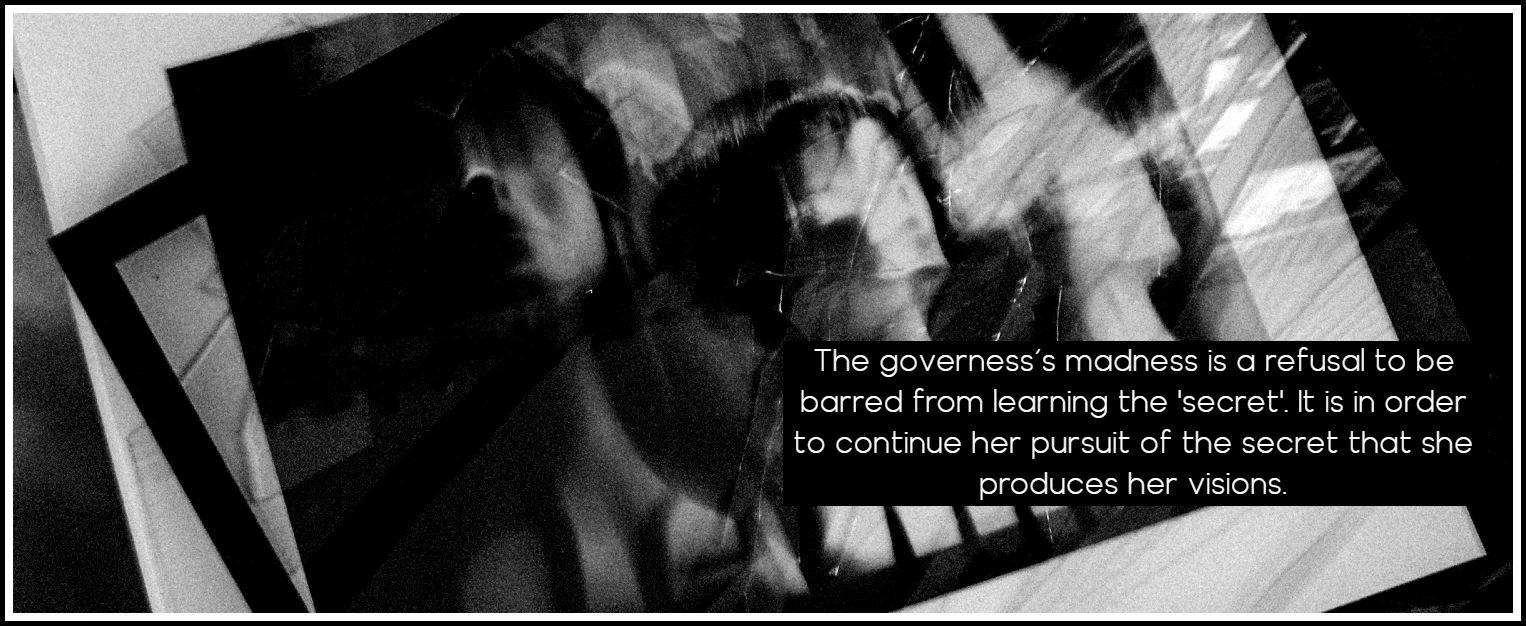
Photo: Francesco Ungaro, Unsplash
Who is the ‘victim’ here? Is it really Mrs. Grose? Quite to the contrary, the governess is victimizing herself. She is the victim of her own intemperate desire to get to the bottom of it all. Mrs. Grose has no reason whatsoever to associate Jessel with mourning attire; she is struck by this detail because it does not fit in place. But the governess sees only what she wants to see, and so she reads the old lady’s response as confirmation that she is on the right track. A screenplay would note that Mrs. Grose poses her question—’The person was in black, you say?’—with a quizzical tone of surprise. It is precisely this diacritical mark at the level of tone that the governess is unable to read. There is indeed a track here, but she errs in thinking that she is on the right one. The task of reading James is one of remembering that although there is a right track, we are not going to be on it.
Photo: Alex Quezada, Unsplash
The first question, therefore, is why the governess dresses Miss Jessel in mourning. Is it simply her predilection for the Gothic? In part, yes, but there is something more at stake here. The governess is so taken with her apparent success that she employs this detail again in her highly dramatic vision of Jessel in the schoolroom. The apparition at the writing desk is ‘dark as midnight in her black dress, her haggard beauty and her unutterable woe.’ As the governess enters the room, she imagines that the figure at the desk might be a ‘housemaid’ who ‘had applied herself to the considerable effort of a letter to her sweetheart.’ The entire scene is the very epitome of Gothic melodrama: the vision of a beautiful, distraught ghost of a woman in mourning as she rises in an eloquently silent gesture of despair. The tone here is also the epitome of James: Then it was—with the very act of its announcing itself—that her identity flared up in a change of posture. She rose, not as if she had heard me, but with an indescribable melancholy of indifference and detachment, and, within a dozen feet of me, stood there as my vile predecessor. Dishonored and tragic, she was all before me; but even as I fixed and, for memory, secured it, the awful image passed away. ‘With the very act of its announcing itself.’ What indeed is ‘announcing itself’ in this scene? What does the governess mean by ‘her identity flared up’? And why the strange construction, ‘stood there as my vile predecessor,’ rather than the simpler and anticipated ‘stood there my vile predecessor’? Every effect of James’s carefully crafted tone here creates an ambivalence between self and other. What is not announced here is the ‘identity’ of the ghost, or even its identity as a ghost. What is announced is the clearly self-reflexive nature of the governess’s imagination.
Photo: Ramin Talebi, Unsplash
For whom is Jessel in mourning, and to whom is she writing? If she is mourning for Quint, then she surely would not be writing to him. The governess has only recently learned of Quint’s death at the time of this vision, and it is quite natural for her to assume that the lascivious Jessel is in mourning for her lover; however, such a scenario is contradicted by the chronology Mrs. Grose sets forth. The question then is, What kind of events do the visions represent? As far as I can determine, all of the governess’s visions take place in the present. They are not glimpses into the past but events of a present haunting. Why, then, should Jessel be in mourning, since Quint is also on the premises? And to whom could she be writing? One might respond that supernatural visitations do not have to have a logic and to look for one is misguided. But if that is the case, why does James take pains to establish a chronology of the events preceding the governess’s arrival at Bly if he does not intend that chronology to serve as a cipher against which to read the legitimacy of the governess’s visions? Only by taking these details into account can we reconstruct the temporality of the story.
Photo: Vitaliy Shevchenko, Unsplash
As we shall see, James’s chronology makes it quite clear that Jessel could never have been in the schoolroom in mourning for Quint. Furthermore, we know that when she has this vision, the governess is intending to write a letter to the master, in violation of his mysterious interdiction against such correspondence. This interdiction against writing, which is indeed the ultimate gesture of an authoritarian metaphysics, looms large in my reading of the story. What, then, are we to make of the governess’s figure of the ‘housemaid’ about to write a letter to her ‘sweetheart’? What is ‘announcing itself’ is the constructive power of the governess’s unconscious phantasy. But beyond this obvious point lies the question of the relation of that phantasy to the actual events concerning the two ill-fated servants. Though her phantasy is merely an image or a figure of the real, it is only in relation to that unreality that we are able to deduce a relation to the real. The ghost at the writing desk is a figure for both Miss Jessel and the governess herself.
Photo: Vitaliy Shevchenko, Unsplash
The art of James’s tone is that it conceals within the governess’s self-mystification an effort to demystify the secret at Bly. James situates us between the supernatural reading that would insist that this is a psychic phenomenon and the psychological reading that would insist that this is simply a hysterical self-projection. For the governess is really not so mad at all, and the supernatural is really no less uncanny for being a synthesis of the real and the phantasized. We must always remember that James is demystifying not only the supernatural but also our presuppositions about mental disorder. We must always remember to displace both sets of presuppositions when reading The Turn of the Screw. Though her phantasy is in error, it forcefully announces the need to construct a more lucid account of the prehistory of this present haunting. Let us now reconstruct the chronology. The governess arrives in June. Mrs. Grose has had the care of Flora for several months already, and Miles is about to return from school for the summer: hence the pressing need for a new governess. We know from Mrs. Grose that the pregnant Miss Jessel left Bly ‘at the end of the year,’ and that by the time she was expected back after the holidays, news came from the master that she had died. This means that she died sometime during the winter. Miss Jessel, already—to Mrs. Grose at any rate—noticeably pregnant, left Bly in December only to die at home some weeks later.
Photo: Massimiliano Sarno, Unsplash
Early in the story, at the point where the governess is questioning the housekeeper about the man she saw on the tower, Mrs. Grose explains that Quint and the master
– ‘Were both here—last year. Then the master went, and Quint was alone.’
– I followed, but halting a little. ‘Alone?’
– ‘Alone with us.’ Then as from a deeper depth, ‘In charge,’ she added.
The italicized us and the suggestion of ‘a deeper depth’ imply that this was the period of the primal scene. The children were there, Miss Jessel was there, and Quint was ‘in charge.’ Everything is in place, even the chronology, for we are now in the summer, which must have been the time when Jessel became pregnant if her condition was noticeable by December. The master’s departure has serious consequences as far as Mrs. Grose is concerned; she is implying that had Quint not been left in charge, the children’s otherwise ‘respectable’ governess would never have succumbed, as she did, to a ‘fellow’ whom Mrs. Grose calls ‘a hound.’
Photo: Alexander Krivitskiy, Unsplash
This is made clear much later in the text when the governess suggests that the master is to blame.
– ‘After all,’ I said, ‘it’s their uncle’s fault. If he left here such people—!’
– ‘He didn’t really in the least know them. The fault’s mine.’ She had turned quite pale.
Here the governess has indeed hit the mark, but this time she doesn’t even recognize it. Clearly, Mrs. Grose agrees with what is for the governess only an offhand remark. But what is it that makes her turn ‘quite pale’? Surely mere negligence on the master’s part would not have been enough. No, James is trying to tell us something more; we have reached the ‘deeper depth’ that the governess sensed was at stake. Mrs. Grose knows that it was the master’s fault but not because of his negligence or inattention. She tells the governess that the master believed in Quint and placed him here because he was supposed not to be quite in health and the country air so good for him. So he had everything to say. Reading James closely enough to know how to read him freely enough reveals that what makes Mrs. Grose turn so pale is her awareness that the master did know what he was doing when he left Quint in charge, that he knew Quint well enough to know what effect the man would have on the otherwise ‘respectable’ Miss Jessel.
Photo: Alexander Krivitskiy, Unsplash
James has set forth not only a chronology of the events of the preceding summer, though one does have to read between the lines to construct it, but also an etiology of the primal scene itself. We know from the prologue what a playboy the master is and what an effect he has upon our governess, the narrator. If even Mrs. Grose knew that Quint was ‘a hound,’ then we can be certain that the master recognized those same instincts in this favored employee, who even has the privilege of wearing the master’s clothes. We know, even though the governess never pursues it beyond her passing remark to Mrs. Grose, that the master is deeply culpable in this scandalous affair. Like the governess, the critics have been blind to the artful Jamesian tone that informs Mrs. Grose’s speech and gesture. It is for that reason that none of them has ever guessed why the master absolutely forbids his servants to write to him. It is the most obvious thing that critics always miss. As any reader of Lacan’s seminar on Poe’s ‘Purloined Letter’ might have recognized, the master is in the place of the real. In The Turn of the Screw it is not the letter but the absence of the letter that enables us to trace the path of the signifier to the real. But like Poe, James can only point to the real without explicating it.
Photo: Anna Stampfli, Unsplash
We never know what is in the letter the Minister D— has stolen, and we never know why the master staged the primal scene at Bly. Like a Joycean god, he remains far behind the scenes, paring his fingernails while, unseen, he directs the action. The secret of the primal scene at Bly is finally in his nature, and that nature James keeps securely out of reach. In sketching the chronology, we have inquired into the etiology of the primal scene. We must still, however, return to the question of mourning and death. We know that Miss Jessel died during the winter, sometime between December and March. Only the master knows the exact date. We know that Quint too died over that same winter. Coming home from the village, no doubt drunk as would befit such a debauchee, he slipped on the ice, hit his head, and died. In other words, Quint and Jessel died at roughly the same time, which means that she could never have been in mourning for him at Bly. Furthermore, she probably would not have mourned his death in any case. Miss Jessel, if I am reading James correctly, is a respectable woman who was seduced and became pregnant with tragic results—the furthest thing from the stormy, romantic heroine the governess makes her out to be. The Turn of the Screw is really a pathetic tragedy of a woman caught in the machinations of a decadent patriarchy.
Photo: Engin Akyurt, Unsplash
The story is much more sordid and commonplace than the governess would have wanted to admit. She fills every detail with all sorts of Gothic paraphernalia, whereas, like the mystery of the master’s interdiction forbidding correspondence, what lies behind the vision in the schoolroom is only a tawdry Victorian tale of the suffering of an innocent woman. The master forbids his servants to write for the very simple reason that he wants nothing more to do with Bly or the children. He has sense enough to recognize the havoc his involvement has brought on and wisely decides to forgo any further involvement in the lives of his servants. He simply wants to cover his tracks and pretend that the whole thing never happened. But something did happen, and Mrs. Grose does not dare let on for fear of losing her job. Only the governess dares to guess at the ‘unguessable.’ Her constructions, regardless of the personal investment she has made in them, are always moving toward the rediscovery of that something. And it is only through her constructions that we are able to find our way to the primal scene of the story.
Photo: Vladislav Nahorny, Unsplash
In ‘The New York Preface’ to The Turn of the Screw, James describes his achievement in terms of a tone that seems a precursor to Derrida’s ‘apocalyptic tone’: ‘The study is of a conceived ‘tone,’ the tone of suspected and felt trouble, of an inordinate and incalculable sore—the tone of tragic, yet of exquisite, mystification’. Notice the care with which James calculates the effect of the ‘incalculable.’ On the one hand there is the tone of suspicion, the tone that speaks of ‘an inordinate and incalculable sore’; on the other hand there is a tone of tragic mystification. In other words, the event remains ‘incalculable’ because it can only be approached in terms of a mystified tone. The governess’s tragic airs, her lurid Gothic imagination, become for James a synecdoche for the work of unconscious phantasy in general, which is always already at work in the determination of an event. The construction I have made here concerning the master and Quint, and my unraveling of the governess’s visions, remain tentative efforts to calculate the ‘incalculable.’ Nothing in James’s text or letters, or from any other source, will verify them absolutely.
Photo: Vitaliy Shevchenko, Unsplash
What I have constructed is the primal scene of The Turn of the Screw, and it is situated, as James made certain it would be, in the zone of différance, in that complex temporal space of the always already but not yet. It is an origin that is an effect of its effects. It is not real, but it takes us closer to the real than any other reading has done. Far from extinguishing the ‘incalculable,’ the construction of the primal scene opens a new path toward it. In making such a construction we do not dispel the ghosts; to the contrary, we ensure that they live on behind an ineradicable concealment. As the ciphers of an ‘incalculable sore,’ the ghosts can never be done away with, for they are the figures of the challenge and necessity of reading. To rest at the level of indeterminacy is to forget that ‘sore’ and to fall victim once again to the ruses of male power. Like ‘The Purloined Letter,’ The Turn of the Screw is mediated by a complex narrative frame. The governess writes her manuscript at an unspecified date, and then sends it to Douglas before she dies. Douglas, in turn, reads it at the Christmas gathering and then, before his death, has it sent to his host, who recopies the manuscript and has it published. With each link in the chain of transmission, James is at once establishing the nonoriginary in the place of the origin and focusing our attention on the question of the origin. By presenting his text as a veritable palimpsest of a multiple scene of writing, each layer of which distances us from the voice of the governess, James at once discloses and conceals the question of the origin.
Photo: Vitaliy Shevchenko, Unsplash
What I want to turn to now is the role that metaphor plays in The Turn of the Screw in revealing and concealing the question of the origin. More particularly, I want to look at the image of fire as a metaphor of the origin. In its self-consuming play of absence and presence, fire perfectly suits the demand that the Jamesian tone makes upon language. The governess writes of the ghost in the schoolroom that its ‘identity flared up in a change of posture.’ At the most expressive moment of its anguish, the ghost appears to burst into flame, to consume itself, and disappear. In a later scene, while on the grounds of the estate with Mrs. Grose, the governess frantically tries to point out to her companion the ‘hideous’ figure of Miss Jessel, who she insists is standing directly in front of them: ‘You don’t see her exactly as we see?—you mean to say you don’t see now—now? She’s as big as a blazing fire! Only look, dearest woman, look—!’ The old lady responds in a manner that anticipates those critics whose focus is exclusively on the errors of ‘literature’: ‘It’s all a mere mistake and a worry and a joke.’ This is indeed the response of the ‘fastidious’ reader, the one who reads so closely as to be myopic. Of course, the difference here is that Mrs. Grose, unlike the fastidious reader, knows that there is something behind this sheet of flame, even though she would rather turn her glance away. For the governess, the figure of fire is a most appropriate one to describe the demonic forces she has set out to vanquish. Though she is steadfast in her struggle against evil, she must sometimes remind herself that ‘it was not my mere infernal imagination’. Between her and the secret knowledge that she believes the children possess, there always looms the disfiguring figure of fire. If she could only see through, or beyond it, she would truly grasp the truth. But as soon as it flares up, as if in a moment of apocalyptic revelation, it invariably vanishes into thin air.
Photo: Bernd Dittrich,Unsplash
Fire in The Turn of the Screw, writes Shoshana Felman, ‘incinerates at once the content of the story and the inside of the letter, making both indeed impossible to read, unreadable, but unreadable in such a way as to hold all the more breathless the readers’ circle round it.’1 Felman is referring to Miles’s incineration of the governess’s prohibited letter to the master, and to the guests gathered round the fireside to hear Douglas read the manuscript. The figure of fire does, as Felman suggests, ‘eliminate the center,’ but it does not, for all that, leave us only with emptiness and the loss of the center. It seems to me that on precisely this question we can distinguish the position of Freud, Heidegger, Nietzsche, or Derrida from that of the ‘Yale School’ of deconstruction. In one of his early essays Derrida characterizes Nietzschean affirmation as that which ‘determines the non-center otherwise than as loss of the center.’2 In other words, even with the loss of the possibility of a determinable origin, there is a kind of gain. Something that is neither presence nor absence persists even in the loss of the origin, and it is to this something that Nietzsche responds with his ‘immense, unbounded Yes.’ Felman’s notion of unreadability stops short of Derridean différance. The figure of fire does not simply destroy the center; it also ‘determines the non-center otherwise than as loss of the center.’ At the beginning of her discussion of fire, Felman cites a passage from Lacan that makes the Heideggerian-Derridean point wonderfully clear: ‘We do not see what is burning, for the flame blinds us to the fact that the fire catches on the real.’ Everything depends upon our remembering that even though the fire blinds us to the real, we have not forgotten that the real, as the indeterminable non-center, is there as something other than an absence.
1 – Felman, ‘Turning the Screw of Interpretation,’ 148
2 – Derrida, ‘Structure, Sign, and Play,’ in Writing and Difference, 292
Photo: Bernd Dittrich,Unsplash
In a footnote to this citation from Lacan, Felman writes of ‘the crucial importance of fire in Henry James’s life, and its recurrent role, both real and symbolic, as a castrating agent.’ Fire played a tragic role in James’s own life and in that of his father. The fact that James’s father lost a leg as the result of a fire and that in another incident James himself suffered a permanent back injury forcefully suggests why fire had such an important role to play in manifesting the real as a mode of concealment and withdrawal. In James’s texts, fire brings the real to presence only by staging its concealment and withdrawal. James uses fire to blind us to the real, but we should not be blinded to the fact that the real is still there to be blinded to. The French psychoanalyst Jean Laplanche has argued that fire is the paradigmatic figure for the perception of the traumatic event. In James’s life and art, this seems indeed to be the case.
Photo: Antonio Verdin, Unsplash
There is in the later James a phrase that appears so insistently that one might, at the risk of a slight exaggeration, regard it as a tic, or compulsive element, in the late Jamesian tone. In his texts of the 1890s, above all in The Turn of the Screw and The Wings of the Dove, James uses the expression ‘hanging fire’ in a variety of permutations and in conjunction with a wide spectrum of character and situation. Regardless of age, social class, or sex, everyone in the latter James seems capable of ‘hanging fire.’ Without reservation we can say that this expression is synonymous with the incalculability of the later Jamesian tone. ‘To hang fire’ means ‘to hesitate,’ ‘to remain concealed,’ ‘to withdraw, or step back, in the very act of seemingly stepping forward to say something.’ ‘To hang fire’ is ‘to keep something hidden in the very act of apparently revealing something.’ By noting the point at which someone ‘hangs fire,’ James locates the point of maximum resistance, the point at which saying something also becomes a way of not saying something else. Felman is well aware of the principle that is at stake here: ‘Mrs. Grose,’ she writes, ‘in saying less than all, nonetheless says more than she intends to say.’1
1 – Felman, ‘Turning the Screw of Interpretation,’ 188
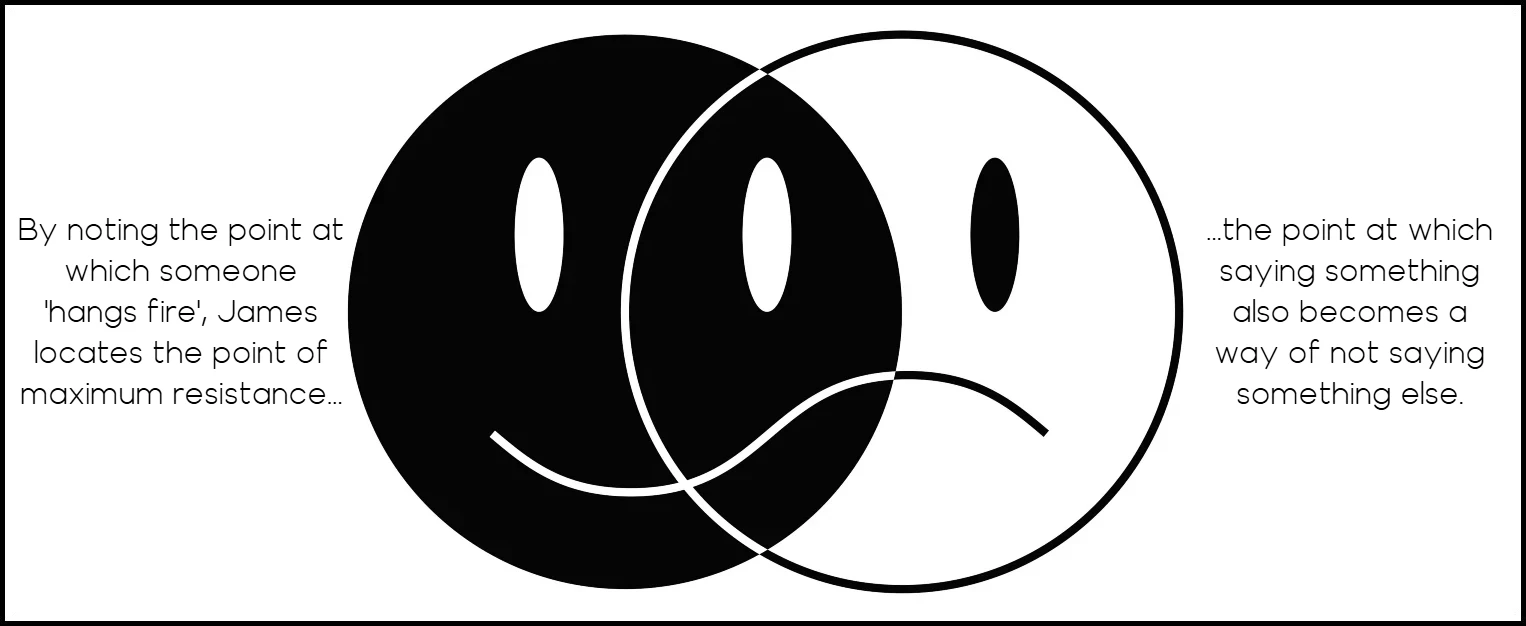
Illustration: Getty Images for Unsplash
And it is in connection with Mrs. Grose that James repeatedly uses the phrase. The governess remarks of the old lady, ‘She hung fire, but she overcame her reluctance’. In response to her inquiries about the man on the tower, Mrs. Grose ‘hung fire so long that I was still mystified’. ‘Hanging fire’ describes the structure of communication throughout The Turn of the Screw, and it is no exaggeration to say that it could easily have been the story’s alternate title. ‘Hanging fire’ describes the same ‘turn’ away from determinable meaning which we come to expect at each of the numerous ‘turns’ in the story. ‘Hanging fire’ is synonymous with the hesitation waltz of Jamesian tone. The expression, from the early history of firearms, describes any discernible delay between the ignition of the powder and the actual firing of the ball. ‘To hang fire’ is thus to be on the threshold between firing and not firing, in the interval between speech and silence. This may well have been a common phrase among the country gentry of James’s acquaintance; wherever he learned it, it must have seemed to him made to order to describe the play of concealment and disclosure. In Douglas’s evasion of his audience’s queries in the story’s prologue, and especially when his host asks him to begin, we might see an image of James himself. As Douglas turns away from his interlocutors, he turns ‘round to the fire,’ which he watches for an instant before facing his audience once again. In this alternating rhythm of turning toward and then away from the fire, we enter the primal scene of the Jamesian text.
Photo: Jayson Hinrichsen, Unsplash
MARA, MARIETTA: A LOVE STORY IN 77 BEDROOMS – READ THE FIRST CHAPTER
A literary novel by Richard Jonathan
RICHARD JONATHAN, ‘MARA, MARIETTA: A LOVE STORY IN 77 BEDROOMS’ — READ THE FIRST CHAPTER
AMAZON & APPLE BOOKS

RICHARD JONATHAN, ‘MARA, MARIETTA: A LOVE STORY IN 77 BEDROOMS’ | AMAZON PAPERBACK OR KINDLE

RICHARD JONATHAN, ‘MARA, MARIETTA: A LOVE STORY IN 77 BEDROOMS’ | APPLE iBOOK
MARA, MARIETTA: A LOVE STORY IN 77 BEDROOMS
A literary novel by Richard Jonathan

Available from AMAZON (paper | ebook) & iBOOKS, GOOGLE PLAY, KOBO & NOOK (see LINKS below)
RELATED POSTS IN THE MARA MARIETTA CULTURE BLOG
CLICK ON THE IMAGE TO GO TO THE POST


By Richard Jonathan | © Mara Marietta Culture Blog, 2026 | All rights reserved
Comments