INTERPRETATION ONE
Syncope: The Philosophy of Rapture
KIERKEGAARD THE SEDUCER: OF YOUNG GIRLS AS THOUGHT
Catherine Clément
From Catherine Clément, ‘Of Young Girls as Thought: Kierkegaard the Seducer’ in her book, Syncope: The Philosophy of Rapture.
Translated by Sally O’Driscoll & Deirdre M. Mahoney (Minneapolis: University of Minnesota Press, 1994) pp. 85-93
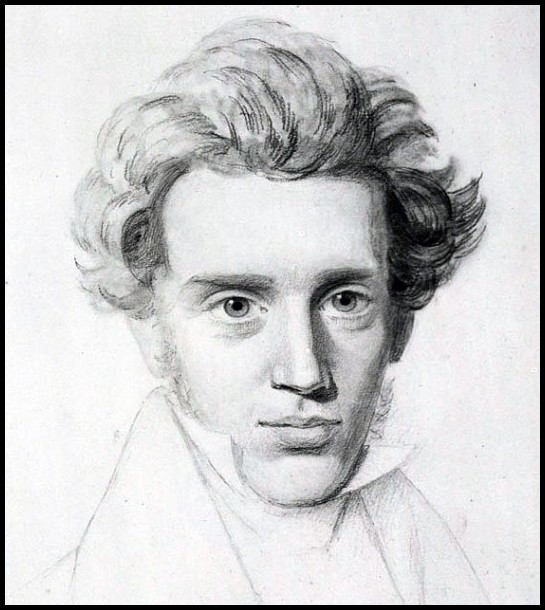
Søren Kierkegaard by Niels Christian Kierkegaard, 1840
In the beginning, there is a young girl. Her name is not important: she has been called Zerlina, Cordelia, Mary, Elvira, Marguerite; once she was Antigone. In Kierkegaard’s real life, we know, she was a real person, and was called Regina Olsen, the philosopher’s fiancée; later, alas, she married Friedrich Schlegel. But in Kierkegaard’s philosophy, her name is first and foremost ‘thought.’ See what he does with her: Thought was calm, rested happy in its knowledge; then I went to it and begged it to bestir itself once more, to venture the ultimate. You read correctly. The philosopher Kierkegaard is thought’s suitor; it is clear that thought is a little lazy, liking nothing so much as peaceful rest in the snug nest of understanding. Now, look how the philosopher wakes her up and sets her in motion. Thought knows very well, continues the philosopher, that it is ‘futile’; since she is rather a good girl, however, she does not refuse to shake a leg. Thought labored in vain; egged on by me, it was continually going beyond itself and continually collapsing back into itself. It was continually looking for a foothold and finding none. It was continually trying to find bottom, but could neither swim nor wade. Poor mad thought, unable to float. It was both a laughing and a crying matter. Therefore I did both and was very grateful that it had not denied me this service. And although I now know perfectly well that it is useless, it could still very well occur to me to ask thought to play once again the game that to me is inexhaustible material for enjoyment. That is one of the philosopher Kierkegaard’s innumerable seduction scenes; this one, which resembles an eclogue, is also a kindly way of putting old Hegel in his place, that old professor who never succeeded with thought—the old hypochondriac who did not even make her laugh or cry. And that is child’s play.
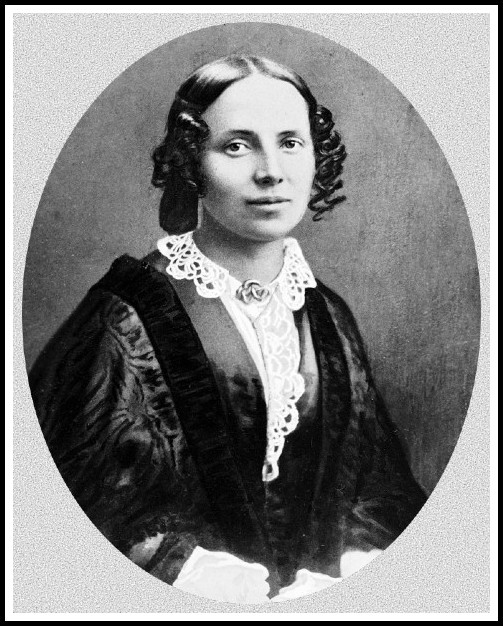
Regine Olsen, 1855
There are innumerable seduction scenes in which Kierkegaard puts himself in the place of the seducer, Cherubino, Papageno, Don Juan, himself finally, or one of his multiple pseudonymous doubles. The attempts to make the young girl fall are innumerable, with the secret hope that this time, no, she will not fall, she will not search vainly inside herself for support, she will succeed, she will resist. What happens when the game is over, after the young girl’s defeat, we will soon see. But for the moment let us watch the seduction carefully, as in it the philosopher’s desired raptus is concealed. The Seducer’s Diary, transplanted right into the middle of the collection Either/Or, tells a tiny, unique story. It is in the genre of the epistolary novel; the plot would be breathtakingly banal if it were not for a touch of strangeness due to the philosophical tone that enchants this passing fancy and perfumes it with heliotrope. A seducer falls in love with a young girl in a green coat; he approaches her, makes her love him, asks for her hand in marriage, they become engaged. From then on our seducer has only one desire: to break the contract, seize her, and carry her off. She is his; immediately, he loses interest in her.
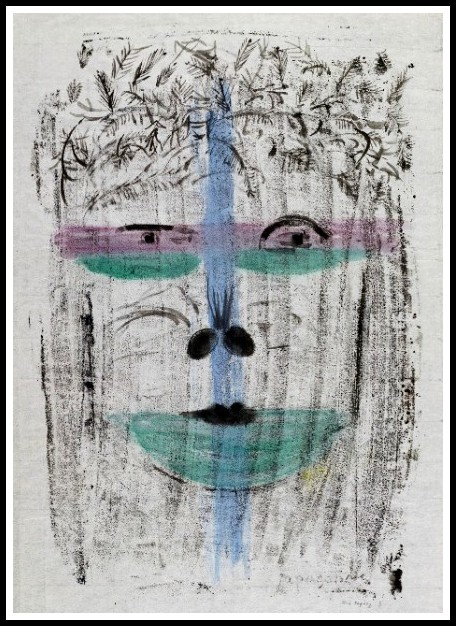
Irmgard Sörensen-Popitz, Papageno, 1925
This plot line for a bad film includes two peculiarities. The first is that the seducer is passionately concerned with persuading the young girl: she will share the desire for the rupture, the abduction, the erotic night—for everything except the desertion. The second peculiarity is the philosophical element itself: Kierkegaard tells us the story of a rupture. He achieves through an interpolated fiction the thing that, in his eyes, Hegel did not succeed in doing to thought. Thought is awakened, it wriggles in vain, outstrips itself without surpassing itself, laughs and cries. It will be made to go through a lot. Thought refuses to make an effort: the philosopher will compel her to break off, and will then sleep with her. At this level of clear-headedness, it would be vain to wonder who decides what, the biographical and the fictive, the real and the philosophical; Kierkegaard’s cunning game leaves no one the trouble of asking these questions, and he asks them himself, of himself, with plenty of brilliance. With fine rigor, Kierkegaard shows us Johannes, the seducer, attracted by a little leap, a step so mundane that one hardly pays attention to it. The young girl gets out of a carriage, and her foot stays in the air. That is all: ‘the decisive step,’ murmurs Kierkegaard already. Of course, it will be explained that the attention that shakes our philosopher’s desire is a fetishistic one. But the emphasis—as furtive as the desire of the fetishist for the boot—is placed on the leap, this little leap of nothing at all. We quickly understand that Cordelia’s leap, when she steps down from the carriage, symbolizes something completely different. Leave aside some amorous episodes, time spent in anticipation with heart palpitating, successive repulsions and other usual attractions; soon Johannes wants to teach infinity to his young conquest.
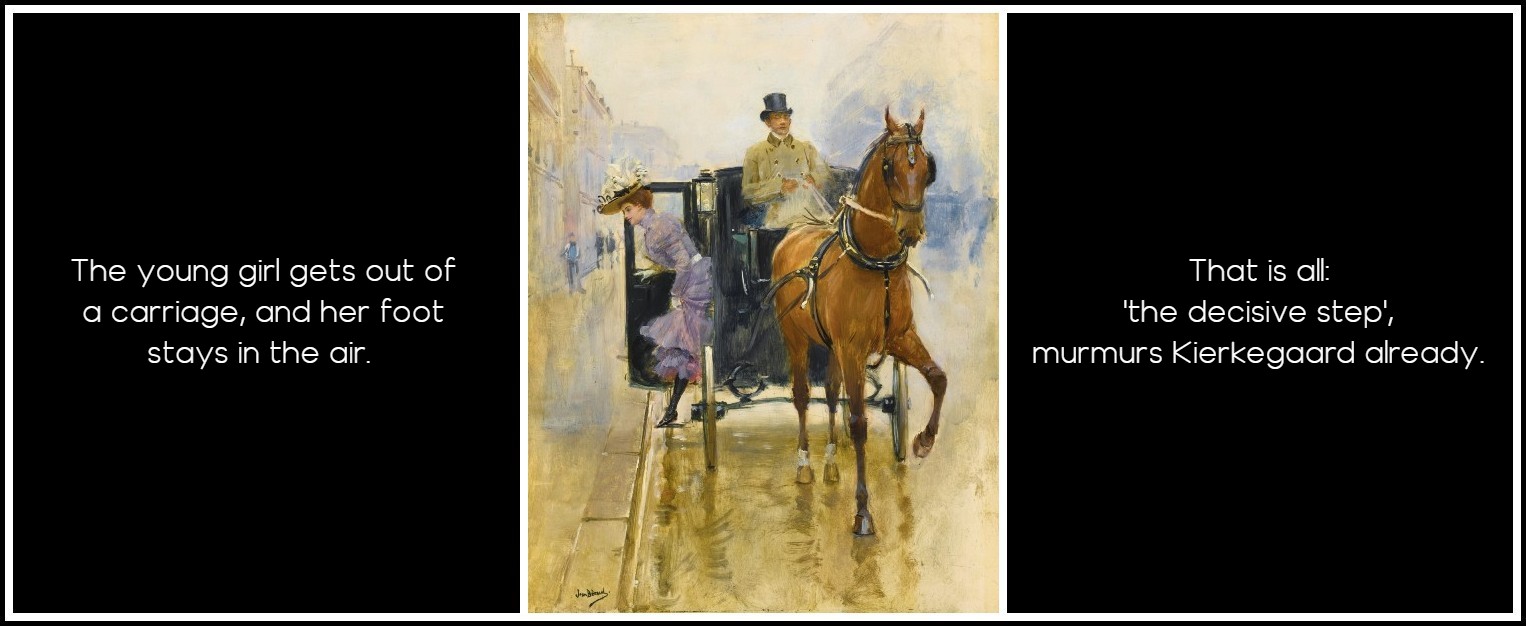
Jean Braud, Jeune femme descendant d’un fiacre, 1885
He cannot wait for this infinity. Only a young girl is capable of it; only a virgin chained to the rocks, waiting to be devoured by the monster, can attach a thin string to the docile neck of the dragon; this is a matter of virginity. But that is not the most important thing. The important thing is the leap. Suddenly, another philosophy is born. Man, born to work, does not know how to leap; he prepares himself for a long time, calculates the distance, reflects, takes a running start… and falls into the hole that he had hoped to jump over. Man’s leap is always ludicrous, continues Kierkegaard, because it is deliberate. The young girl leaps so well that the untraversable gulfs between two towering mountain peaks are called ‘the Maiden’s Leap.’ It is characteristic of young girls that they do not need a running start. Indeed, a running start would go against the grain of the young girl’s leap: That is, a running start has in itself the dialectical, which is contrary to woman’s nature. The same goes for Hegel: using the young girl as a stand-in, Kierkegaard indicates clearly that Hegel’s dialectic is rather heavy. The young girl, the ageless Diotima on the edge of the abyss: Her leap is a gliding. And once she has reached the other side, she stands there again, not exhausted by the effort, but more beautiful, more soulful than ever; she throws a kiss over to us who stand on this side. Young, newborn, she swings out over the abyss so that everything almost goes black before our eyes.
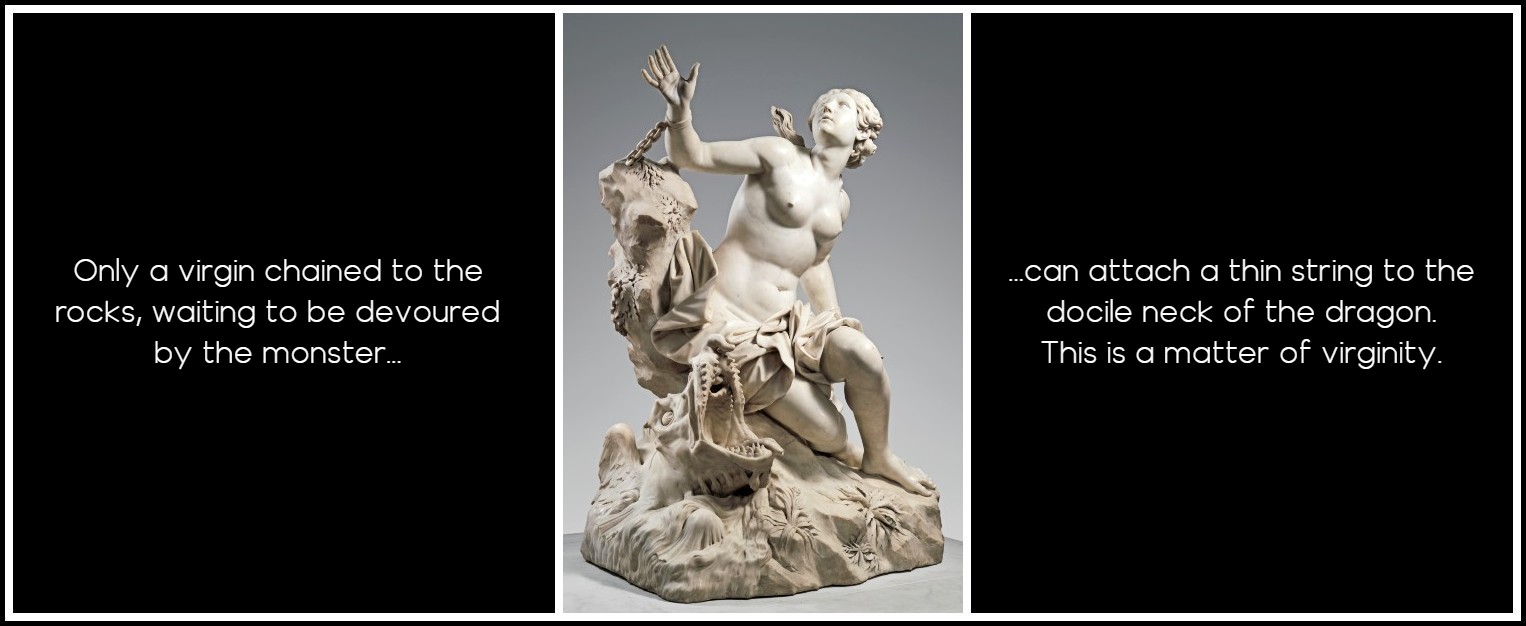
Domenico Guidi, Andromeda and the Sea Monster, 1694
One feels how this young woman carries myth and dream with her; one feels also that she is the philosophical virgin who will confront the dialectical monster contrived by Hegel, and will put around its neck the halter of infinity; the same infinity in which, a few lines further down, she is invited to ‘frolic.’ It is with the same metaphysical lightness that the young girl Cordelia, after her engagement, indulges in an odd game with ‘her’ Johannes. The engaged couple have already exchanged their rings. The serious burghers around them comment on the symbol of the exchange with such heaviness that suddenly the young man takes the rings, slips them onto a stick, and tosses them into the air, carelessly. At the same moment the young girl understands what Kierkegaard calls by an odd name: the pause. The pause: rings thrown as if launched into flight, by chance and completely freely. Quickly, she in turn seizes the rings and throws them, but so high that no one can catch them anymore: There is a story of a French soldier who had been in the Russian campaign and had to have his leg amputated because of gangrene. The very moment the agonizing operation was over, he seized the leg, tossed it up into the air, and shouted: Vive l’empereur! With a look such as that, she, even more beautiful than ever before, tossed both rings up into the air and said to herself: ‘Long live erotic love’.
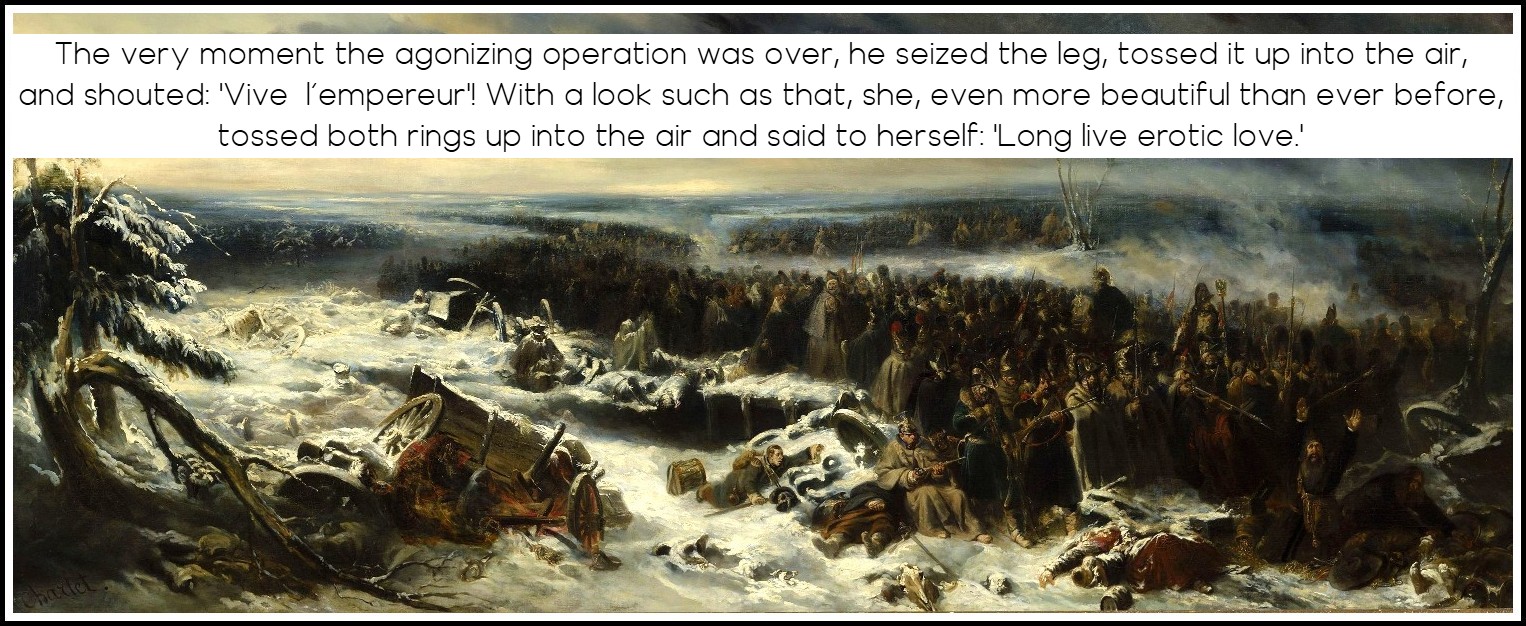
Nicolas Toussaint Charlet, Épisode de la campagne de Russie, 1836 (detail)
That is the moment, the irreparable moment. We have been there since the initial leap; since the abyss between the two rocks, and the Maiden’s Leap. We are approaching the breach that is unbridgeable and yet crossed, a ghastly amputation that is consented to, however valiantly, only through the philosopher’s virtue and in order to flout dialectic. Kierkegaard knows the breach by heart; he decided it like Johannes, he broke off his engagement and does not want to reinstate it. It is a matter of breaking and jumping; of breaking off and leaping; of shattering and reuniting. That is what the seducer is going to devote himself to by abducting the young girl the moment she is no longer his fiancée. Horses, carriage, clandestine night; a syncope in bourgeois life, a syncope in morality, and the first glimpses of metaphysical syncope: The bond has broken—full of longing, strong, bold, divine, she flies like a bird that now for the first time is allowed to spread its wings. Fly, bird, fly!
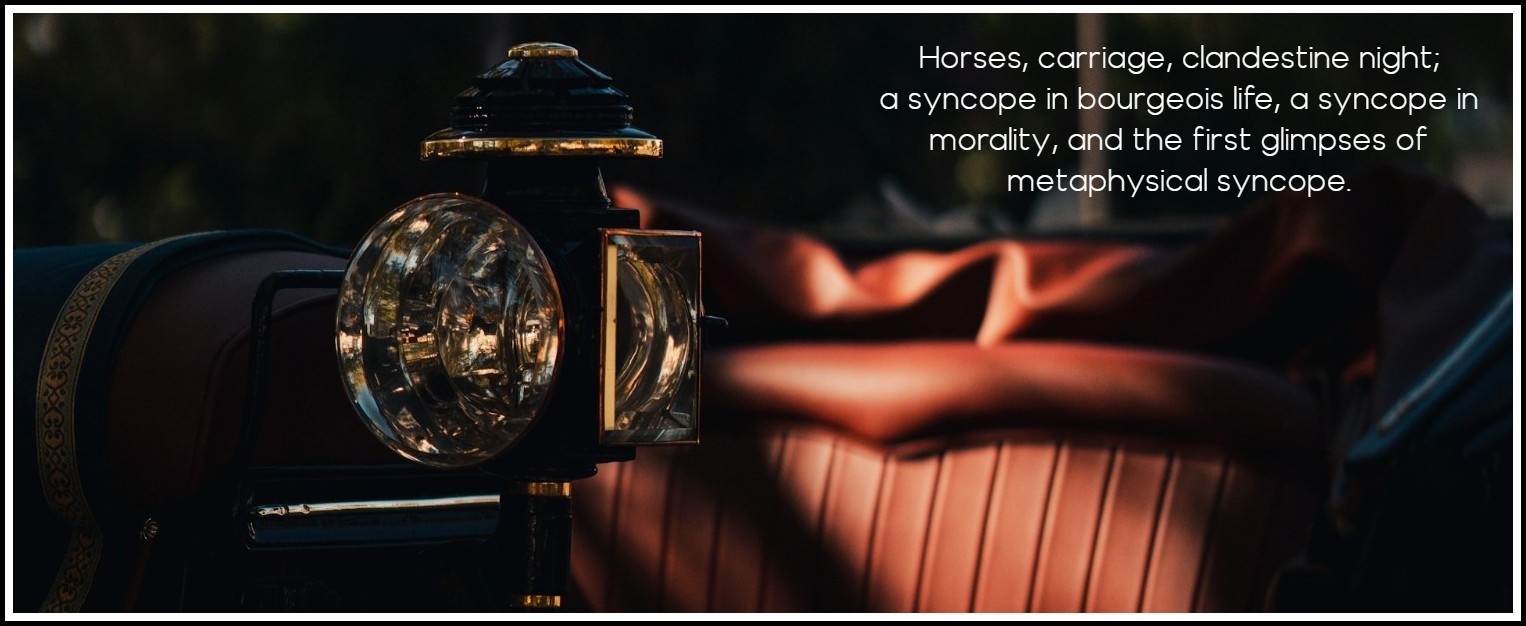
Photo: Hernan Gonzalez, Unsplash (detail)
A quarter of an hour before midnight, the seducer abducts the young girl. Everything sleeps in peace, but not erotic love. At dawn: But now it is finished, and I never want to see her again. When a girl has given everything away, she is weak, she has lost everything. I do not want to be reminded of my relationship with her; she has lost her fragrance, and the times are past when a girl agonizing over her faithless lover is changed into a heliotrope. If I were a god, I would do for her what Neptune did for a nymph: transform her into a man. There it is then, the true breach: here the seducer appears in his essence. Kierkegaard’s scenario is otherwise more complicated than that of a simple Don Juan, even if he were the immortal prototype himself. For two breaches follow one on the other: that of the engagement—a break in bourgeois life and in marriage—and that one, the latter, the true one. Having risked everything—the young girl, or thought—she has lost everything. The philosopher only has to find another young girl, gentle and fresh, to beg her to put herself in motion, and to play the game of throwing rings once again.
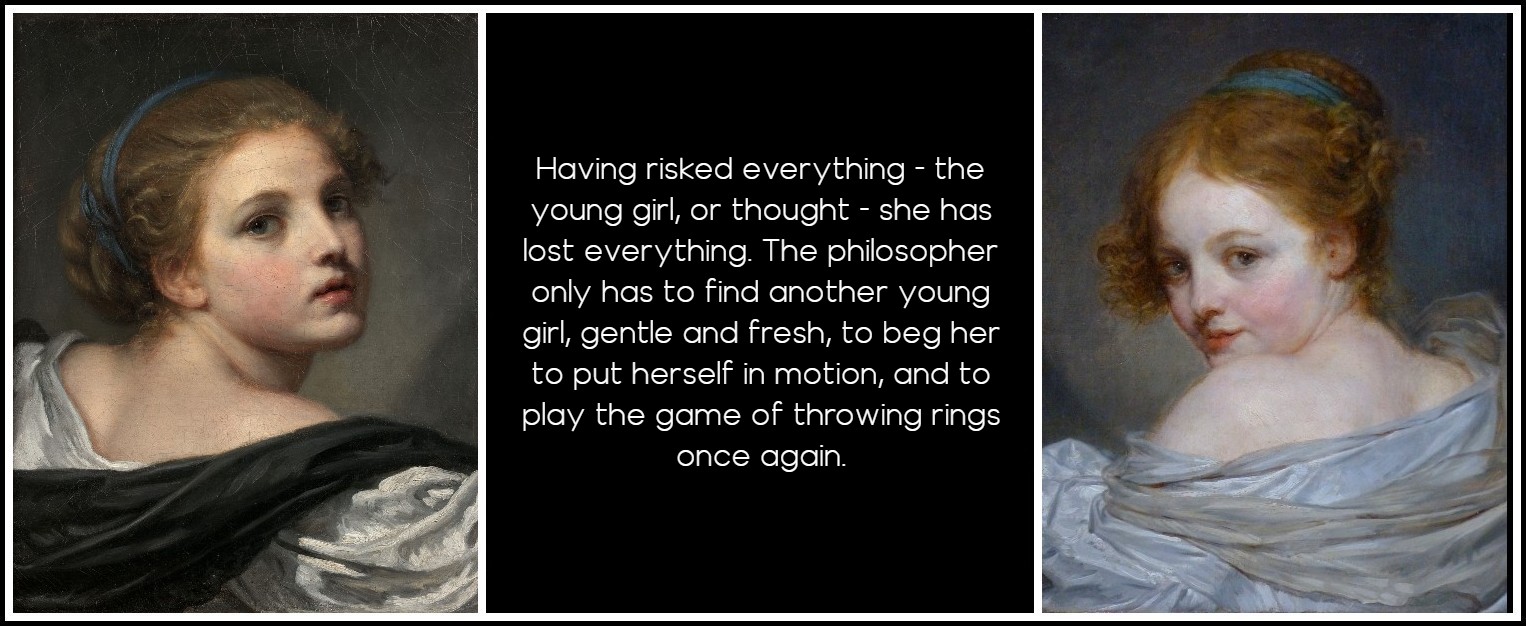
JEAN-BAPTISTE GREUZE (1725-1805)
Portrait de jeune fille au ruban bleu | Portrait de jeune fille vue de dos
But the seducer regrets the ‘one never knows.’ He wants the young deflowered girl to be a heliotrope, the flower turned passionately toward the sun—at the time, it wasn’t known that this mythical flower is endowed with an autonomous rhythm that owes nothing to the sun. He wanted her to be a man, above all, like the nymph Kainis whom Poseidon turned into Kaineus, and who along with Narcissus is the other model for the Hermaphrodite, endowed with so prodigious a power that it took a whole mountain to bury him and finish him off. Did Kierkegaard know that Kainis, abandoned and transformed into a man, became immortal at the same time? Perhaps not; but in the moment of deflowering—the very moment of breaches, of hymen and love, of membranes and desire—the immortality that always haunts syncope slips in. This immoderate leap that suspends man’s weight has the very lightness of fainting away: the magical grace of human time as it passes, of thought as it stops. At this precise moment the myth of immortality begins. That is called a fall; Cordelia ‘fell,’ and the syncopated body collapses heavily. One does not escape from Newton any more than from the seducer. What fascinates the philosopher is the perilous moment of the young girl. It is a shared danger. The dizzying grace of the young girl is dangerous for whoever is caught up in it. No one knows whether Johannes suffers from having abandoned the deflowered Cordelia; but we will see later on that anguish catches the philosopher by his heels, and causes him to make other sacrifices than a beauty’s virginity.
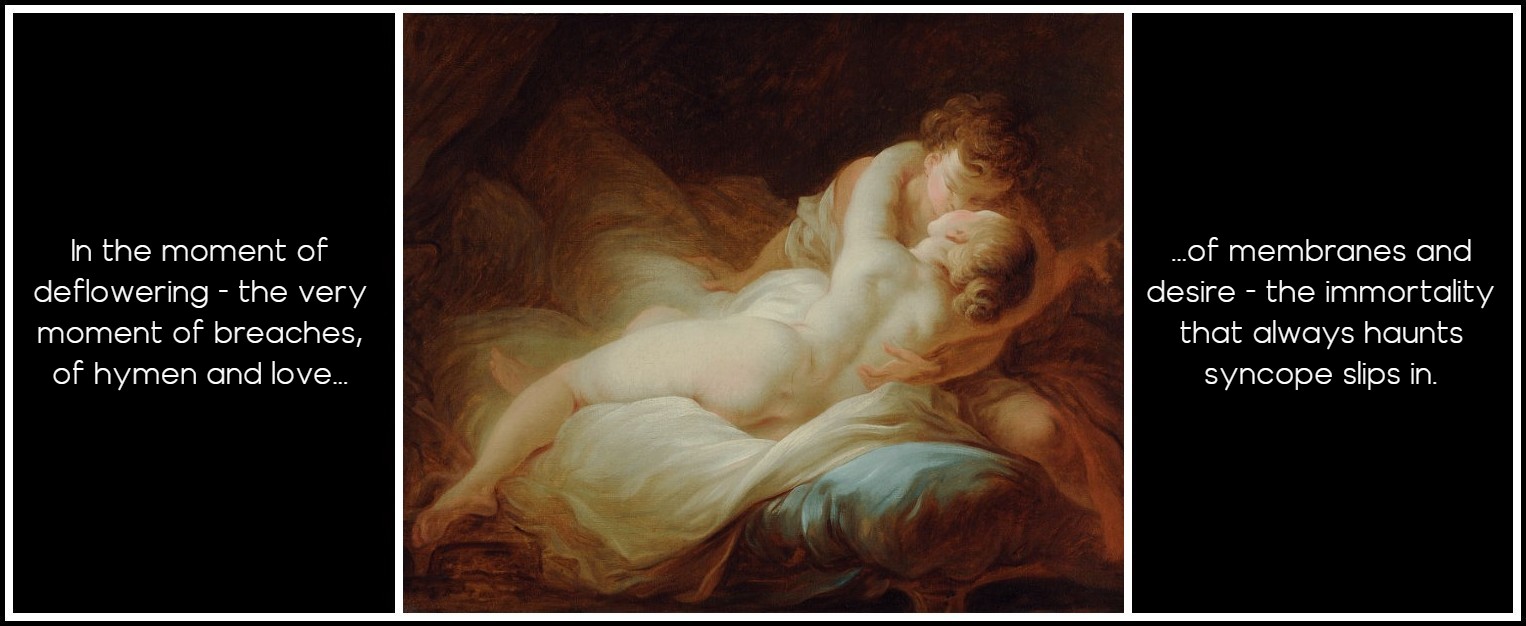
Jean-Honoré Fragonard, L’Instant désiré, 1765
Other young girls, who resemble Cordelia like two peas in a pod, bring about strange schisms: look at Charlotte, across from Werther, and across from Sigmund Freud, Dora. Poor Werther is not an active seducer, but completely the opposite—he will die for having approached the chosen young lady a little too closely. It is a courtly love scene; from the outset Charlotte has been promised to a certain Albert, and even before meeting her Werther knows all this. On one and the same day, however, he sees her cutting a loaf of brown bread that she hands out to a flock of children, he goes off to the ball with her, and the die is cast. Leaving aside the rosy Charlotte’s appearance in a motherly role, and her pronounced unavailability as a young girl engaged to another man, let us see what connects the two lovers from the beginning. Charlotte has a passion, which she confesses: dancing. If anything worries me, I go to my old squeaky piano, drum out a quadrille, and everything is well again. The instrument’s being out-of-tune matters little to the artless girl; she is carried away as she strikes the keys, and that soothes her worries. The ball begins; they pass each other in the minuets—that is not dangerous. Then come the allemandes, which go on until the waltz, in which, contrary to custom, the couple stays together. The dancers whirled around each other like planets in the sky, remembers Werther, who writes to his friend Wilhelm: I vowed at that moment that a girl whom I loved, or for whom I felt the slightest attachment, should never waltz with another, even if it should be my end! You will understand. We do not know whether his friend Wilhelm has understood, but we understand that Werther will end up dying of having seen Charlotte waltzing with her husband. However, Werther and Charlotte continue to waltz—flying with her like the wind, till I lost sight of everything else—to the point where a woman shakes a threatening finger at Charlotte and utters the name of her husband-to-be. Only then does Werther discover what he already knew, which gives him his death blow.
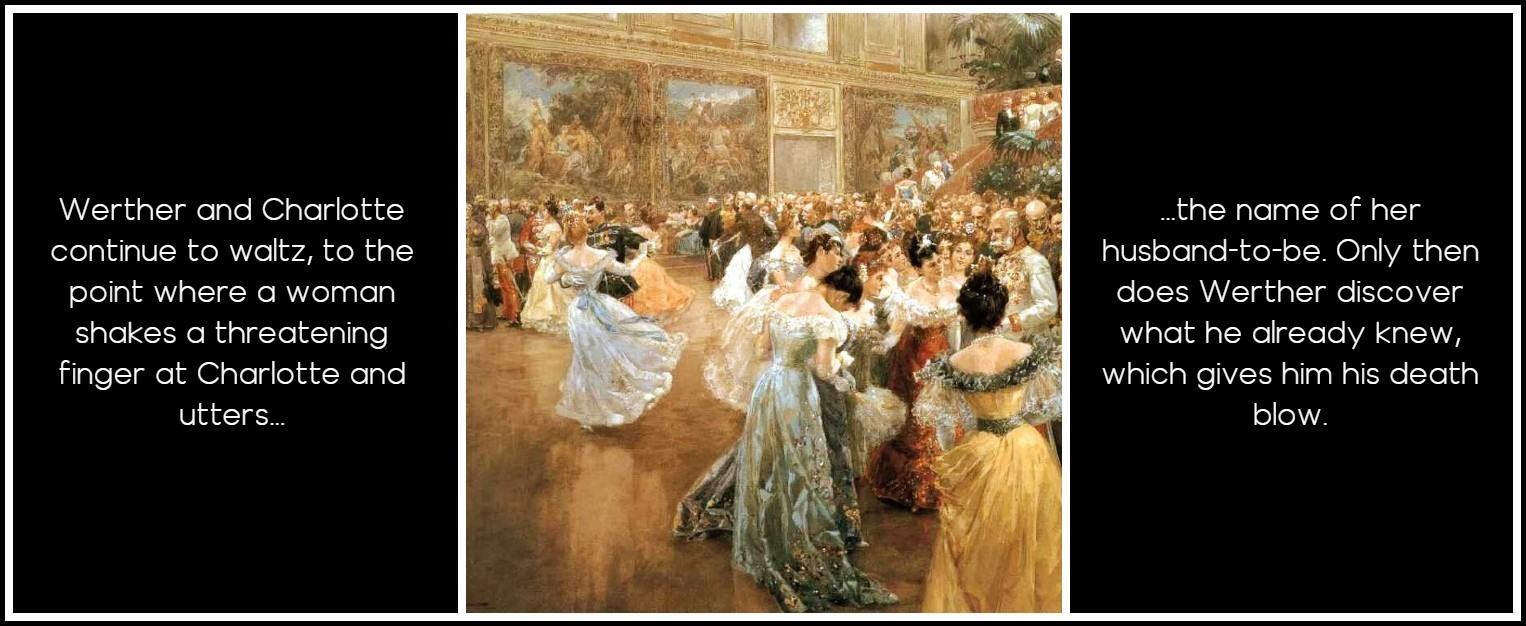
Wilhelm Gause, Hofball in Wien, 1900
Up until now it has only been one of those deadly, sparkling waltzes that we are beginning to recognize. But the day is not yet over; the storm bursts, and the thunder puts an end to the dancing. Then the young girl invents a game to pass the time and reassure the company. It is called playing ‘at counting.’ She sets herself to going around the circle, arm outstretched; as the beautiful girl’s finger passes, each person must say the number that falls to his lot. Whoever is silent, hesitates, or makes a mistake gets a slap. She went round the circle with upraised arm. ‘One’ said the first; ‘two,’ the second; ‘three,’ the third; and so on, till Charlotte went faster and faster. One man made a mistake—instantly a box on the ear; and amid the laughter that ensued, another box; and so on, faster and faster. I myself came in for two. ‘I imagined,’ said Werther, ‘that they were harder than the rest, but felt quite delighted.’ Nobody doubts that Werther—although he does not say so—jealously makes sure to miss his count. We do not have to wait long for the result of this magic sequence: the slicing of the bread, the waltz, the storm, and the slap have made Werther a lost man: And since that time sun, moon, and stars may pursue their course: I know not whether it is day or night; the whole world about me has ceased to be.
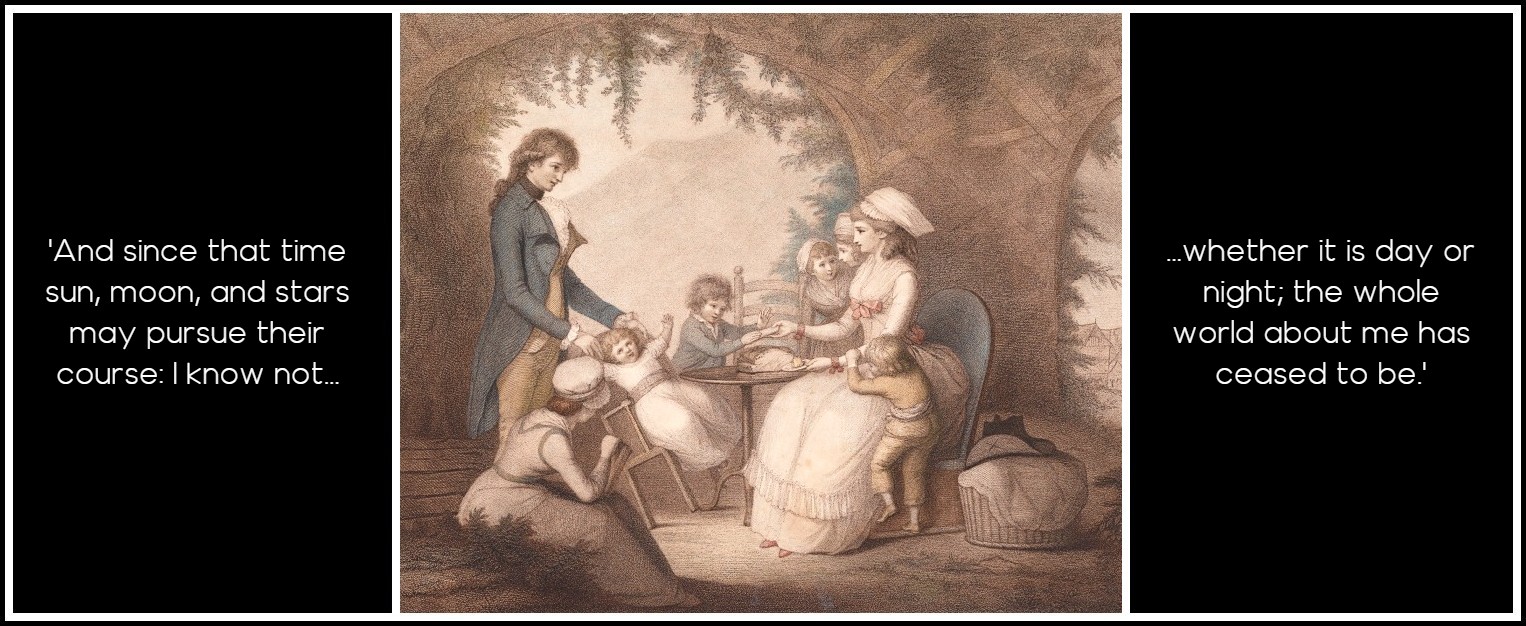
John Raphael Smith after Henry William Bunbury, The First Interview of Werther and Charlotte, 1782
That young girl does not leap over chasms, she does not lean over the edge of the abyss of Asia; no, she is more mundane. With a knife, by whirling, and with a slap she makes a split, with her finger pointing and a smile on her lips. Dangerous Charlotte, the engaged woman, who whirls and extricates herself, then slips away: God knows, however, that she does not have the manner of a femme fatale. But if she is certainly not that, she is simply a young girl, one of those about whom Søren Kierkegaard made the metaphor about thought. She who cuts, waltzes, and slaps. With Dora the nineteenth century is over, and from now on the slap is called a smack.
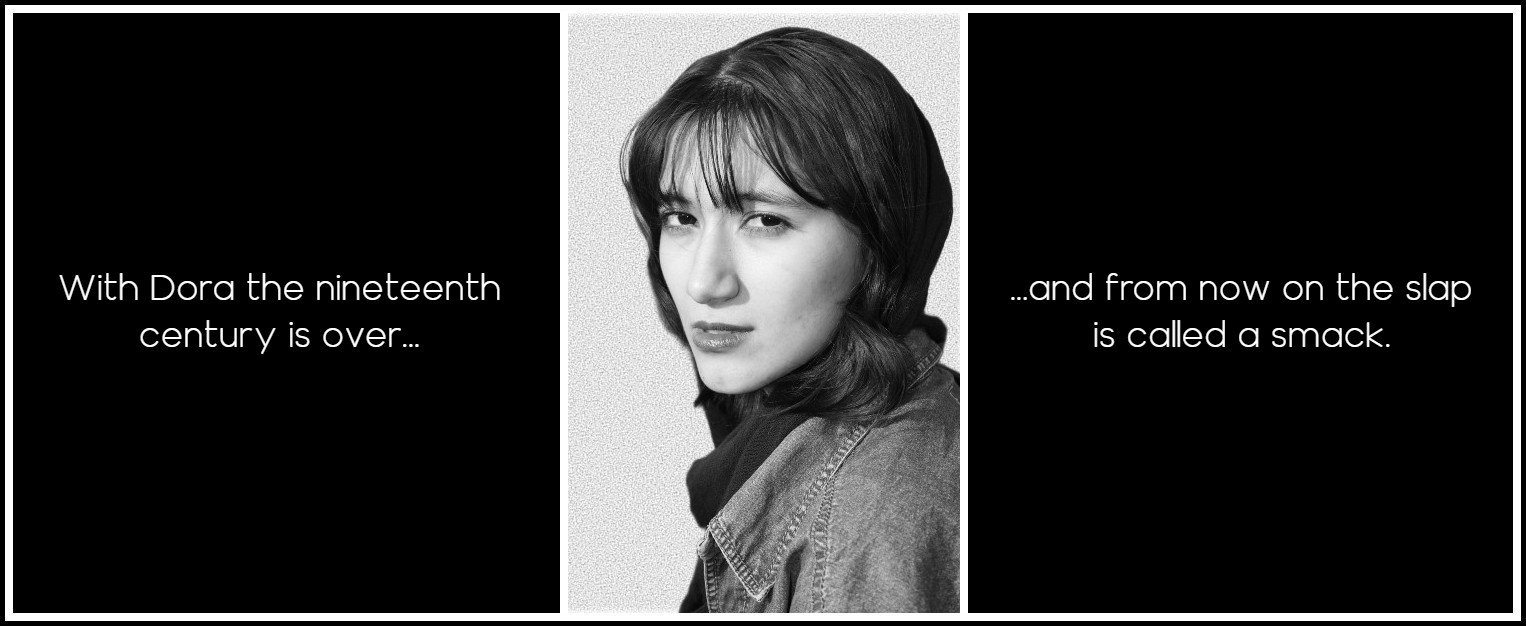
Photo: Mina Rad, Unsplash
In 1935, the year in which Chekhov died, the great Soviet director Meyerhold staged a performance in his honor. Its title is stunning: 33 Swoonings. Meyerhold, in three little farces by Chekhov, counted no fewer than thirty-three swoonings. Chekhov, the playwright, knew what he was doing: the swoon is one of those theatrical jokes borrowed from vaudeville. Meyerhold’s title is his argument in a nutshell, showing—syncope after syncope—‘petit-bourgeois daily life in all its loathsome diversity.’ The swoon is a weapon in the social game; it is an evasion, a mockery, or a wedding procession. This is the same world that will produce psychoanalysis: a vaudevillian universe in which the joke of fainting will at last be taken seriously.
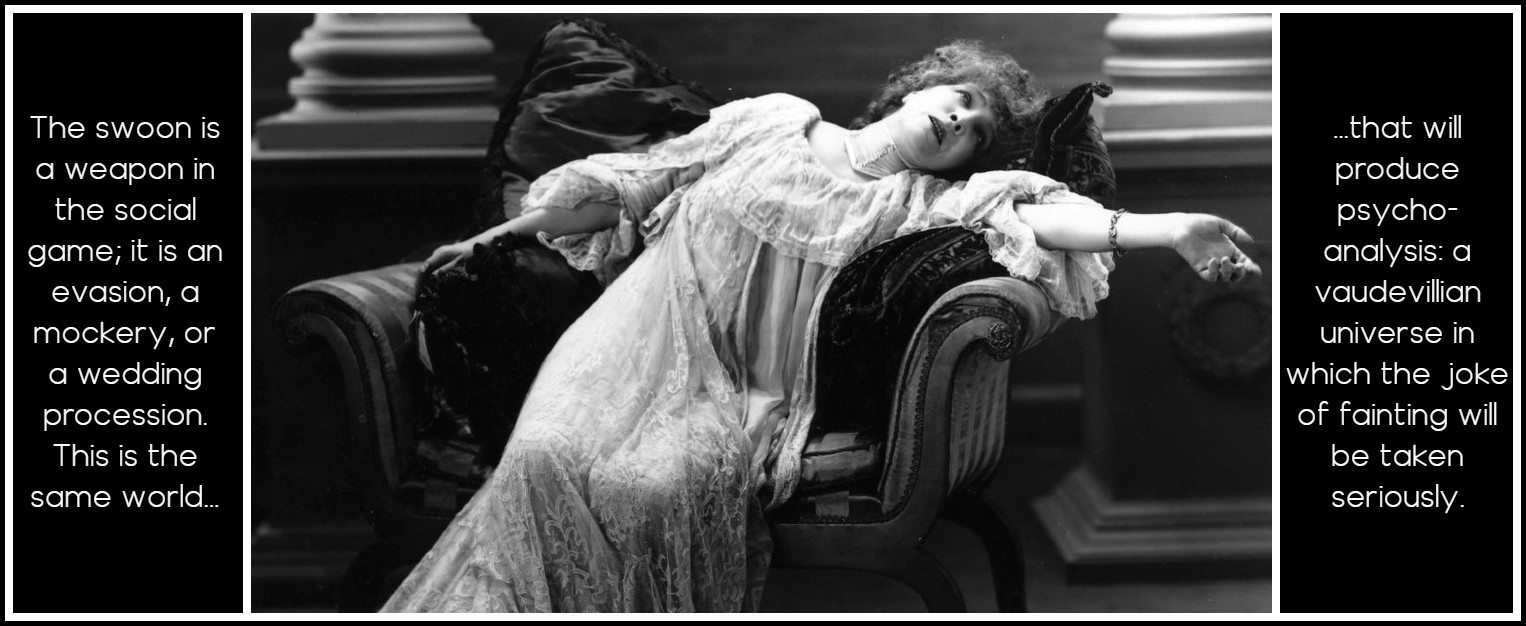
Sarah Bernhardt
Freud approaches young girls as Kierkegaard does: as strange birds, capable of converting their most secret shameful acts into odd spasmodic phenomena. Strange white geese who read erotic books in secret, allow themselves to be caressed by an uncle, a father, a governess, or by a woman who is a friend of the family. And they are dangerous for thought, to the point where Freud will hesitate for a long time before deciding: either they are speaking the truth, and all the fathers are vile; or they are liars, and the paternal honor is safe. Who is telling the truth? The young girl who in terror describes her father above her adolescent bed, uncovering a shameless and erect member, or the father who, of course, does not even suspect that his daughter is accusing him? Freud invents an expression for the category of young girls, an expression that already debunks the philosophical idea of every beginning: the hysteric’s ‘first lie,’ ‘proton pseudos.’ In the beginning was the lying young girl; but that was, and always will be, the decision of a circumspect and cautious Freud. Does one ever know? He too found himself the romantic prey of one of them; and his friend Breuer impregnated—with a hysterical pregnancy—one of his patients. Freud was warned about ‘one never knows.’
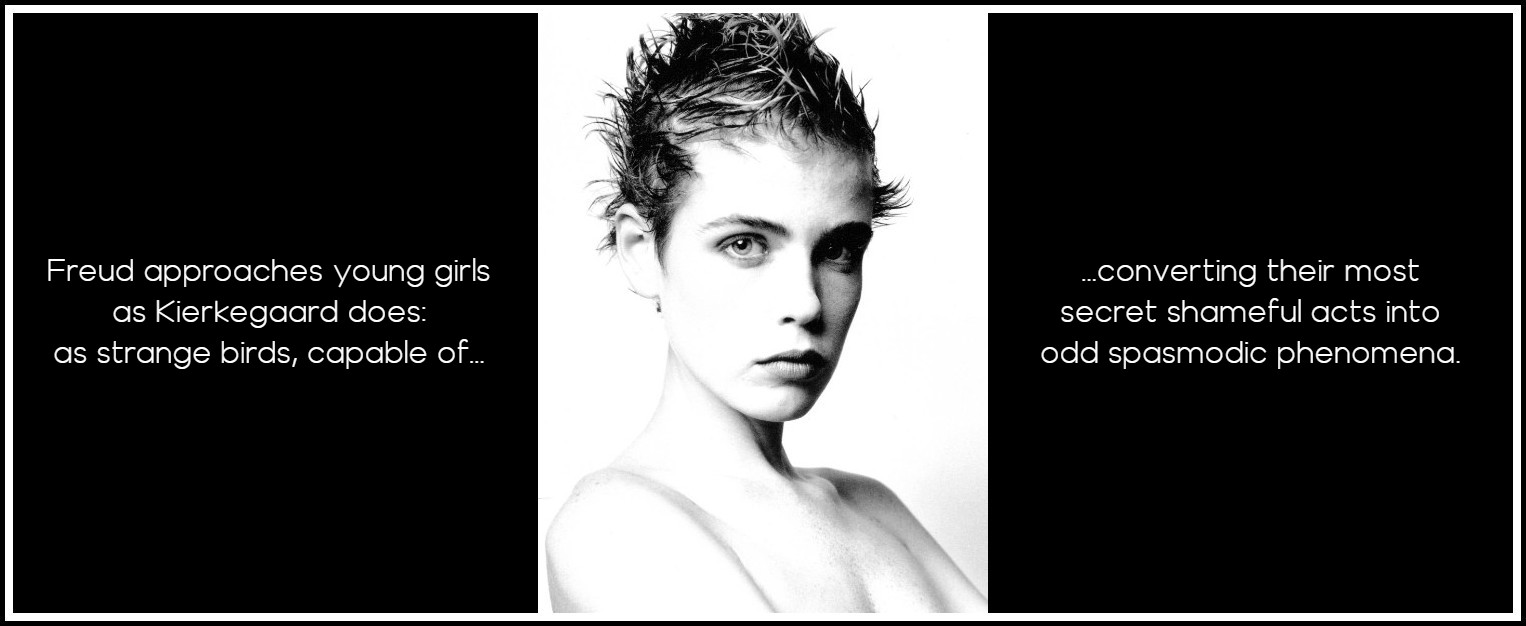
Jeny Howorth | Photo: Bettina Rheims, 1986
So, Dora was a hysterical young girl. Dyspnea, convulsions, asthma, coughs, nothing was lacking from the panoply of the perfect fin de siècle syncope. This case history, much written about, took place in a bourgeois universe, and the case of Dora could without much effort look like an Offenbach operetta. There is an adulterous father, a deceived mother: these are the young girl’s parents. Then there is an ambiguous couple, willingly seductive: a certain Herr K. who pays court to little Dora, while his ravishing wife is not averse to caressing her too. Add in the fact that Frau K. is the mistress of Dora’s father, and there you have a bourgeois comedy. As for Dora, she will have nothing to do with all this song and dance; no doubt she is the only one to sense, in a confused way, that real drama can arise from these light comedies, as in Jean Renoir’s The Rules of the Game. Her refusal is not an open revolt; it is spoken in syncopated troubles, it expresses itself when she coughs, when she chokes. That is why she is sent to Freud’s couch. The good doctor quickly renders an opinion: Dora is in love—which is true. She loves Herr K.—that is false. When the said Herr K. declares his passion to the little one, he is imprudently precise: ‘My wife means nothing to me,’ he says, and receives a sound smack. Not the gentle slap that the young girl Charlotte gives to her beloved Werther, but a real smack. Freud strives to demonstrate to Dora that this smack is still love. ‘Tough love,’ but love all the same; Freud still thinks he is in Werther. So, finding that what Freud tells her ‘is not very important,’ Dora leaves Freud, out of the blue. Dora’s true love was not Herr K., but Frau K., with the ravishing body that the young girl’s father was able to enjoy. Things had changed, and Freud was behind the times. The smack was a smack aimed at all the men in the case, including Freud.

Nataliya Melnychuk, Unsplash | Morena Fortino, La chatte, 2016
But young girls are dangerous, and drama is not far off. A little later, Herr K., crossing the street in Vienna, catches sight of the young girl Dora. He becomes flustered, hesitates, loses his balance and is run over by a car. There was a real Dora, a real Freud, also a real cough. There was a real Charlotte; a real Werther whose name was Goethe. I do not know if he danced with her, but they shelled beans together. There was a real Cordelia, whose name was Regina; and Søren Kierkegaard never stopped signing himself Johannes, the first name of the seducer in the Journal, as automatically as one makes a sign of the cross. All that is as true as the dancing and the hysteria; as true as I tell it to you. In order to stymie the philosophical system, to smash the wheel of dialectical thought, nothing is as effective as a young girl’s smack, or her first lie. That virgins are dangerous is nothing new. When a virgin is deflowered, what is inside her bites you; at the back of her crack she has sturdy teeth hidden, made for tearing your member to shreds. The young girl Athena, Greek virgin and goddess of philosophy, does not set one’s mind at rest; she is a virgin on the offensive, an impassive warrior, often cruel. As for the young girl Artemis, goddess of the hunt and of chastity, she is quite capable of giving her suitors to the dogs to be eaten. That is to say that the young girl does not always fall before the seducer’s blows. If Freud loves young girls so much, it is because they also resist.

Giovanni Maria Benzoni, Diana Hunting, 1859 (adapted from 4th century B.C. marble, Diane de Versailles)
The resistance is what fascinates Freud and seduces Kierkegaard. Once deflowered, the young girl becomes an ordinary woman; once analyzed, she also becomes that. But with the hysterics Freud analyzed, there is no danger: they escape him, change symptoms, disappear—they are capricious—and change. From syncope or from the analyst, it makes no difference: they flee. As for Kierkegaard, while writing the Seducer’s Diary he goes to the very limits of his thought. With a mixture of repulsion and sadness, he abandons the young girl who did not know how to resist. One part of his philosophy circumvents the eternal young girl: Regina, Cordelia, Antigone. Another part of himself goes to look in more highly spiced thoughts for other leaps than the Maiden’s. When the philosopher-seducer has finished with the young girl, he is busy with anguish. Anguish is an old man. An old man from whom God has demanded his son as sacrifice. It is a dreadful, violent scene. Divine Law is savage, and man is crushed.
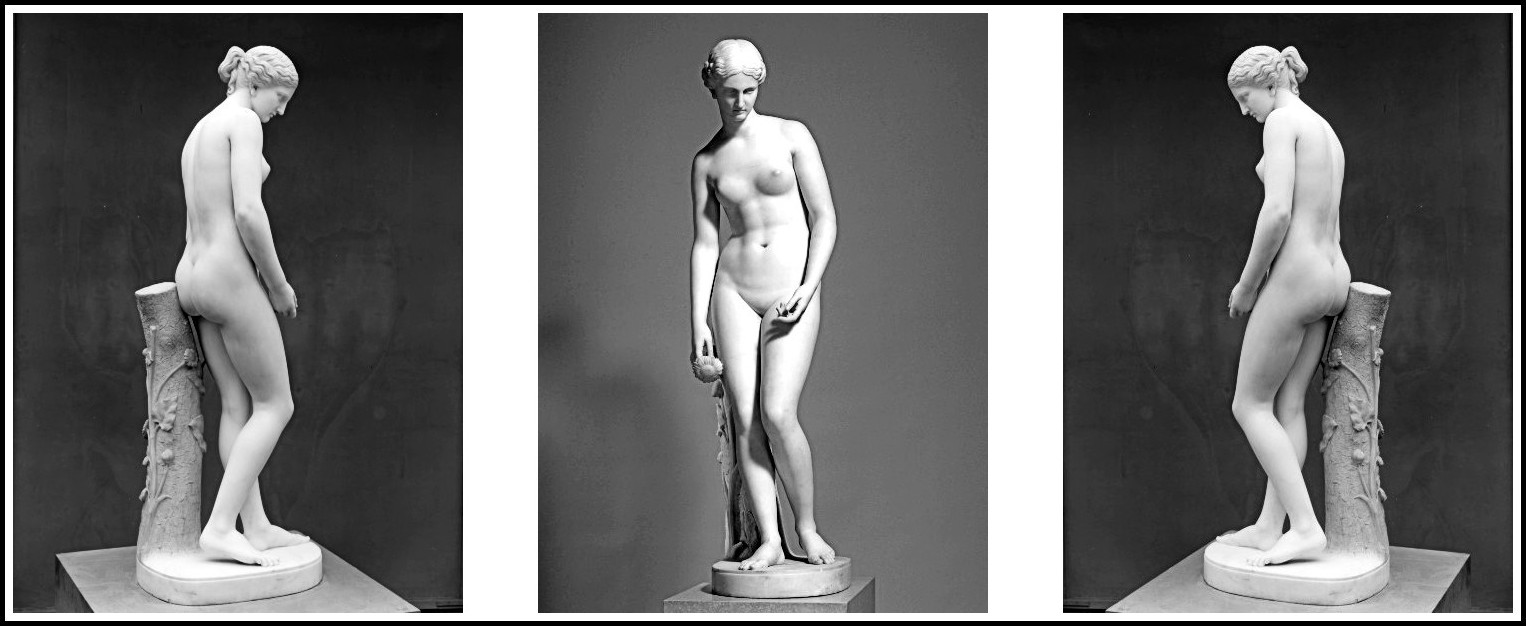
William Henry Rinehart, The Nymph Clytie, 1872
Make no mistake, however: anguish haunts the first seduction. Kierkegaard has told us often enough that anguish is at the end of the amorous chase; the Commander invites Don Giovanni to the last supper of his life. But what is true of the seducer is not true of the young girl: leaping and supernatural, and as long as she has not fallen, she escapes anguish. The old man Abraham will not escape it, nor yet the seducer Kierkegaard. To read Kierkegaard is to progress from one syncope to the next; it is impossible to avoid the leap. After the maiden’s leap, there is the “knight of faith’s” leaping in place: after the young girl, the old man. To read Kierkegaard is to understand the suspended moment; it is to fall in love, to wait for a rendez-vous with heart pounding, to break off an affair, to flee in the night with the beloved. It is also to retire at dawn, disappointed, and to find oneself suddenly, without warning, on a mule path with a little donkey, and at one’s side one’s only son, whose throat God has demanded that you slit on top of the mountain.
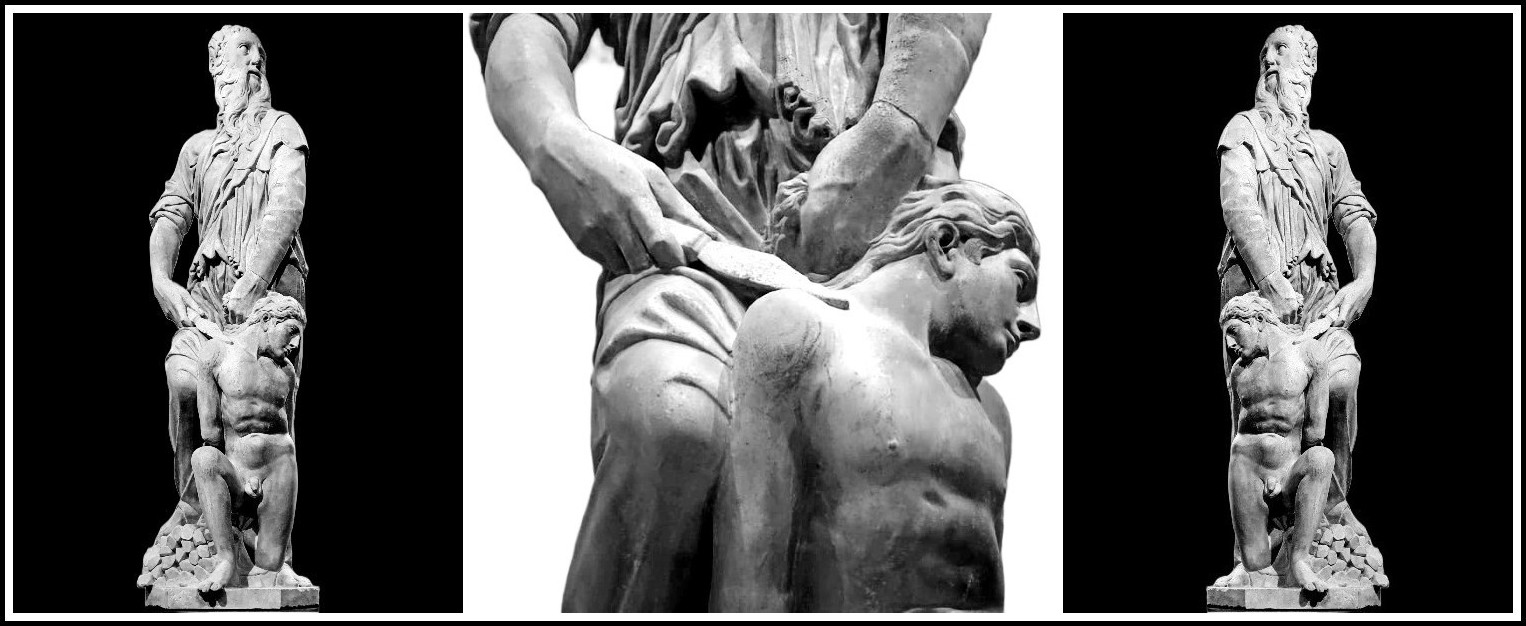
Donatello, Sacrifice of Isaac, 1420
INTERPRETATION TWO
Søren Kierkegaard and Regine Olsen
ON ‘THE SEDUCER’S DIARY’
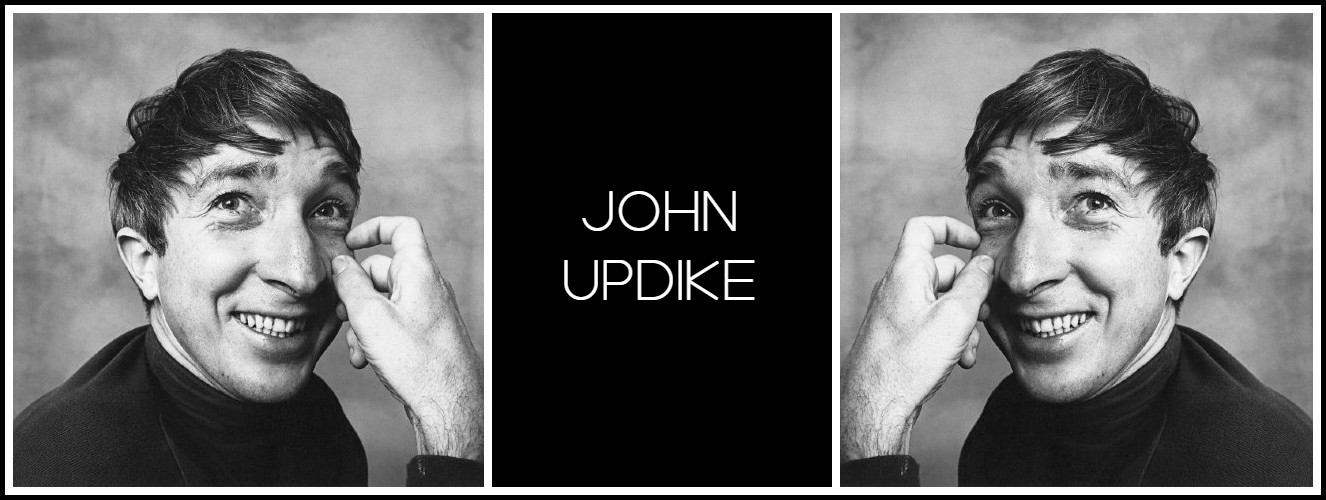
John Updike
From John Updike, Foreword, Søren Kierkegaard, The Seducer’s Diary (Princeton University Press, 2013 [1997]) pp. vii-xv
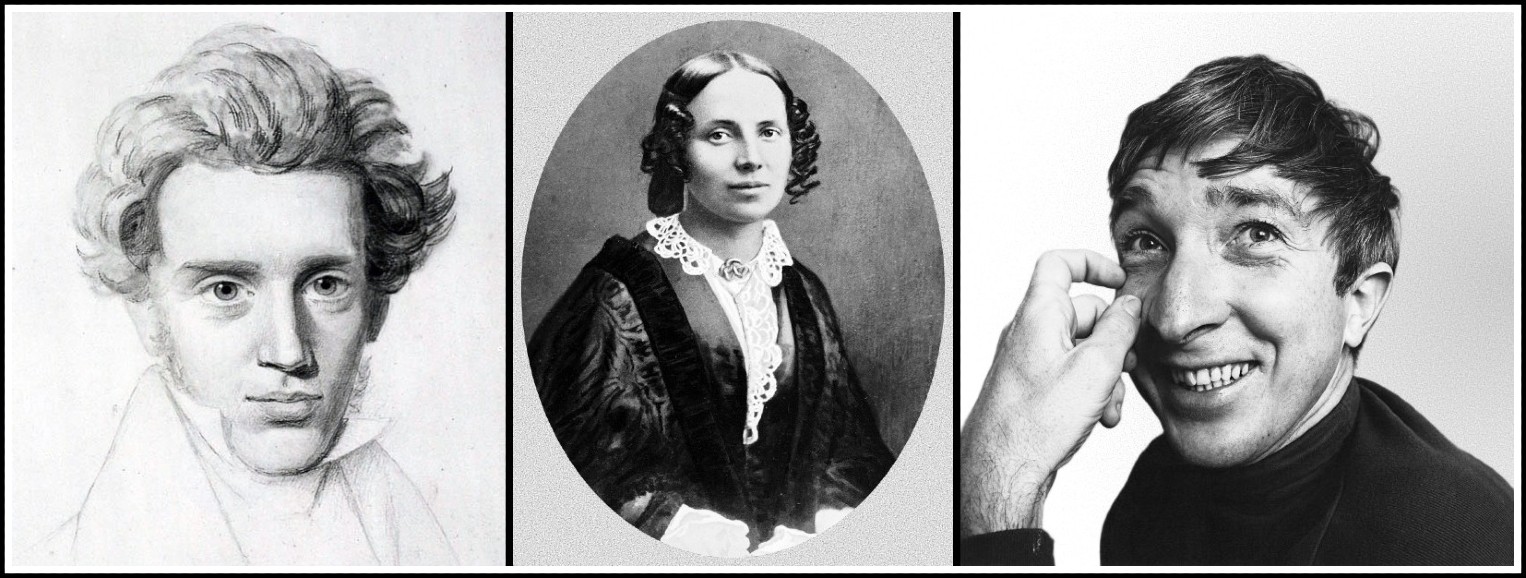
Søren Kierkegaard | Regine Olsen | John Updike
Søren Kierkegaard’s method, dictated by his volatile and provocative temperament, resembles that of a fiction writer: he engages in multiple impersonations, assuming various poses and voices with an impartial vivacity. The method is, in one of his favorite words, maieutic—from the Greek term for mid-wifery—like that of his beloved model Socrates, who in his questioning style sought to elicit his auditors’ ideas rather than impose his own. Either/Or, Kierkegaard’s first major work, was a bulky, two-volume collection of papers ostensibly found by the editor, ‘Victor Eremita’ (‘Victor Hermit’), in the secret compartment of a writing desk to which he had been mysteriously attracted in the shop of a secondhand dealer. Some time after its acquisition, he tells us, he took a hatchet to a stuck drawer and discovered a trove of papers, evidently composed by two distinct authors. As arranged and published by Victor Eremita, the first volume consists of aphorisms, reflections, and essays by ‘A,’ a nameless young man who styles himself an aesthete, and the second volume of two long letters to this first writer, with some final words, composed by an older man, ‘B,’ who is named William and has been a judge. The last item in the first volume is a narrative, ‘The Seducer’s Diary,’ which ‘A,’ deploying the same mock-scholarly documentary specifics as Victor Eremita offers in regard to the whole, claims to have discovered and to be merely editing. The overall editor ironically complains that this complicates his own position, ‘since one author becomes enclosed within the other like the boxes in a Chinese puzzle.’
Elvire Ferle, Untitled XLVI, 2018
Either/Or’s intricate, arch, and prolix medley, published in Copenhagen in February of 1843, made a significant stir and eventually required a second edition, to which Kierkegaard considered (but decided against) appending this postscript: I hereby retract this book. It was a necessary deception in order, if possible, to deceive men into the religious, which has continually been my task all along. Maieutically it certainly has had its influence. Yet I do not need to retract it, for I have never claimed to be its author. In dealing with an author so deceptive, so manifoldly removed in name from his own words, we need to insist that there were events of a sore personal nature behind so prodigiously luxuriant a smokescreen. In brief, Kierkegaard had, just before the surge of literary activity bound into Either/Or, broken off a year’s engagement with a woman, Regine Olsen, ten years younger than himself. Externally, their engagement appeared a happy one, uniting two youngest children of prosperous Copenhagen households. Michael Pedersen Kierkegaard was a retired merchant, and Terkild Olsen a state councillor and a high official in the Ministry of Finance. Young Kierkegaard, then a university student, first saw Regine when she was fourteen, in May of 1837, at a party of schoolgirls in the home of the widowed mother of another girl, Bolette Rørdam, whom Kierkegaard was pursuing. According to the lightly fictionalized account in the ‘Quidam’s Diary’ section of Stages on Life’s Way (1845), Kierkegaard began to spy on the girl, frequenting a pastry shop along the route whereby Regine went to her music lessons: I never dared sit by the window, but when I took a table in the middle of the room my eye commanded the street and the opposite sidewalk where she went, yet the passersby could not see me. Oh, beautiful time; Oh, lovely recollection; Oh, sweet disquietude; Oh, happy vision, when I dressed up my hidden existence with the enchantment of love! Yet she is not mentioned in his journal until nearly two years after the first meeting: Sovereign of my heart, ‘Regina,’ kept safe and secret in the deepest corner of my breast.
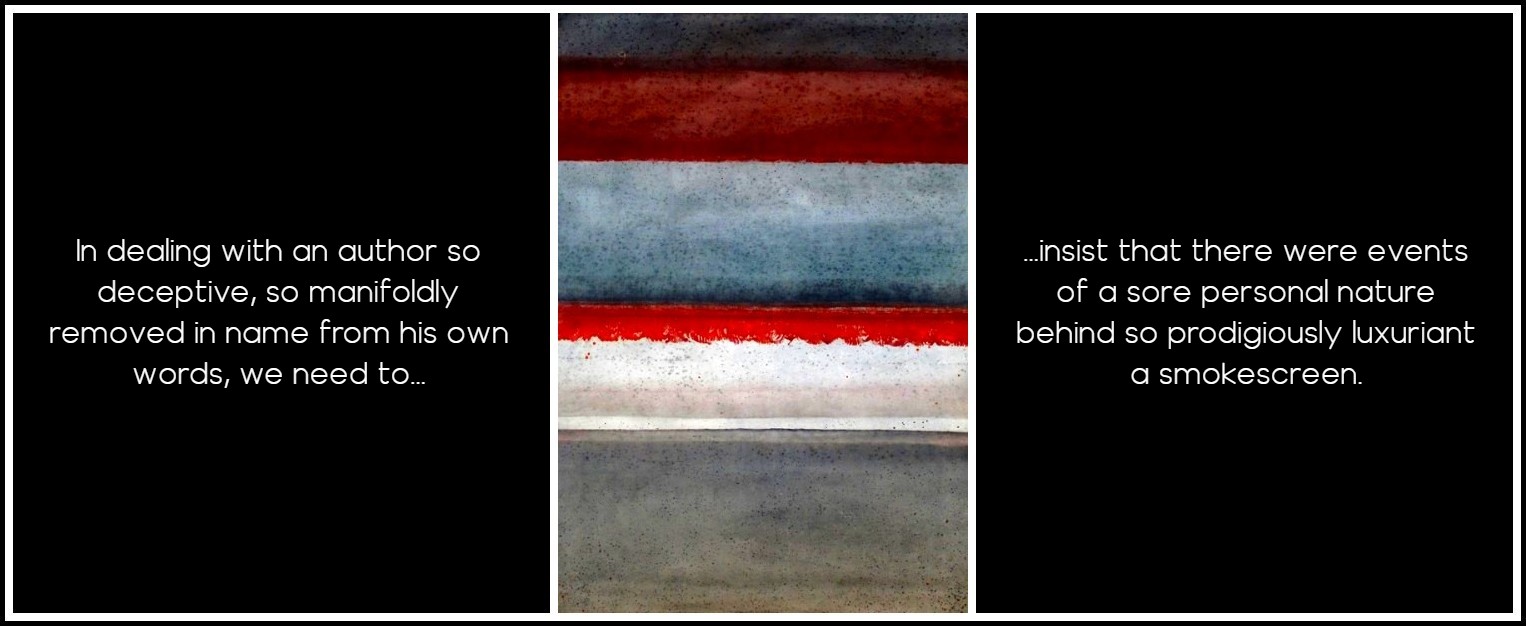
Elvire Ferle, Untitled LXIII, 2019
In the summer of 1840, Kierkegaard, now twenty-seven, passed his theological examination and made a pilgrimage to West Jutland, the desolate birthplace of his father, who had died in 1838. Soon after returning, on September 8, he went to the Olsen’s house, found Regine alone, and proposed with such abrupt passion that she said nothing and showed him the door. Two days later, however, with her father’s consent, she accepted. Writing an account in his journal eight years later, Kierkegaard confessed, The next day I saw that I had made a blunder. As penitent as I was, my vita ante acta, my melancholy, that was enough. I suffered indescribably in that period. For a year, the formal attachment held: fond letters went back and forth; calls upon their extensive families were made; the couple strolled together up Bredgade or on the Esplanade; and Kierkegaard, preparing himself for a respectable post in the church or university, gave his first sermon and wrote his philosophical dissertation, The Concept of Irony, with Continual Reference to Socrates.
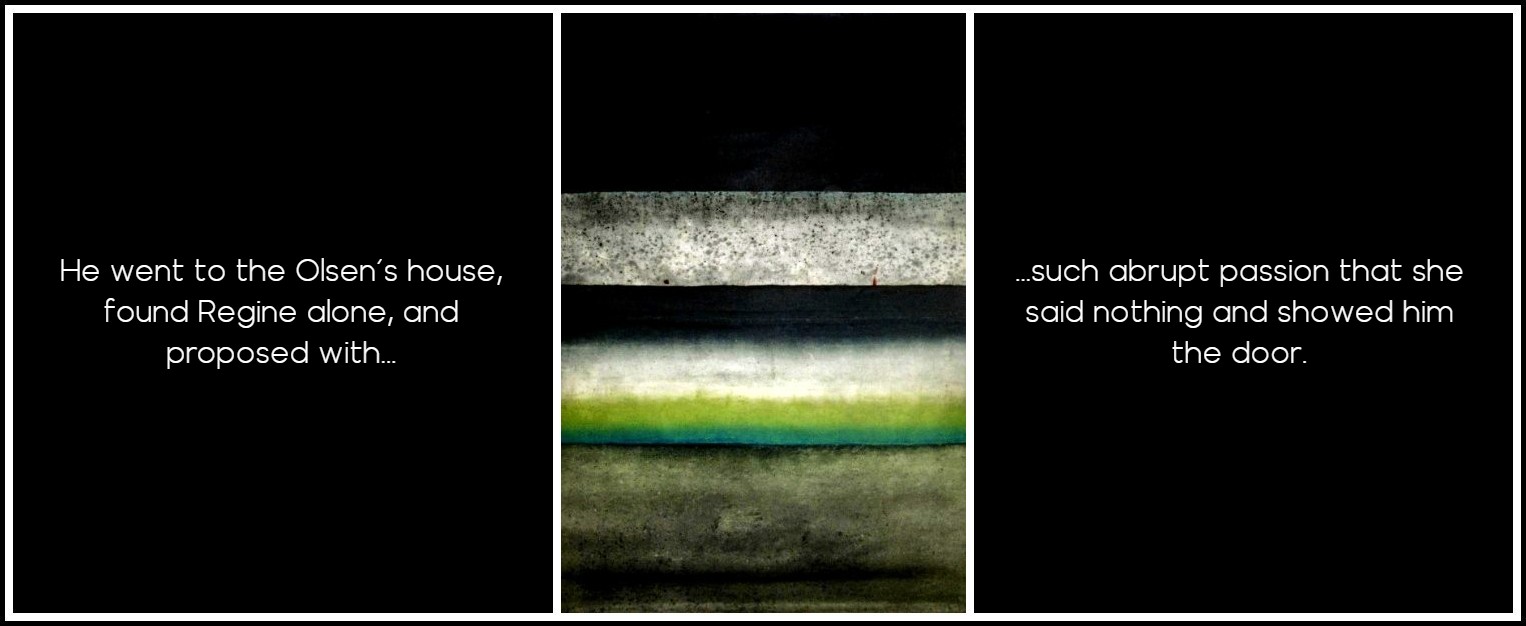
Elvire Ferle, Untitled LXVIII, 2022
Regine, though, observed how her fiancé ‘suffered frightfully from melancholy,’ and her friends sensed ‘something sad hanging in the air.’ On August 12, 1841, he sent her back her ring, with a note that said, Forget him who writes this, forgive a man who, though he may be capable of something, is not capable of making a girl happy. Regine resisted rejection, taking the bold step of calling upon him in his rooms; he was out. For two months the engagement dragged on, while he defended and published his thesis. Then, in October, in response to a plea from her father, he met her for an exchange that he later reported as follows: I went and talked her round. She asked me, Will you never marry? I replied, Well, in about ten years, when I have sown my wild oats, I must have a pretty young miss to rejuvenate me. She said, Forgive me for what I have done to you. I replied, It is rather I that should pray for your forgiveness. She said, Kiss me. That I did, but without passion. Merciful God! To get out of the situation as a scoundrel, a scoundrel of the first water if possible, was the only thing there was to be done in order to work her loose and get her under way for a marriage.
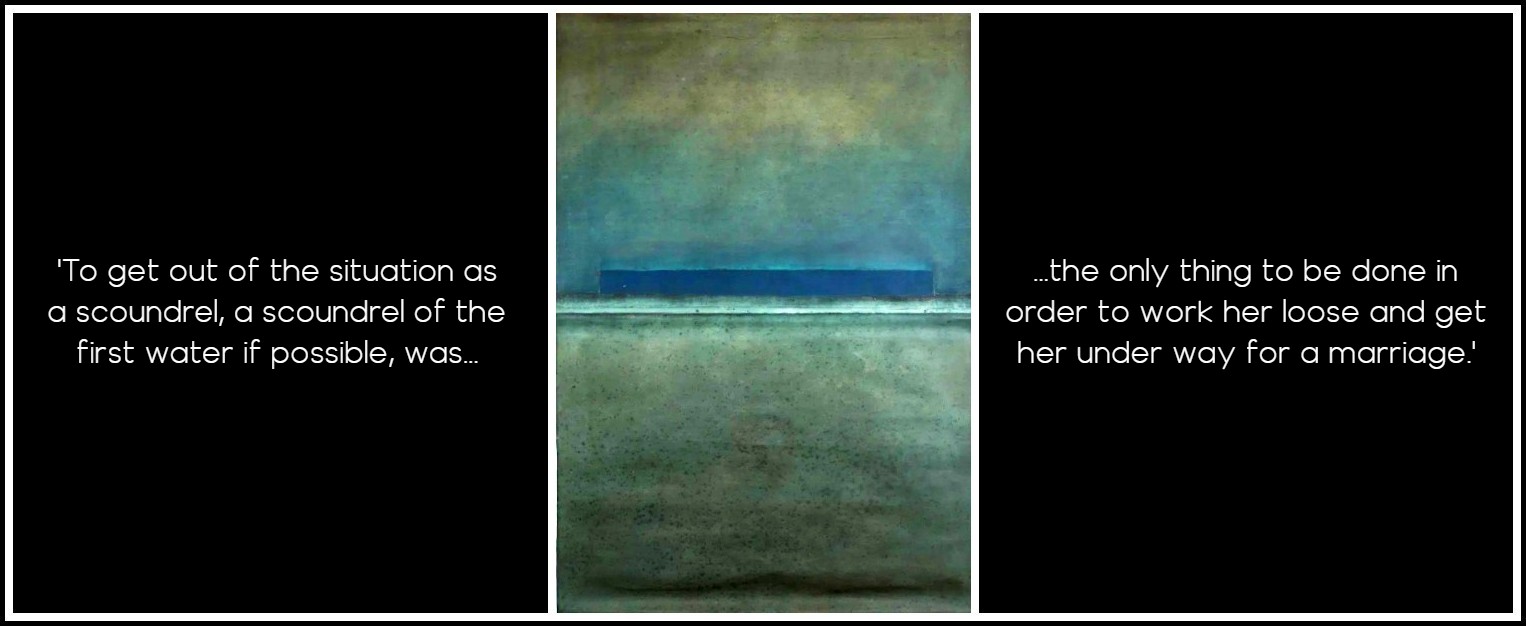
Elvire Ferle, Untitled XXVIII, 2020
Two weeks later, Kierkegaard left Copenhagen for Berlin and began, with Either/Or, the flood of volumes in which he pondered and dramatized such matters as marriage, the ethical versus the aesthetic, anxiety, and, increasingly, the severities of Christianity. In his mind Regine was the muse and object of much of his production, and it shocked him when, two years after their break, she accepted an earlier suitor, Johan Frederik Schlegel, and they became betrothed, marrying in 1847. To the end of his life Kierkegaard wrote of Regine in his journals; four weeks before his death in early November 1855 he put it succinctly: I had my thorn in the flesh, and therefore did not marry.
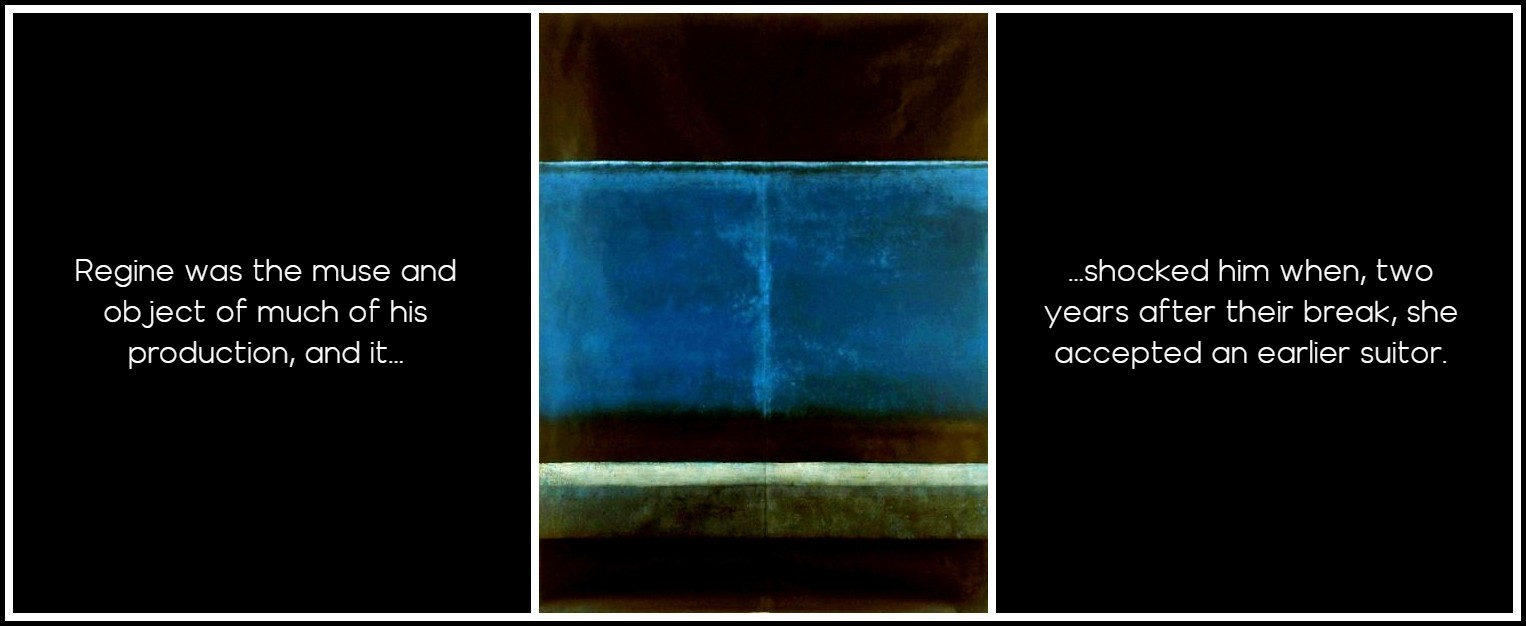
Elvire Ferle, Untitled Xl, 2005
Was this ‘thorn in the flesh’ the religious melancholia he had inherited from his father, or was it somehow physical? The child of elderly parents, he was frail and slight, with an erratic gait and a bent carriage noted by acquaintances and caricaturists, but he possessed no apparent deformity that would explain his self-description as in almost every way denied the physical qualities required to make me a whole human being. His sexual experience may have been confined to a single drunken encounter with a prostitute in November of 1836. Though he extolled marriage for many pages, there is little trace, in his surviving love letters or reminiscences, of carnal warmth. His later theology endorses celibacy and declares a frank hostility to the sexual instinct. Woman, he wrote in 1854, is egoism personified. The whole story of man and woman is an immense and subtly constructed intrigue, or itis a trick calculated to destroy man as spirit. He once complained of Regine that she ‘lacked a disposition to religion.’ His hero, Socrates, had been married to a legendary shrew, Xanthippe, and European philosophy was ever since dominated by bachelors, one of whom, Kant, succinctly defined marriage as the union of two persons of different sexes for the purposes of lifelong mutual possession of their sexual organs. Kierkegaard’s breaking the engagement perhaps needs less explaining than the imperious impulse that led him into it.
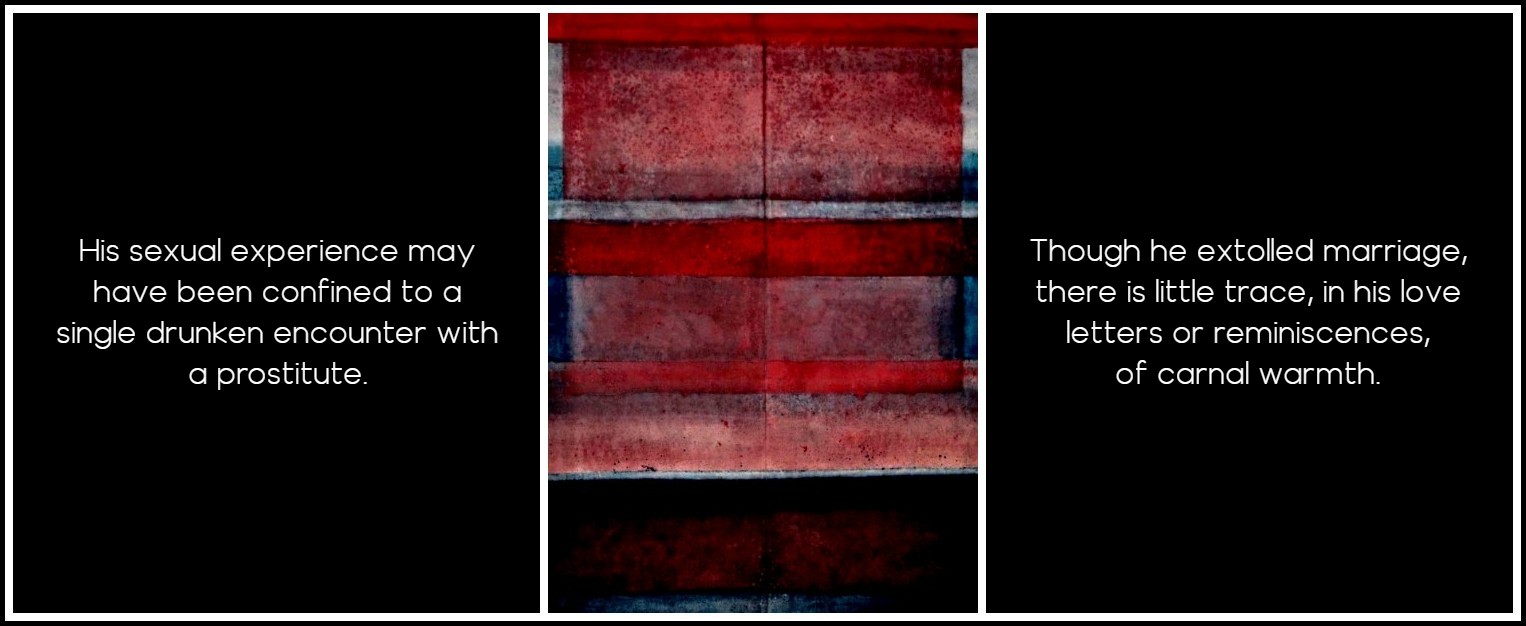
Elvire Ferle, Untitled XLVI, 2018
His attempt to set right, in writing, the botch of his relation with Regine taught him, he wrote, the secret of ‘indirect communication.’ As he came to frame the matter, ‘The Seducer’s Diary’ was part of his campaign to portray himself as a scoundrel and thus make their break easier for her. His journal of 1849 claims that he wrote it for her sake, to clarify her out of the relationship. In 1853 he notes that ‘it was written to repel her’ and quotes his Fear and Trembling: When the baby is to be weaned, the mother blackens her breast. ‘The Seducer’s Diary,’ then, is a work with a devious purpose and an uneasy conscience. A number of details connect the real Regine with the fictional Cordelia Wahl. When the Seducer writes, Poor Edward! It is a shame that he is not called Fritz, the allusion is not only to a comedy by Scribe but to Regine’s other suitor, Schlegel, who was called Fritz. The hero’s long and loving stalking of a girl too young to approach provides, in fiction as in reality, the peak of erotic excitement. The little party of girls that occasioned Kierkegaard’s first glimpse of Regine is evoked with a piquant vividness but placed much later in the affair, as its cold-hearted dissolution nears. No doubt a number of particulars spoke only to Regine.
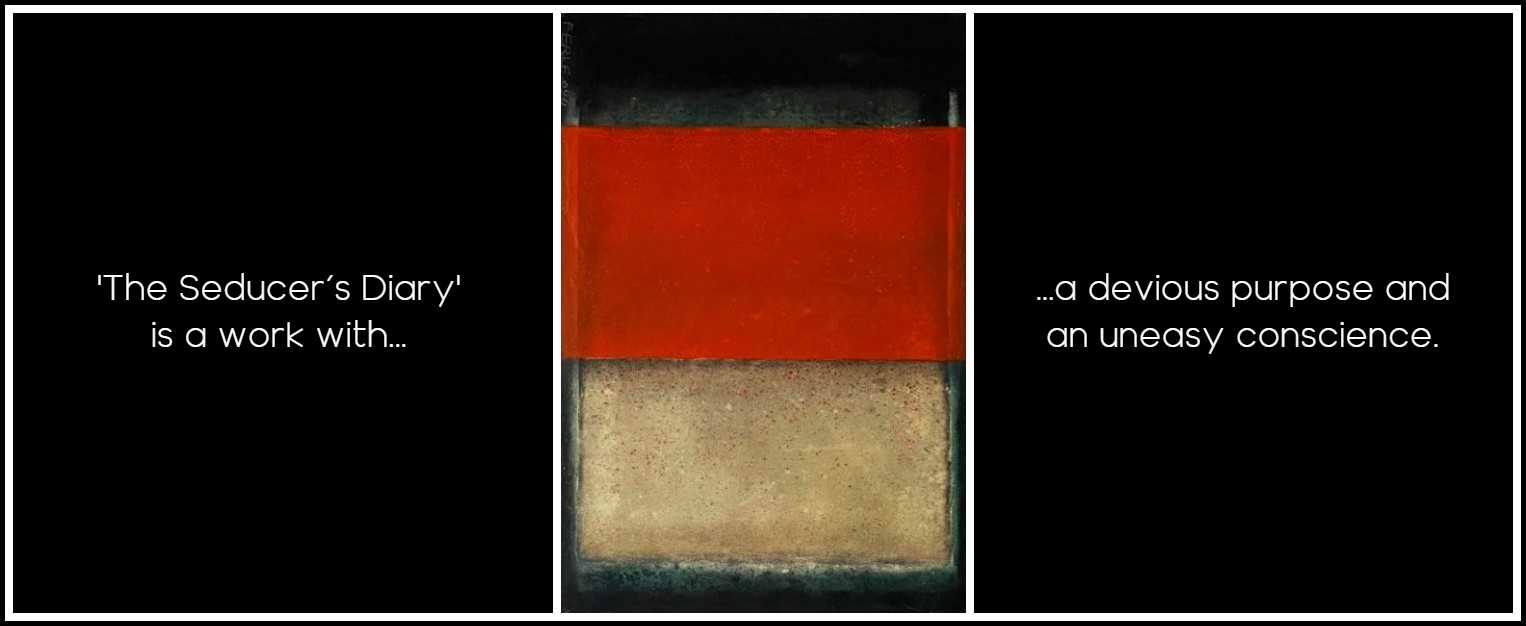
Elvire Ferle, Untitled XXXI, 2020
And yet a cool shimmer of falsity plays over the finespun fabric; the Seducer’s desire seems curiously abstract. Contemporary readers, especially younger readers, may be put off by his tone of sexist condescension; under the name of a seduction he conducts a perverse sort of educational experiment. Seeking to teach her to be victorious as she pursues me, he retreats before her, so that she will know all the powers of erotic love, its turbulent thoughts, its passion, what longing is, and hope. In an artful teasing that is close to torture, he labors at cheating her of the essentially erotic and thus bringing her to a new power and certain freedom, ‘a higher sphere.’ He mentions Pygmalion, but he reminds us more of heartless Dr. Frankenstein, in one of Romanticism’s first masterpieces. The nineteenth century was romantic from beginning to end; the eighteenth century’s man of reason yielded as a cultural ideal to the man or woman of sensibility, of feeling. As the old supernatural structures faded, sensation and emotion took on value in themselves; the Seducer exults in the turbulence of his awakening love. How beautiful it is to be in love; how interesting it is to know that one is in love. He likens himself to a bird building its nest on ‘the turbulent sea’ of his agitated mind and proclaims, How enjoyable to ripple along on moving water this way—how enjoyable to be in motion within oneself.
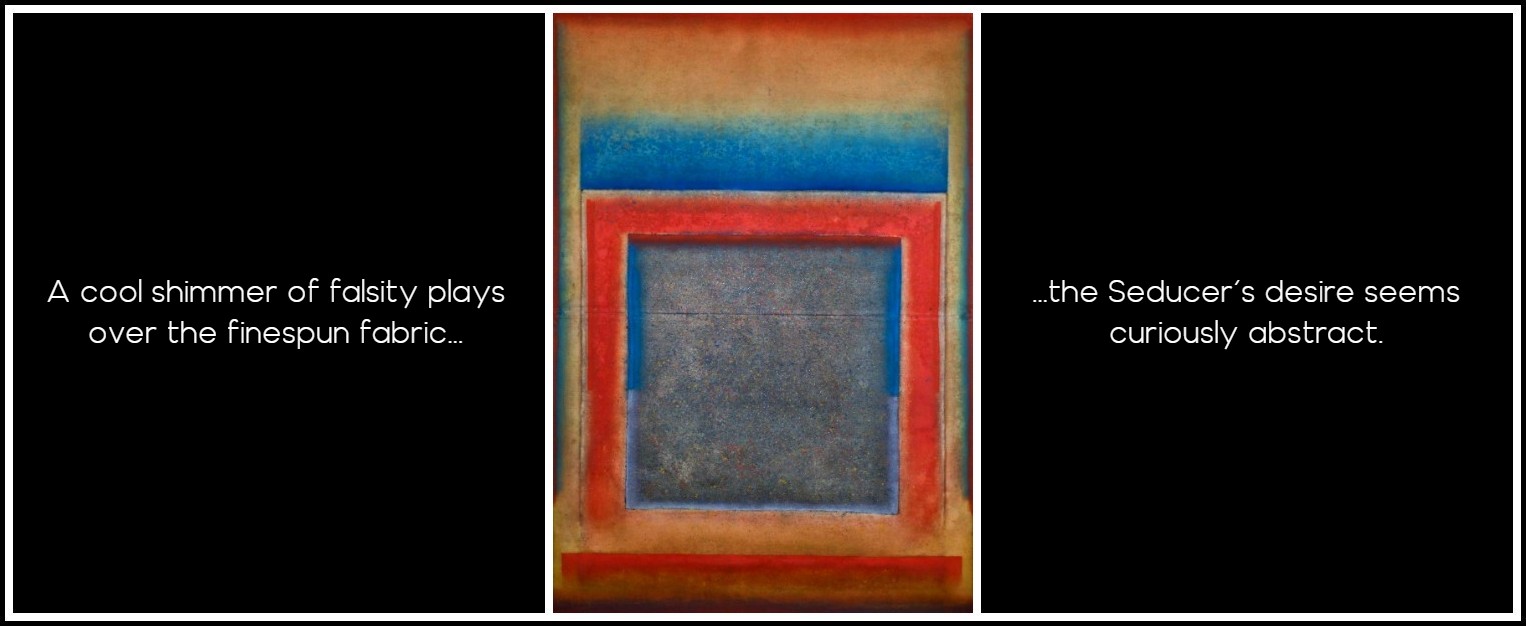
Elvire Ferle, Untitled XXXIII, 2012
Inner turbulence is a piece of nature’s magnificent turbulence, and the female an emissary of this same worshipped nature: Woman is substance, man is reflection. In a certain sense man is more than woman, in another sense infinitely much less. Women were both the objects of romantic desire and, in their susceptibility to love, Romanticism’s foremost practitioners. Female psychology became an object of fascination to seducers and their chroniclers. Nineteenth-century novelists from Jane Austen to Henry James embraced as a patently major theme the sentimental education of their heroines; the outcome could be comic and triumphant, as for Austen’s Emma Woodhouse and George Eliot’s Dorothea Brooke, or tragic, as for Emma Bovary and Anna Karenina. Kierkegaard would not have been aware of these novels, but Mozart’s opera Don Giovanni was much on his mind, and he breathed the same dandyish intellectual atmosphere that produced Byron’s Don Juan and Stendhal’s superb study of erotic psychology, On Love. Even the classic texts supplied touchstones and handbooks: ‘The Seducer’s Diary’ cites both Ovid and Apuleius’s Amor and Psyche.
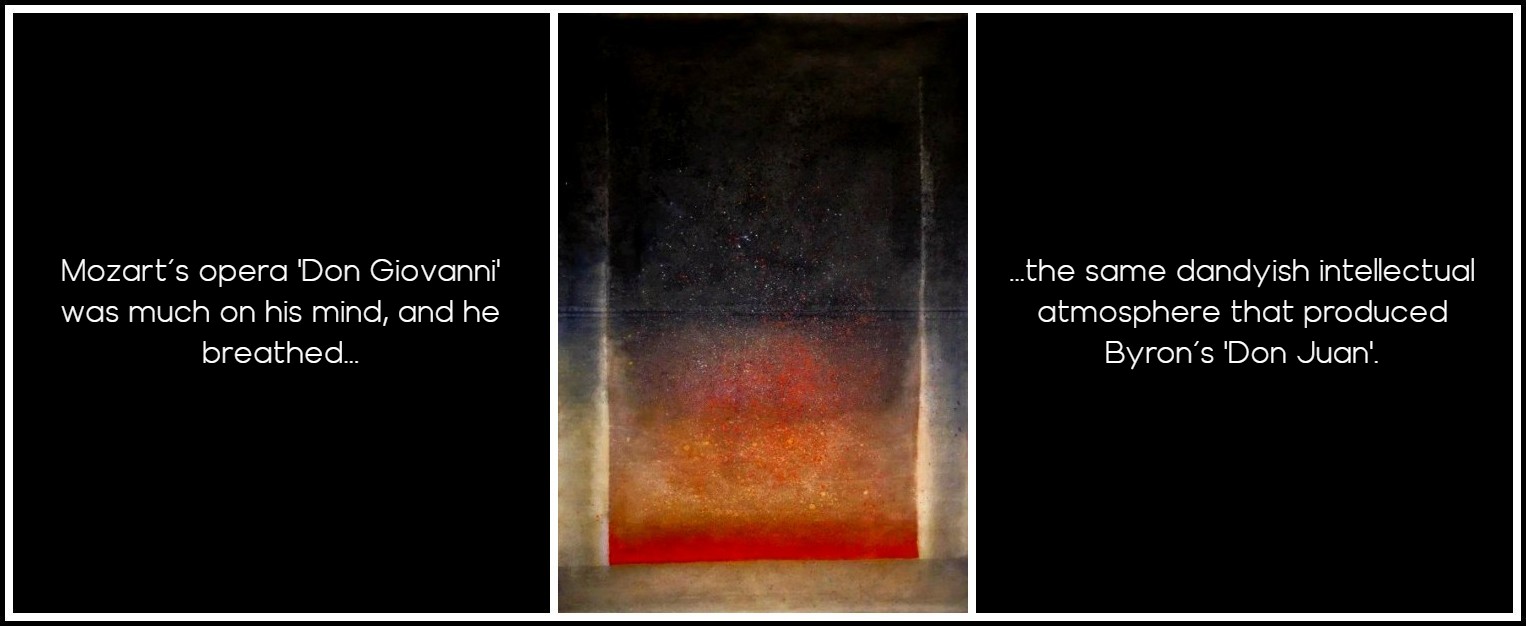
Elvire Ferle, Untitled, 2015
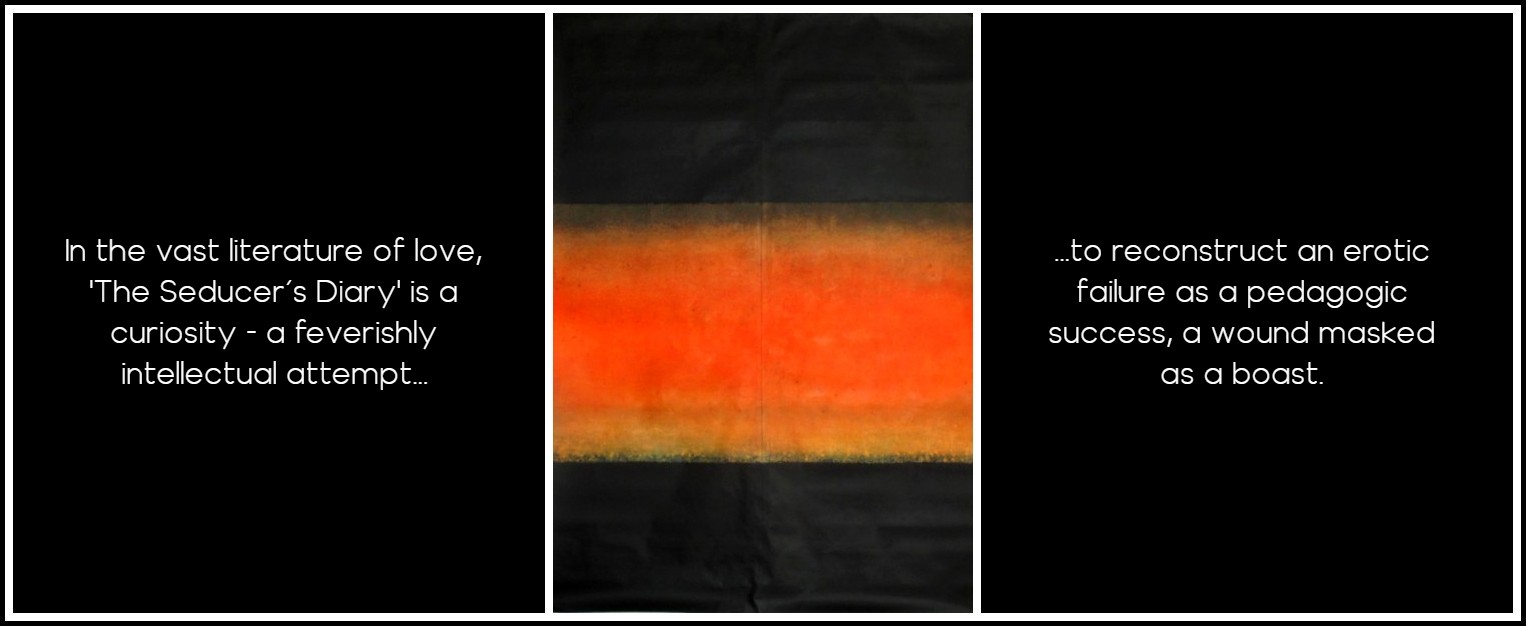
In the vast literature of love, ‘The Seducer’s Diary’ is a curiosity—a feverishly intellectual attempt to reconstruct an erotic failure as a pedagogic success, a wound masked as a boast, a breast blackened to aid a weaning. It sketches a campaign of hallucinatory cleverness: If I just keep on retreating before her superior force, it would be very possible that the erotic in her would become too dissolute and lax for the deeper womanliness to be able to hypostatize itself. Yet a real enough Copenhagen, with its tidy society and sudden sea views, peeps through, and a real love is memorialized, albeit with a wearying degree of rationalization—much like the tortuous Winkelzüge with which Kafka, Kierkegaard’s spiritual heir, was to fend off Felice and Milena in his letters to them. Kierkegaard did succeed, in ‘The Seducer’s Diary’ and his other apologetic versions of the engagement, in immortalizing Regine. She outlived him, and then her husband, and was remembered by the Danish philosopher Georges Brandes, who saw her in her middle age, as radiantly beautiful—with clear, roguish eyes and a svelte figure. She lived into the next century, until 1904, and as a white-haired celebrity gave gracious and modest interviews, recalling those dim events of over sixty years before, when she was but eighteen. Her fame was a vestige of her old suitor’s convoluted gallantry. If our impression is that she behaved with the greater dignity, consistency, and human warmth in the affair, it was Kierkegaard who created the impression.
Elvire Ferle, Untitled I, 2003
MARA, MARIETTA: A LOVE STORY IN 77 BEDROOMS – READ THE FIRST CHAPTER
A literary novel by Richard Jonathan
RICHARD JONATHAN, ‘MARA, MARIETTA: A LOVE STORY IN 77 BEDROOMS’ — READ THE FIRST CHAPTER
AMAZON & APPLE BOOKS

RICHARD JONATHAN, ‘MARA, MARIETTA: A LOVE STORY IN 77 BEDROOMS’ | AMAZON PAPERBACK OR KINDLE

RICHARD JONATHAN, ‘MARA, MARIETTA: A LOVE STORY IN 77 BEDROOMS’ | APPLE iBOOK
MARA, MARIETTA: A LOVE STORY IN 77 BEDROOMS
A literary novel by Richard Jonathan

Available from AMAZON (paper | ebook) & iBOOKS, GOOGLE PLAY, KOBO & NOOK (see LINKS below)
RELATED POSTS IN THE MARA MARIETTA CULTURE BLOG
CLICK ON THE IMAGE TO GO TO THE POST


By Richard Jonathan | © Mara Marietta Culture Blog, 2026 | All rights reserved
Comments